
If you have arrived here after typing one word into a search box, this is the short version: pikal is a Visayan word from the Philippines meaning to rip. In knife work it describes holding the blade point-down, generally, with the edge turned toward your own forearm, and cutting as the arm closes rather than as it opens.
That is roughly the whole idea. The rest of this explains what it changes, what kind of knife it needs, how I build for it, and where it stops being the right answer.
I am A.N. Nash. I have been designing and building knives for this grip since 2010.
Where the word comes from
As I said above, pikal is Visayan, and it means, literally, to rip.
It is also written pakal, and the two words are the same thing. Pakal is the spelling used inside Pekiti-Tirsia Kali, the Filipino system most often credited with bringing this use of the knife to a wider audience. I used pakal myself for years. I moved to pikal for one reason only: it is the spelling that took hold in the wider knife world, and there is nothing to be gained from being the last person using the other one.
In Filipino martial arts the word is used two ways at once. Broadly, it means the reverse grip. Narrowly, it means the reverse grip with the edge turned inward. Both uses are correct, which is why arguments about the term never resolve — the people arguing are describing different things with the same word. The next section takes those two things apart.
That is as much as the word is worth. Knowing it lets you read what other people write about the subject without getting lost. It will not make you better with a knife. What follows is the part that will.
Four combinations, two of them pikal
Two variables are in play here, and most of the confusion comes from treating them as one.
The first is grip position — point-up or point-down. Point-down is the reverse grip.
The second is edge orientation — with the blade in the hand, the edge either faces away from your forearm or toward it.
Two variables, two states each, four combinations. All four exist and all four get used:
Reverse grip, edge out: Point down, edge away. What, before pikal terminology spread, was often just called hammer grip. Good for hooking outward and upward and for wide arcs. Loses most of its cutting function the moment the arm is controlled, though the thrust remains available.
Reverse grip, edge in: Point down, edge toward the forearm. This is pikal in the strict sense, also written RGEI — Reverse Grip Edge In.
Sabre grip, edge out: Point up, edge away. The general-purpose default, and the orientation most people should be competent in before anything else.
Sabre grip, edge in: Point up, edge toward you — SGEI. The least discussed of the four and the one usually left out of these explanations. It exists, it is uncommon, and I take it seriously for extreme close quarters and grappling. Four of my models are built around it: the DAK Trench, the Pikal Trench, the Urban Trench and the Baby Trench.
Of the four, only two are pikal: RGEI and SGEI. The edge faces in, and that is what the word is describing. Those two are what the rest of this article is about.
The reason to keep grip position and edge orientation apart is simple. Grip position changes how a movement is shaped. Edge orientation changes what the movement can do.
What turning the edge in changes
An edge facing out cuts as the arm opens: the hand travels away from the body and the work happens at the far end of the movement.
An edge facing in cuts as the arm closes: the elbow folds, the forearm rotates, and the work happens on the way back.
The wrist does more than people notice
The elbow and the shoulder get the attention. The wrist is what makes the movement work.
With the point down, the vertical action of the wrist governs three separate things: where the point lands, whether you can catch and hold a limb, and how the blade behaves on the way out — the final tear and the withdrawal. Take the wrist out of it and you have a stiff arm with a knife on the end of it.
The comparison I keep coming back to is a mantis. It does not strike and retreat. It hooks, brings the prey in against its own arms, and holds it there. Everything happens close, and the closing is the technique.
Three things that follow
It survives contact distance. At the range where the arm gets grabbed, trapped against a body, or pinned to a wall, an edge facing out has lost the movement that produces the cut. The thrust is still there — that never goes away — but the cut is gone. An edge facing in keeps both, because pulling is harder to prevent than pushing: shorter path, stronger muscle groups, more intuitive, and a hand on your wrist does very little about it.
It generates more force on entry. The forearm transmits body weight straight down the line of the blade instead of through the wrist joint. Anyone can test this safely against a dead tree, and the difference is not subtle.
It is closer to instinct. The movements are simpler, more direct, and more aggressive than their sabre-grip equivalents. Under real stress that matters more than anything on this list — fine motor control is the first thing to go, and pikal asks for very little of it. I have written about the physiology behind that in Pikal Knife Fighting: Biomechanics, Anatomy, and the Reality of Edge In.
That is what pikal is for. Not a better grip in general — a grip that still functions once things have stopped going the way you wanted, and that a body under stress can still execute.
What kind of knife suits it
A knife drawn for cutting on extension does not fail dramatically when you turn the edge in. It just does less than it could. Some of them, without the right technique, will cut the hand that holds them.
Point and edge are separate questions and they want separate answers. The point is what gets you in. The edge is what happens next.
Point position. What matters is where the point sits while the hand is closing and the blade is rotating, not where it sits at rest.
Retention. The blade goes in, then comes back. That is two directions of load inside one movement, and a handle that holds against one will often let go of the other. It is the first thing to fail on a knife that was not built for this.
Size. Long blades lose the advantage twice over. The whole point is working inside the space where a long blade cannot be brought to bear, and a long blade is harder to aim from this grip.
My own preferences
Everything below comes from one habit: simplify, reduce, and keep asking whether a feature is earning its place. More intuitive, more versatile, more universal, more practical. That has been the discipline since the first Nosaf knives, which were governed by two rules and nothing else — 2mm stock and simplicity.
Blade profile
Most dedicated RGEI knives use a hooked or hawkbill profile. I have moved the other way, toward straighter and more traditional shapes with a proper belly.
The hook does rip, and that was never in dispute. The problem is that mostly only the tip does the work. The rest of the blade is along for the ride, contributing very little to the cut it is attached to.
To see why the belly matters, it helps to know which way the cut actually runs. As I use pikal there are two main modes, and in both of them the cut travels the same direction.
In the first, you are blocked, or you are looking to be blocked. Your forearm makes contact with the opponent, you retract, and the cut begins there — starting at the base of the blade, by the pinky choil, and running out toward the point as the arm closes.
In the second, you start with a thrust. As the arm retracts the cut begins again from the widest part of the blade near the pinky choil and runs out toward the point, as the blade leaves the tissue.
Either way the edge works from base to point on the way back. That is the whole argument for a belly. A blade that only cuts at the tip is idle for most of that travel. A belly slices along its length, the way a butcher’s knife slices, and every millimetre between the choil and the point is doing something on the way out.
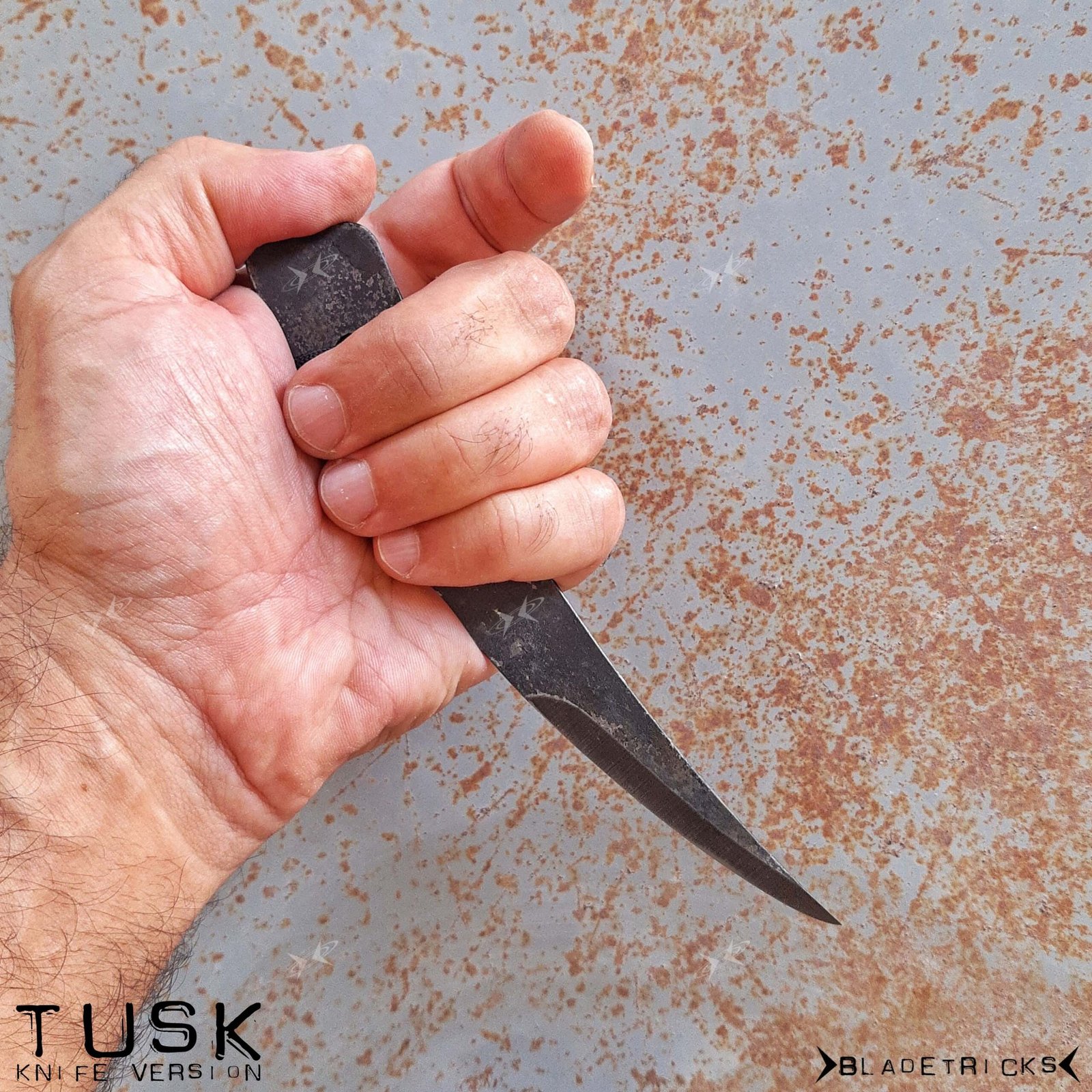
The hook is the more impressive object. So are thick blades with heavily marked grind lines, which are also easier to grind — worth saying. They look more dangerous and they sell themselves faster. The belly is the quiet one that gets more done.
There are practical arguments too — a straighter profile is easier to sharpen, gives a more robust tip and a cleaner path of entry — but the cutting argument is the real one. I built the first Nosaf Karambit with a belly instead of a hook at a time when I had not seen anyone else do it, on the one format that is defined by its hook.
I did not arrive here in a straight line. The early Zikit had a straight edge. After that I went through hooks, though never very pronounced ones. And in 2010 I built a pair of self-defence tools — the Cuervo and its smaller brother the Loro — with no edge at all but with a definite hook, because they were conceived as impact and limb-control tools.
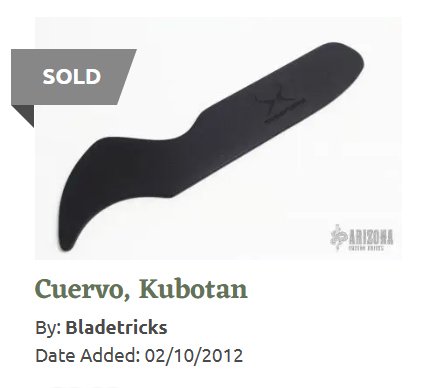
That pair is what taught me what the hook is actually for. It is a hooking device. It catches limbs, it controls, and on a tool with no edge it does that job well. What it does not do is earn its place on a blade whose job is to cut, where it works with the tip alone and leaves the rest of the edge idle.
The hook does keep one real advantage, and it is worth saying plainly: it looks frightening. That is deterrence, and deterrence has value. It is just not a cutting argument, and for years I treated it as though it were.
Point alignment
The point should sit on the line running between where the little finger meets the palm and where the index finger rests on the handle. The further the point strays from that line, the harder it becomes to aim. And the closer it sits to the centre of the handle — the classic dagger arrangement — the more your own hand hides it from you, and the less the blade tears.
Retention, and where it comes from
Grip strength does not come from the whole hand. It comes from the last two fingers, and mostly from the little finger, which wraps the handle like a prehensile tail and closes around it. That frees the rest of the hand to stay relaxed and available — to grab, to tear, to deflect. Relaxed matters for two reasons: you do not yet know what you will need that hand to do, and a relaxed hand moves faster than a clenched one.
This is why my choil sits where it does. The usual arrangement, and the one a good many makers use, puts a choil for the index finger at the far end of the handle — on a knife held point-down, the end away from the blade. I cut mine for the little finger instead, close to where the blade begins. There is no established name for that, so I call it a pinky choil.
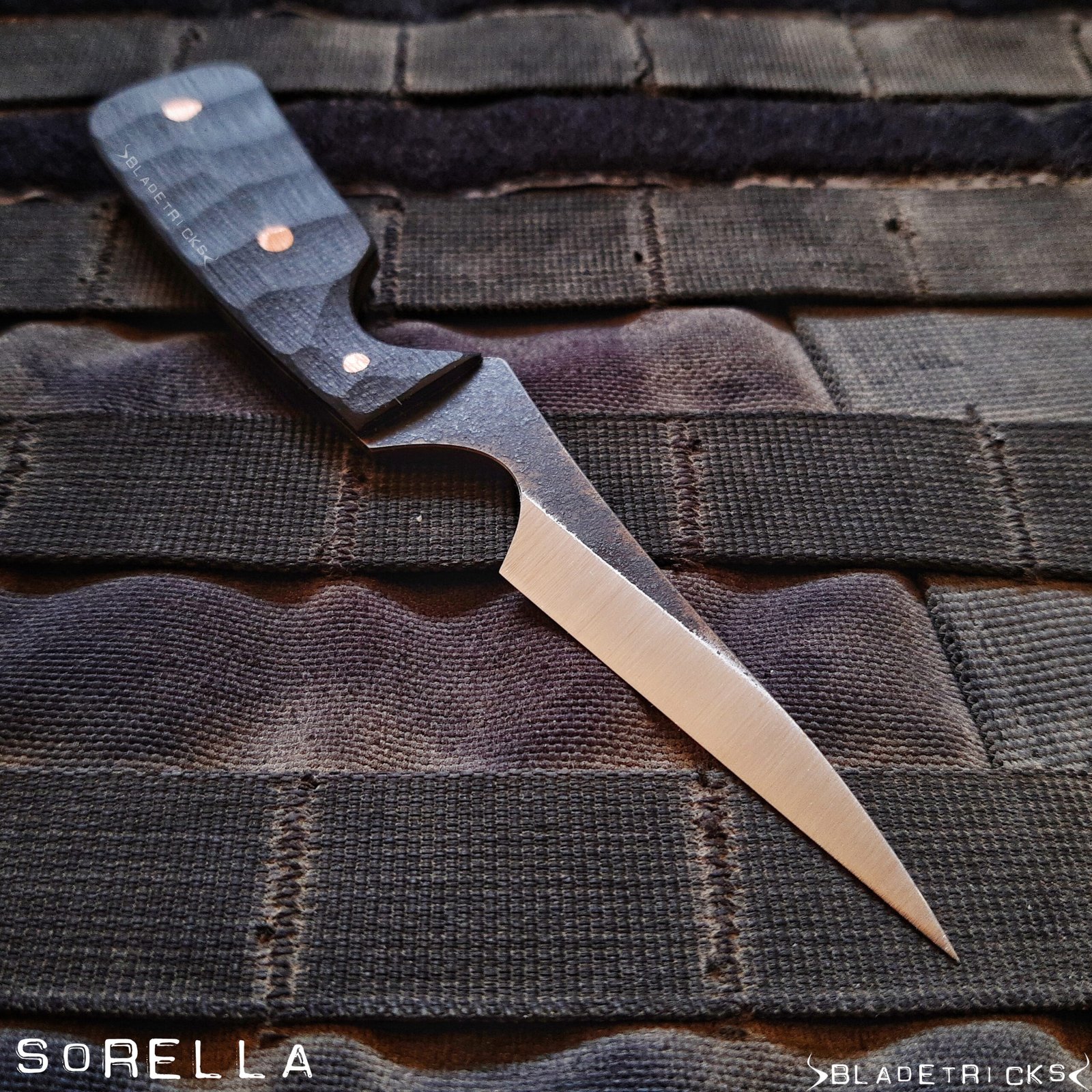
It gives the knife a firm seat, adds control and power, and stops the hand sliding forward onto the edge when you drive the point in. At the other end of the handle a thumb rest does the same job from the opposite direction. Two anchors, one at each end, and the fingers in between left free.
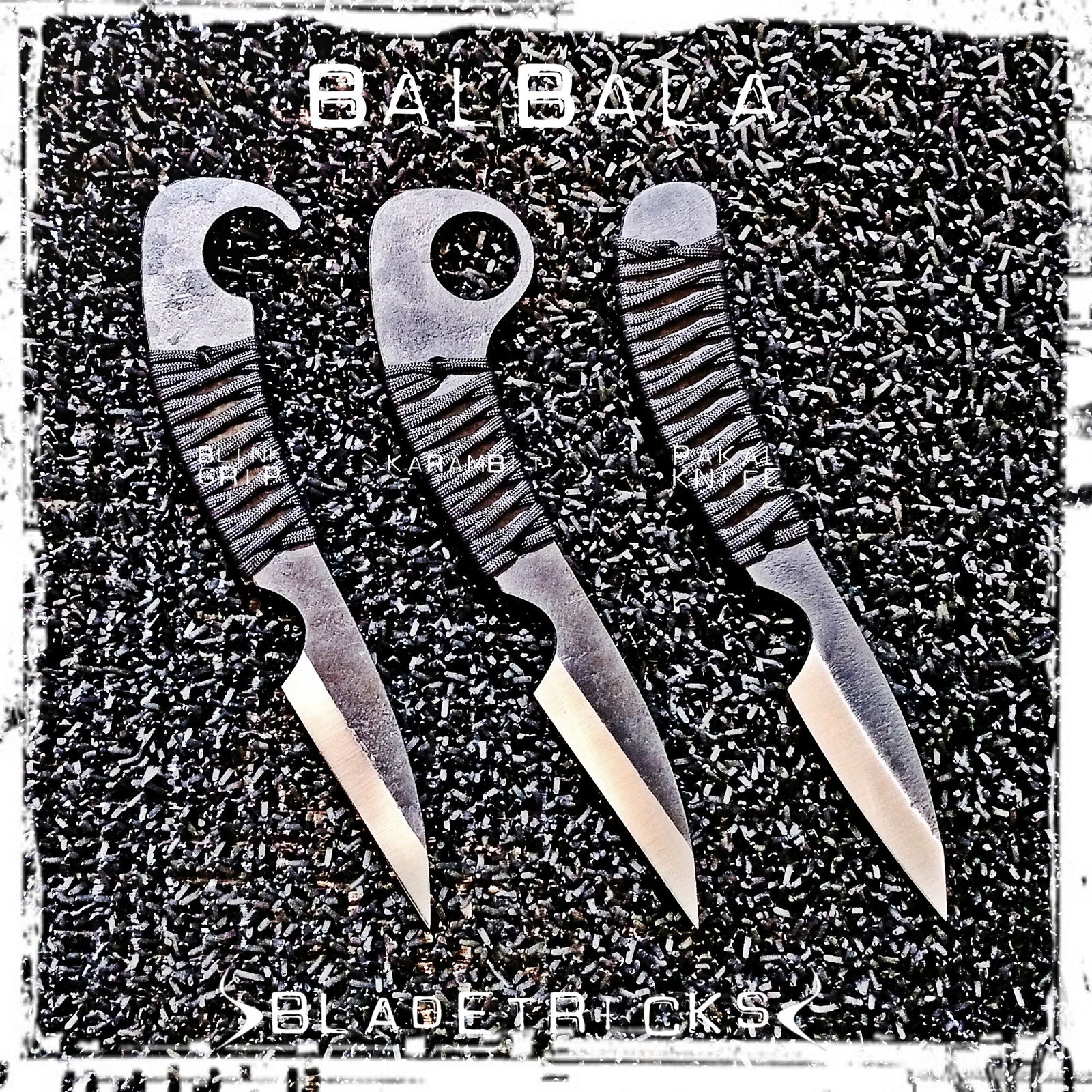
This is a separate question from the draw. On the Blink Grip the index finger reads the handle geometry as the tool clears the sheath, so the hand arrives correctly oriented without thinking about it. Index finger for indexing, little finger for holding. Two jobs, two fingers.
Handle
Generous, and shaped to keep the hand away from the edge. A choil that is not too pronounced, so it fits hands that are not mine — we do not all have the same hand.
Width matters more than it gets credit for. A wider handle tells you where the edge is. You are more aware of its orientation and you have more control over it, without having to look or think. That is why the most recent Nosaf Raal Knife uses a modified Kadesh Dagger handle, widened. It also works the other way: my models with very narrow handles end up being treated, and named, as icepicks — the Tarantula karambit among them — because a narrow handle stops telling you where the edge is pointing.
Blade length
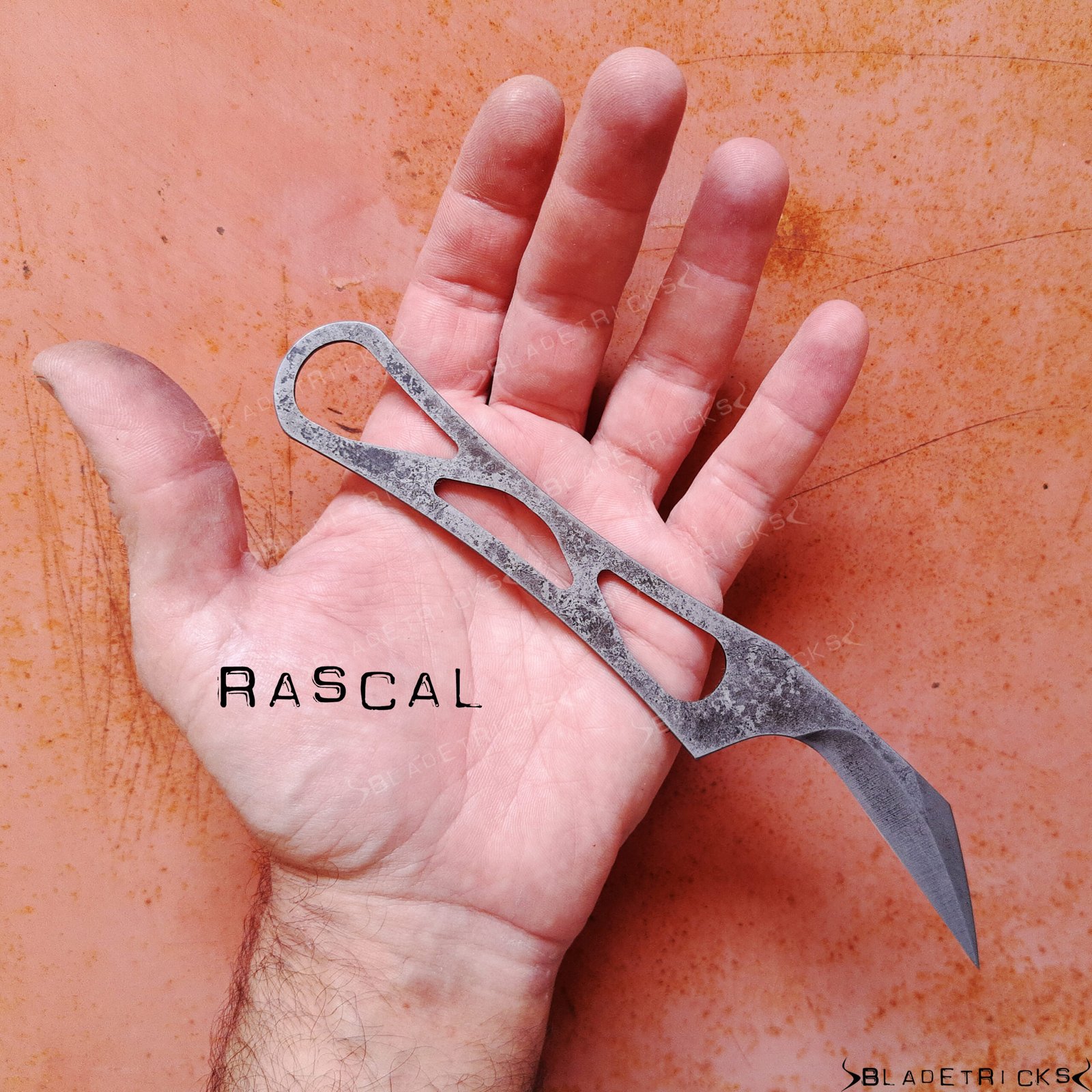
Generally no more than 100mm, and that is already long for a pikal knife. There is no real floor. I can picture a perfectly good pikal knife with a 30mm blade.
What it is good at, and what it is not
Where it works. Confined space and contact distance. Situations where the arm is already partially controlled. Retention under grappling pressure, with the blade close to the body rather than out where it can be stripped. And concealment: the tool is usually shorter, it rides point-down, and once it is in the hand it disappears along the forearm.
Where it does not. Reach is the real cost — you give up distance, and against someone with room and a longer blade that matters. You also give up the fluidity of the sabre grip. Everyday utility, since almost nothing about the orientation helps you open a box, although the recent belly-profile models go some way toward solving that; the Tusk is the clearest example. And the learning curve, because the movements do not come naturally to most people and half-learned pikal is worse than competent edge out.
There is also the legal question. In my experience the formats that suit this work best — ringed handles, double edges — meet more restriction in more places than a plain single-edged utility knife does, which is part of why the Nosaf Raal exists in a ringless knife version. That is a practical observation from selling internationally, not legal advice. Check your own jurisdiction.
Anyone telling you it has no drawbacks is selling something.
Related formats
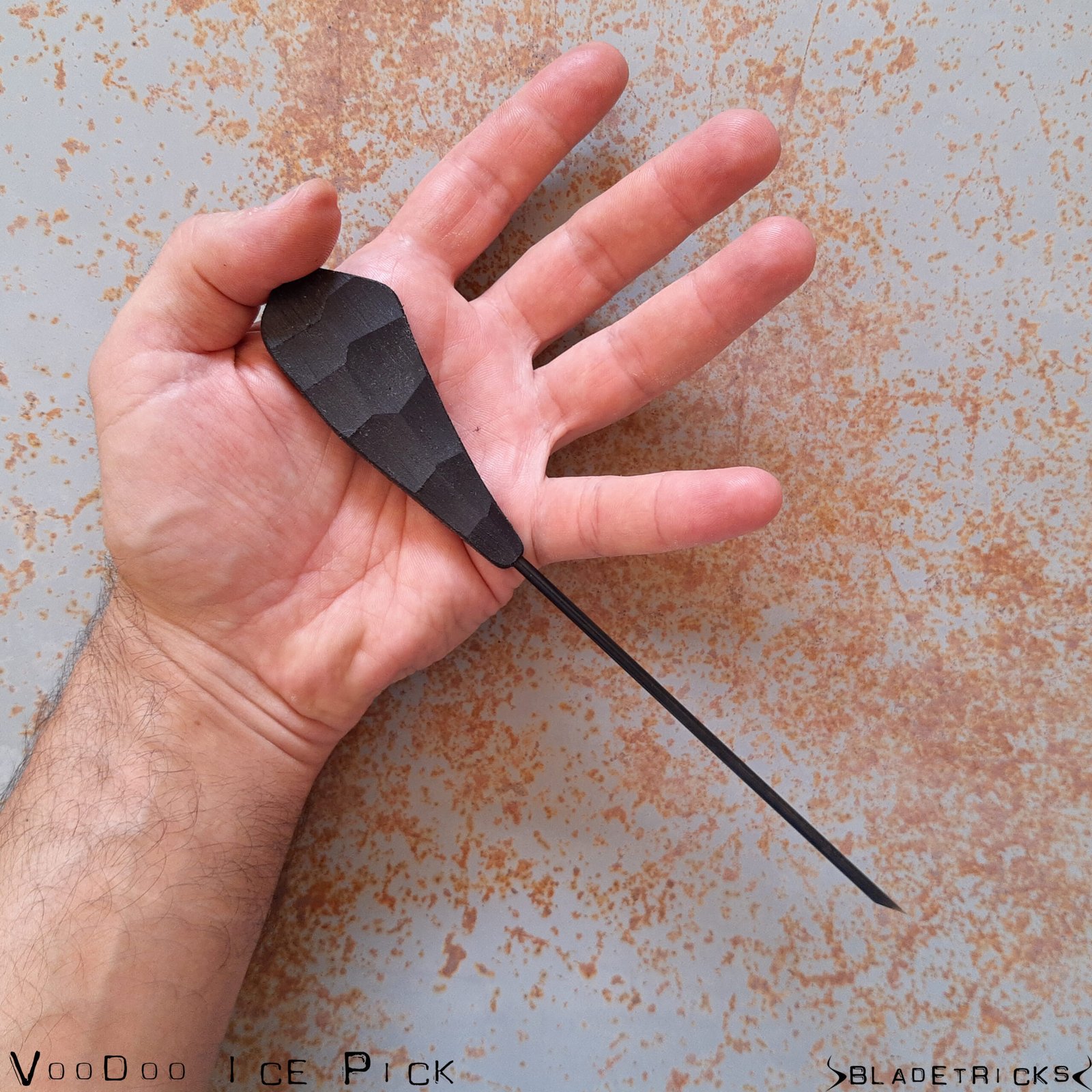
The icepick. Worth being precise here, because four things get treated as one and they are not. A point penetrates. An edge cuts. An icepick has the first and not the second. A knife has both.
That distinction settles a question people argue about: strictly speaking an icepick cannot be pikal, because pikal is a statement about which way the edge faces and an icepick has no edge to face anywhere. What it has is the reverse-grip mechanics — the same closing arm, the same axial line through the forearm — without asking the user to get edge alignment right, which is why it predates every formalised system built on this orientation and why it still works for people who have trained none of them.
What does not change is the handle. Pinky retention and a thumb rest matter just as much on an icepick as on a knife, and arguably more, because everything depends on the tool not moving.
Ring and hooked handles — karambit-derived formats — appear often here because a ring solves retention directly rather than through grip strength. The trade is that the ring also fixes your carry, your draw and your deployment.
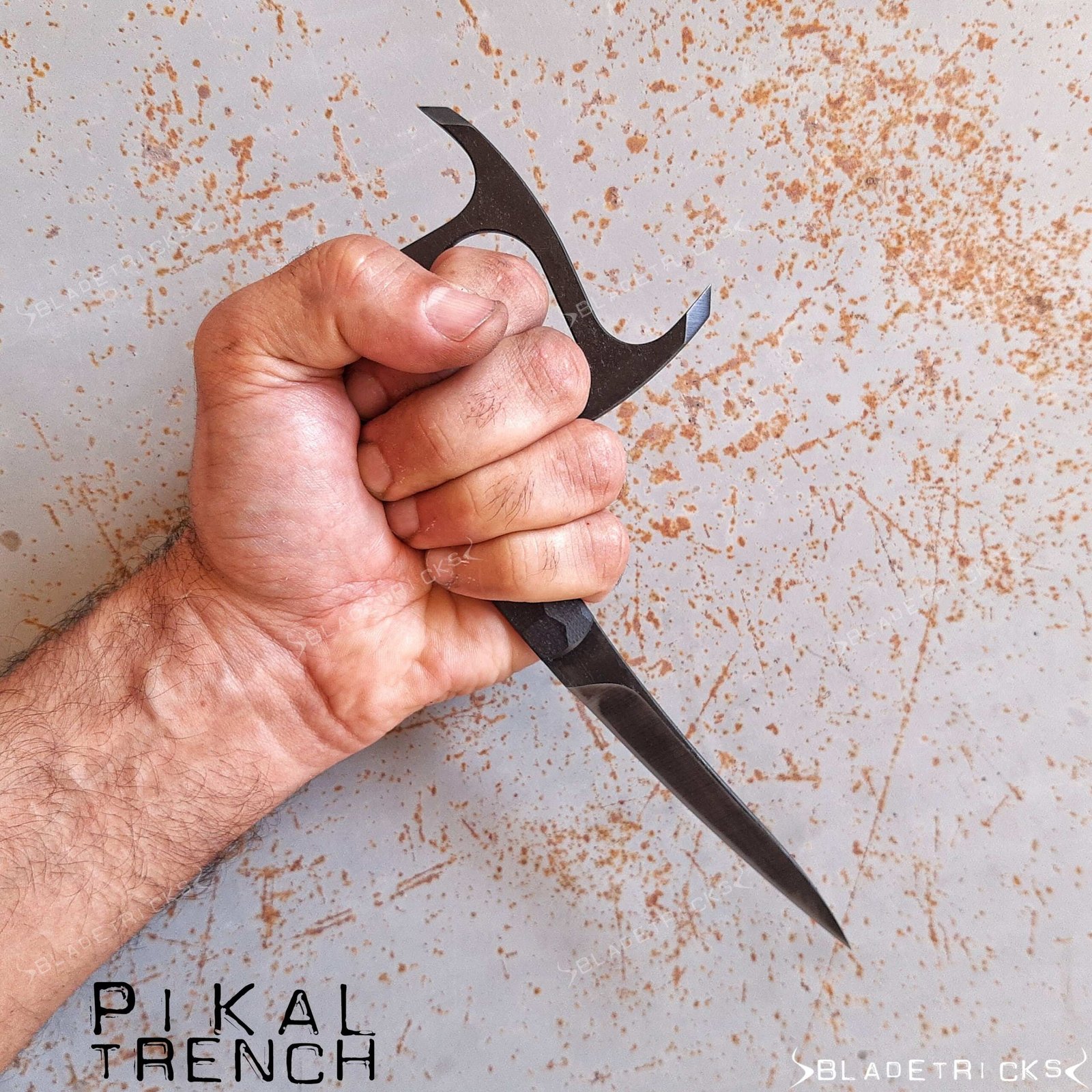
The ring can do more than hold. Small edges or spikes worked into or around it — as on the Baby Trench and the Pikal Trench — open up movement options in extreme situations. The main blade runs RGEI and the horns work as SGEI, which is the fourth combination from earlier appearing on the same tool as the second.
Targeting
Edge in reaches roughly what your empty hand reaches. That is the most useful way to think about it: the near side of the opponent, the limbs, the space between two bodies — the same territory you would work with nothing in your hand at all.
Edge out reaches arm plus blade. That extra distance is the trade, and it is why the two orientations produce different habits in the people who train them.
The mechanical detail behind it sits in the biomechanics article, which goes considerably deeper than is useful here.
If you are just starting
Learn empty hand first. No matter what. This is not a formality. A great many people train knife work — and a fair number teach it — without a solid base in close-quarters work with nothing in the hand, and it is a serious mistake. The knife does not create the movement. It joins one that should already be there.
Then learn a sabre grip properly.
And only then pikal, whatever brought you to it — the confined-space problem, the simplicity, or the fact that it asks less of you when you have least to give.
If you are choosing a knife for it, the thing to check is not the blade shape. It is whether the handle stays put when you push, and then again when you pull.
I design and build these for a living, and I take on commissions and design work for people who need something specific. If that is you, get in touch.