After the last hardening session, I ran the usual knifemaker’s check: a fresh file across the edge, straight out of the quench. It’s the oldest and most easily available test there is — hardened steel skates the file, soft steel lets it bite. That day the file bit more than it should have. Not on one blade: across the whole batch. Different steels, each at its proper temperature (my own numbers, cross-checked over the years against Knife Steel Nerds), each with its soak respected. And still, broadly, the hardness was neither what I expected nor what I’d accept.
When several known steels fail the same way on the same day, the steel is not the suspect. Something upstream of all of them is, and finding it turned into a full kiln calibration, done with what the kitchen had to offer.
Thinking it through, with a new tool
I worked the problem with a tool I’ve been learning to use lately: an AI. Double-edged, that one. It reasons fast, it holds more metallurgy than my bookshelf, and it will also state a wrong number with the same confident face as a right one. Working with it is a skill in itself: you learn to interrogate the answers, keep what survives checking against real sources, and discard the rest without sentiment. Same as breaking in any tool, except this one talks back.
After a long and, frankly, nervous back-and-forth, one explanation kept surviving every attack: an offset between the real temperature inside the chamber and the number on the controller. A thermocouple ages and drifts, and the controller reporting it has no idea.
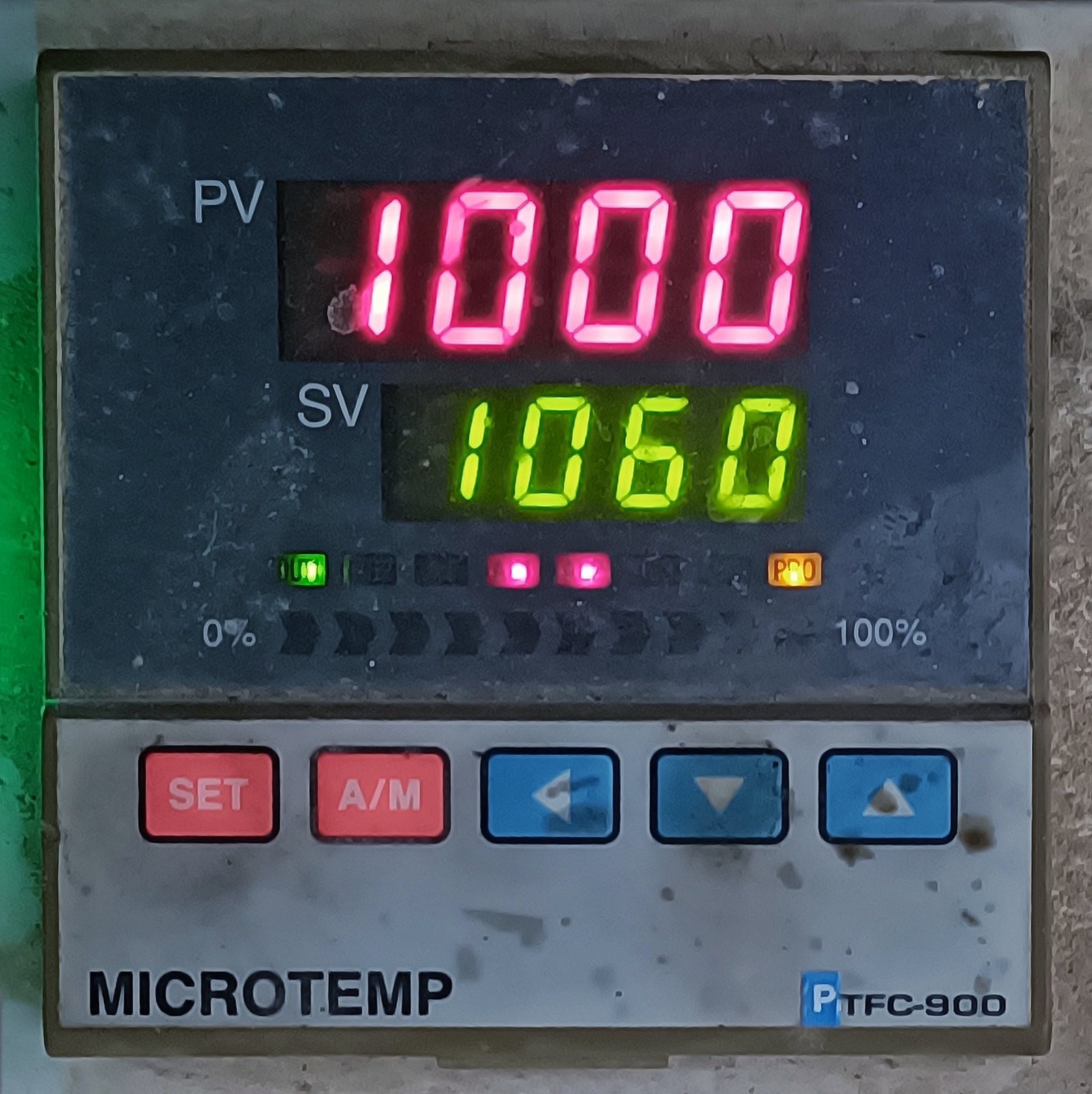
The number on trial: mid-climb toward a stainless soak.
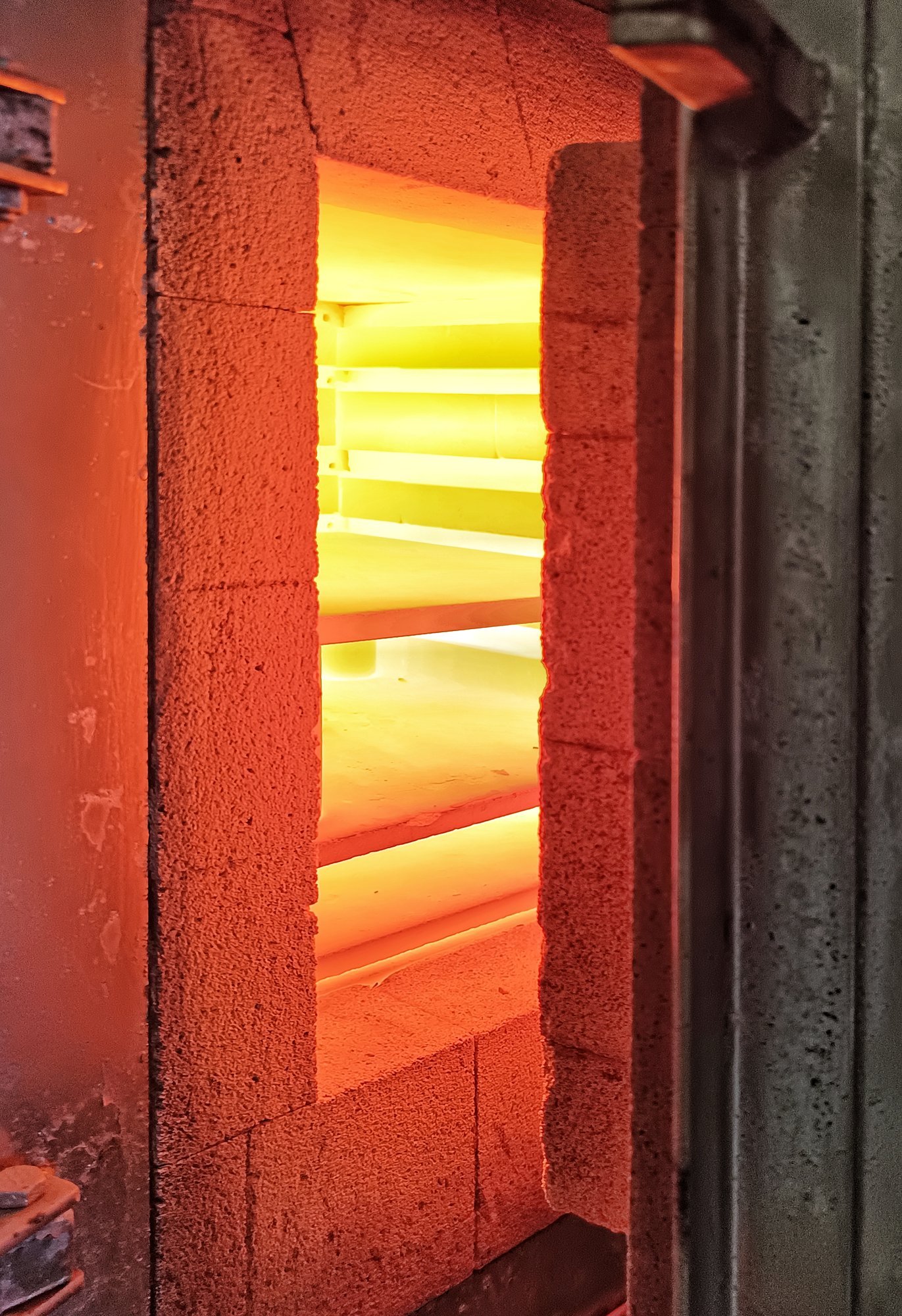
That diagnosis fit what I know about the oven itself. Mine is an old pottery kiln, built the old way, with an enormous thermal mass. It takes around twelve hours to climb to the temperatures steels like AEB-L and 14C28N ask for (one of the reasons this workshop runs in batches: when the kiln finally gets there, it earns its keep on a full load, not a single blade). And once there it is precise and stable: it holds a soak flat and does the same thing tomorrow.
That was exactly the disguise: the kiln reaches “800” today and “800” next week, perfectly repeatable, and repeatably wrong. The instability was never in the machine. It was in the sensor’s idea of the truth, and repeatability had hidden it for years.
Fine. Hypothesis on the table. Now, how does a man verify it with no electronics background, in a remote spot, without ordering a reference thermocouple and waiting weeks? The way I like doing things anyway: with what’s on hand.
Melting points don’t drift
The trick is that pure substances change state at temperatures physics has already fixed. Aluminum melts at 660°C and copper at 1085°C anywhere; they’re actual calibration points of the international temperature scale. Put a known material in the kiln, note what the display reads at the exact moment it transforms, and you have one honest kiln calibration point. Enough points and you have the whole map of the lie.
The kiln calibration kit came from the kitchen and the scrap bin:
Sugar: melts and caramelizes at ~186°C. Checks the tempering range.
Aluminum foil: pure aluminum, 660°C. Alloyed aluminum scrap is useless here; alloys melt low and vague. Foil is the pure, cheap form.
A magnet on a steel rod: steel stops being magnetic at the Curie point, ~770°C.
Coarse salt: 801°C, sitting dead center in the carbon steel hardening range.
A ring of copper pipe: 1085°C, covering stainless territory.
Running the kiln calibration tests
The method is step, soak, peek: set the kiln below the expected trip, let it stabilize, write down the stable reading before opening the door (once it’s open the display means nothing), quick look, close, raise five degrees, repeat. The melted markers are latches: once tripped, they stay tripped, so a glance answers “did we pass X during that soak” without ambiguity.
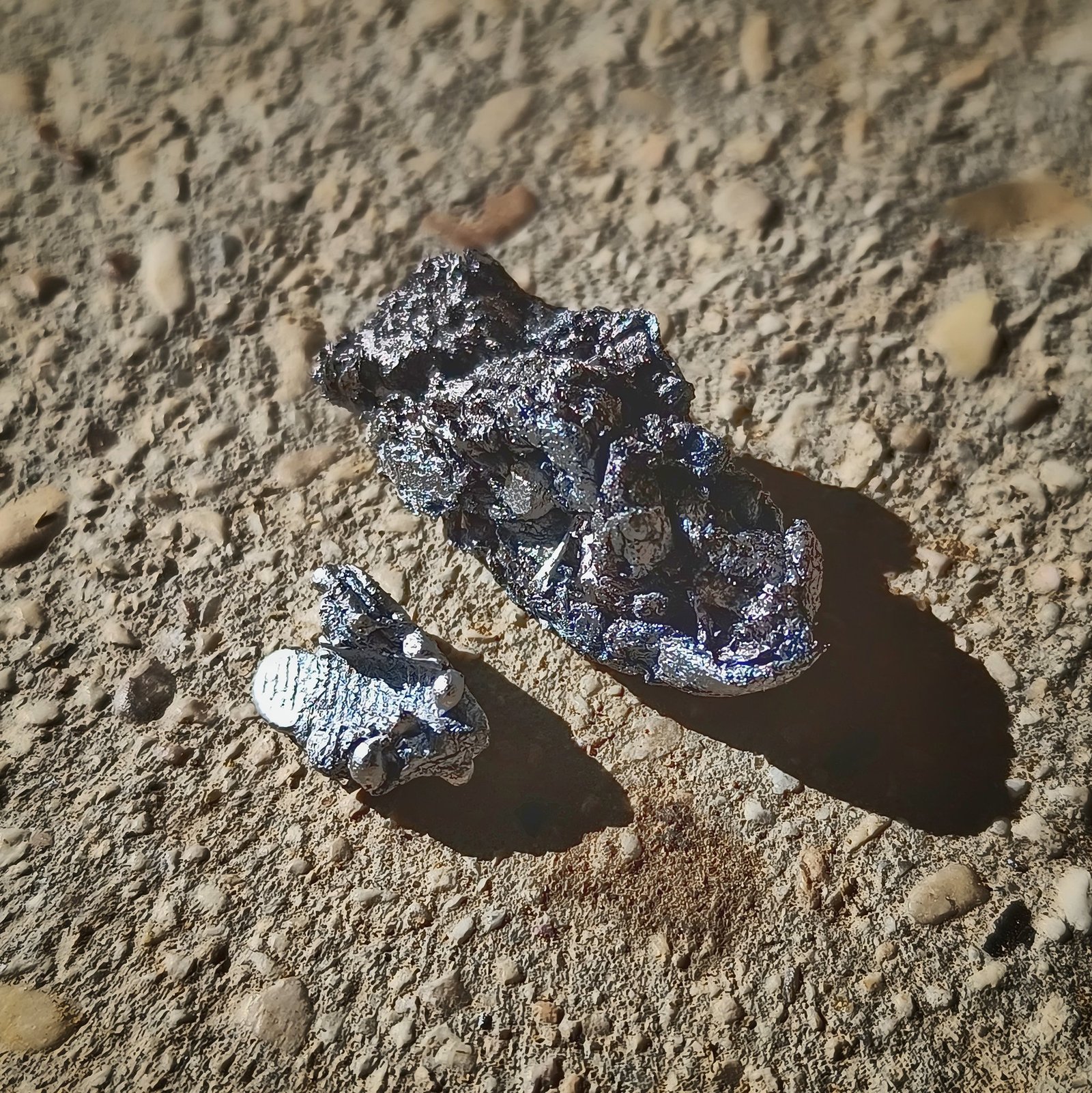
Each marker taught its own lesson. The foil, crumpled loose, melts inside its own oxide skin and keeps its shape: the eye swears it never melted while the metal inside went liquid. The fix: compress the ball hard beforehand, and squeeze the retrieved ball with pliers. Round, smooth beads mean it was liquid. Soft plasticine means hot solid, not melted: try again.
Top: a foil ball I believed had melted, it hadn’t, not fully. Bottom: one that did, squeezed with pliers; the round, smooth beads extruded through the grip marks are the proof of liquid. The eye lies; the pliers don’t.
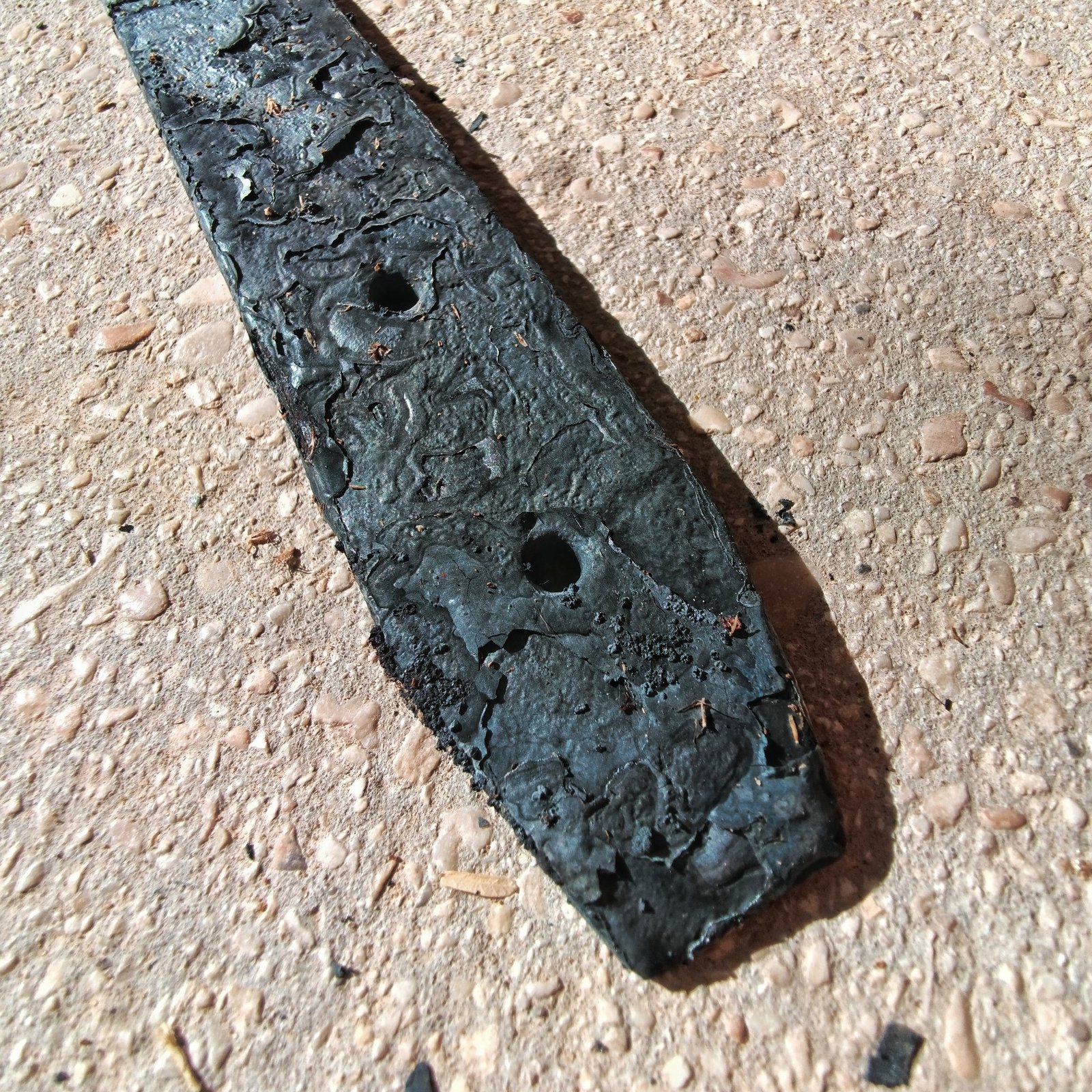
The magnet is a floor, not a target: non-magnetic proves you passed 770, nothing more, and once transformed the steel stays non-magnetic even as it cools, so there’s no latch to re-read later. The salt announced its trip by melting into a clear puddle and eating a hole through its stainless dish: molten salt is not a polite substance. The copper gives a warning first: shiny sweat beads on the black scale about twenty degrees before the ring collapses into a bead.
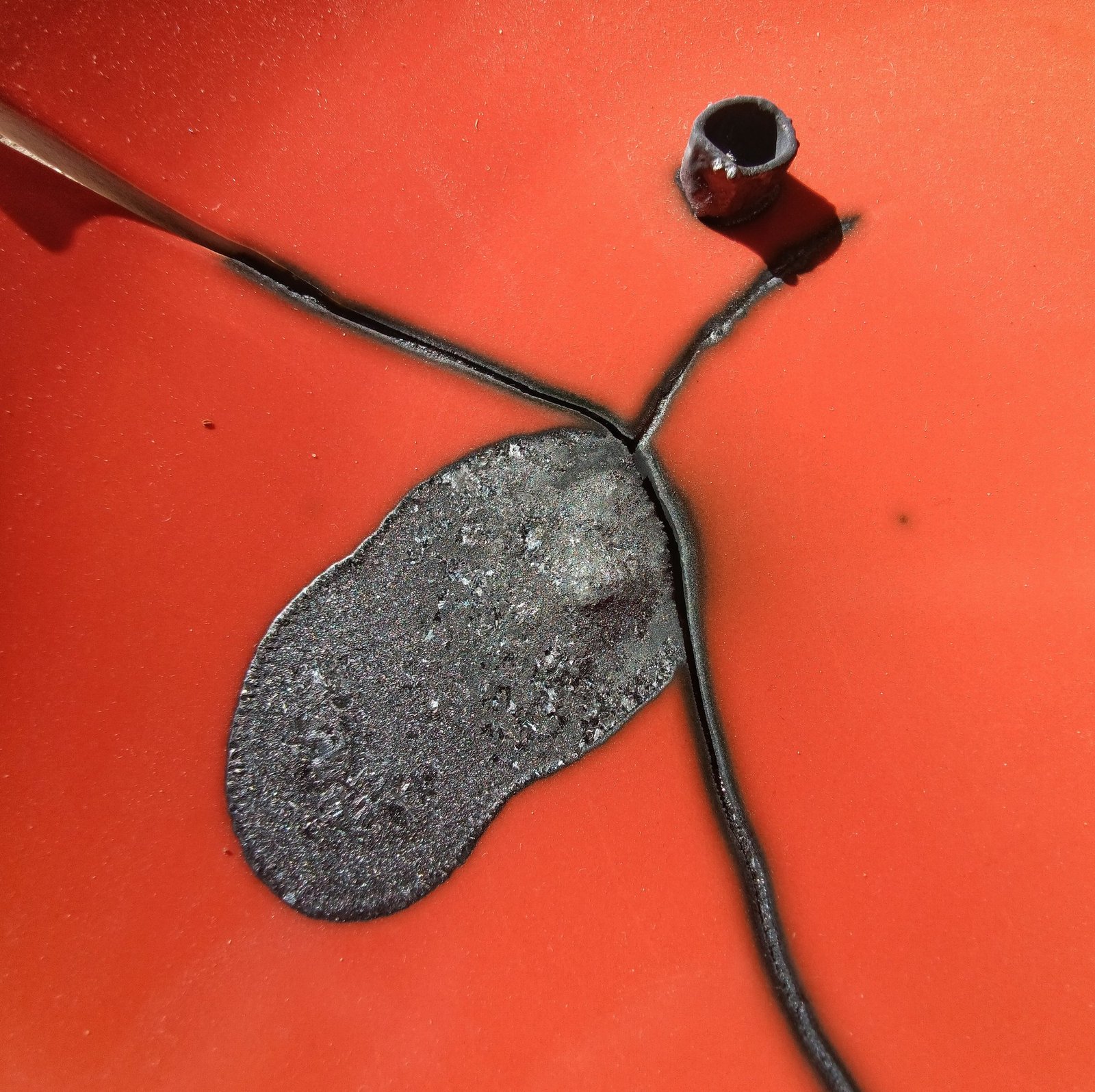
The salt ate through its foil dish, spilled, and etched this piece of spring steel on its way.
What the map said
At sugar temperature, the kiln was honest to within a degree. At aluminum: display 25 degrees high. At the Curie point: 25 again. At salt: around 20. At copper: past 40. The error wasn’t a constant to subtract once, it grew with temperature, so the fix is a kiln calibration curve through the measured points, not a single number scribbled on the controller.
The top of the map: copper survived ten minutes with the display reading 1125, and collapsed at 1130. True melting point: 1085. That gap, photographed.
And there was the answer to the file test. Ask that kiln for a carbon steel’s 800°C and the steel soaks at roughly 775, below where its structure finishes transforming. The blade quenches soft, and the display never blinks. Years of the occasional stubborn batch, explained by forty invisible degrees.
The retest
Then the part that mattered: I hardened the whole batch again, every steel on its corrected setpoint from the kiln calibration curve. This time the file skated on every edge. From there, tempering: a first cycle shared by all my steels, 150°C for two hours, then a second cycle tailored to each steel and to the work each edge is headed for (a thin slicer and a chopper don’t want the same hardness, and the second temper is where that gets decided).
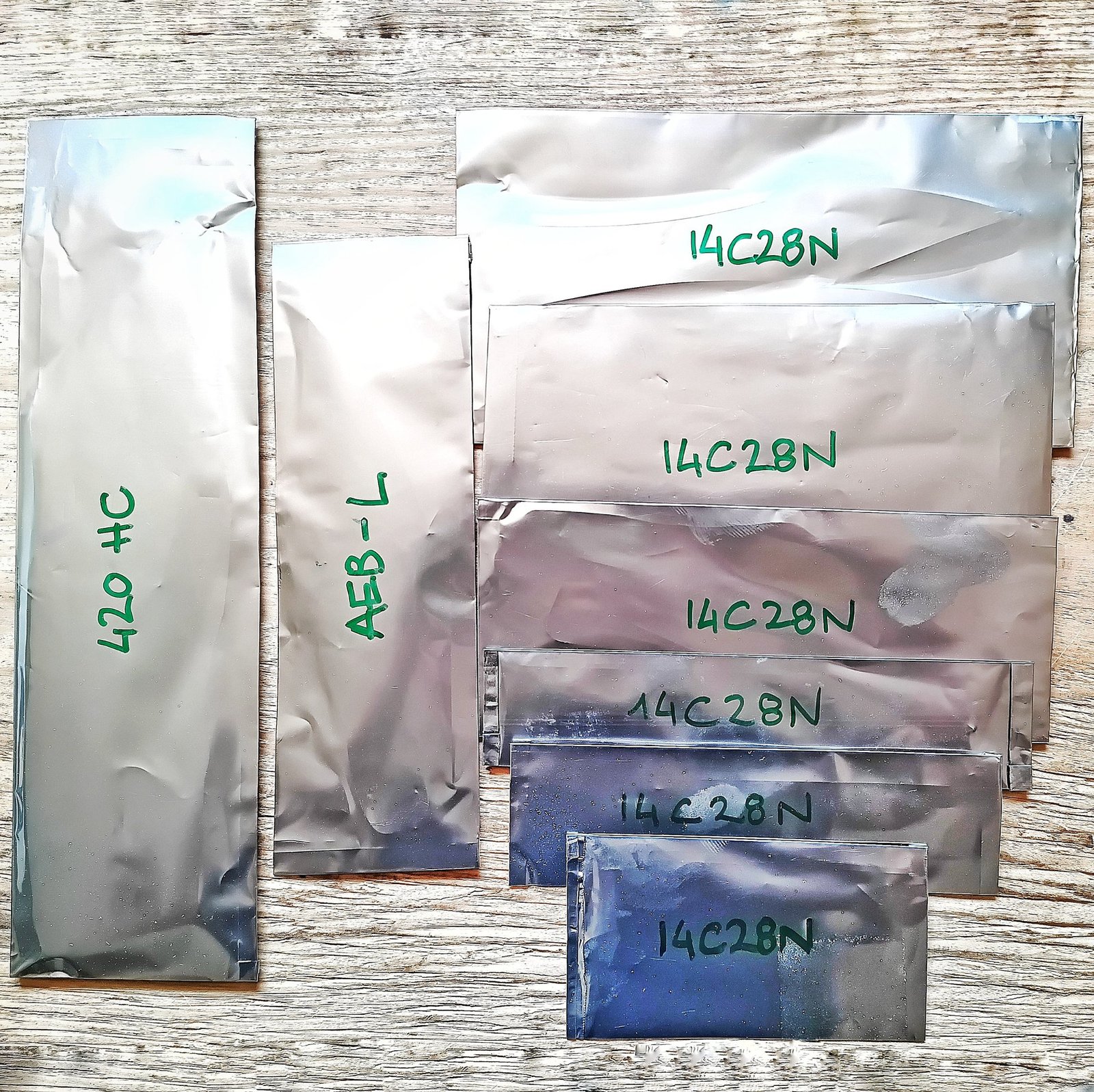
The retest, packed: 14C28N, AEB-L and 420HC in foil, headed back in on corrected setpoints.
What runs differently now
The marker test has joined the routine of this workshop: kiln calibration re-run yearly and after any thermocouple or controller change, because drift never announces itself. I’d argue it belongs in the routine of every workshop that hardens steel: it costs a few spoonfuls of sugar and salt, foil, a magnet and a slice of scrap pipe, and it answers a question no display can be trusted to answer about itself. Every setpoint here now comes off the measured curve, never raw from the book.
Every hardening and temper goes into a pencil log next to the kiln. And the file test keeps its job at the door: it’s the one that raised its hand in the first place.
Everything the process taught me ended up in writing. With the same AI at the bench, I built a 25-page workshop manual: the kiln calibration method and its measured curve, plus complete hardening and tempering references for every steel I regularly run, each number traced to its source: the steel producers’ own data sheets and Larrin Thomas’s published work. It lives next to the kiln, and it gets a new dated entry every time a number changes and a reason exists.
The same lessons pushed one project further: I’m now working on the design of a new kiln, purpose-built for blades, with a fairly unconventional layout that should cut the hardening cycle from half a day to a fraction of it. That one deserves its own post when it’s ready.
I keep trying to learn what actually happens in this workshop. This time it was the oven’s turn. That’s the craft as I understand it: understanding one more piece of the process each year, so that the knives that leave this bench are serious, professional, sensible tools. If you run a kiln, run the markers. If you buy blades, it’s a fair question how the maker knows his oven tells the truth.
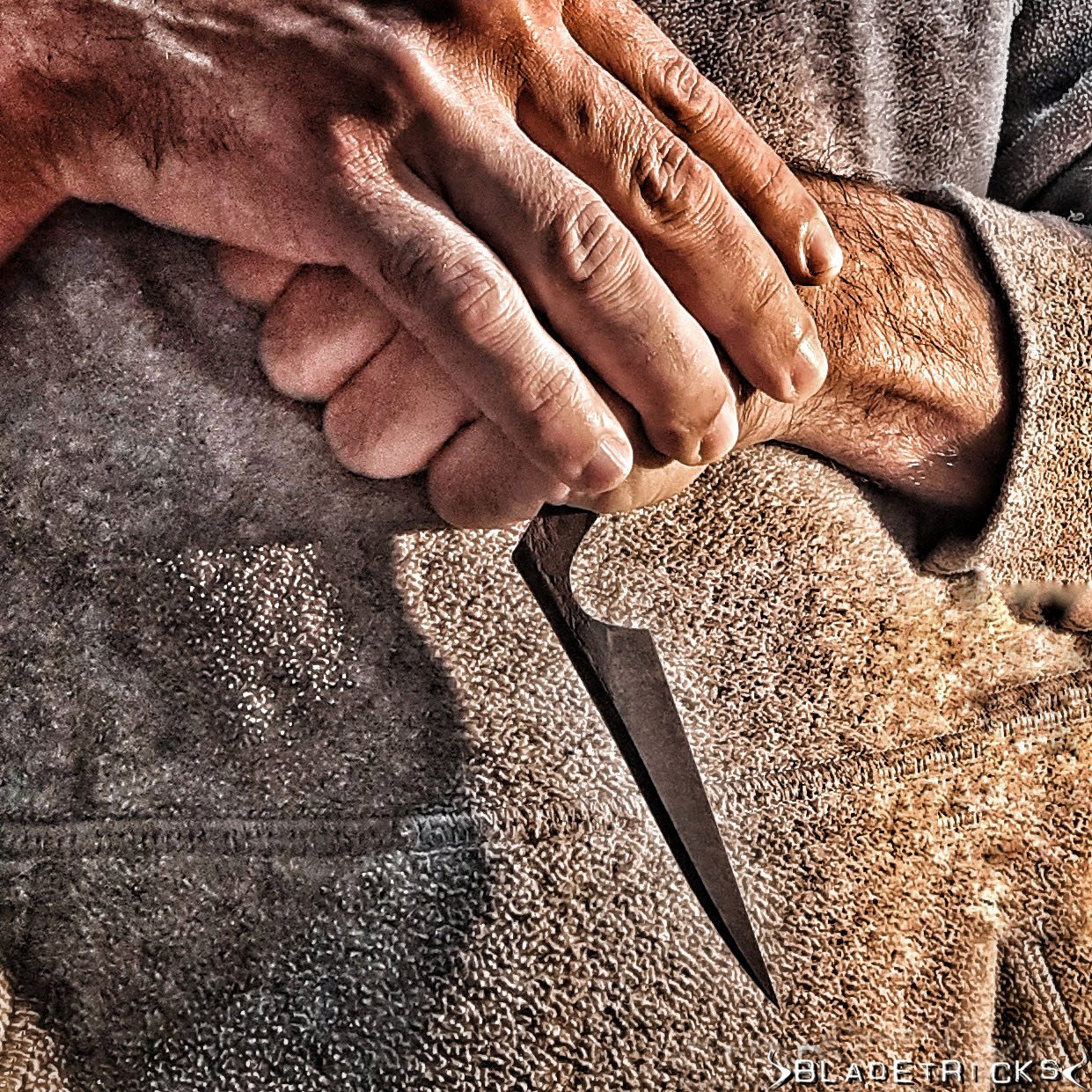
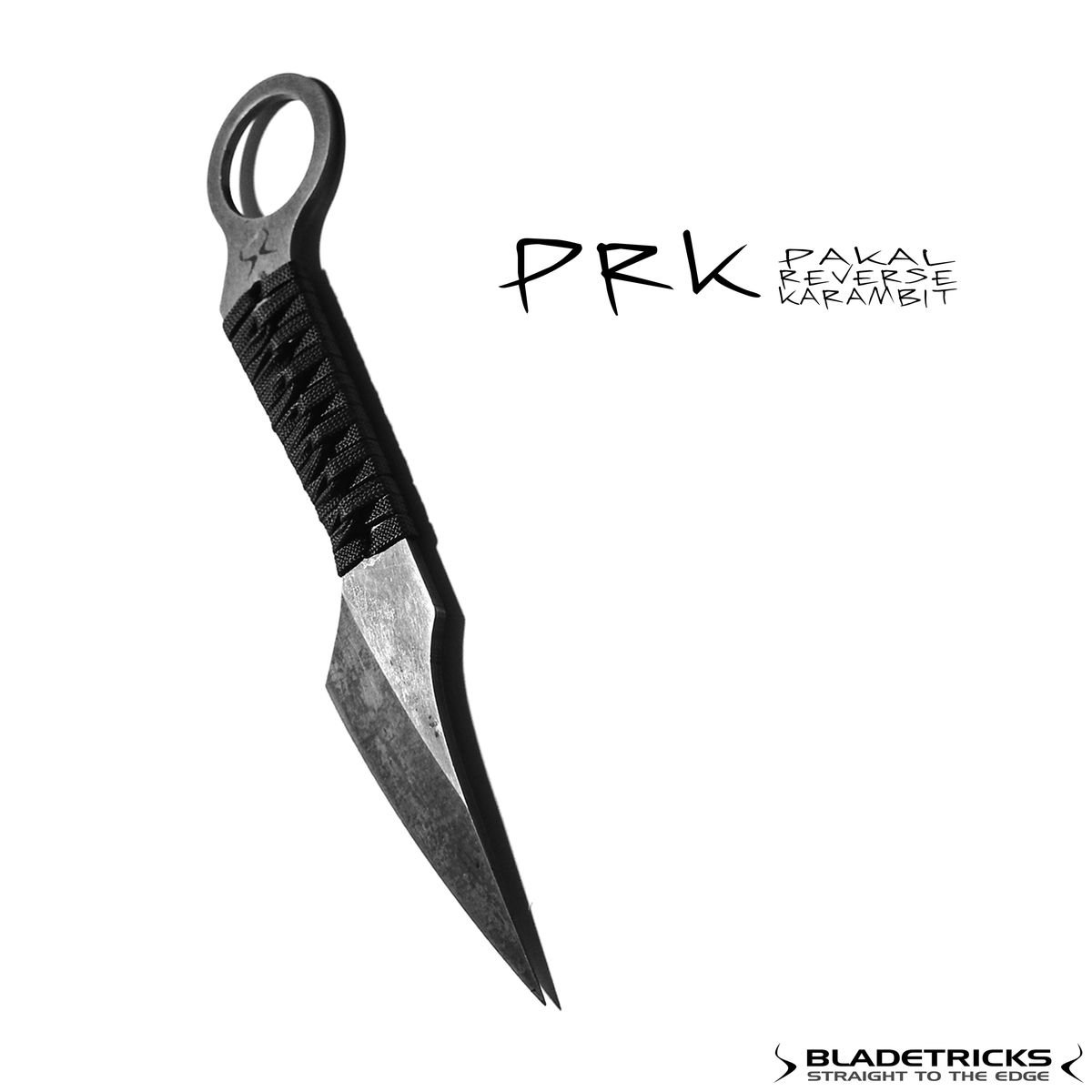
If you have arrived here after typing one word into a search box, this is the short version: pikal is a Visayan word from the Philippines meaning to rip. In knife work it describes holding the blade point-down, generally, with the edge turned toward your own forearm, and cutting as the arm closes rather than as it opens.
That is roughly the whole idea. The rest of this explains what it changes, what kind of knife it needs, how I build for it, and where it stops being the right answer.
I am A.N. Nash. I have been designing and building knives for this grip since 2010.
Where the word comes from
As I said above, pikal is Visayan, and it means, literally, to rip.
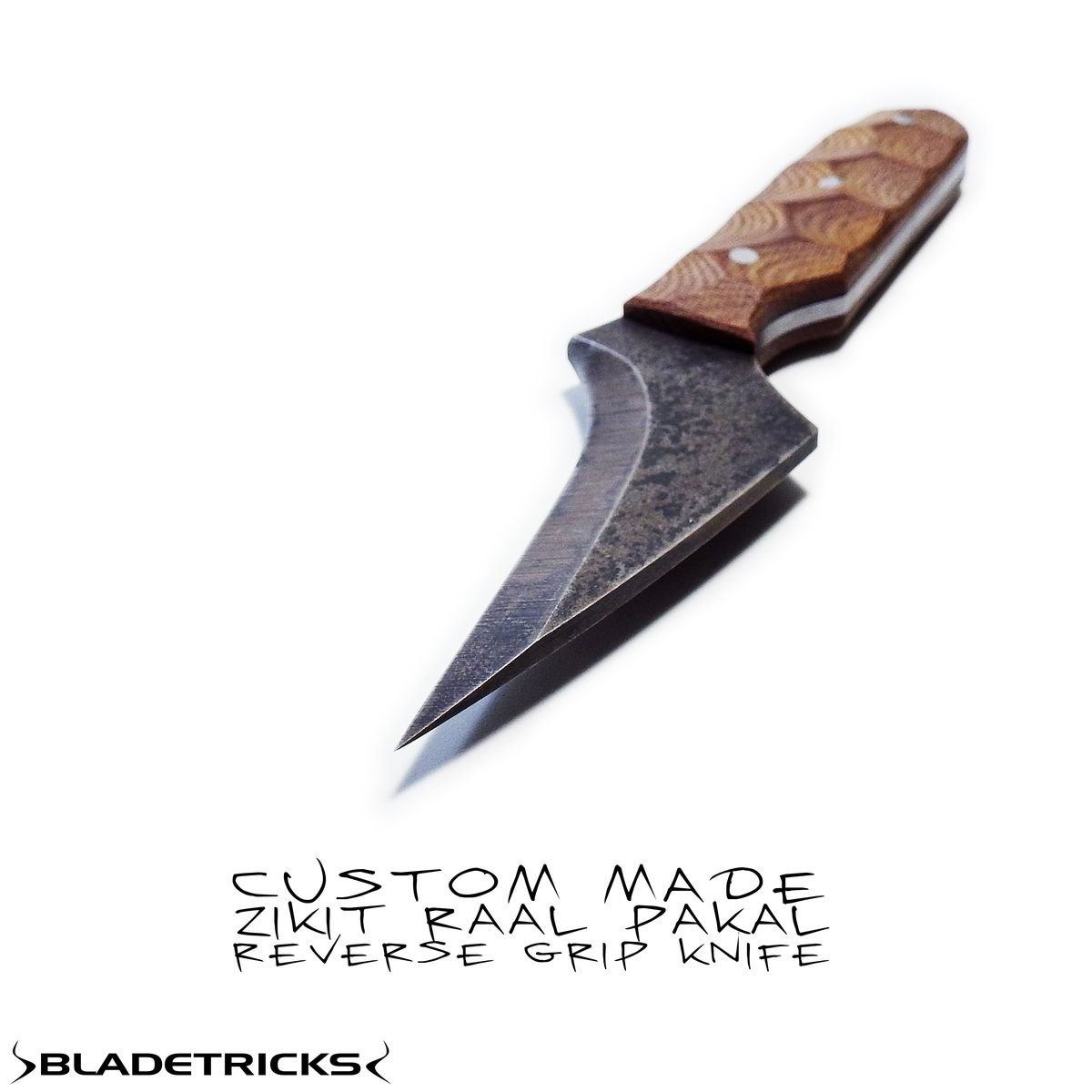
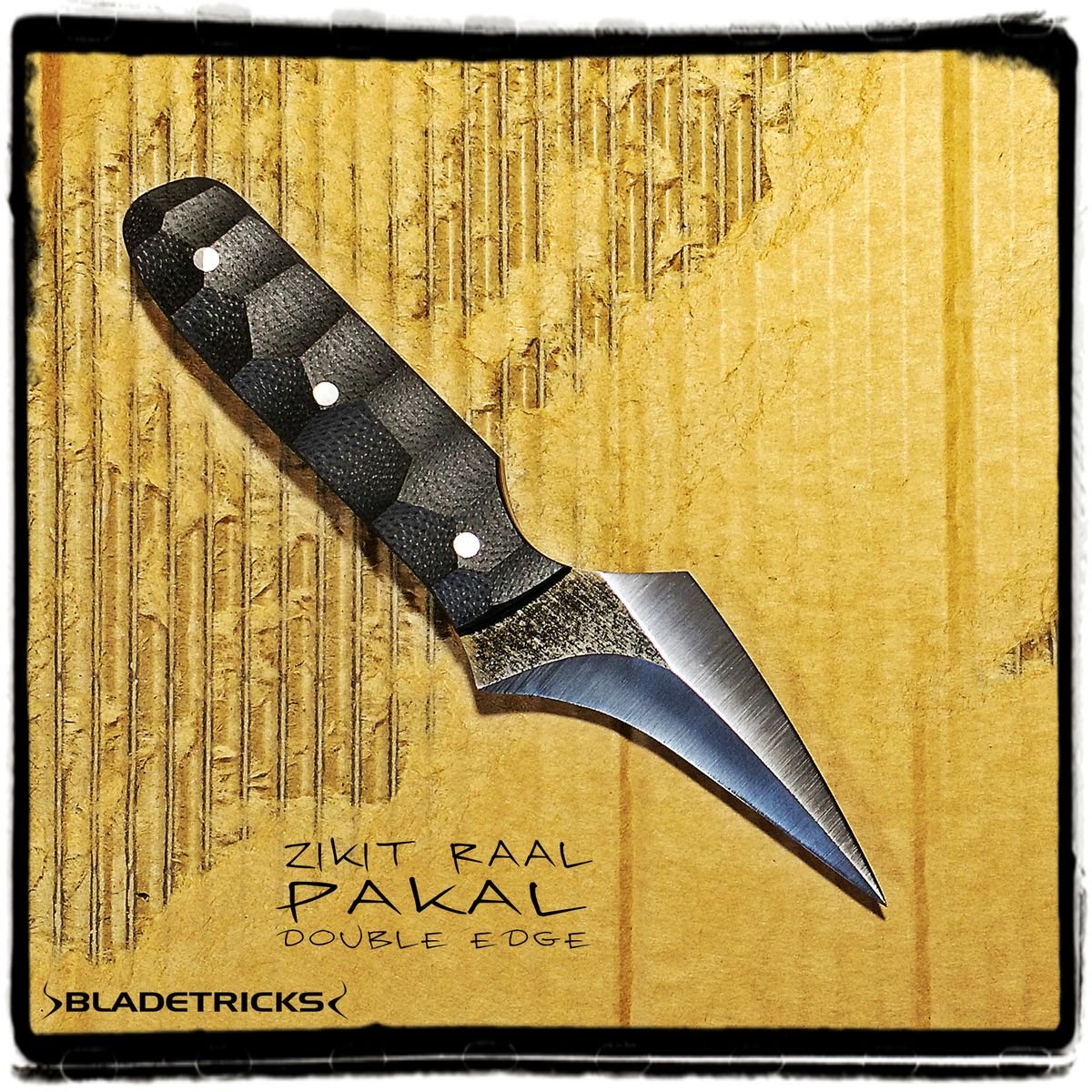
It is also written pakal, and the two words are the same thing. Pakal is the spelling used inside Pekiti-Tirsia Kali, the Filipino system most often credited with bringing this use of the knife to a wider audience. I used pakal myself for years. I moved to pikal for one reason only: it is the spelling that took hold in the wider knife world, and there is nothing to be gained from being the last person using the other one.
In Filipino martial arts the word is used two ways at once. Broadly, it means the reverse grip. Narrowly, it means the reverse grip with the edge turned inward. Both uses are correct, which is why arguments about the term never resolve — the people arguing are describing different things with the same word. The next section takes those two things apart.
That is as much as the word is worth. Knowing it lets you read what other people write about the subject without getting lost. It will not make you better with a knife. What follows is the part that will.
Four combinations, two of them pikal
Two variables are in play here, and most of the confusion comes from treating them as one.
The first is grip position — point-up or point-down. Point-down is the reverse grip.
The second is edge orientation — with the blade in the hand, the edge either faces away from your forearm or toward it.
Two variables, two states each, four combinations. All four exist and all four get used:
Reverse grip, edge out: Point down, edge away. What, before pikal terminology spread, was often just called hammer grip. Good for hooking outward and upward and for wide arcs. Loses most of its cutting function the moment the arm is controlled, though the thrust remains available.
Reverse grip, edge in: Point down, edge toward the forearm. This is pikal in the strict sense, also written RGEI — Reverse Grip Edge In.
Sabre grip, edge out: Point up, edge away. The general-purpose default, and the orientation most people should be competent in before anything else.
Sabre grip, edge in: Point up, edge toward you — SGEI. The least discussed of the four and the one usually left out of these explanations. It exists, it is uncommon, and I take it seriously for extreme close quarters and grappling. Four of my models are built around it: the DAK Trench, the Pikal Trench, the Urban Trench and the Baby Trench.
Of the four, only two are pikal: RGEI and SGEI. The edge faces in, and that is what the word is describing. Those two are what the rest of this article is about.
The reason to keep grip position and edge orientation apart is simple. Grip position changes how a movement is shaped. Edge orientation changes what the movement can do.
What turning the edge in changes
An edge facing out cuts as the arm opens: the hand travels away from the body and the work happens at the far end of the movement.
An edge facing in cuts as the arm closes: the elbow folds, the forearm rotates, and the work happens on the way back.
The wrist does more than people notice
The elbow and the shoulder get the attention. The wrist is what makes the movement work.
With the point down, the vertical action of the wrist governs three separate things: where the point lands, whether you can catch and hold a limb, and how the blade behaves on the way out — the final tear and the withdrawal. Take the wrist out of it and you have a stiff arm with a knife on the end of it.
The comparison I keep coming back to is a mantis. It does not strike and retreat. It hooks, brings the prey in against its own arms, and holds it there. Everything happens close, and the closing is the technique.
Three things that follow
It survives contact distance. At the range where the arm gets grabbed, trapped against a body, or pinned to a wall, an edge facing out has lost the movement that produces the cut. The thrust is still there — that never goes away — but the cut is gone. An edge facing in keeps both, because pulling is harder to prevent than pushing: shorter path, stronger muscle groups, more intuitive, and a hand on your wrist does very little about it.
It generates more force on entry. The forearm transmits body weight straight down the line of the blade instead of through the wrist joint. Anyone can test this safely against a dead tree, and the difference is not subtle.
It is closer to instinct. The movements are simpler, more direct, and more aggressive than their sabre-grip equivalents. Under real stress that matters more than anything on this list — fine motor control is the first thing to go, and pikal asks for very little of it. I have written about the physiology behind that in Pikal Knife Fighting: Biomechanics, Anatomy, and the Reality of Edge In.
That is what pikal is for. Not a better grip in general — a grip that still functions once things have stopped going the way you wanted, and that a body under stress can still execute.
What kind of knife suits it
A knife drawn for cutting on extension does not fail dramatically when you turn the edge in. It just does less than it could. Some of them, without the right technique, will cut the hand that holds them.
Point and edge are separate questions and they want separate answers. The point is what gets you in. The edge is what happens next.
Point position. What matters is where the point sits while the hand is closing and the blade is rotating, not where it sits at rest.
Retention. The blade goes in, then comes back. That is two directions of load inside one movement, and a handle that holds against one will often let go of the other. It is the first thing to fail on a knife that was not built for this.
Size. Long blades lose the advantage twice over. The whole point is working inside the space where a long blade cannot be brought to bear, and a long blade is harder to aim from this grip.
My own preferences
Everything below comes from one habit: simplify, reduce, and keep asking whether a feature is earning its place. More intuitive, more versatile, more universal, more practical. That has been the discipline since the first Nosaf knives, which were governed by two rules and nothing else — 2mm stock and simplicity.
Blade profile
Most dedicated RGEI knives use a hooked or hawkbill profile. I have moved the other way, toward straighter and more traditional shapes with a proper belly.
The hook does rip, and that was never in dispute. The problem is that mostly only the tip does the work. The rest of the blade is along for the ride, contributing very little to the cut it is attached to.
To see why the belly matters, it helps to know which way the cut actually runs. As I use pikal there are two main modes, and in both of them the cut travels the same direction.
In the first, you are blocked, or you are looking to be blocked. Your forearm makes contact with the opponent, you retract, and the cut begins there — starting at the base of the blade, by the pinky choil, and running out toward the point as the arm closes.
In the second, you start with a thrust. As the arm retracts the cut begins again from the widest part of the blade near the pinky choil and runs out toward the point, as the blade leaves the tissue.
Either way the edge works from base to point on the way back. That is the whole argument for a belly. A blade that only cuts at the tip is idle for most of that travel. A belly slices along its length, the way a butcher’s knife slices, and every millimetre between the choil and the point is doing something on the way out.
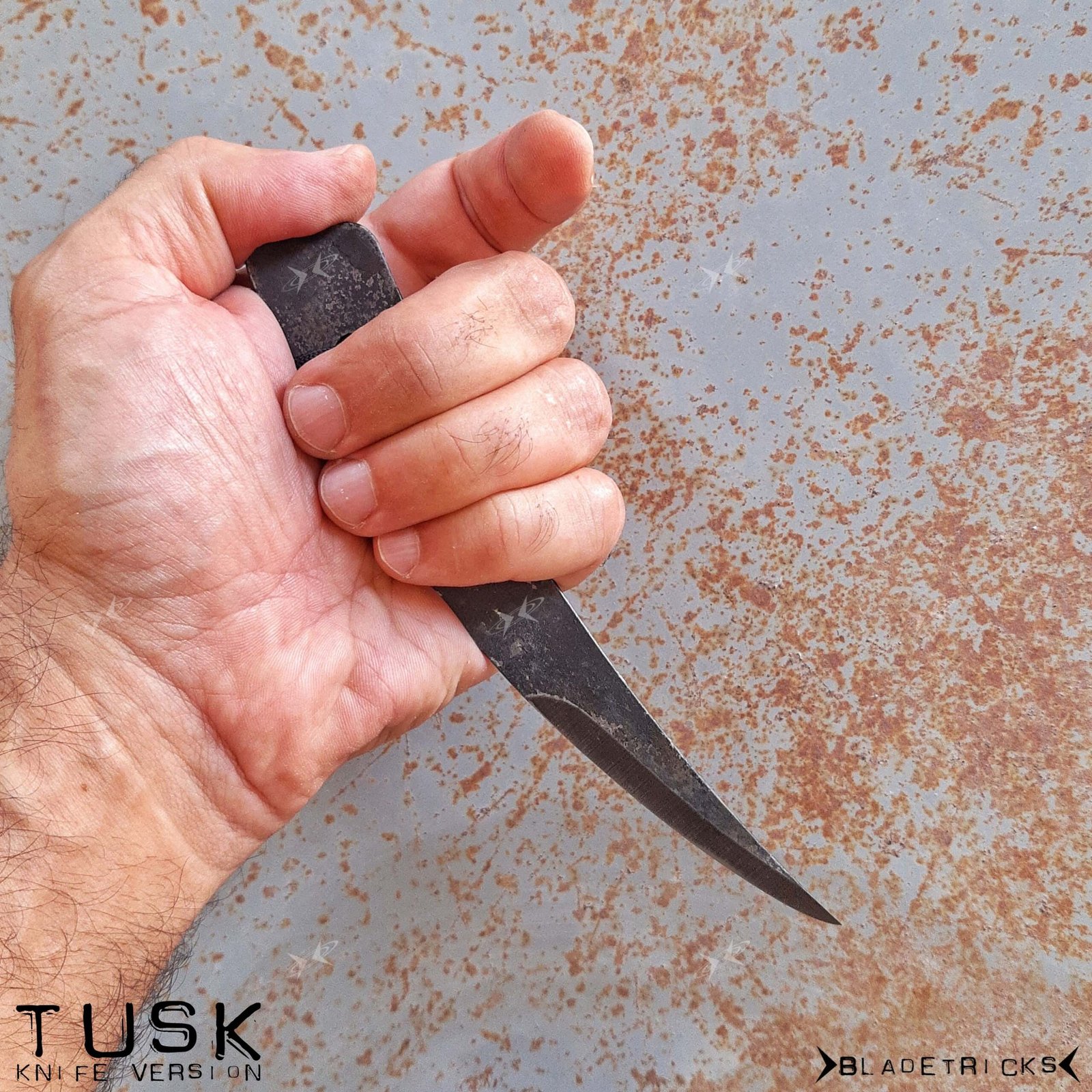
The Tusk. The belly runs the length of the edge, so the whole blade works on the way back — not just the tip.
The hook is the more impressive object. So are thick blades with heavily marked grind lines, which are also easier to grind — worth saying. They look more dangerous and they sell themselves faster. The belly is the quiet one that gets more done.
There are practical arguments too — a straighter profile is easier to sharpen, gives a more robust tip and a cleaner path of entry — but the cutting argument is the real one. I built the first Nosaf Karambit with a belly instead of a hook at a time when I had not seen anyone else do it, on the one format that is defined by its hook.
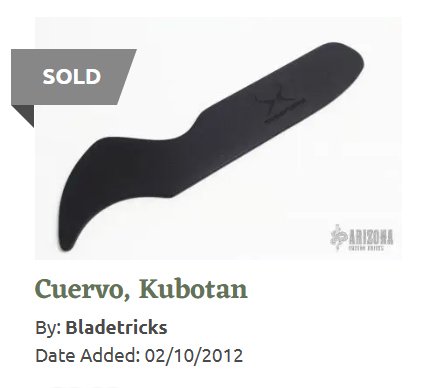
I did not arrive here in a straight line. The early Zikit had a straight edge. After that I went through hooks, though never very pronounced ones. And in 2010 I built a pair of self-defence tools — the Cuervo and its smaller brother the Loro — with no edge at all but with a definite hook, because they were conceived as impact and limb-control tools.
The Cuervo, listed in February 2012. No edge, and a hook — built for impact and limb control.
That pair is what taught me what the hook is actually for. It is a hooking device. It catches limbs, it controls, and on a tool with no edge it does that job well. What it does not do is earn its place on a blade whose job is to cut, where it works with the tip alone and leaves the rest of the edge idle.
The hook does keep one real advantage, and it is worth saying plainly: it looks frightening. That is deterrence, and deterrence has value. It is just not a cutting argument, and for years I treated it as though it were.
Point alignment
The point should sit on the line running between where the little finger meets the palm and where the index finger rests on the handle. The further the point strays from that line, the harder it becomes to aim. And the closer it sits to the centre of the handle — the classic dagger arrangement — the more your own hand hides it from you, and the less the blade tears.
Retention, and where it comes from
Grip strength does not come from the whole hand. It comes from the last two fingers, and mostly from the little finger, which wraps the handle like a prehensile tail and closes around it. That frees the rest of the hand to stay relaxed and available — to grab, to tear, to deflect. Relaxed matters for two reasons: you do not yet know what you will need that hand to do, and a relaxed hand moves faster than a clenched one.
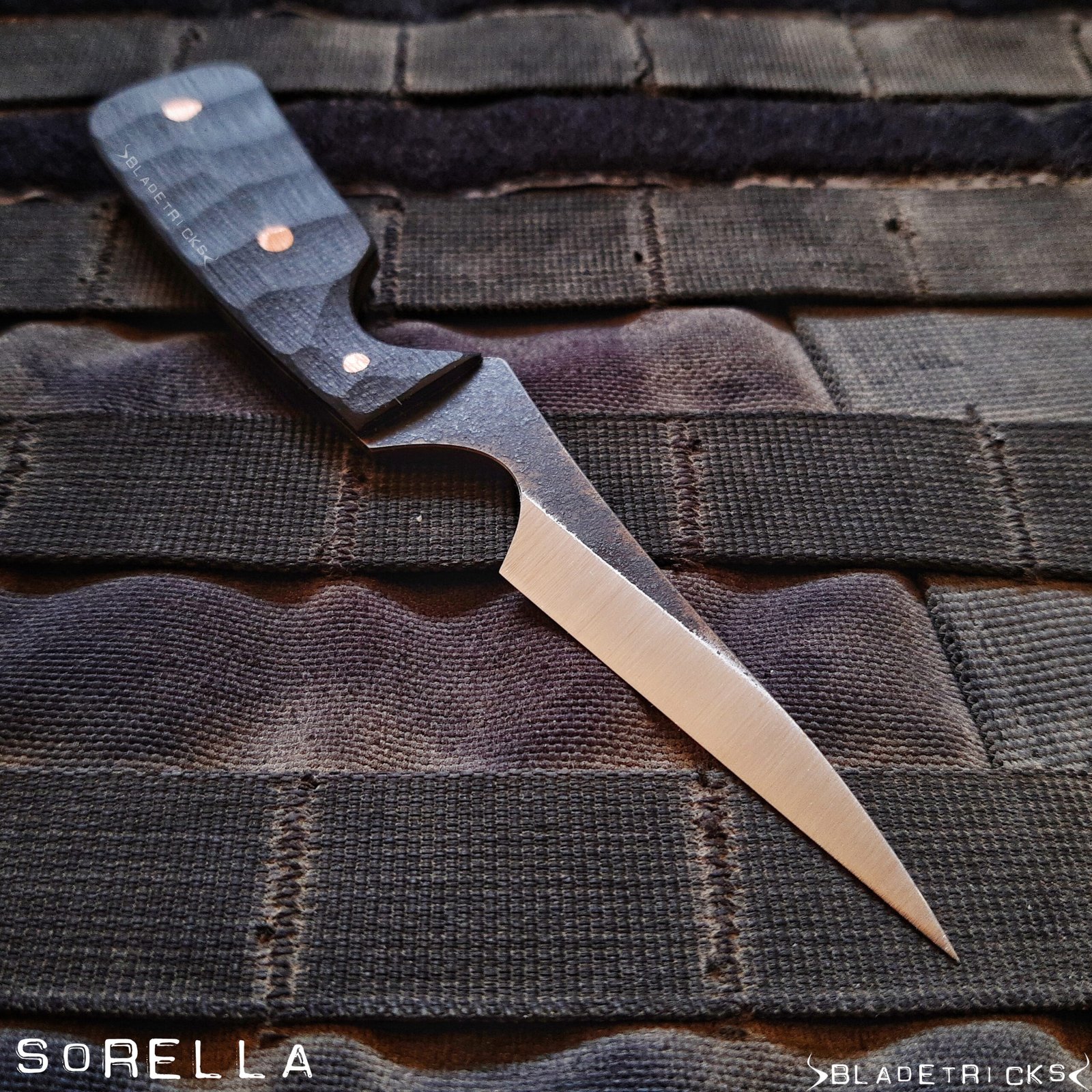
This is why my choil sits where it does. The usual arrangement, and the one a good many makers use, puts a choil for the index finger at the far end of the handle — on a knife held point-down, the end away from the blade. I cut mine for the little finger instead, close to where the blade begins. There is no established name for that, so I call it a pinky choil.
The Sorella. A different blade profile, the same choil placement — cut for the little finger, where the blade begins.
It gives the knife a firm seat, adds control and power, and stops the hand sliding forward onto the edge when you drive the point in. At the other end of the handle a thumb rest does the same job from the opposite direction. Two anchors, one at each end, and the fingers in between left free.
This is a separate question from the draw. On the Blink Grip the index finger reads the handle geometry as the tool clears the sheath, so the hand arrives correctly oriented without thinking about it. Index finger for indexing, little finger for holding. Two jobs, two fingers.
Handle
Generous, and shaped to keep the hand away from the edge. A choil that is not too pronounced, so it fits hands that are not mine — we do not all have the same hand.
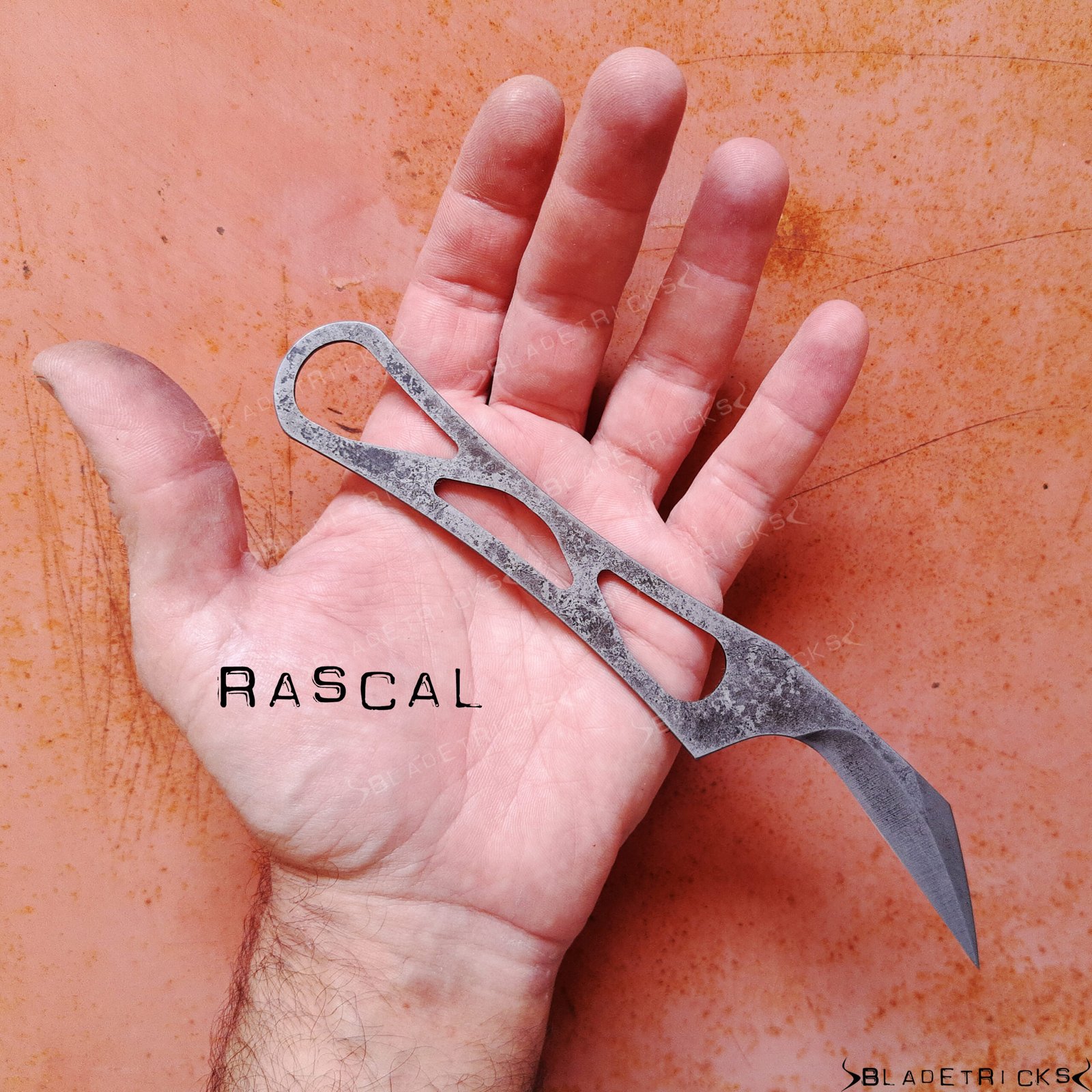
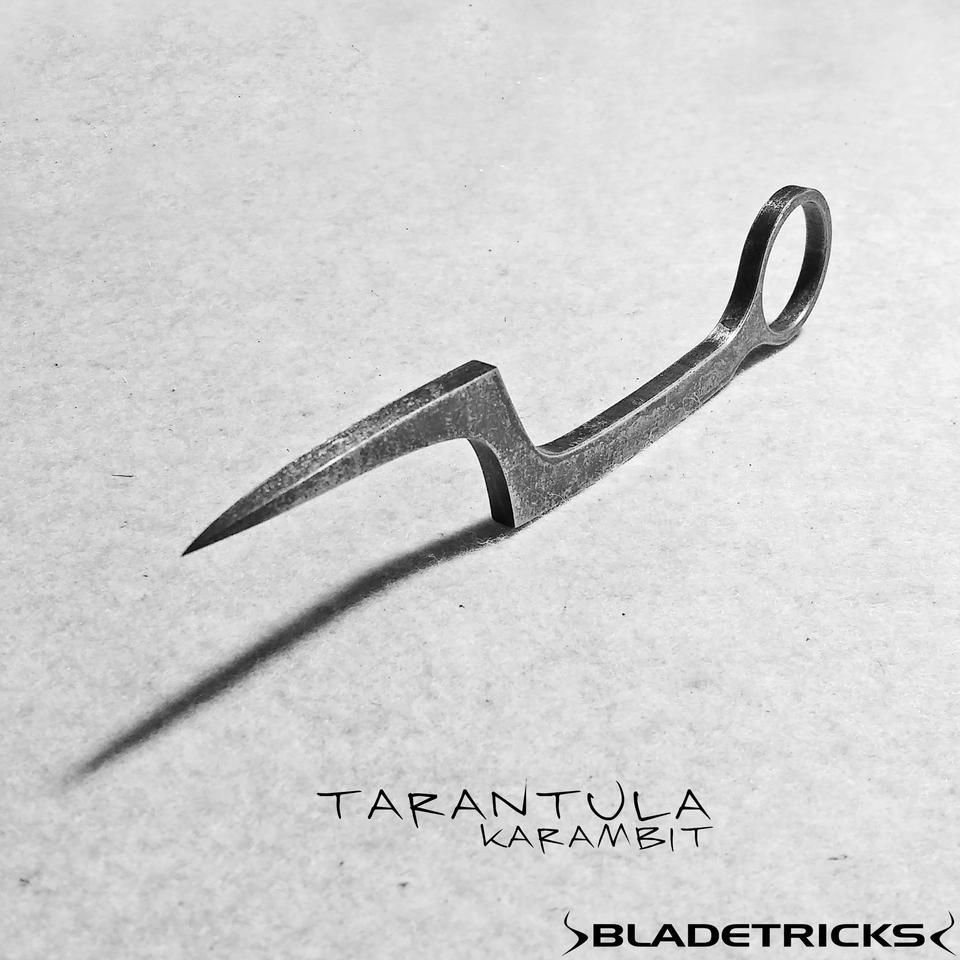
Width matters more than it gets credit for. A wider handle tells you where the edge is. You are more aware of its orientation and you have more control over it, without having to look or think. That is why the most recent Nosaf Raal Knife uses a modified Kadesh Dagger handle, widened. It also works the other way: my models with very narrow handles end up being treated, and named, as icepicks — the Tarantula karambit among them — because a narrow handle stops telling you where the edge is pointing.
The Rascal. A wide flat handle derived from the Kadesh — the width is what tells the hand where the cutting edge is pointing.
Blade length
Generally no more than 100mm, and that is already long for a pikal knife. There is no real floor. I can picture a perfectly good pikal knife with a 30mm blade.
What it is good at, and what it is not
Where it works. Confined space and contact distance. Situations where the arm is already partially controlled. Retention under grappling pressure, with the blade close to the body rather than out where it can be stripped. And concealment: the tool is usually shorter, it rides point-down, and once it is in the hand it disappears along the forearm.
Where it does not. Reach is the real cost — you give up distance, and against someone with room and a longer blade that matters. You also give up the fluidity of the sabre grip. Everyday utility, since almost nothing about the orientation helps you open a box, although the recent belly-profile models go some way toward solving that; the Tusk is the clearest example. And the learning curve, because the movements do not come naturally to most people and half-learned pikal is worse than competent edge out.
There is also the legal question. In my experience the formats that suit this work best — ringed handles, double edges — meet more restriction in more places than a plain single-edged utility knife does, which is part of why the Nosaf Raal exists in a ringless knife version. That is a practical observation from selling internationally, not legal advice. Check your own jurisdiction.
Anyone telling you it has no drawbacks is selling something.
Related formats
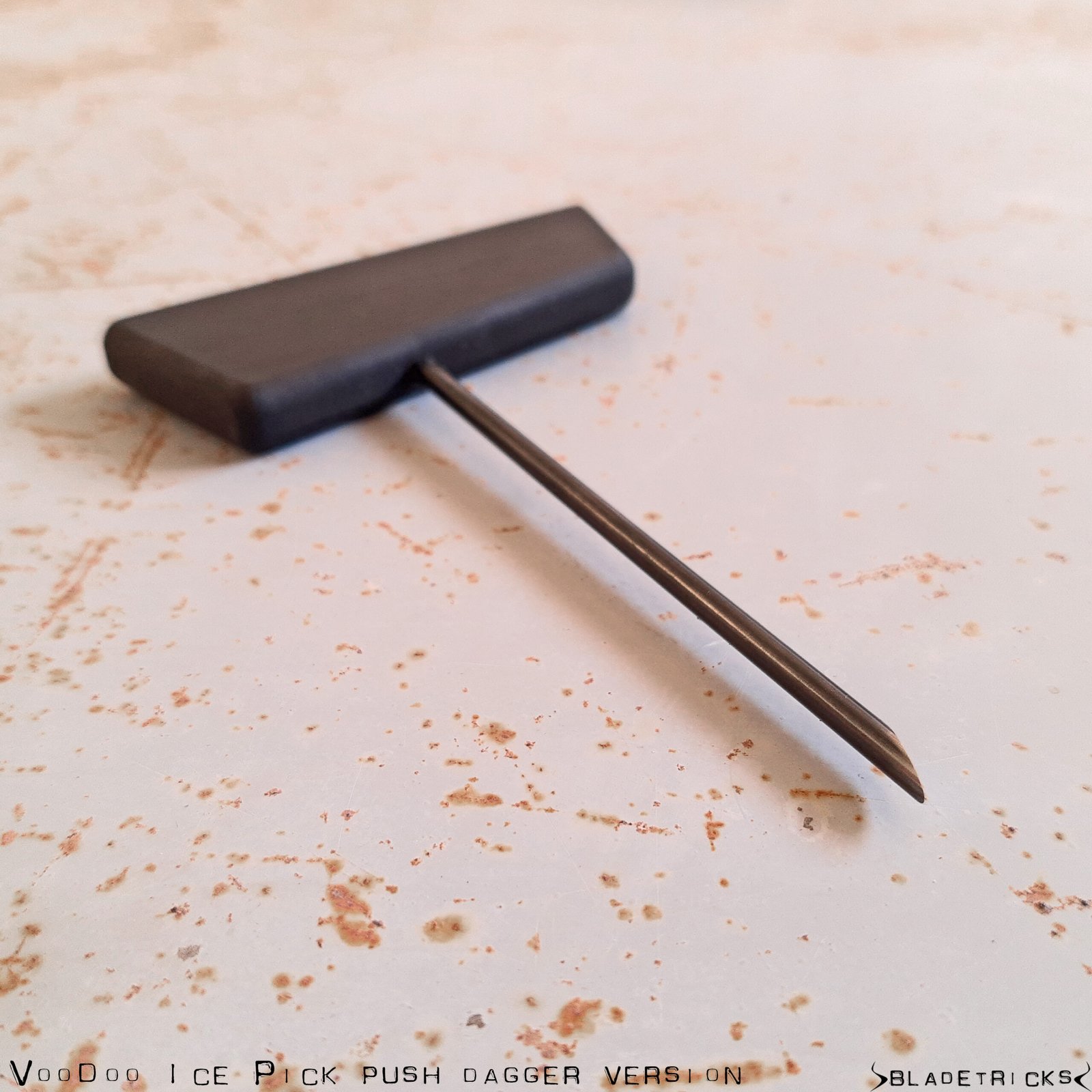
The icepick. Worth being precise here, because four things get treated as one and they are not. A point penetrates. An edge cuts. An icepick has the first and not the second. A knife has both.
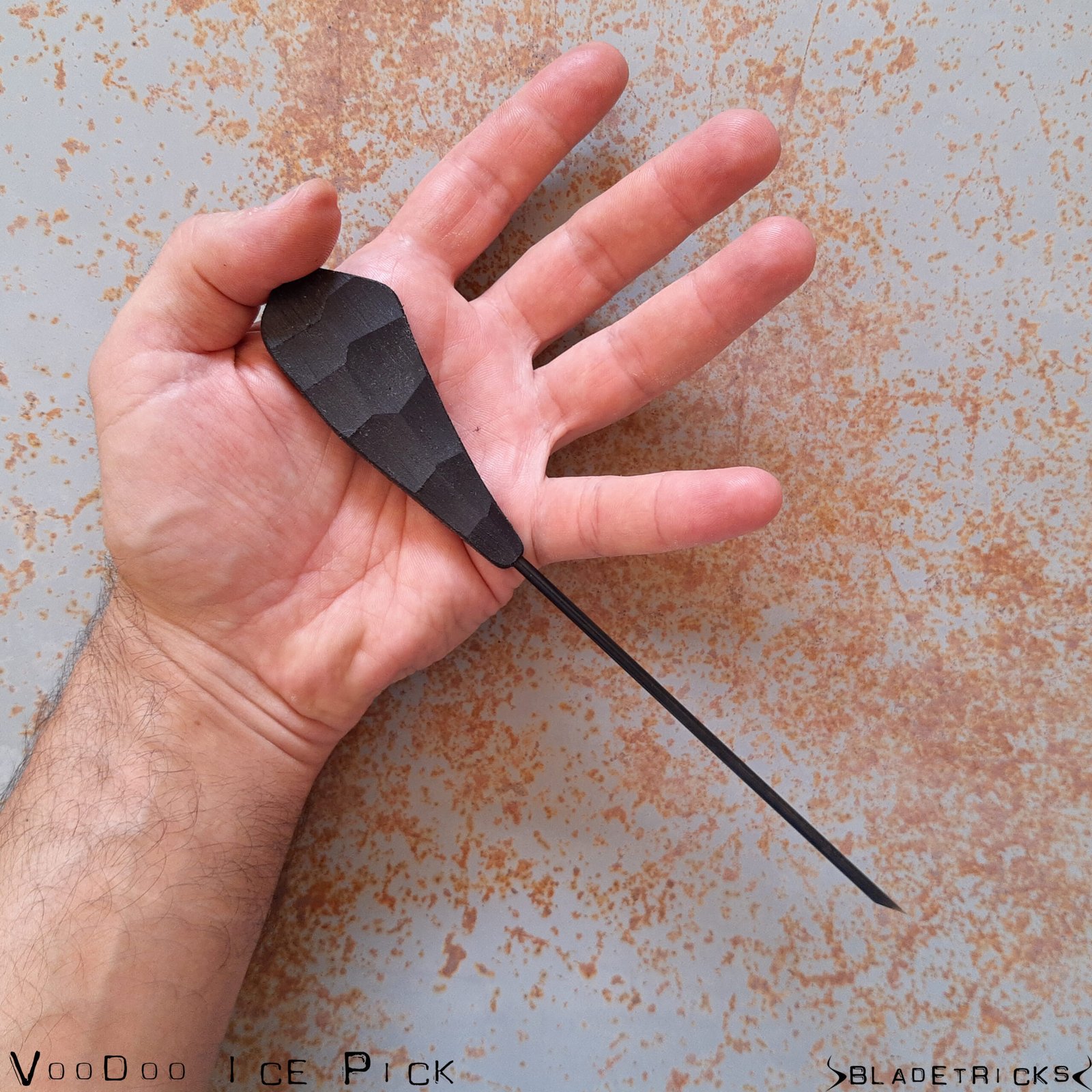
That distinction settles a question people argue about: strictly speaking an icepick cannot be pikal, because pikal is a statement about which way the edge faces and an icepick has no edge to face anywhere. What it has is the reverse-grip mechanics — the same closing arm, the same axial line through the forearm — without asking the user to get edge alignment right, which is why it predates every formalised system built on this orientation and why it still works for people who have trained none of them.
What does not change is the handle. Pinky retention and a thumb rest matter just as much on an icepick as on a knife, and arguably more, because everything depends on the tool not moving.
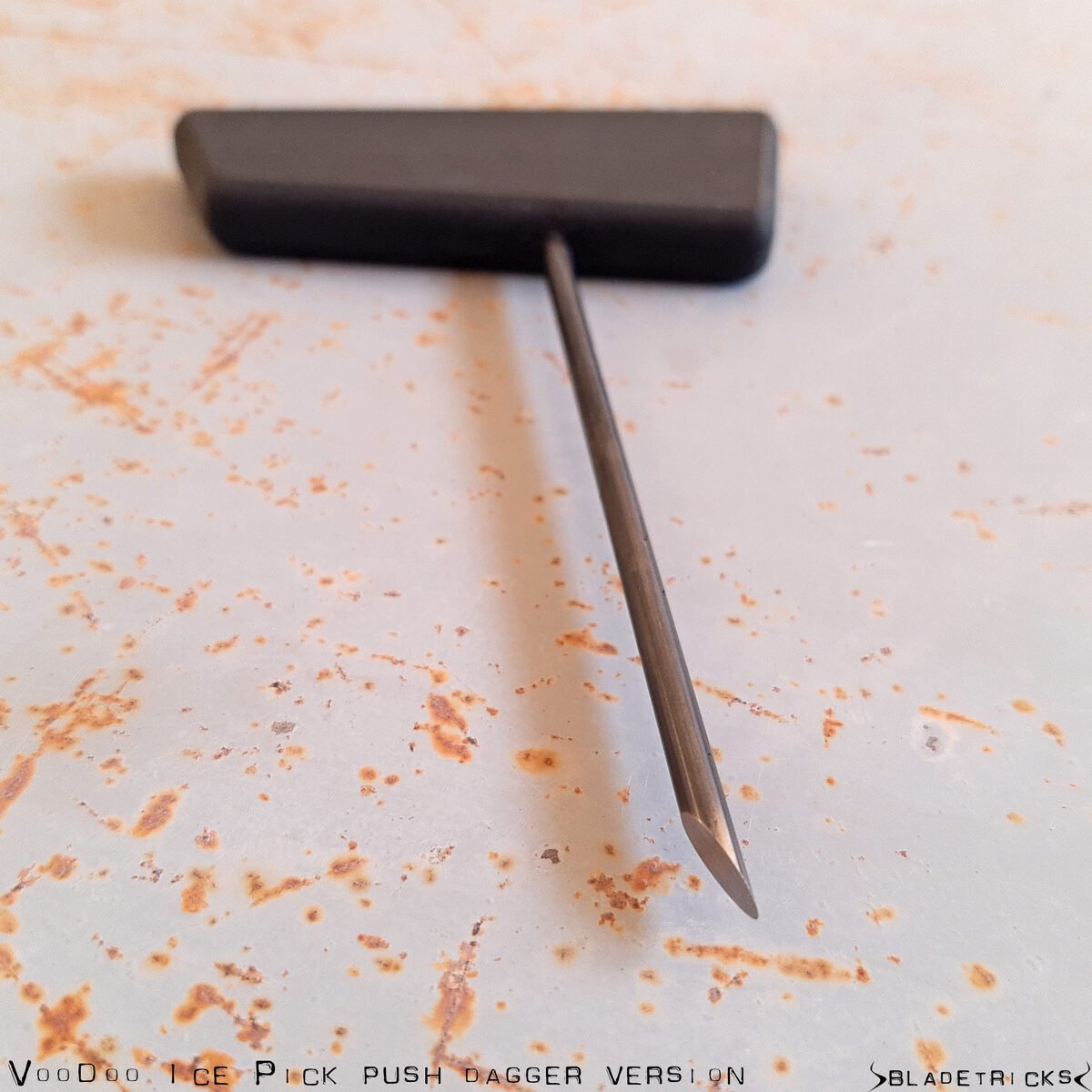
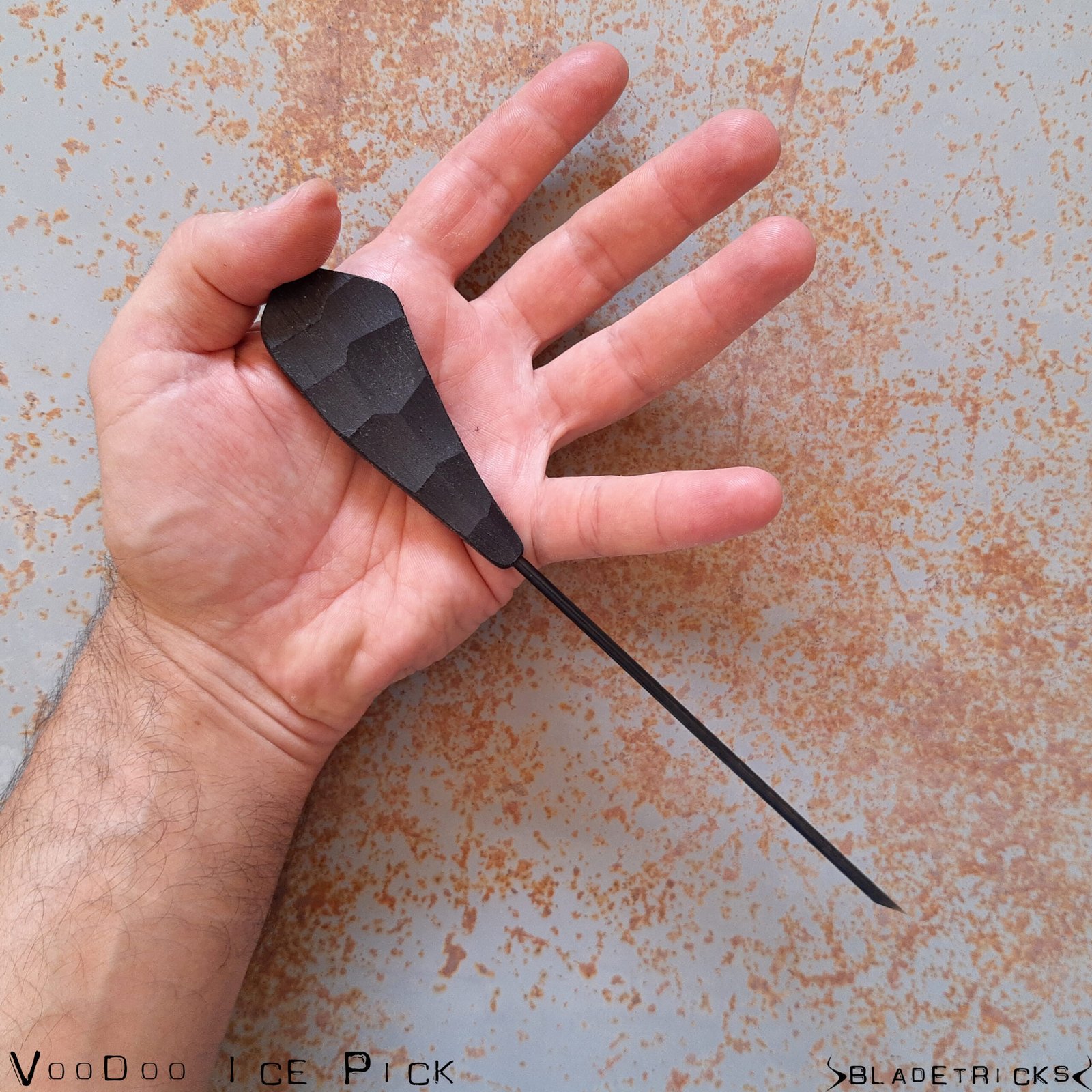
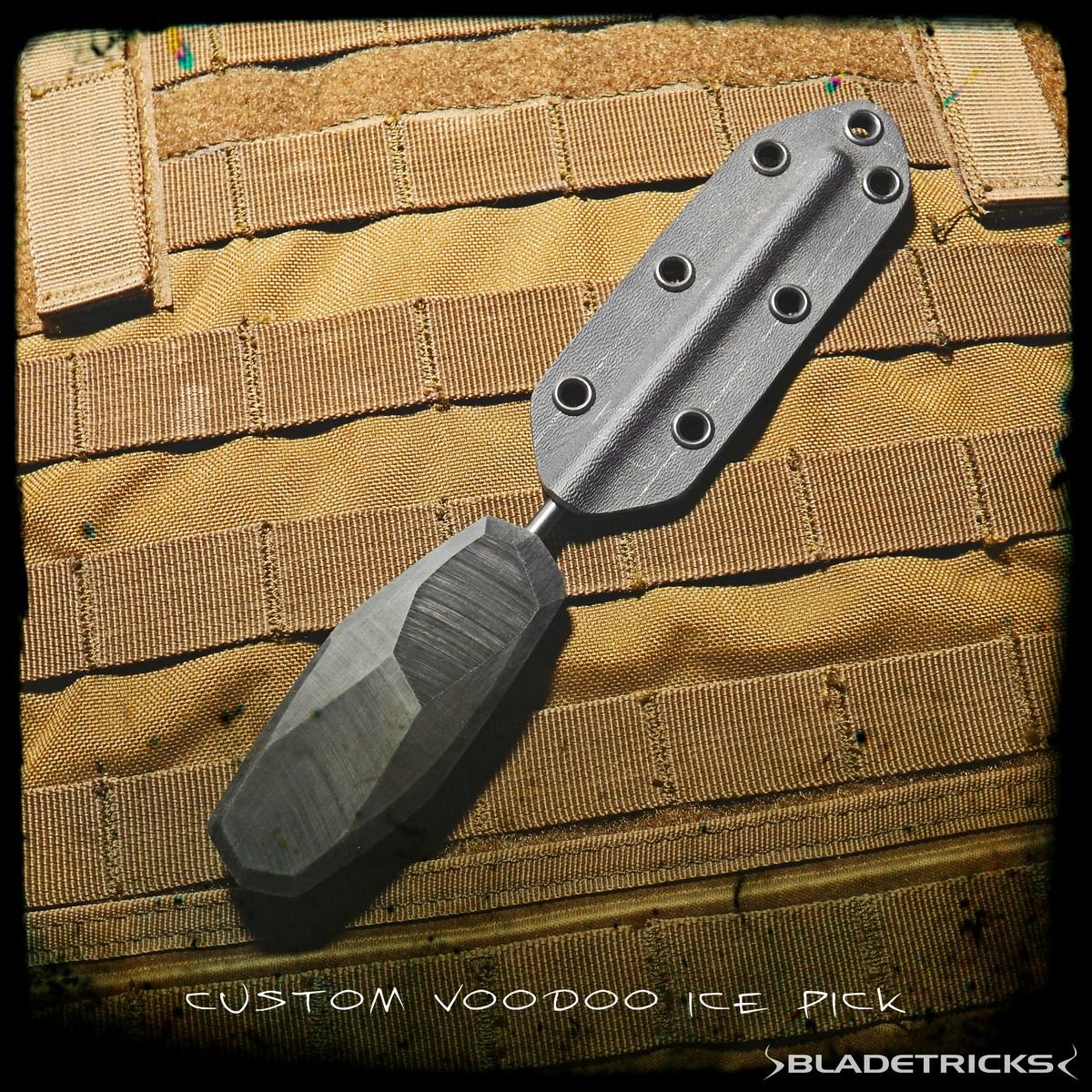
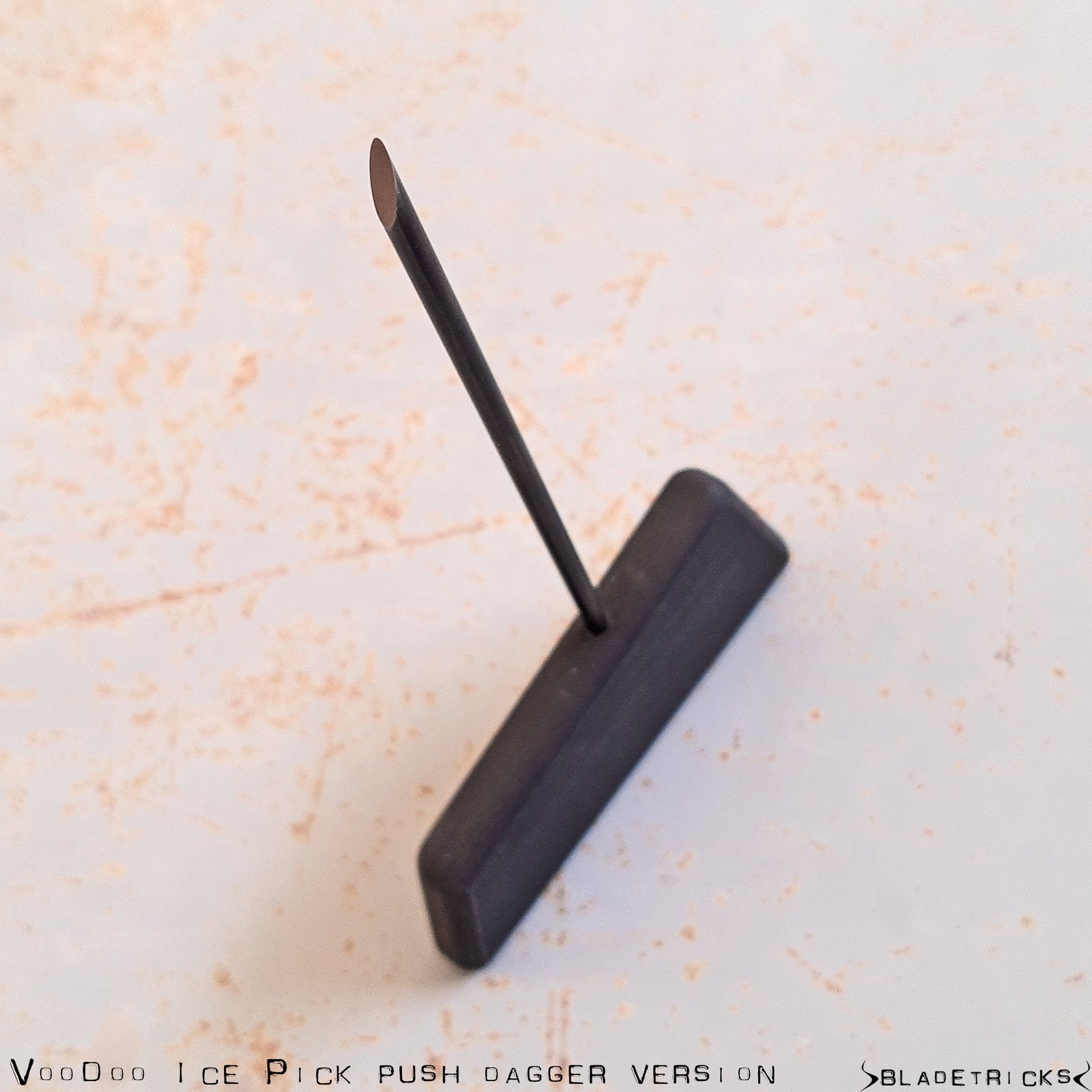
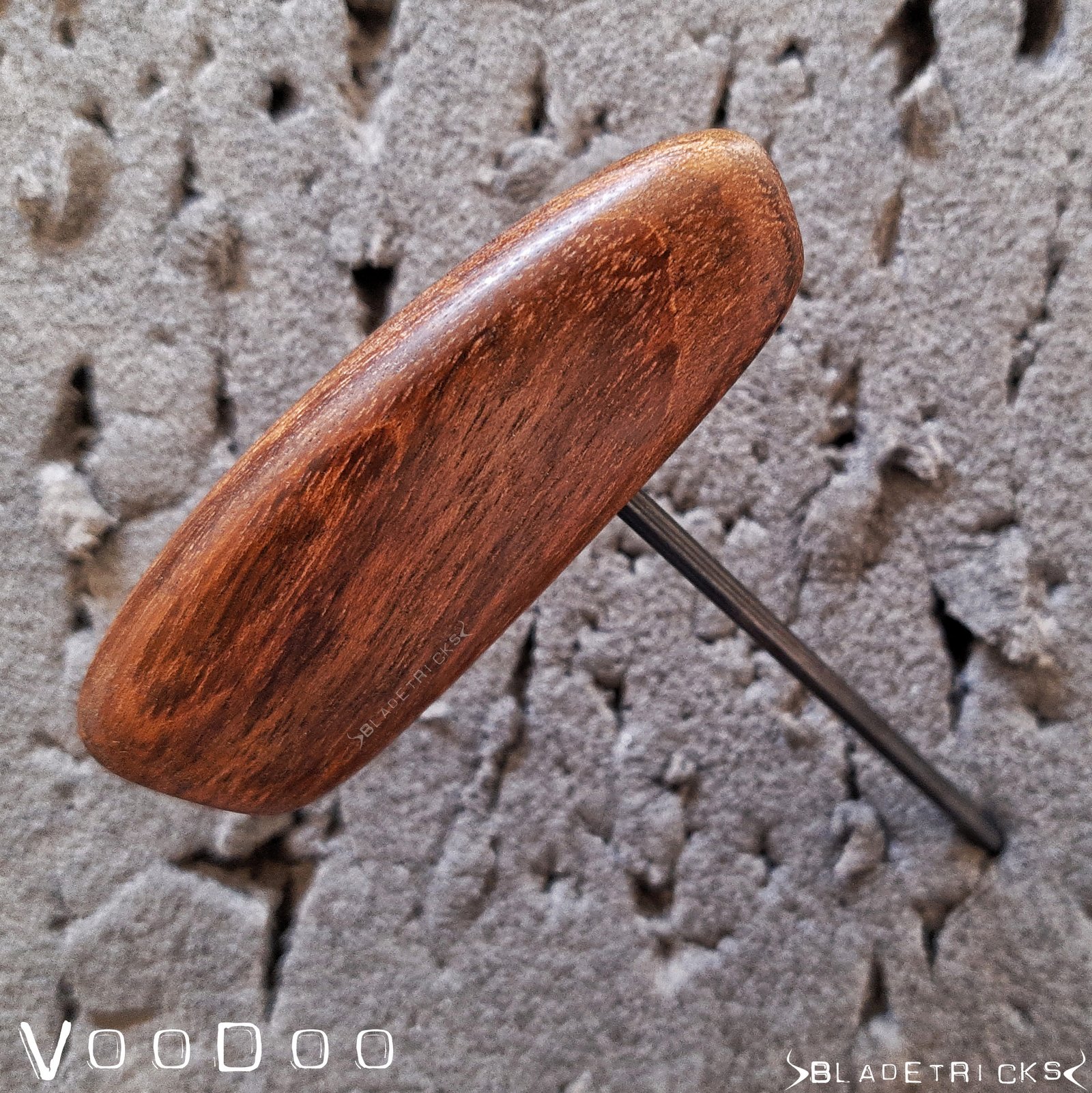
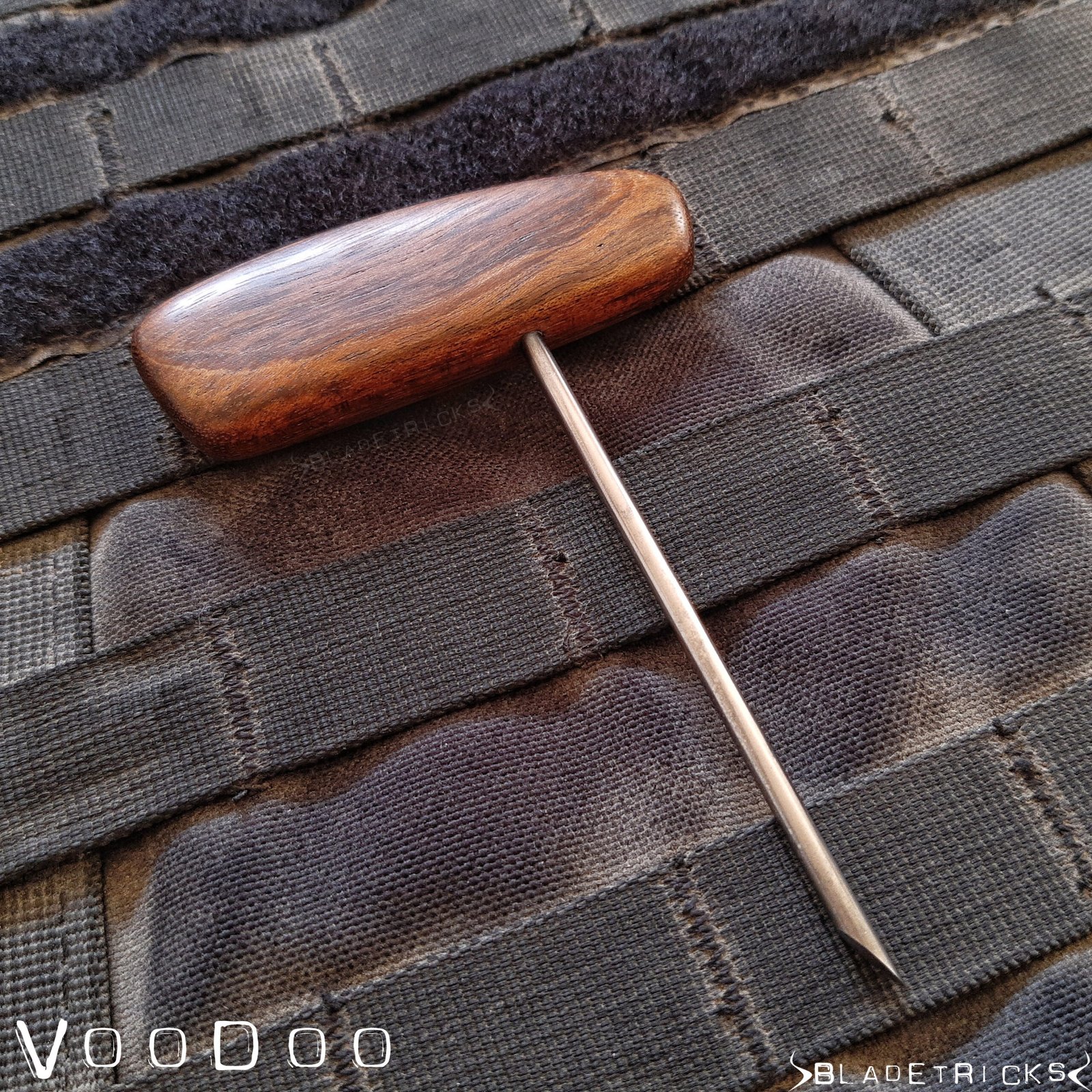
The Voodoo. A point and no edge — which is why, strictly, an icepick is not pikal. The handle still does the same job.
Ring and hooked handles — karambit-derived formats — appear often here because a ring solves retention directly rather than through grip strength. The trade is that the ring also fixes your carry, your draw and your deployment.
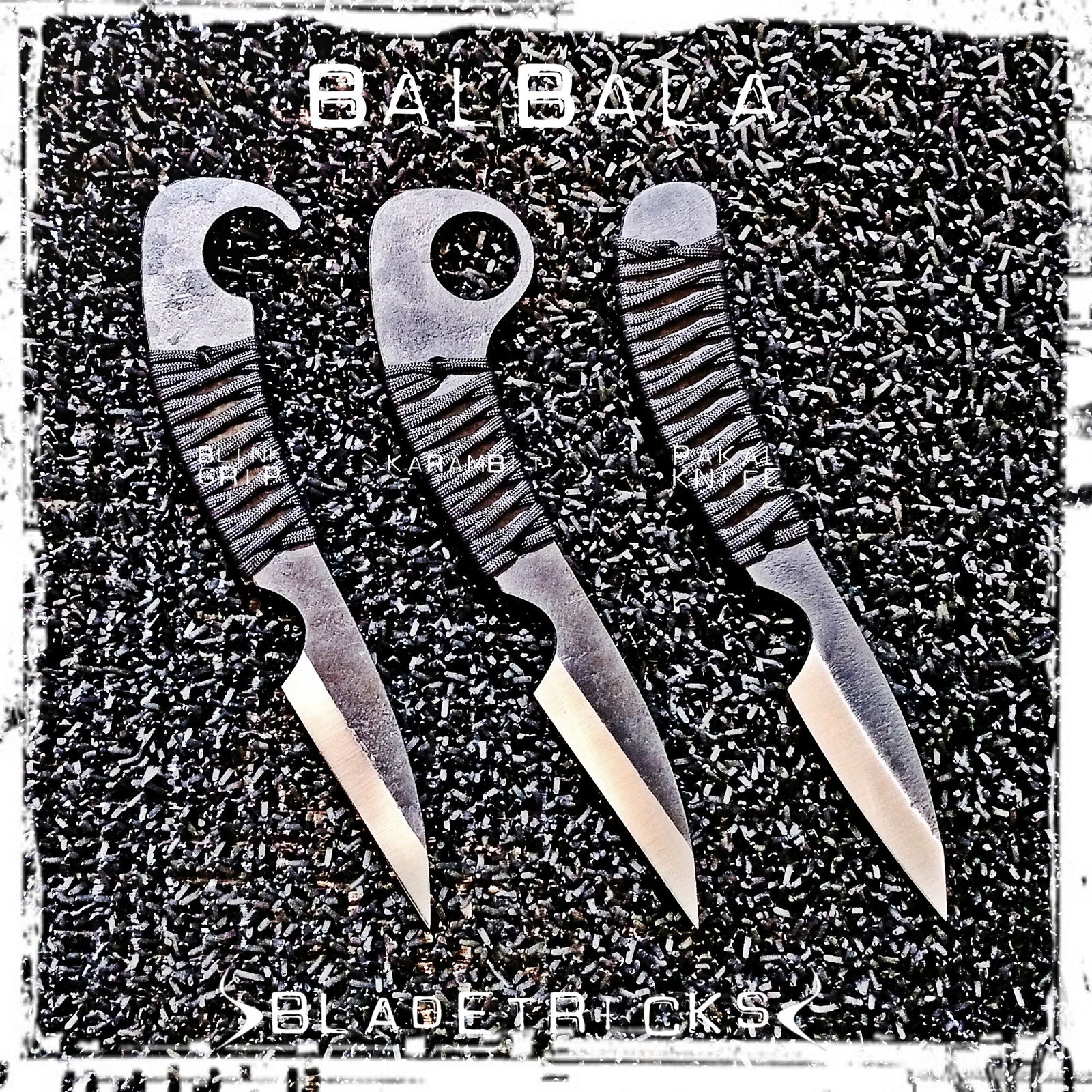
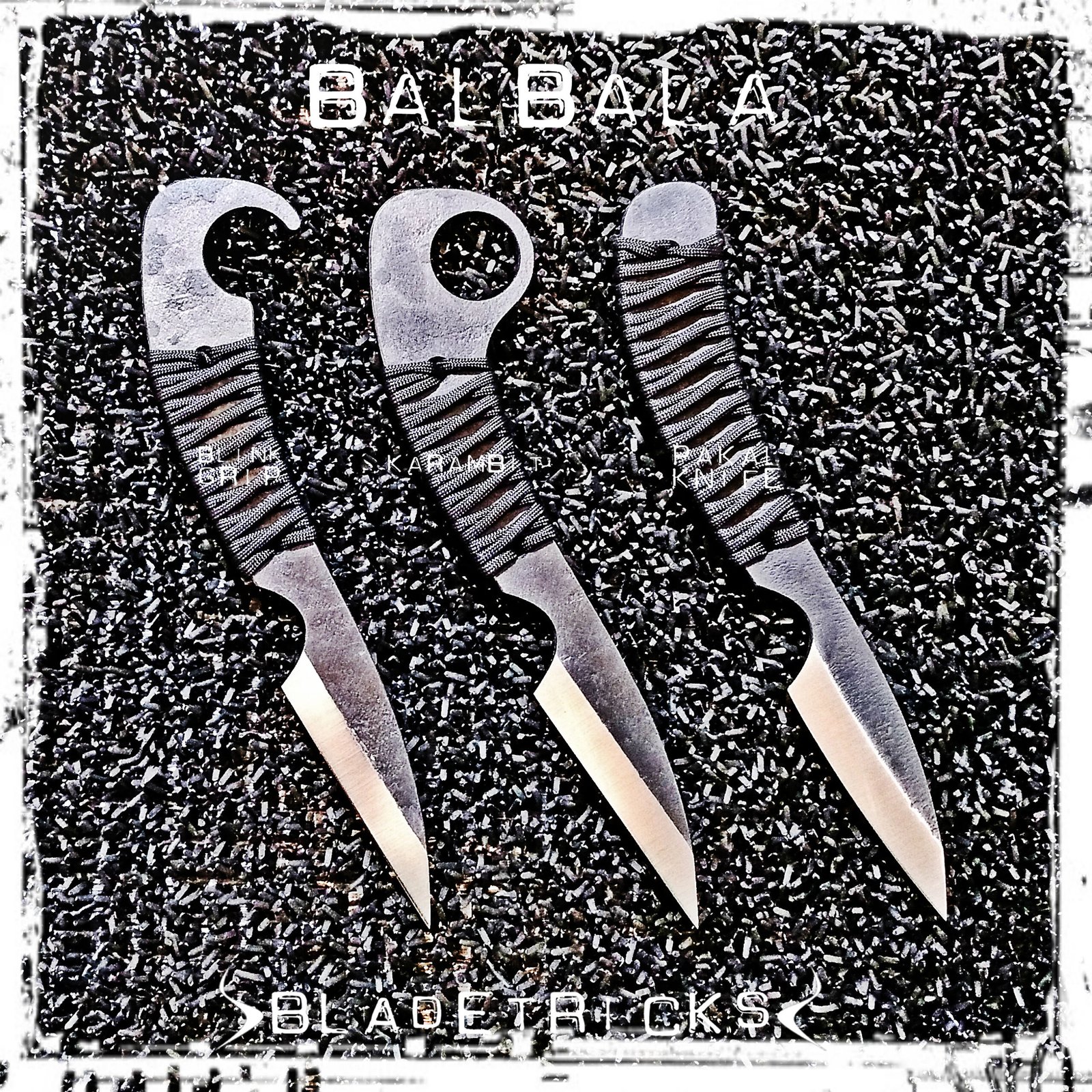
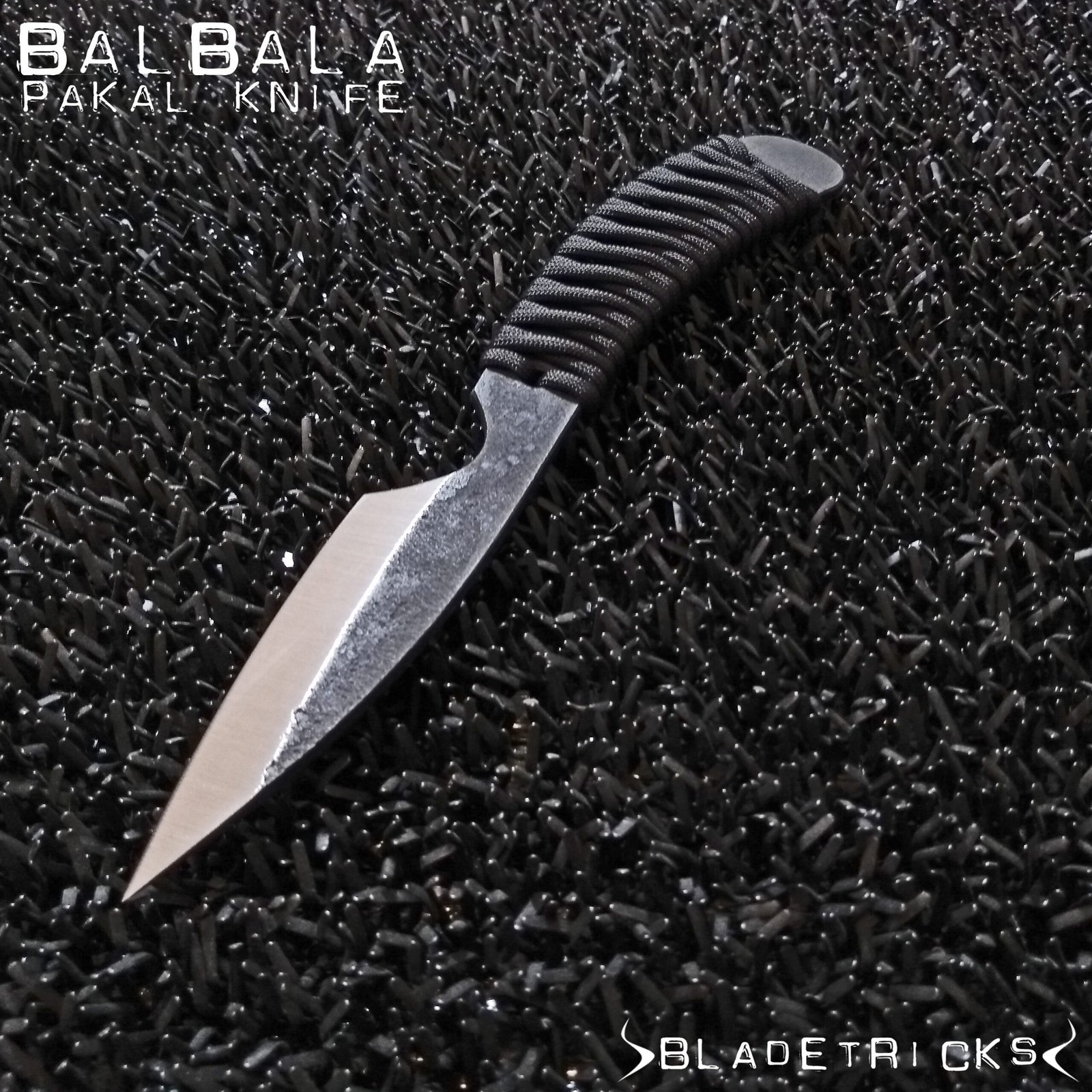
The Balbala. The same blade in three formats — Blink Grip hook, karambit ring, plain pakal handle. The geometry does not change. Only the retention does.
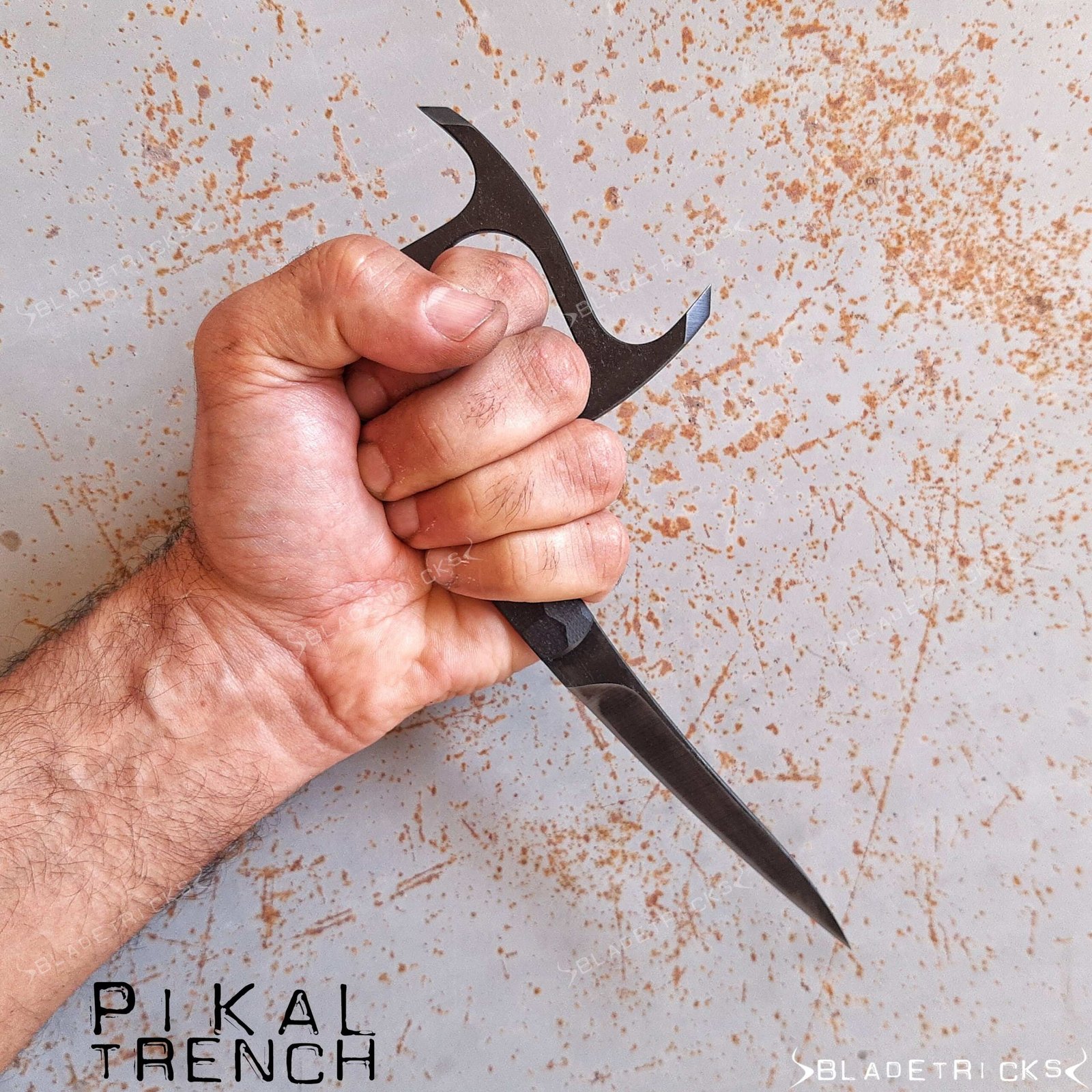
The ring can do more than hold. Small edges or spikes worked into or around it — as on the Baby Trench and the Pikal Trench — open up movement options in extreme situations. The main blade runs RGEI and the horns work as SGEI, which is the fourth combination from earlier appearing on the same tool as the second.
The Pikal Trench in the hand. The blade runs edge in below the fist; the horns point up above it. Two of the four combinations on one tool, in one grip.
Targeting
Edge in reaches roughly what your empty hand reaches. That is the most useful way to think about it: the near side of the opponent, the limbs, the space between two bodies — the same territory you would work with nothing in your hand at all.
Edge out reaches arm plus blade. That extra distance is the trade, and it is why the two orientations produce different habits in the people who train them.
The mechanical detail behind it sits in the biomechanics article, which goes considerably deeper than is useful here.
If you are just starting
Learn empty hand first. No matter what. This is not a formality. A great many people train knife work — and a fair number teach it — without a solid base in close-quarters work with nothing in the hand, and it is a serious mistake. The knife does not create the movement. It joins one that should already be there.
Then learn a sabre grip properly.
And only then pikal, whatever brought you to it — the confined-space problem, the simplicity, or the fact that it asks less of you when you have least to give.
If you are choosing a knife for it, the thing to check is not the blade shape. It is whether the handle stays put when you push, and then again when you pull.
I design and build these for a living, and I take on commissions and design work for people who need something specific. If that is you, get in touch.
Every penetrating tool ends in a decision. Most of the time that decision is inherited rather than made.
The conical point is what the icepick came with. It arrived from the ice trade already finished, and the men who later found other uses for it were not in a position to be fussy about tip geometry. They wanted something that worked and something that could be explained away if found. The cone did both. What went unasked, for the better part of a century, was whether it was the right shape.
Two things made that question easy to avoid. The cone has structural advantages that invite no complaint: its geometry distributes mass evenly around the axis in the manner of a convex grind — the strongest blade geometry — which makes it resistant to lateral force and difficult to chip or deform under off-axis load. And it is the natural product of a lathe. Taper a round bar, refine the taper, polish. The icepick point was always going to be a cone because that is what a lathe produces without extra decisions. Ease of manufacture and structural robustness together are a strong argument for not asking questions.
I asked. The chisel tip was the answer, and it changed most of what I make.
The Cone Everyone Inherited
A conical point is radially symmetric. It tapers to a single apex. Every cross-section along its length is a circle. That symmetry is the source of both its virtues and its limits — worth being precise about which is which.
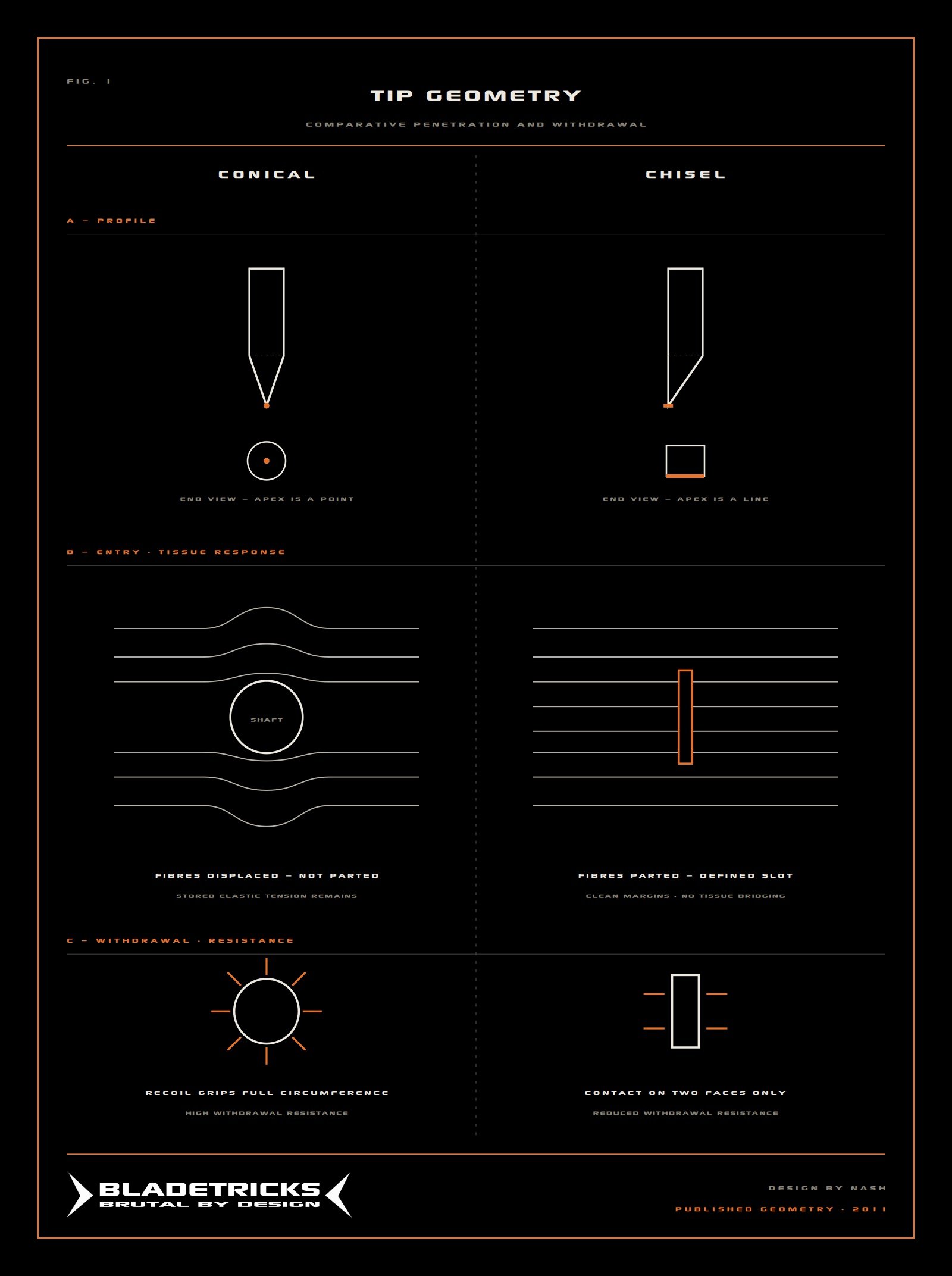
Mechanically, a cone penetrates by displacement. It forces material aside radially. In elastic tissue — skin, muscle, fascia — that material is pushed apart rather than parted. The fibres stretch around the advancing shaft. They do not separate. They move.
This matters more than it sounds. Elastic tissue does not stay where you put it. The moment forward pressure stops, it recoils. The displaced fibres close back against the shaft and grip it along its full inserted length. Entry is comparatively easy. Recovery is not.
Anyone who has driven a round punch into dense material and had to work it back out understands this without needing the vocabulary. The tool goes in cleanly. It comes back reluctantly. The reluctance scales with depth. The chisel tip addresses that last property directly.
What Changes When the Point Becomes a Plane
A chisel tip replaces the cone with two converging planes terminating in a straight leading line. The point is no longer a point in the geometric sense. It is a short line.
That line does something the cone cannot: it parts material along a defined axis instead of pushing it outward in every direction at once. The resulting opening is not a round hole stretched into existence. It is a slot.
Entry
At the moment of contact the chisel presents a much smaller initial bearing area than a cone of equivalent diameter — a line rather than a growing circle. Penetration begins at that line and only afterwards becomes a wedging action along the converging planes. In practice this means the tip finds purchase on hard or angled surfaces where a cone would skate.
Extraction
This is where the difference stops being academic.
Because the chisel has parted material rather than displaced it, the tissue surrounding the shaft has been structurally separated. It does not recoil into contact with the same force, because there is less stored elastic tension holding it there. The opening is a slot with parted margins rather than a stretched aperture straining to close.
Extraction resistance drops accordingly. The tool comes back the way it went in.
I want to be careful about the strength of that claim. I am not offering a measured coefficient. What I am offering is the consistent result of making both geometries for fifteen years and listening to people who have used them in conditions I would not choose. The pattern does not vary.
An Additional Capability
There is a secondary behaviour that emerges from the geometry rather than being designed into it. A chisel tip, presented at the correct angle, can scrape and define rather than simply penetrate — in the same way that a wood chisel used laterally in a mortise pares and cleans the surface rather than splitting the grain. This is not the primary purpose of any tool I build. But it is a consequence of having a geometry that produces a defined plane rather than a displaced hole, and it is worth noting as part of what the form makes possible.
Penetration Is Not Cutting
Here is the part that most discussions of this subject get wrong before they begin, and it is worth stating plainly because everything else depends on it.
I do not sharpen these tools. They do not cut. They are not intended to.
On the pry tools I leave between 0.5 and 1 mm of thickness at the tip. That is not a compromise, it is a requirement: the tool has to work as a lever and a driver, and any sharpened apex would roll or chip the first time it took a lateral load. It is measurably blunt, and anyone with a caliper can confirm it.
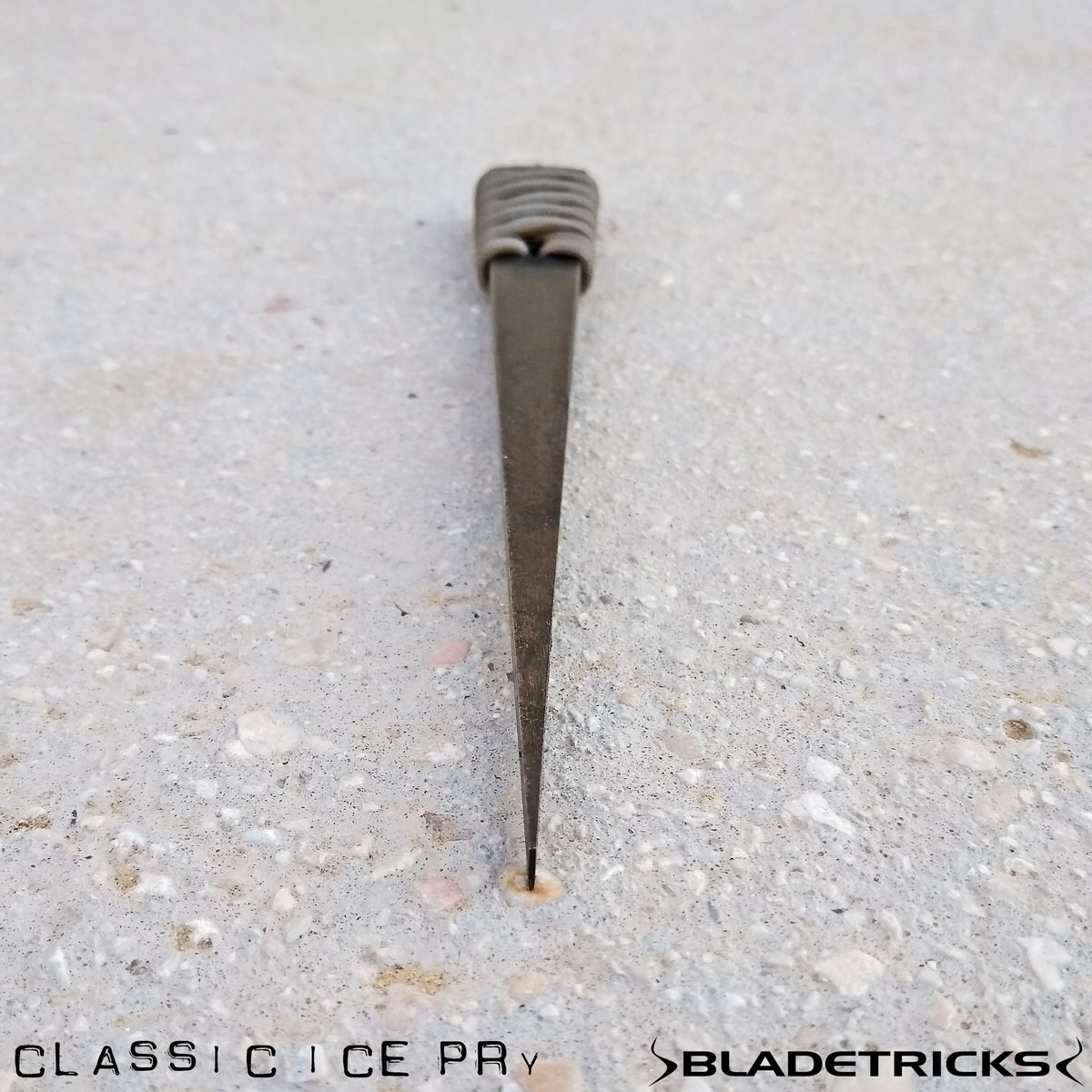
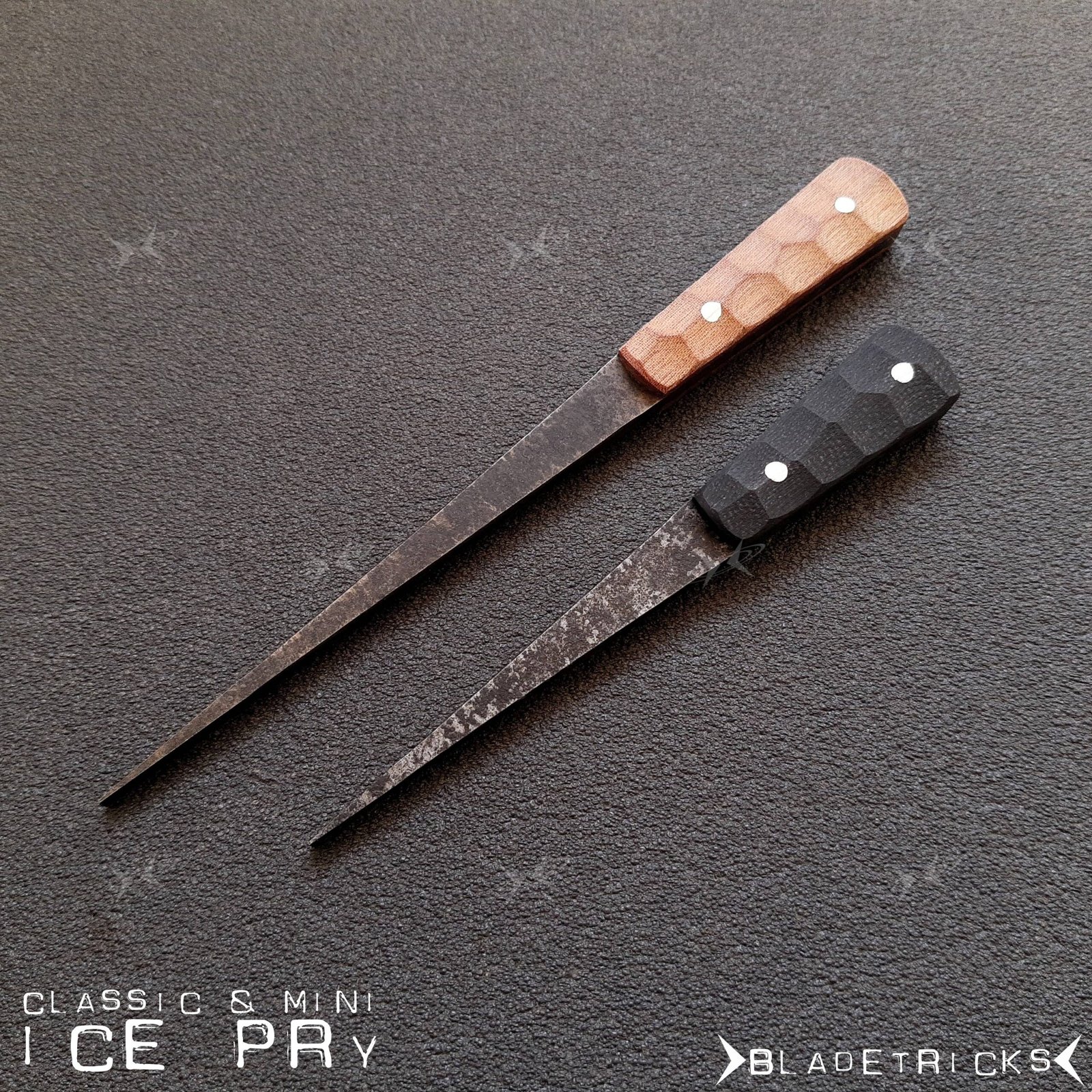
Classic Ice Pry: deliberately blunt at the tip to function as lever and driver without rolling under load.
On the spikes and the karambits the two chisel planes converge to a line, and on a cylindrical spike it is the intersection of the shaft with the angled cut. I take that convergence as far as it goes and then polish it. I do not hone it. I make no claim that it cuts paper, and I would not make that claim even if it sometimes did, because it would be difficult to demonstrate consistently at fine sections and I am not willing to tell a buyer something I cannot stand behind.
What does the work is not sharpness. It is a convergence that is well defined and well polished, combined with the force a reverse or hammer grip permits you to put behind it.
That distinction is the whole argument. Penetrating and cutting are different mechanical operations. Cutting severs material laterally along an edge. Penetration parts it ahead of an advancing point. A tool can be excellent at the second while being incapable of the first, and designing for the second frees you from every constraint the first imposes — maintenance, fragility, and a good deal of law.
So the range divides into two grinds doing two jobs. The pry tools are blunt by requirement. The spikes carry a polished convergence with no sharpened apex. Neither claims to cut, and neither needs to.
What the Forensic Record Shows
There is independent documentation of this, and it comes from people with no interest in my conclusions.
Forensic pathology has a small but real literature on injuries produced by screwdrivers — a blunt, unsharpened, converged implement, which is to say the closest mass-produced analogue to what I make. Roger Byard’s Patterned injuries from screwdrivers, published in Forensic Science, Medicine and Pathology in 2022, sits alongside Croft’s earlier study in the Journal of Forensic Sciences and more recent work by Reyes Albaladejo in the same journal.
Two findings matter here.
The first is that tip geometry is legible after the fact. A cruciform driver leaves a cruciate pattern reproducing its own cross-section, consistently at around five millimetres square. A flat driver leaves something entirely different. The geometry of the tip is recorded so faithfully that a pathologist can work backwards from the pattern to the shape of the implement.
I have a personal observation that confirms this from the making side. Ice Pry models finished with a minimal secondary bevel at the convergence — what I call a microfilo — leave a distinctive H-shaped footprint in cardboard and EVA foam. The vertical bar of the H is the slot the leading line parts; the horizontal bars are the impression of the two faces as the tool advances. The geometry writes itself into the material. The cross-section of the tool is readable in what it leaves behind, which is exactly what Byard’s literature describes from the other end of the process.
I know of no stronger way to state the thesis of this article. Tip geometry is not a styling decision that slightly modifies performance. It is the determining variable, and it is determinative enough to be read off afterwards by someone who was not there.
The second finding is the one that speaks directly to what I build. A flat, slotted tip produces roughly rectangular openings with no tissue bridging, with margins subtly split, classified in that literature as a hybrid of sharp and blunt force.
Tissue bridging is the signature of blunt tearing — the strands that survive when material is ripped rather than parted. Its absence means the material separated cleanly. And it separated cleanly under a tool with no sharpened edge whatsoever.
That is the mechanism I described above, documented by people studying something else entirely. A defined, converged, polished line parts material without needing to cut it.
A separate observation — which I offer as working hypothesis rather than established mechanism — concerns the edges I leave near the tip. I finish them without chamfer, at ninety degrees, so they continue separating material as the tool advances beyond the leading line. My interpretation is that this produces a wound character distinct from a clean incision: the slot is defined, but the margins are worked rather than merely parted. Whether this translates into any practical difference in effect is not something I can demonstrate in a laboratory. I note it because it is part of how I build, and because the forensic literature’s hybrid classification — neither purely sharp nor purely blunt — suggests the mechanism is real, even if its consequences are not fully mapped.
The honest caveat: a hardware screwdriver is not one of my tools. Different steel, different finish, different section, no attention paid to the convergence at all. The analogy is close — far closer than the surgical-needle literature people usually reach for — but it remains an analogy, and I will not pretend it is a test of my work.
Byard also notes, in passing, that screwdrivers are surprisingly rarely used in fatal assaults. The literature exists because the cases are unusual enough to be worth writing up. I mention it because I would rather give you the inconvenient half of a source than have you find it yourself.
There is a second, institutional leg to this. The United States National Institute of Justice publishes Standard-0115.00, governing the stab resistance of personal body armor. It does not treat penetrating threats as one category. It separates edged blade threats from spike threats and tests them under distinct protocols, because a point and an edge defeat protective material by different mechanisms, and armor that stops one does not necessarily stop the other.
An institution charged with keeping people alive reached the same conclusion I did, from the opposite direction. Point and edge are not variations on a theme. They are different problems.
The Argument Nobody Makes
Everything above concerns behaviour at the moment of use, which is the part people enjoy discussing. The advantage that actually determines whether a tool is still worth carrying in a decade is duller than that.
A conical point cannot be restored by hand in any meaningful sense. To bring it back you must remove material evenly around a full circumference while maintaining concentricity and a consistent included angle. That is a task for a fixture and a patient operator. In the field it is not a task at all. What happens instead is that the point degrades — dropped on concrete, corroded, worked against something harder than it — and stays degraded, because restoring it properly is beyond what the owner can do and beneath what they will pay someone else to do.
A converging flat is one plane. Any flat stone brings it back. So does the unglazed base of a ceramic mug, which is what most people actually have to hand. Restoring it requires no fixture, no skill beyond holding a consistent angle, and no decision more complex than which way up to hold the tool. Note what this is not: it is not sharpening. It is returning a polished convergence to its intended shape.
The converged flat tip can be restored on any flat stone. No skill beyond a consistent angle.
A tool that can be maintained is a tool that is still a tool in twenty years. A tool that cannot is an object that used to work. The geometry that makes the difference is not the one that performs best on the first day. It is the one that can be brought back on the four thousandth.
Where the Cone Still Wins
If this reads as though the chisel is simply better, I have written it badly. There are three conditions under which I would still choose a cone.
The cone requires no indexing. It is symmetric, so it behaves identically regardless of how it is held. A converged flat has an orientation, and orientation is one more thing to get right at a moment when fine motor control has already left the building. For a user with no training base and no intention of acquiring one, that symmetry is worth more than any extraction advantage. It is also why several of my designs address indexing directly rather than working around it — the blind-index geometry behind the Blink Grip exists because orientation seemed to me the wrong thing to leave to chance.
That said, this advantage deserves qualification. At the shaft diameters I work with — typically three to ten millimetres in the Voodoo range — the geometric offset between the tool’s centreline and the leading line of a chisel tip is small enough to be practically irrelevant. Under stress, when fine motor control has already degraded, the additional orientation required is a fraction of the variation already present in the grip. I made the same observation when writing about chisel grinds in tactical knives. The indexing advantage of the cone is real at the drawing board. Whether it survives contact with the conditions it is supposed to address is a different question.
The cone resists lateral load equally from all directions. Material is distributed evenly around the axis, so a bending force from any angle meets the same resistance. A converged flat is asymmetric and has a strong plane and a weak one. Against unpredictable off-axis loading, the cone is the more forgiving structure.
And against genuinely hard barriers, the mass sitting immediately behind a conical apex resists deformation better than the thinner section behind a converged line. If the anticipated use involves striking bone or rigid material at unfavourable angles, that difference is not theoretical — it is exactly why the pry tools keep their half millimetre.
The chisel is the better geometry for most of what I design. It is not the better geometry in every case, and I have never claimed otherwise.
A Note on Priority
On 3 October 2011 I published a tool called the Ice Pry, described then in my own words as a lever, a wedge, a screwdriver or a punch. Posts that followed extended that description to include dagger and push dagger — which is exactly how I had conceived the tool’s potential from the start, and how I was already using it. That record remains online and remains dated. It is the first public appearance of a flat converged tip applied to a tool built to penetrate, and it is the origin of a geometry that now runs through the Voodoo series, the Ice Pry family, the Compact Pry Knife, the Goliath Tarantula and the Micro Edge line.
I want to state the claim narrowly, because narrow claims are the only kind worth making.
I did not invent the chisel point. It is older than any of us, and claiming it would be both unprovable and untrue. What I am stating is that its application to dedicated penetrating tools appears in my published, dated work from 2011, and that I was making them before I began publishing.
The geometry has become more common since. I take that as confirmation rather than as grievance — a design nobody copies is usually a design nobody needed.
What travels is the shape. The reasoning stays here.
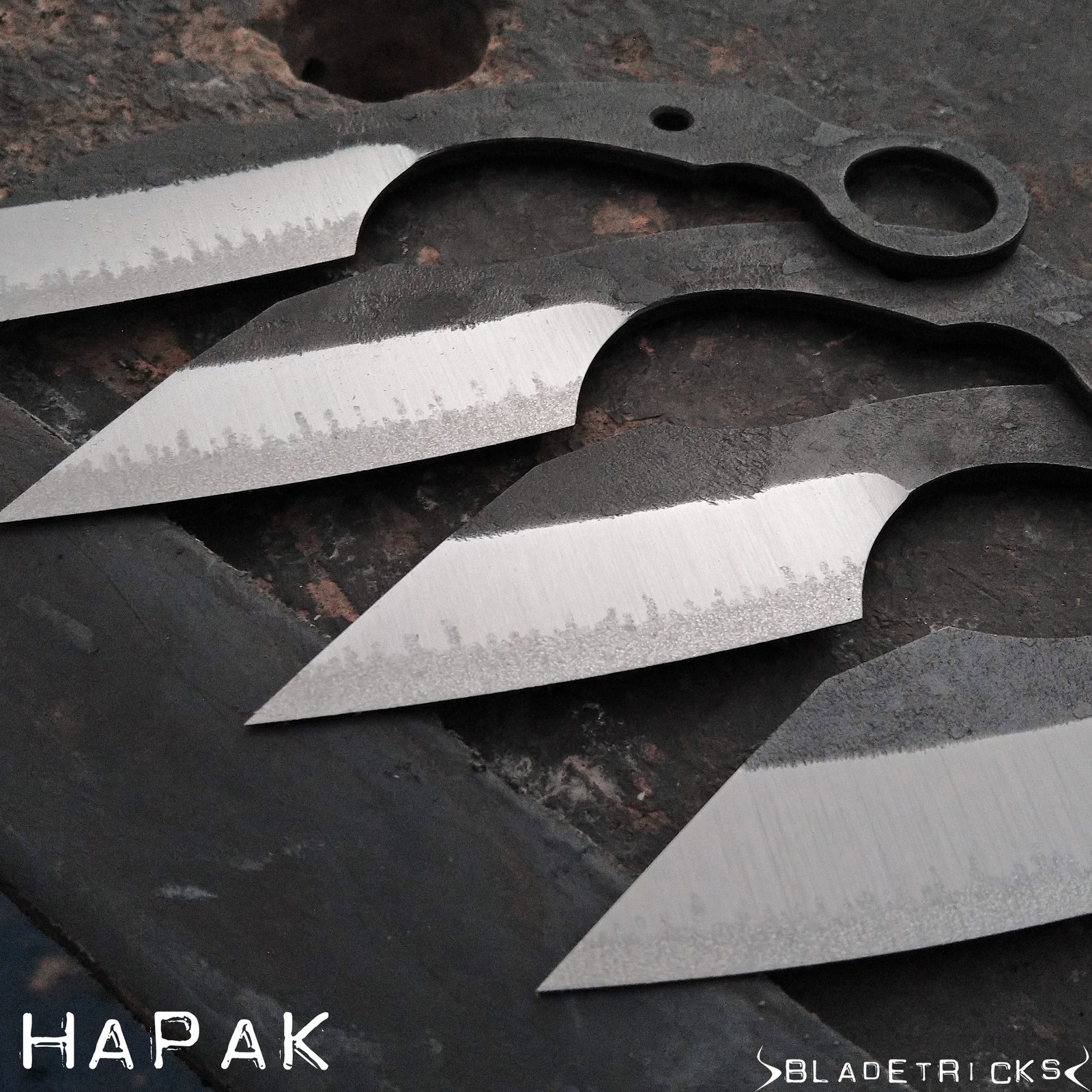
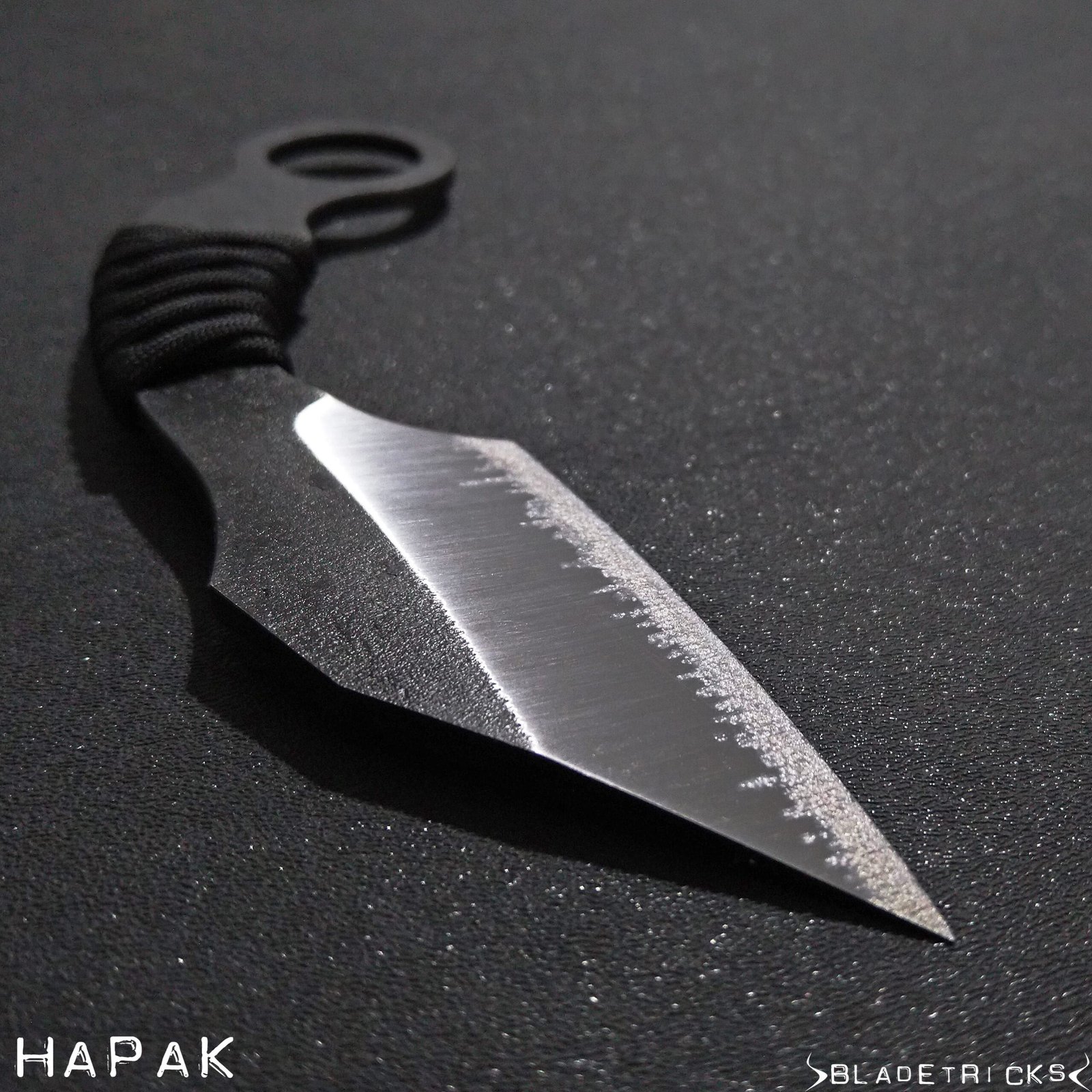
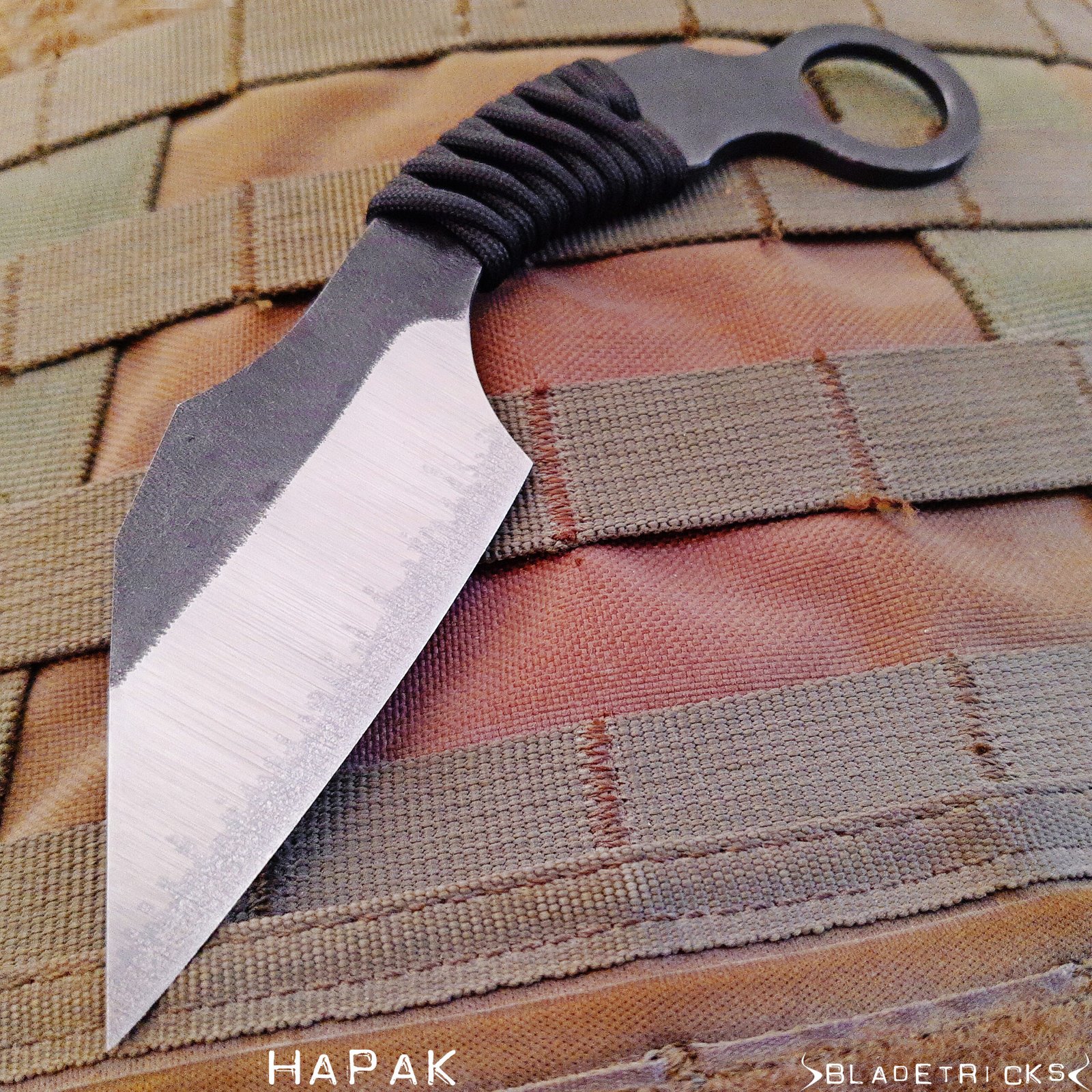
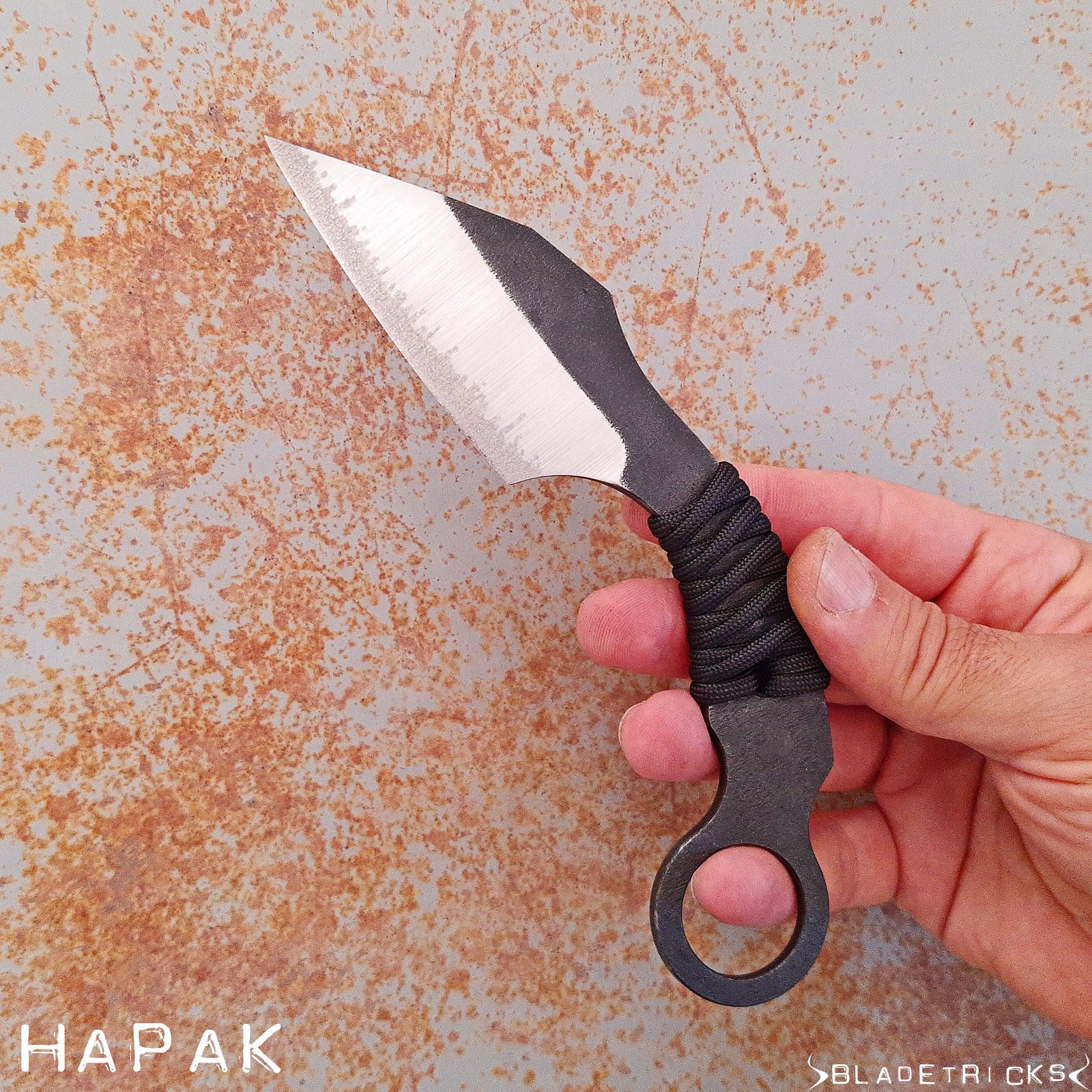
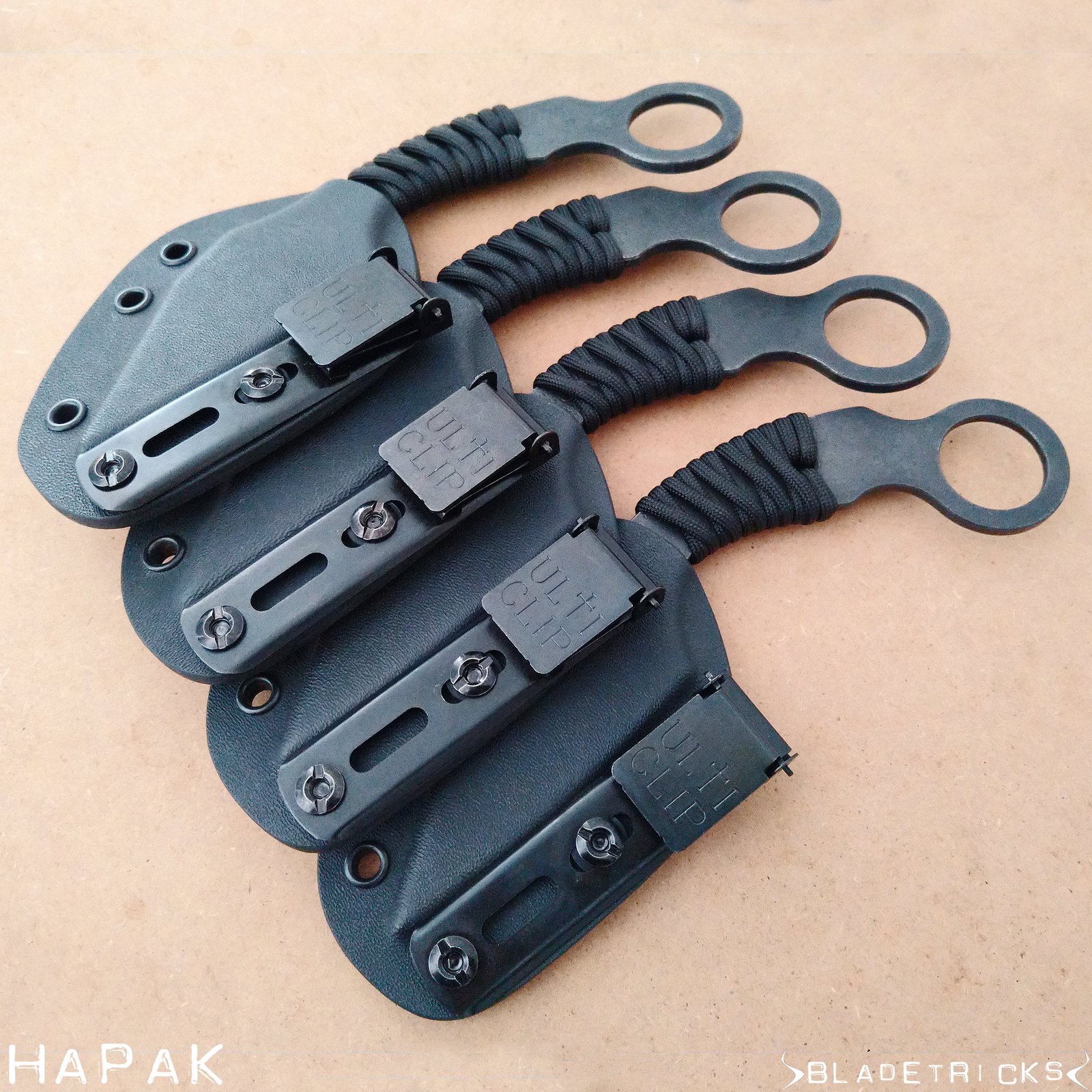
Some projects arrive with a specific brief. This one came from the HAPAK — the Home Front Command Squad — with a clear requirement: a simple, lightweight, hard-use field knife for daily carry. Reliable, tough, and purpose-built for the people using it.
The Geometry
A wharncliffe blade was the logical choice. Its flat spine, strong tip, and full belly make it one of the most capable utility profiles available — precise under controlled cuts, robust enough to handle hard use without complaint.
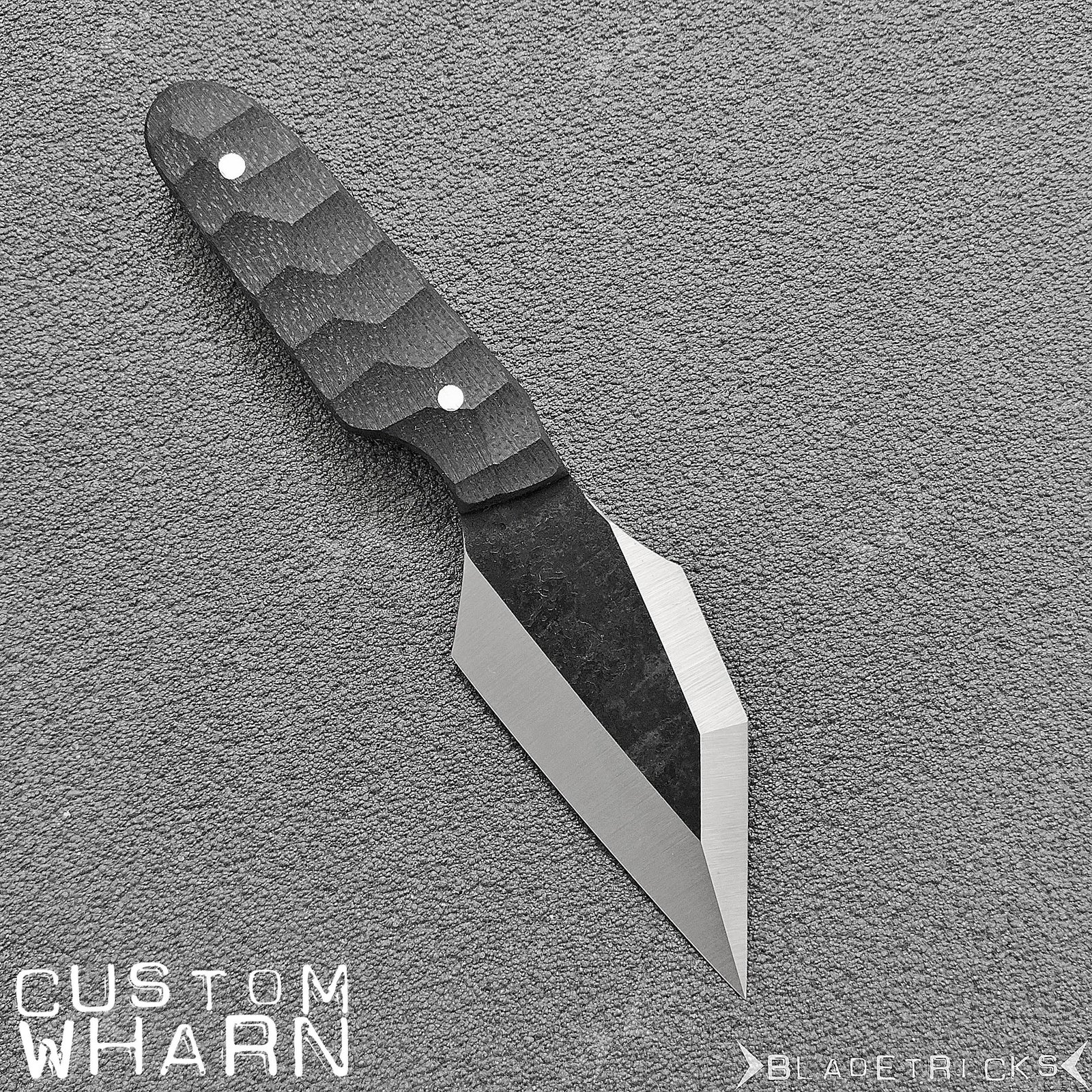
Bladetricks Custom wharncliffe Black G10 Handle
Combined with traditional Bladetricks karambit (ringed) handle, the result is a tool that carries like an EDC knife and transitions to a fighting grip when the situation demands it. The ring adds retention and capability without adding bulk.
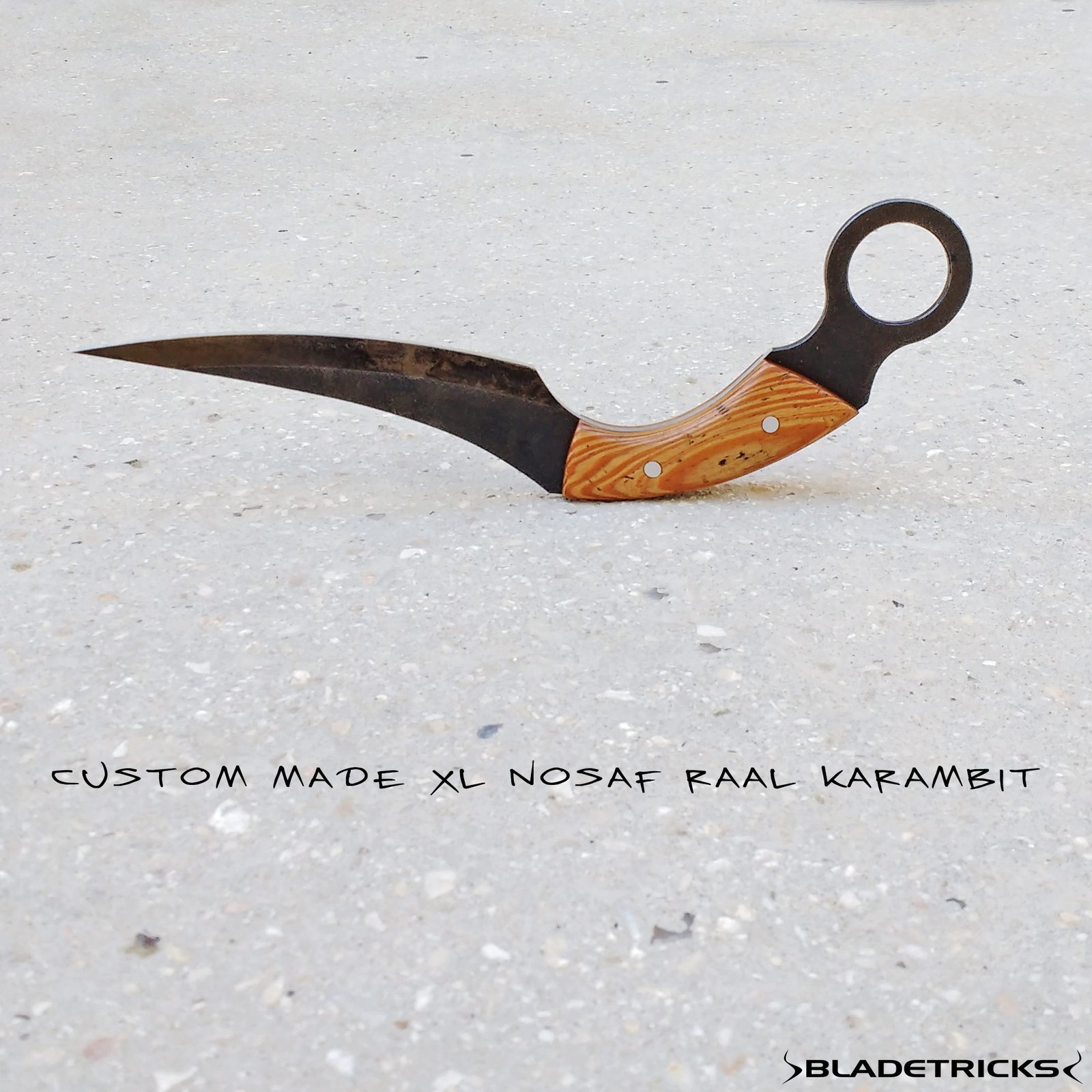
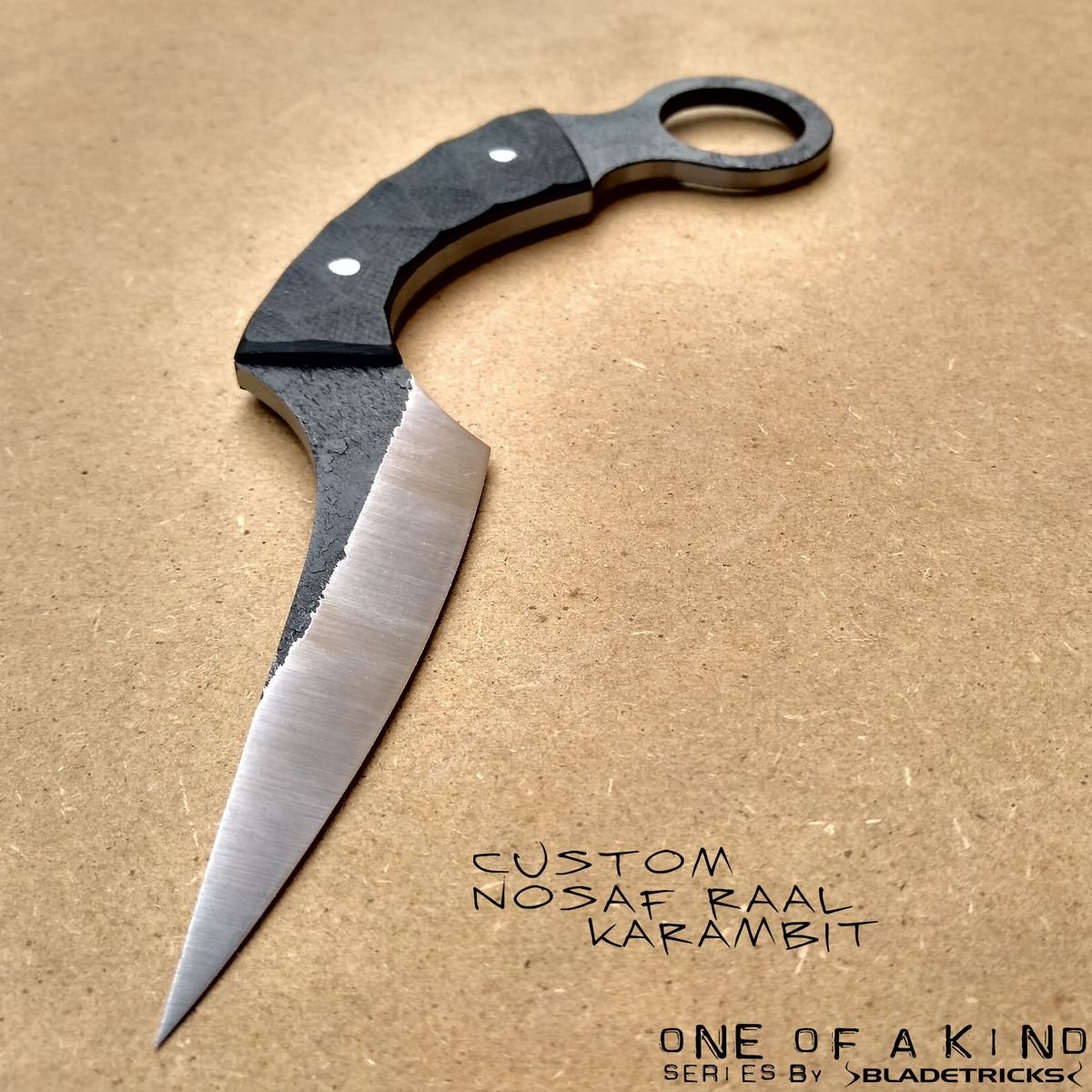
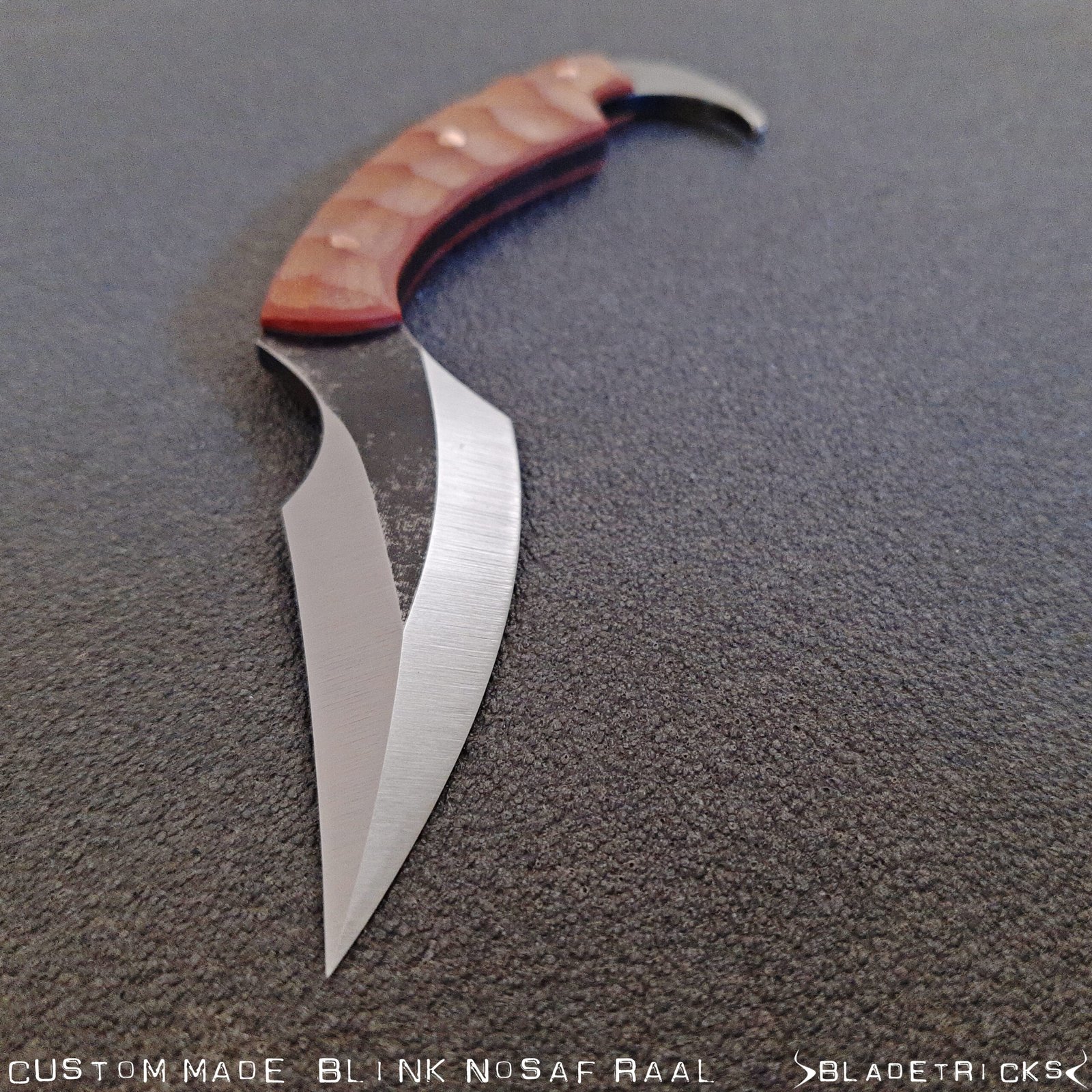
Custom made XL Nosaf Raal Karambit fir wood aged scales by A.N. Nash
The Steel
For this build I used my last reserve of thin stock 4340 alloy steel — a high-strength material used in military aircraft and heavy-duty industrial applications for its exceptional toughness and impact resistance. It is by far the toughest steel I work with.
Its only weakness is edge retention, which I addressed by microwelding a thin layer of tungsten carbide onto the edge — delivering the structural resilience of properly heat-treated 4340 with the cutting performance of a 70-80 HRC carbide edge. The result is a steel combination that has no right to perform as well as it does.
Tungsten Carbide on a 4340 Alloy Steel Blade
The Complete Tool
The HAPAK ships with a multi-position Kydex sheath and an Ulticlip retention clip — a carry system that keeps the tool accessible in any position without unnecessary bulk.
HAPAK Utility Karambit Knife
Bladetricks HAPAK Home Front Command Karambit
Ulticlip Sheath Clip mounted on the HAPAK Karambits Kydex Sheaths
The Custom Version
A custom interpretation of the HAPAK is currently in progress — longer blade, hand-sculpted black G10 recessed scales with a clean border of exposed steel around the handle. The customer asked for more. We obliged. Follow the build on Instagram.
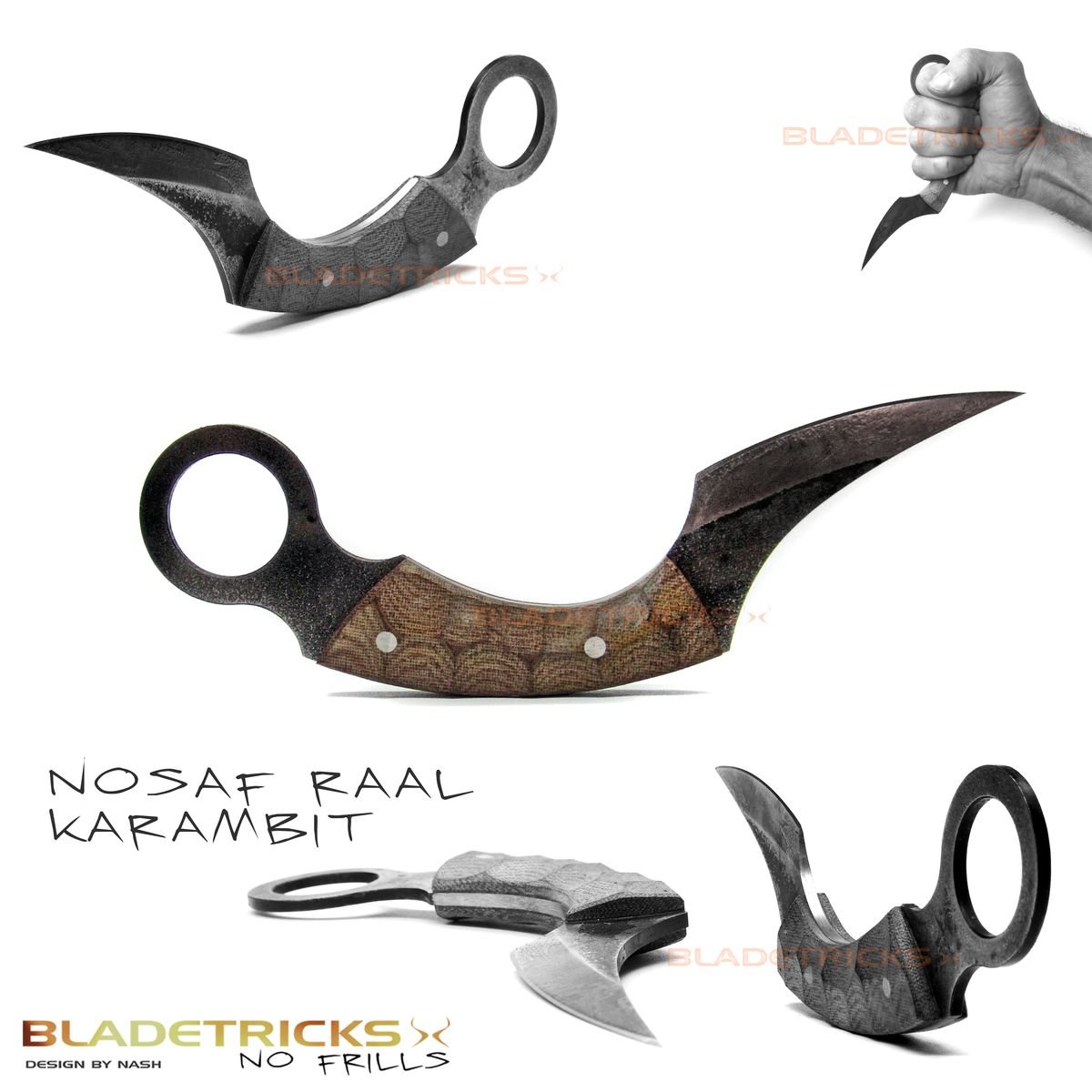
The Nosaf Raal is a design concept that does not stay still — not because it is unresolved, but because it keeps feeling its own potential and demanding more of itself. It began as a traditional (straight knife), evolved into a refined karambit geometry, and has not stopped expanding since.
What follows is not a catalogue entry. It is an account of why this geometry exists, what it demanded across more than a decade of continuous refinement — subtle adjustments in proportions, angles, grinds, adapted to specific uses, specific budgets, specific customers, and wherever possible pushed forward aesthetically as well as mechanically. The decisions were not purely stylistic, but they were never purely mechanical either. A tool has to earn its appearance as much as its function.
The Foundation: Simple Knives with a Simple Rule
The Nosaf line began as a straightforward proposition. I wanted a series of very simple, compact knives — full hand and two-finger grip formats — utilitarian, versatile, honest in their construction. No rings. No curves. Two rules governed the entire early series: 2mm stock and simplicity. Those constraints were not limitations. They were a discipline. They kept every design honest, stripped of the unnecessary, true to the concept of a tool that disappears until it is needed.
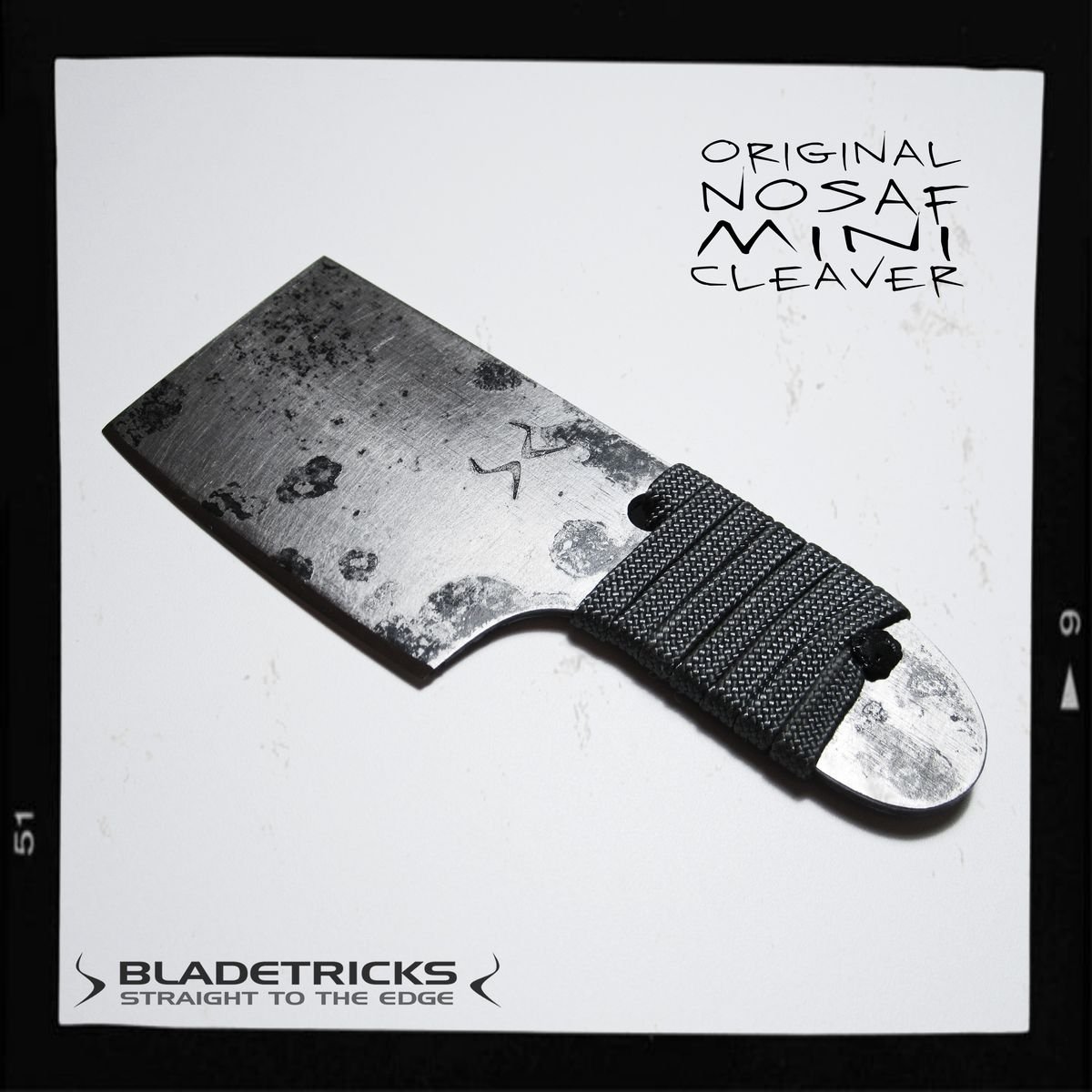
Original Bladetricks Mini Cleaver
Bladetricks Original Nosaf Skin
Bladetricks Original Nosaf Bush Knife
Bladetricks Original Nosaf Combat Tribal Version
Bladetricks Nosaf Light Combat Knives
The Nosaf Wharncliffe emerged at the same time, another expression of the same philosophy applied to a different blade profile. Its flat spine and aggressive yet rugged tip gave it a distinct character within the family: a precise, controlled cutter that complemented the more aggressive profiles that would follow. It remains in the catalogue today, mostly unchanged in its essential purpose.
Bladetricks Original Nosaf Wharn Original Version
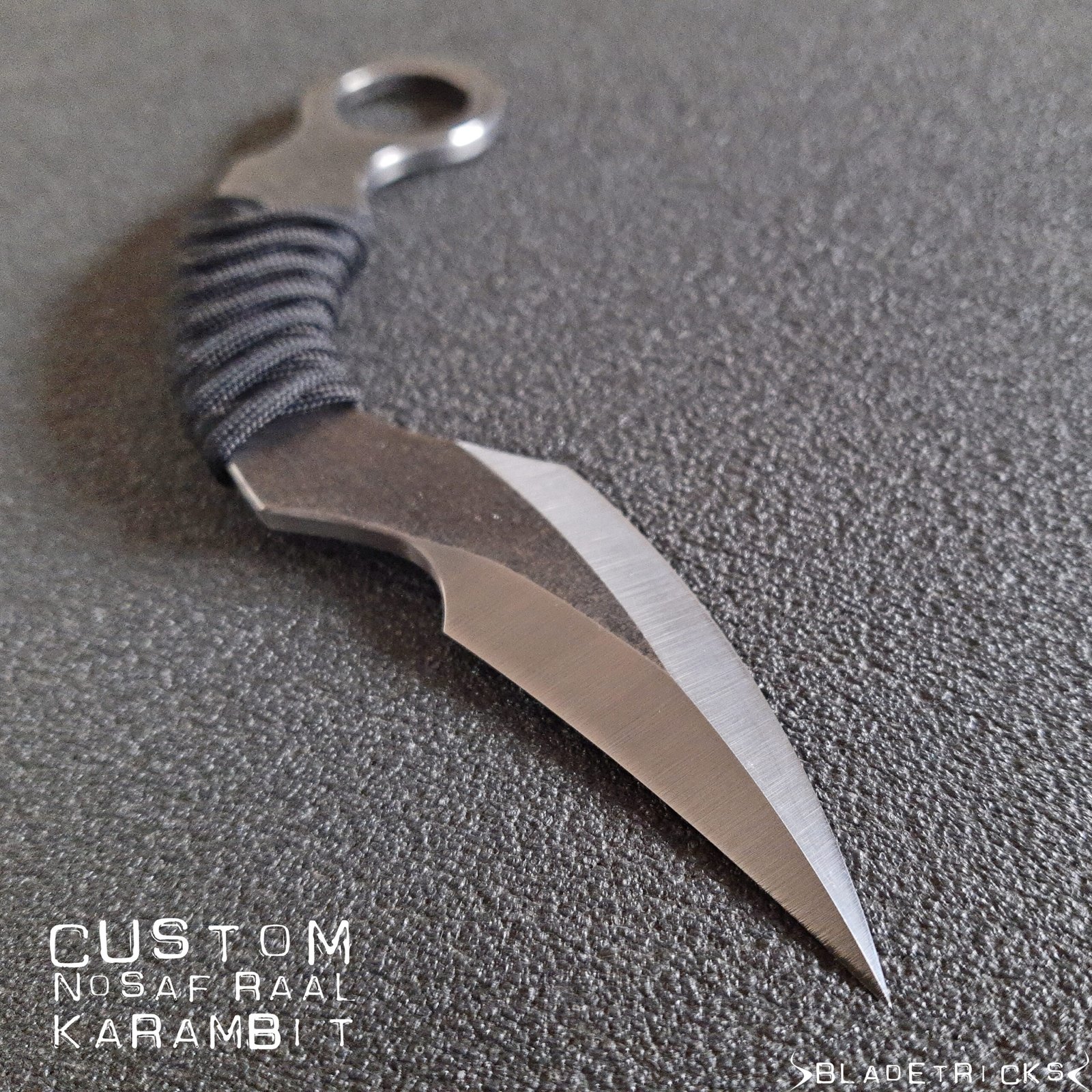
From that foundation, a customer request introduced the karambit format to the Nosaf. The result was the first Nosaf Karambit — and with it, an entirely new palette of geometric possibilities opened up.
The Karambit With a Belly
The karambit format traces its origins to the Minangkabau people of West Sumatra, where the curved blade began as an agricultural implement before becoming a weapon of last resort. In modern knife making, its most recognizable characteristic is the retention ring — the feature that defines the format more than the blade itself — and the hooked blade is its traditional signature.
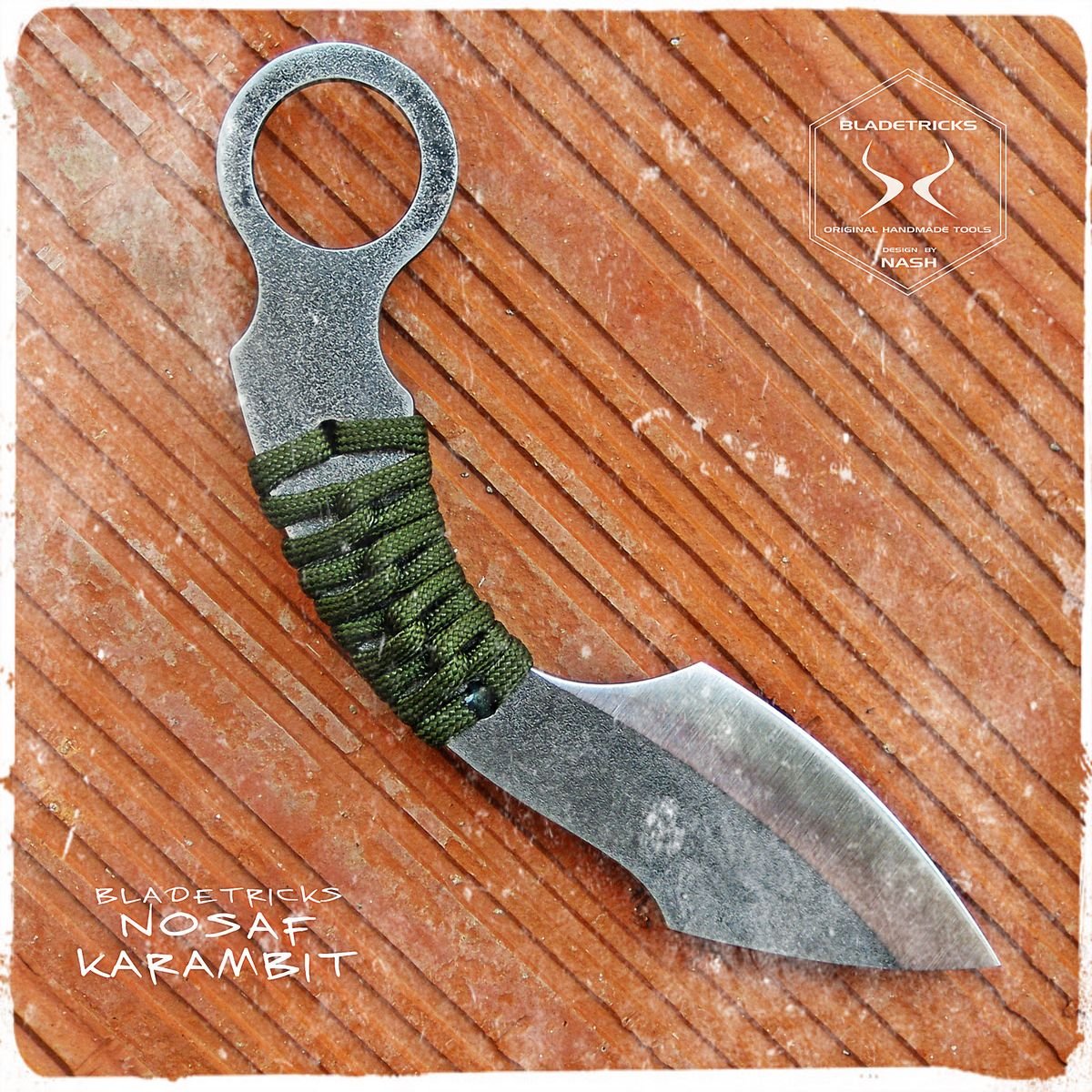
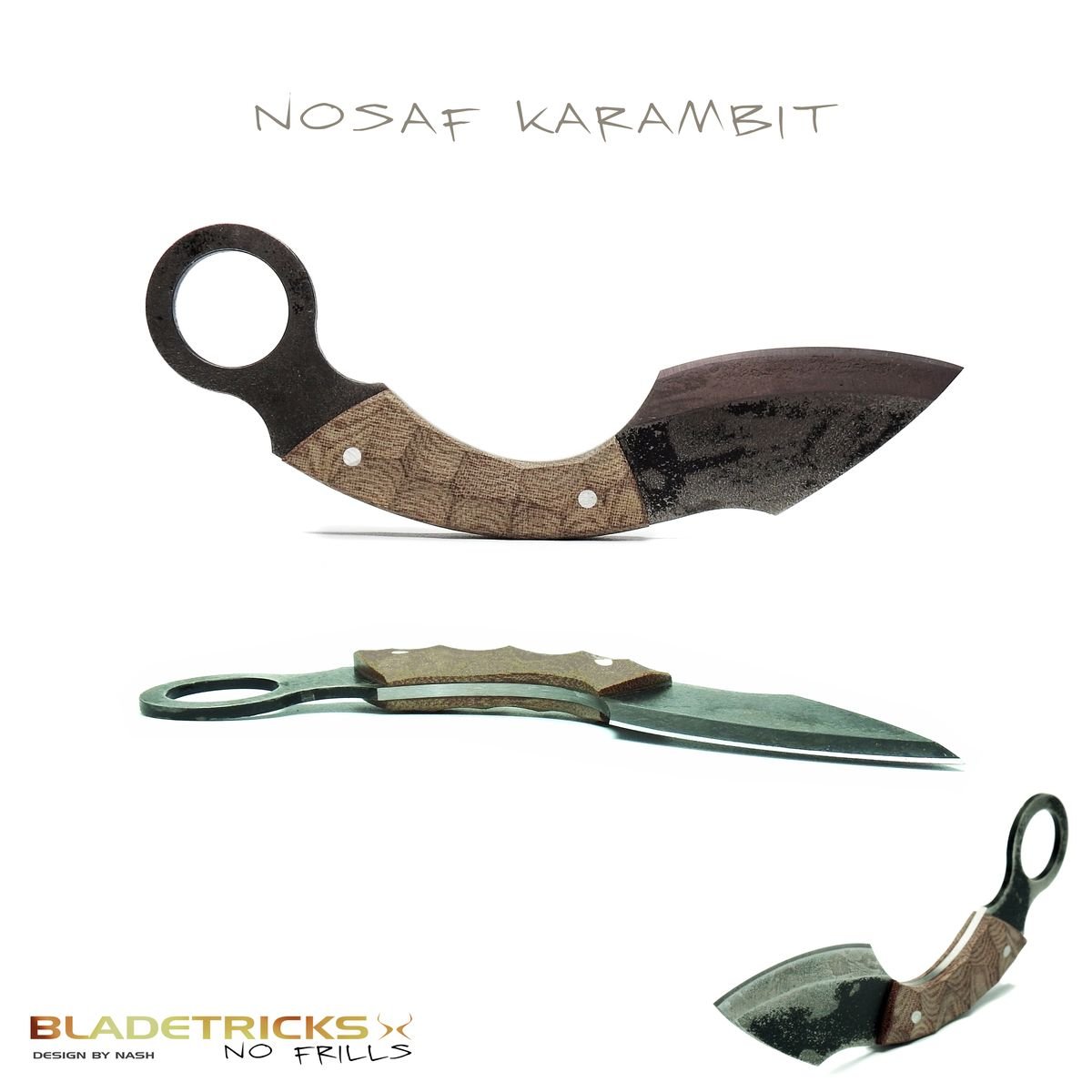
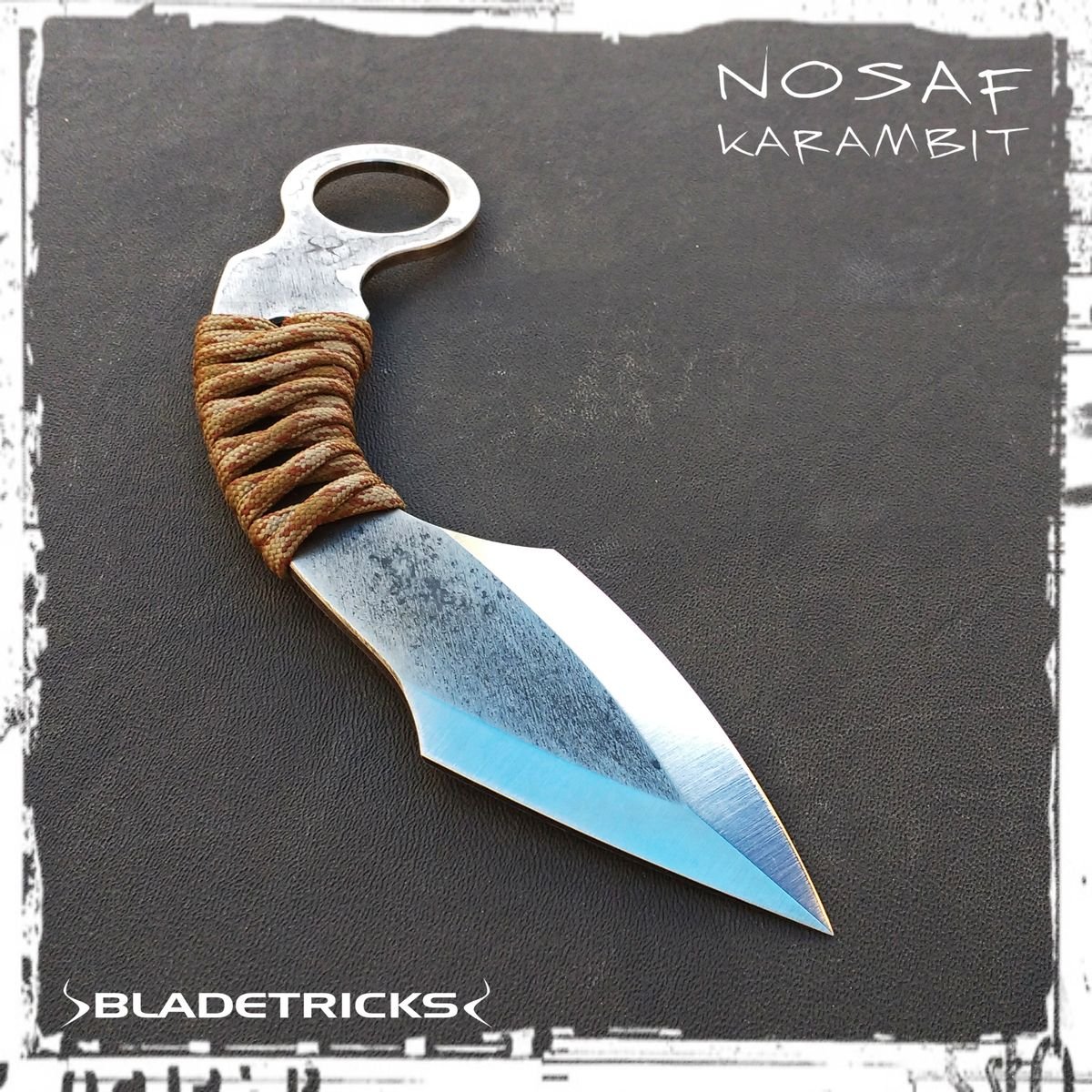
The first Nosaf Karambit did something different: it used a traditional blade profile with a belly — a curved, slicing geometry rather than a hook. At the time, that was genuinely uncommon. I had not seen it done elsewhere. It was a deliberate departure from what the market understood a karambit to be, driven by the belief that the ring format was worth more than the hook it was always paired with.
Bladetricks Original Nosaf Karambit Oiginal Version Cord Wrapped
Bladetricks Nosaf Karambit Original Micarta Version
Bladetricks Nosaf Karambit cord wrapped
That first version was made in steel and was built to prove the concept. Multiple versions followed — cord wrapped, micarta — each refining the proportions incrementally. But as I worked with the geometry, a specific limitation became clear. The standard Nosaf Karambit blade profile was capable, but not committed. It was a tool — somewhere between an aggressive EDC utility knife and a fighting blade — that could do many things adequately. I wanted a tool that did one specific thing with complete mechanical authority.
The answer was the Nosaf Raal.
Raal: The Geometry of Commitment
“Raal” is the designation I apply to the most aggressive version of any Bladetricks model. It means the slenderest blade, the sharpest tip, the most uncompromising geometry in the family. Pure poison, literally. On the karambit platform, it meant taking the existing external slicing edge curve and driving the tip geometry further — harder, more defined, built for penetration rather than general utility.
The result was a blade that operated differently from anything I had made before. The angle between the handle axis and the blade — the detail that many karambit makers treat as a stylistic choice — became a calculated mechanical variable. In a standard grip, that geometry drives a forward and downward thrust aligned with the forearm axis. The same grip, with a change of intent but no change of hand position, loads directly into the pulling arc of the pikal system for control and engagement. And from the same hold, the external edge is available for an upward or lateral slash without repositioning the hand.
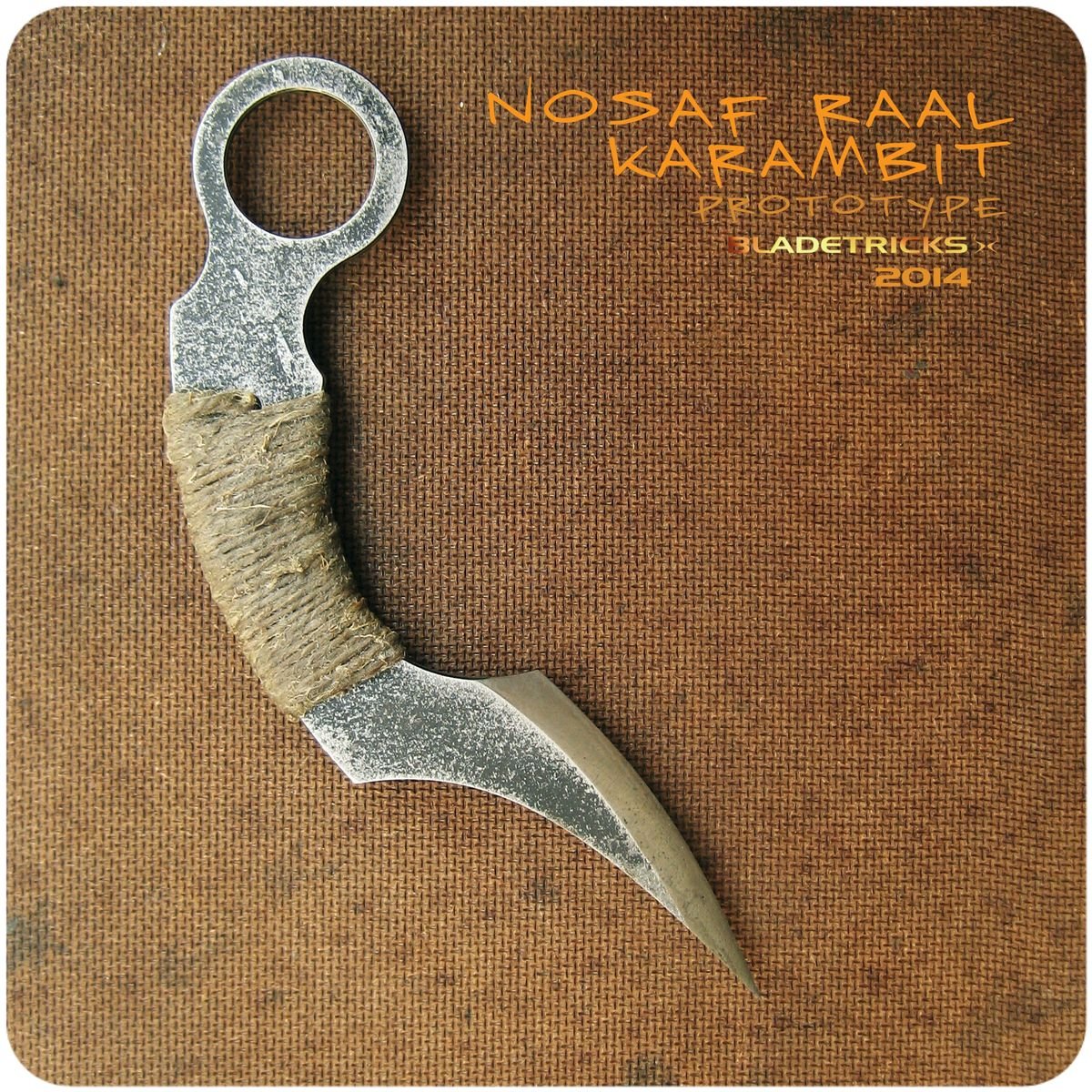
Bladetricks Nosaf Raal Karambit Tribal Version Prototype
Three vectors. One grip. The hand barely moves. The geometry does the work.
This is not a feature that was added to the Nosaf Raal. It is what the geometry produced when the proportions were finally correct. The model was subsequently made in steel, titanium, and G10 — each material imposing its own constraints, each version confirming that the geometry held regardless of what it was made from. Subtle refinements continued across versions, each one responding to a specific observation about how the tool performed in real hands.
Bladetricks Nosaf Raal Karambit Micarta Version
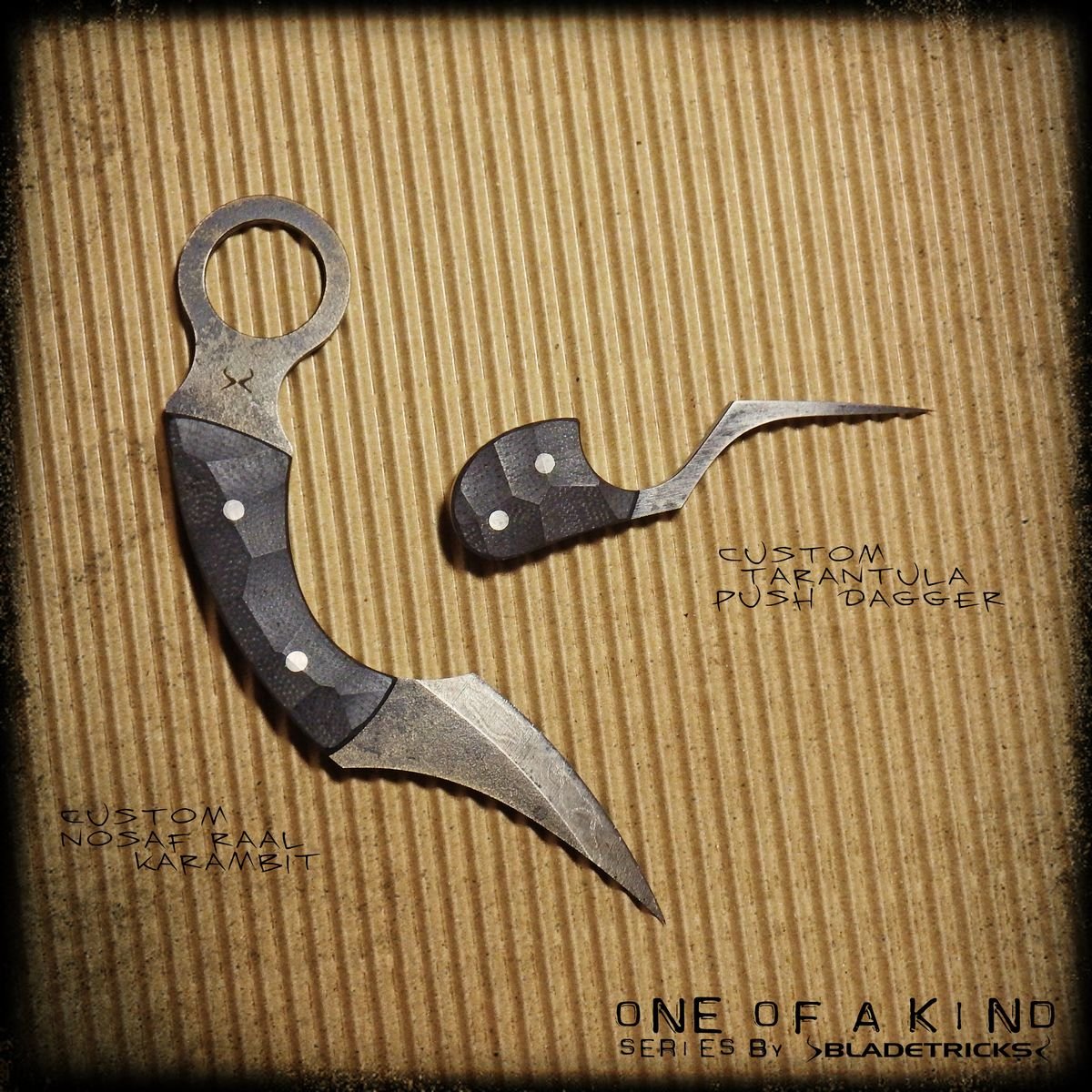
Bladetricks Custom Made Set Nosaf Raal Karambit and Tarantula Push Dagger
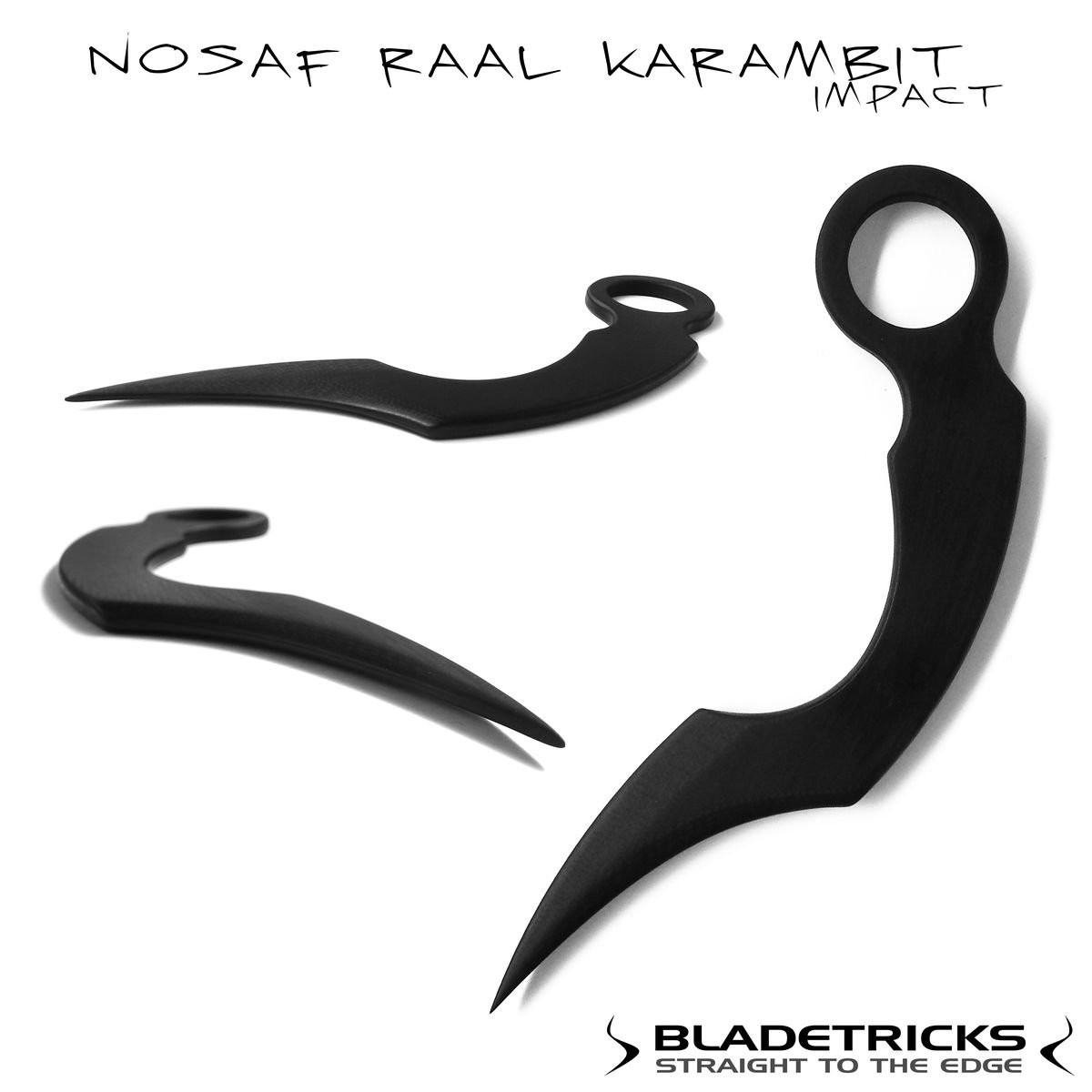
Bladetricks Nosaf Raal Karambit Black G10 Impact Version
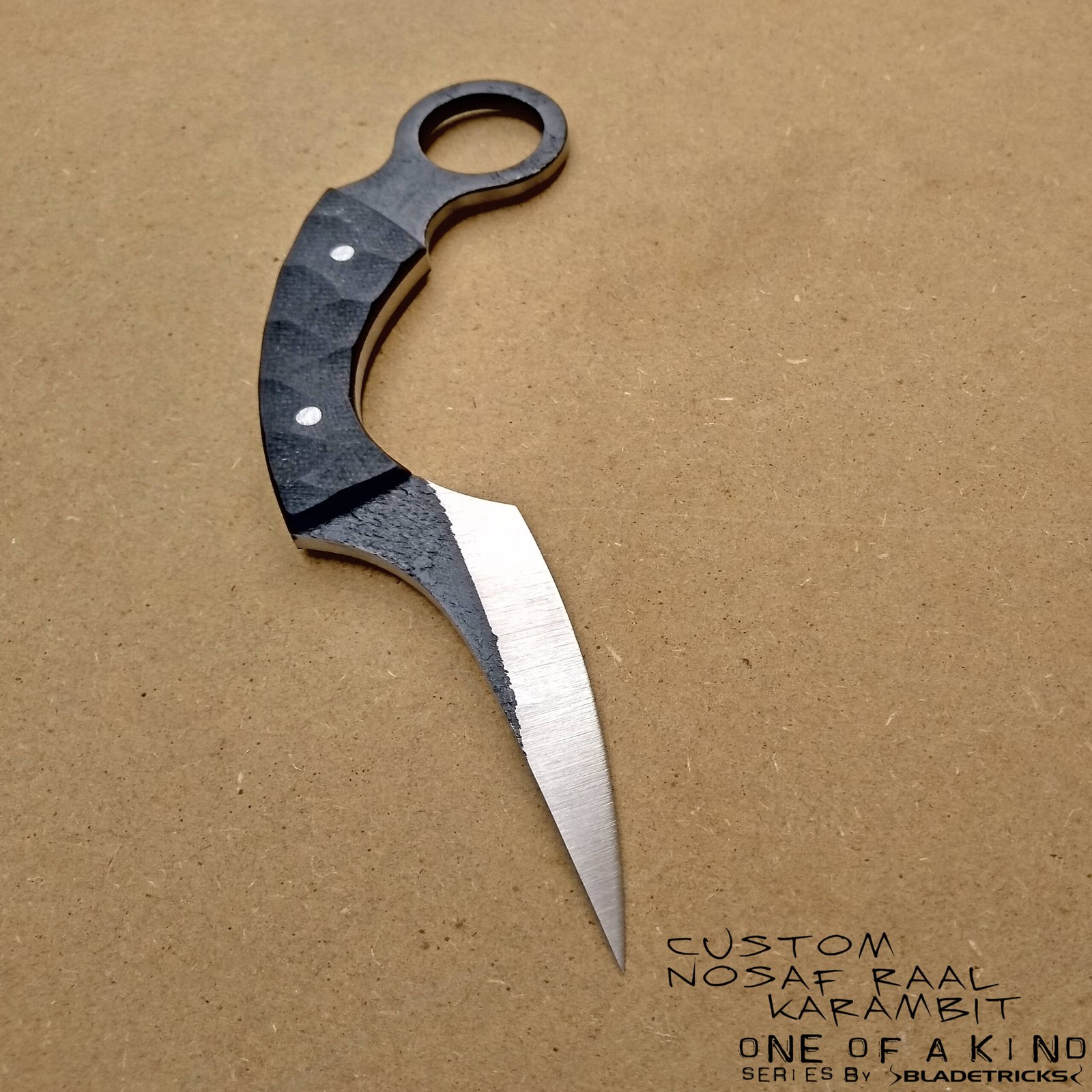
Bladetricks Nosaf Raal Karambit Black G10 Handle Version
The RGEI Question
At some point, the natural next question was obvious: what happens when you invert the edge?
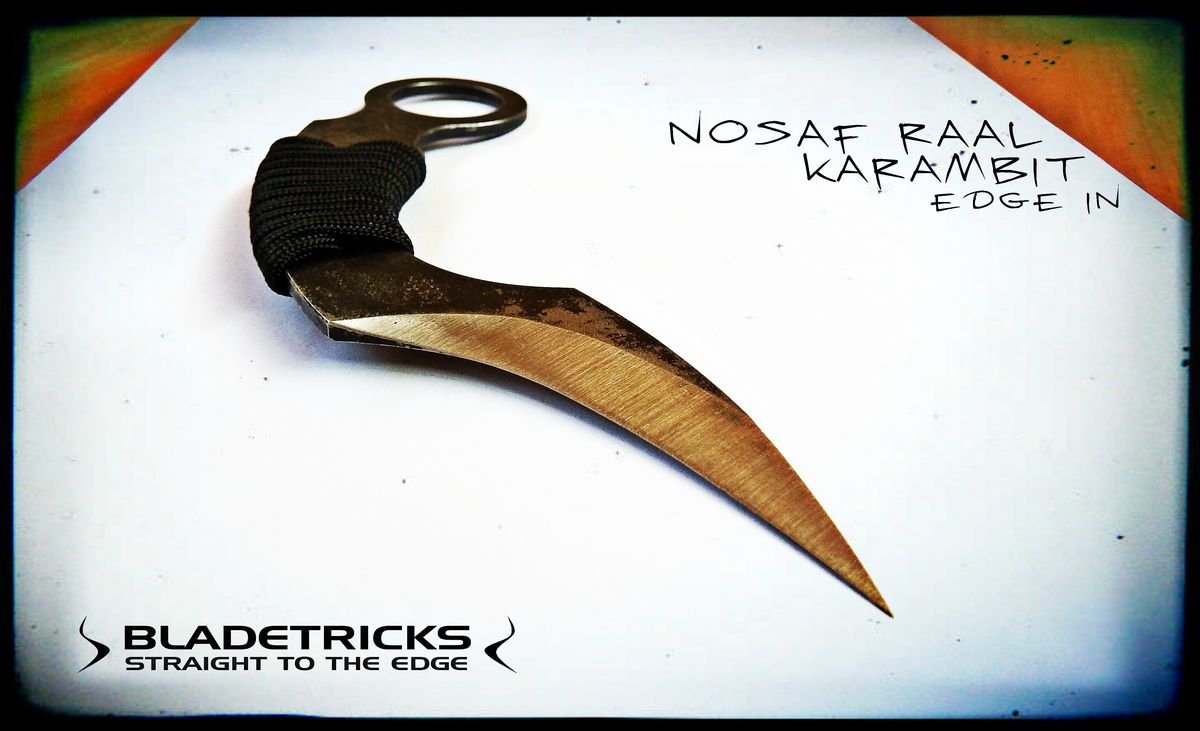
The answer was the first pikal version of the Nosaf Raal — the RGEI configuration that takes the inside edge and turns it into the primary cutting surface. The pulling mechanics of the pikal system generate a kinetic force that is difficult to intercept, engaging the body’s strongest pulling muscles in a motion that is both instinctive and mechanically efficient. The Nosaf Raal’s handle-to-blade angle, already calculated to serve both push and pull mechanics, loaded into the RGEI orientation with a precision that confirmed the geometry had been correct from the beginning.
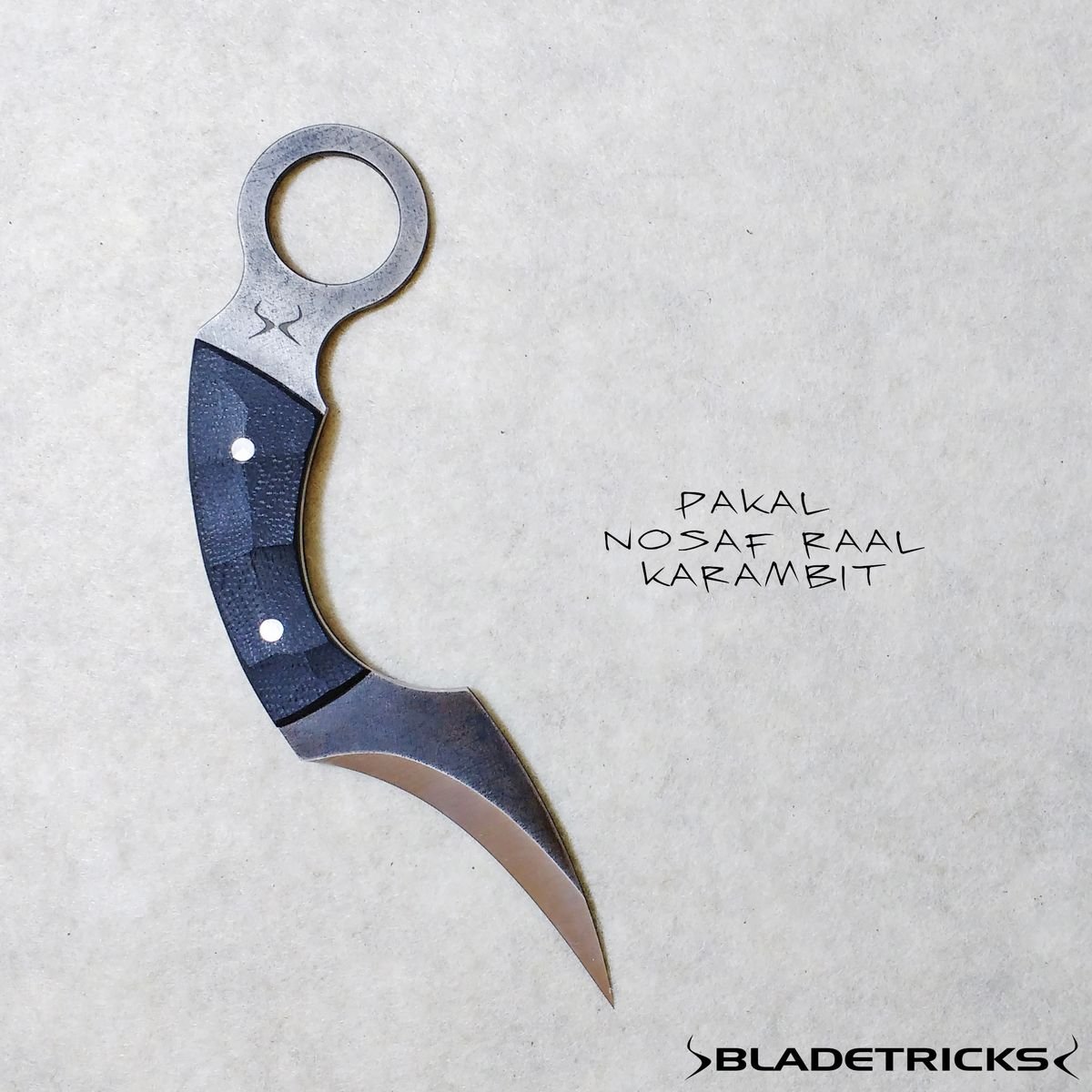
Bladetricks Nosaf Raal Karambit Pakal Version
Bladetricks Nosaf Raal Karambit Reverse Grip Edge In RGEI Version
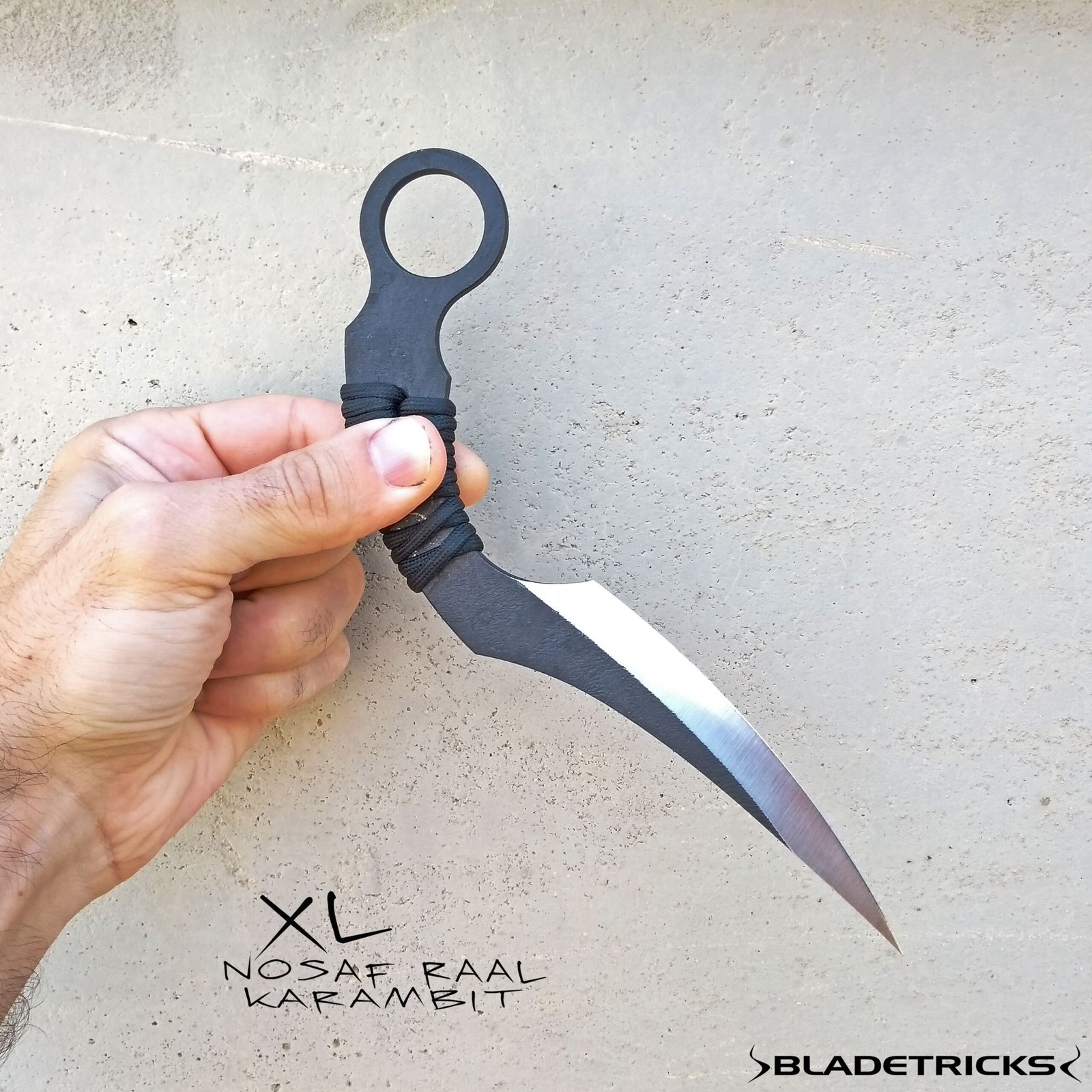
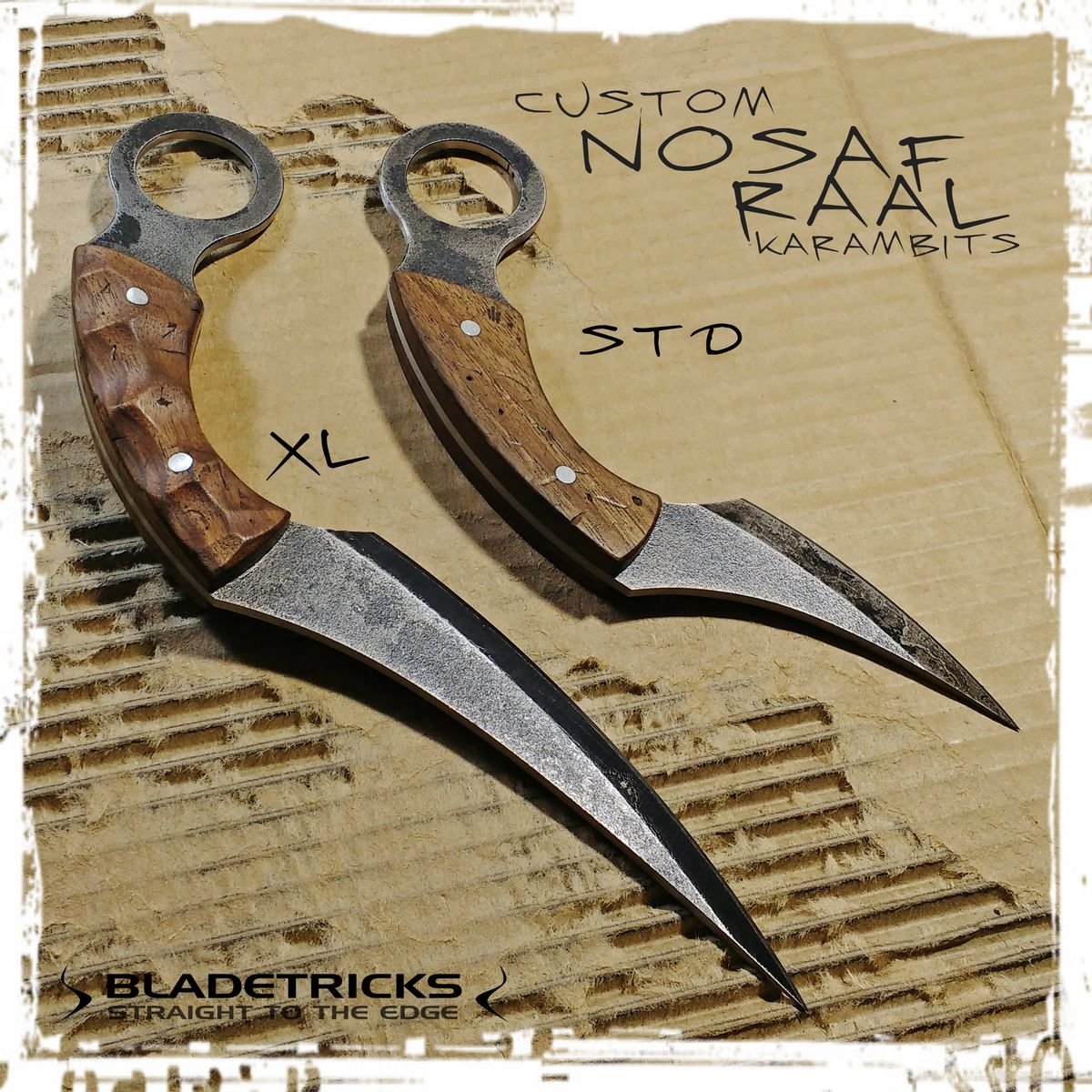
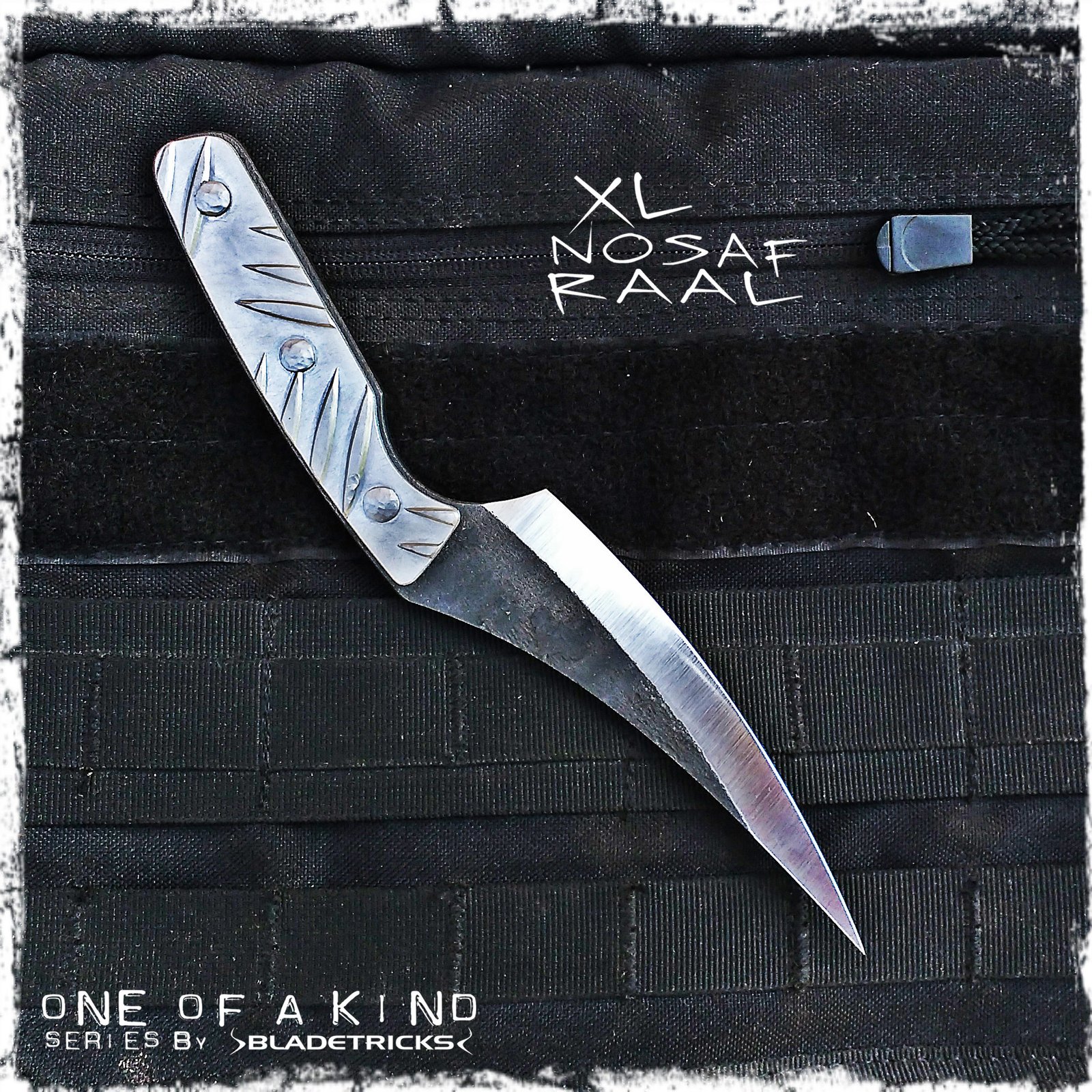
The XL version followed — a blade that nearly doubled the original length, extending reach without altering the fundamental proportions. Same geometry. Different scale. The logic held.
Bladetricks XL Nosaf Raal Karambit
Bladetricks Custom Made Nosaf Raal Karambits
The Knife Version: Removing the Ring Without Losing the Geometry
The ring is the karambit’s defining feature and its most significant constraint. It locks the blade in the hand under extreme stress. It also locks the user — mostly — into a specific carry profile, a specific draw sequence, and a specific deployment geometry.
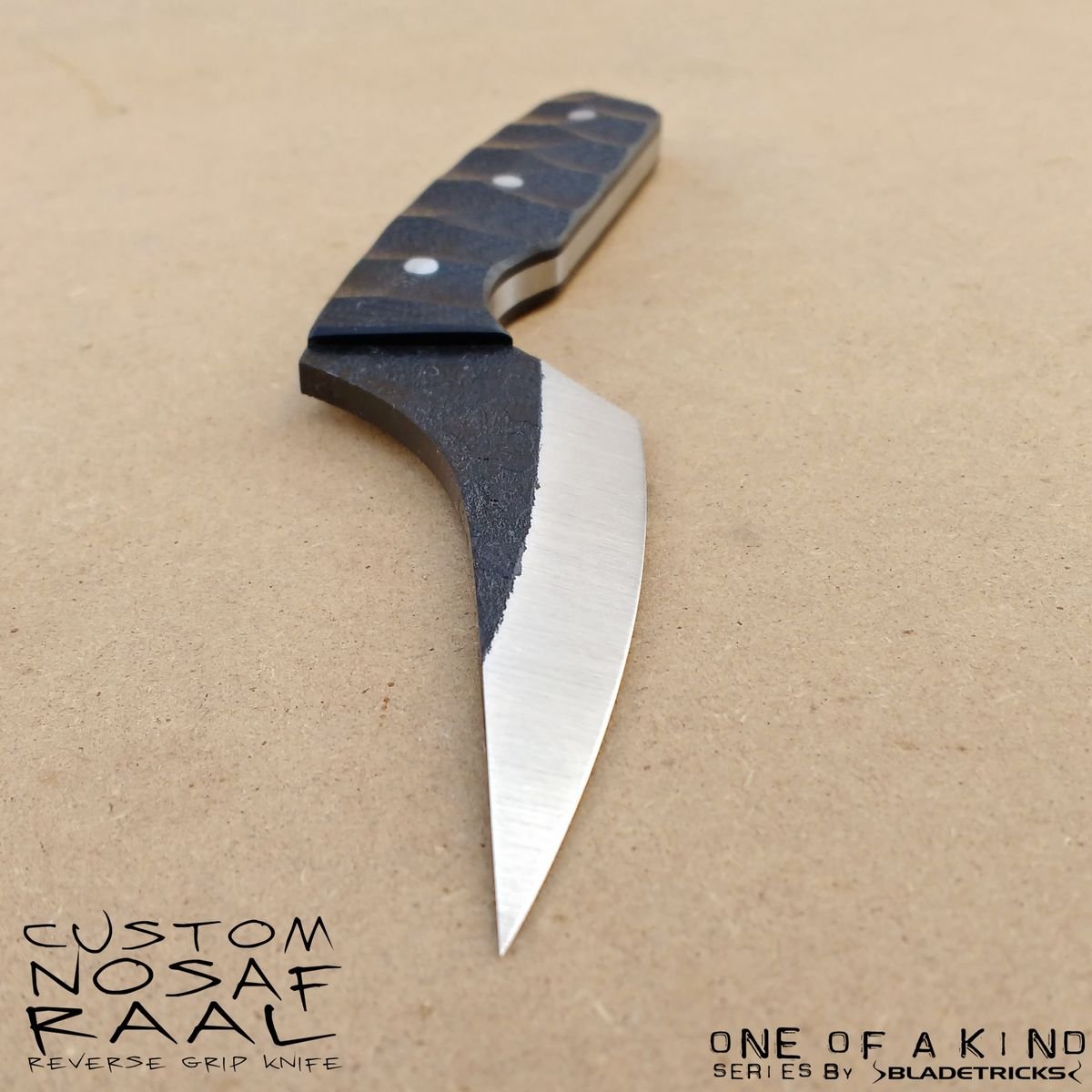
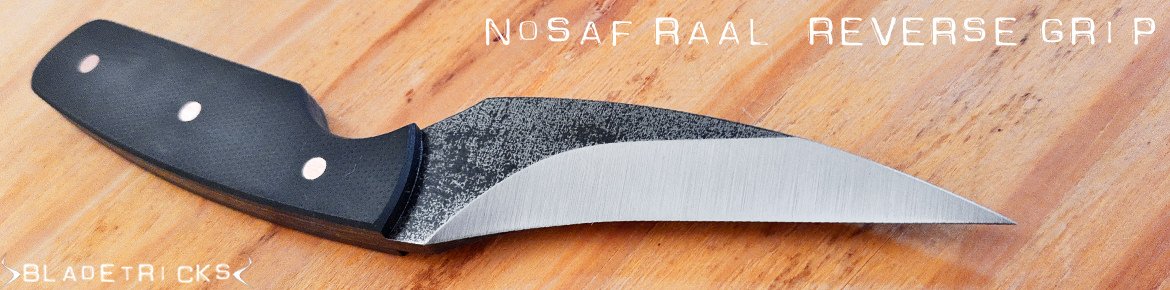
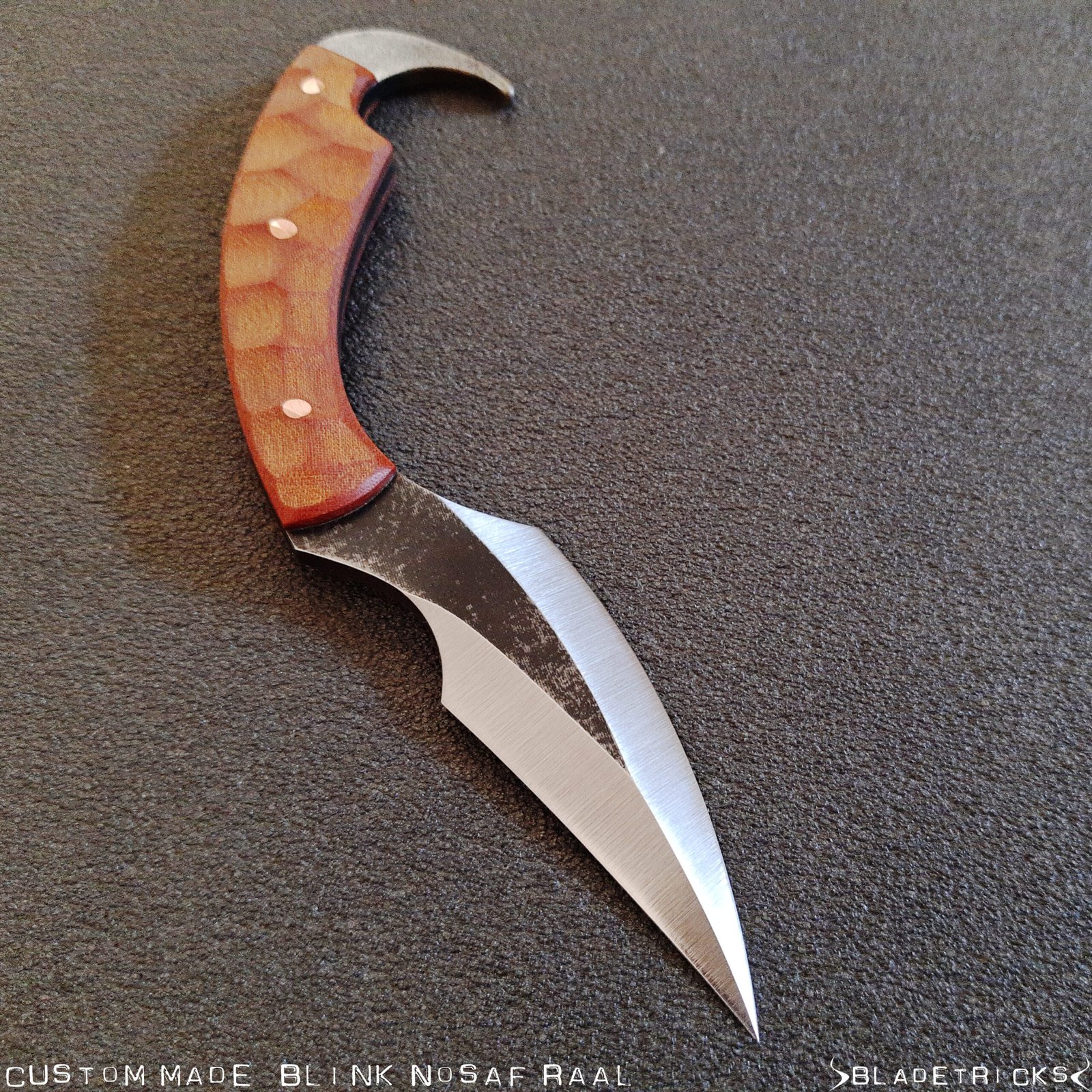
The Nosaf Raal Knife replaced the ring with a knife handle — same blade, same handle-to-blade angle, same mechanical relationships — but now accessible to users who carry and deploy differently. Not everyone works well with a karambit format in the hand. Some professionals prefer the familiarity of a straight handle, the cleaner pocket profile, the less conspicuous carry, and in some jurisdictions, the more straightforward legal status that a conventional knife profile carries over a ringed blade. The Nosaf Raal Knife answers that preference without asking them to give anything up mechanically. The geometry did not change. The platform did. The knife version performed identically — both as a pikal tool and in edge-out XL configurations.
Custom Nosaf Raal Knife by AN Nash
Bladetricks Pikal Nosaf Raal RGEI Knife Back G10
XL Nosaf Ral Knife Smilodon by AN Nash
The Double Edge: Three Vectors Become More Consequential
Adding a second edge to the Nosaf Raal Karambit was not an aggressive gesture. It was a structural decision with a specific mechanical outcome.
The double edge is wider than the single edge version — a necessary accommodation for structural integrity across both cutting surfaces. What it sacrifices in slenderness it recovers in capability. The same three vectors available in the single edge version — downward thrust, inside pulling arc, outside upward slash — now carry consequence on both sides of the blade. There is no neutral angle. There is no dead side. Every position of the blade in motion is a working position.
The double edge Karambit was the first expression of this. It retained the ring. The geometry it established became the foundation for everything that followed.
The Blink Grip was created to solve a specific problem: draw speed. In a life-threatening encounter, fumbling a draw and / or failing to establish a secure grip immediately are the real failure points — not technique, not blade geometry. The Blink Grip allows a near-instantaneous, consistent, blind-indexed draw from the Kydex sheath with no mechanical parts and no conscious adjustment required. The index finger reads the geometry, the hand closes, and the result is a fast, secure grip every time — regardless of conditions. It is worth noting that chronologically, no single edge Blink Nosaf Raal was ever produced. The Blink Grip system was introduced directly on the double edge platform — the most mechanically complete version of the geometry — and has remained there.
It is worth noting that chronologically, no single edge Blink Nosaf Raal was ever produced. The Blink Grip system was introduced directly on the double edge platform — the most mechanically complete version of the geometry — and has remained there (at least for the moment).
The Blink Nosaf Raal is that platform: the full mechanical capability of the double edge Nosaf Raal, combined with the fastest possible deployment system and a handle built without compromise.
The Kadesh Handle: The Latest Development
The most recent chapter in the Nosaf Raal lineage introduces the adapted Kadesh handle to the double edge Nosaf Raal blade. The Kadesh handle profile — proven across several Bladetricks models for its exceptional grip security and seamless transition between pikal and sabre positions — brings a new ergonomic and flexible dimension to the Nosaf Raal geometry without altering the blade that has defined it. Same blade. New handle language. The geometry continues to find new expressions.
Cardboard prototype for the “Kadesh” Double Edge Nosaf Raal Knife
Bladetricks P-578511 Pikal Nosaf Raal Knife
What the Evolution Confirms
A geometry that survives more than a decade of refinement — across materials, handle formats, blade configurations, and deployment systems — is not one that arrived by accident. It is one that was refined through a consistent discipline: is there room for improvement? Can this angle be optimized? Can this grind be pushed further? Can this version serve a specific user better than the last one did?
The Nosaf Raal has been asked those questions in steel, titanium, G10, single edge, double edge, ringed, knife handle, Blink Grip, and Kadesh handle configurations. The proportions have held across all of them. The geometry works. The evolution is not finished.
Keyword: karambit
The Bladetricks Nosaf Raal — a decade of karambit geometry refined across steel, titanium, double edge, Blink Grip, and Kadesh handle. The full lineage.
A.N. Nash on the Nosaf Raal lineage — how one karambit geometry evolved across a decade into the most complete pikal platform Bladetricks has built.
Explore the full Bladetricks Nosaf Raal family — karambit, knife, double edge, Blink Grip. A pikal geometry refined across more than a decade of refinement.
There is a moment between reaching for a blade and having it in your hand that has always been a dilemma for the knife user. Not a failure of design — people train the knife draw, and train it seriously. But training a sequence of conscious movements under stress has a ceiling. I was looking for something simpler. The same logic as an automatic knife: press a switch, the blade is there. The Blink Grip is an attempt to bring that simplicity to a fixed blade draw.
The Blink Grip is not a feature added to a handle. It is the handle, built around a single purpose.
The knife world has spent decades refining blade geometry, steel selection, and handle ergonomics. The draw — the sequence of events between the tool leaving the sheath and the grip being established — has received less systematic attention. In a high-stress encounter, that gap is frequently where everything is already decided. A blade that performs perfectly once it is in the hand is only half a system.
The other half is what happens before that.
The Problem Nobody Was Solving Simply Enough
The inspiration was not another knife. It was a handgun draw.
A trained shooter draws with one goal: the weapon arrives in the hand oriented correctly, every time, regardless of conditions. The mechanics of the draw — the path the hand travels, the contact points, the transition from holster to grip — are not designed. They are calculated and trained in a specific sequence until the outcome is consistent without conscious intervention. The shooter does not think about grip orientation during the draw. The sequence handles it.
I wanted the same consistency for a blade, but through geometry rather than repetition alone. The karambit ring — which I have always respected for what it does once the tool is in the hand — does not always solve the deployment problem. It solves the retention problem. These are not the same thing, and conflating them is where most fast draw attempts fall short.
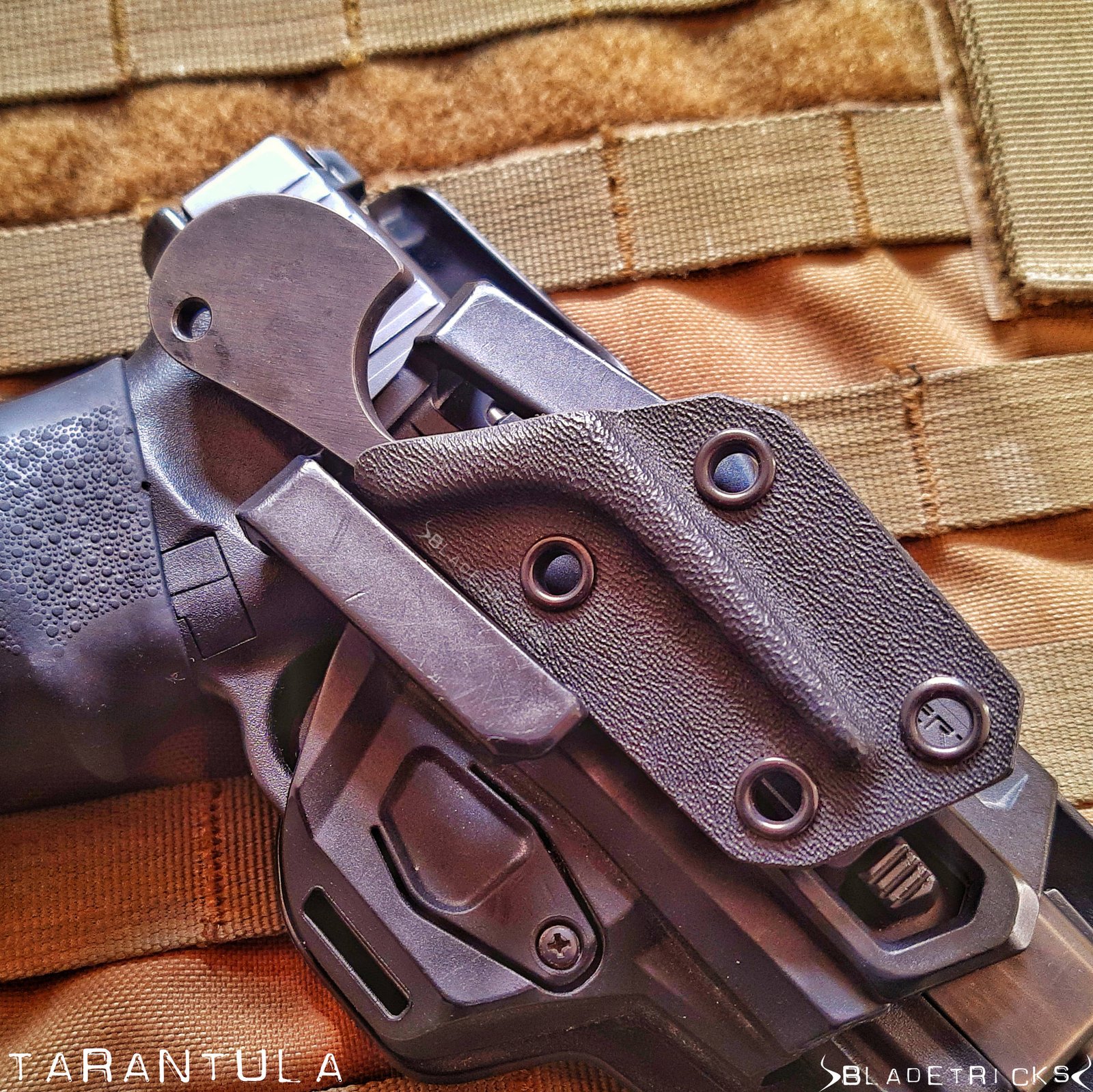
Glock holster draw and Tarantula Push Dagger sheath draw
The Index Finger
I did not approach this through biomechanical analysis. I asked myself a simpler question: who reads the space in the hand?
The answer was the index finger. It touches, feels, and reports back — angles, orientations, forces, spatial relationships — while the rest of the hand is still forming its grip. That reading happens quickly, ahead of conscious thought. Not around a retention ring, but around the finger that already knows where and how things are.
The tool sits in its Kydex sheath tip-down. The operator reaches for it — fast, with intent — with the index finger contacting the lateral side of the handle, the exposed steel of the handle sandwich. The hand, led by the index finger, climbs upward along the handle. As it reaches the open ring section, the index finger makes contact with the horn at approximately the point where the tangent begins. The upward force continues. The knife is pulled clear of the sheath. The hand closes around the handle with a secure grip.
The geometry does the hard work for you.
No moving parts. No buttons. No retention mechanisms to defeat under stress. The system works the same way whether the operator is calm, exhausted, or wet — or operating well past the threshold where fine motor skills are no longer a realistic expectation. It was not designed for the training hall. It was designed for the moment after the training hall stops being relevant.
The Horn and the Index Rest
The original Blink Grip — still most clearly visible on the Balbala Pikal Karambit — features a longer horn than later iterations. Through continuous use and feedback, I optimized the length so the system remained efficient without becoming cumbersome. What was refined was not the indexing principle but its most practical expression.
Bladetricks Balbala Collection of Pikal Reverse Grip Knives and Karambits
The inner section of the open ring serves a secondary but essential function: a dedicated rest for the index finger. This prevents the hand from sliding forward toward the blade during high-impact axial thrusts, and allows the operator to apply additional force without compromising grip security. The geometry that enables the draw and the geometry that secures the grip are the same geometry. One solution. Two problems.
Detail of Blink Grip Fast Draw Knife and tool Handle
The Compact Variation
For more compact setups — where overall profile and weight are the primary constraints — I developed a shorter variation of the system. The horn is reduced to the minimum length that still delivers reliable indexing. The index rest is eliminated. The draw speed is preserved. The result is a lower-profile handle that disappears in the carry without sacrificing the core function of the system.
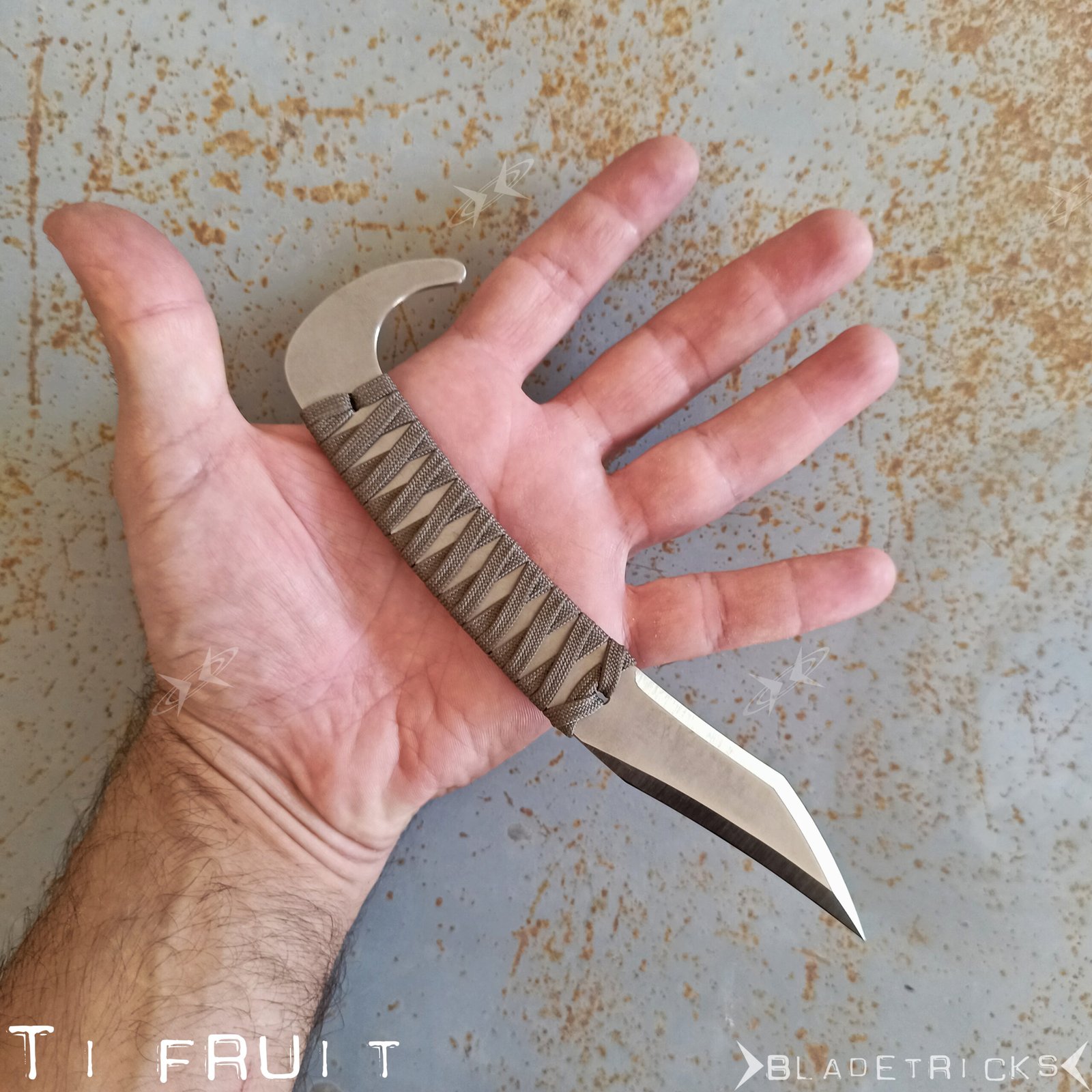
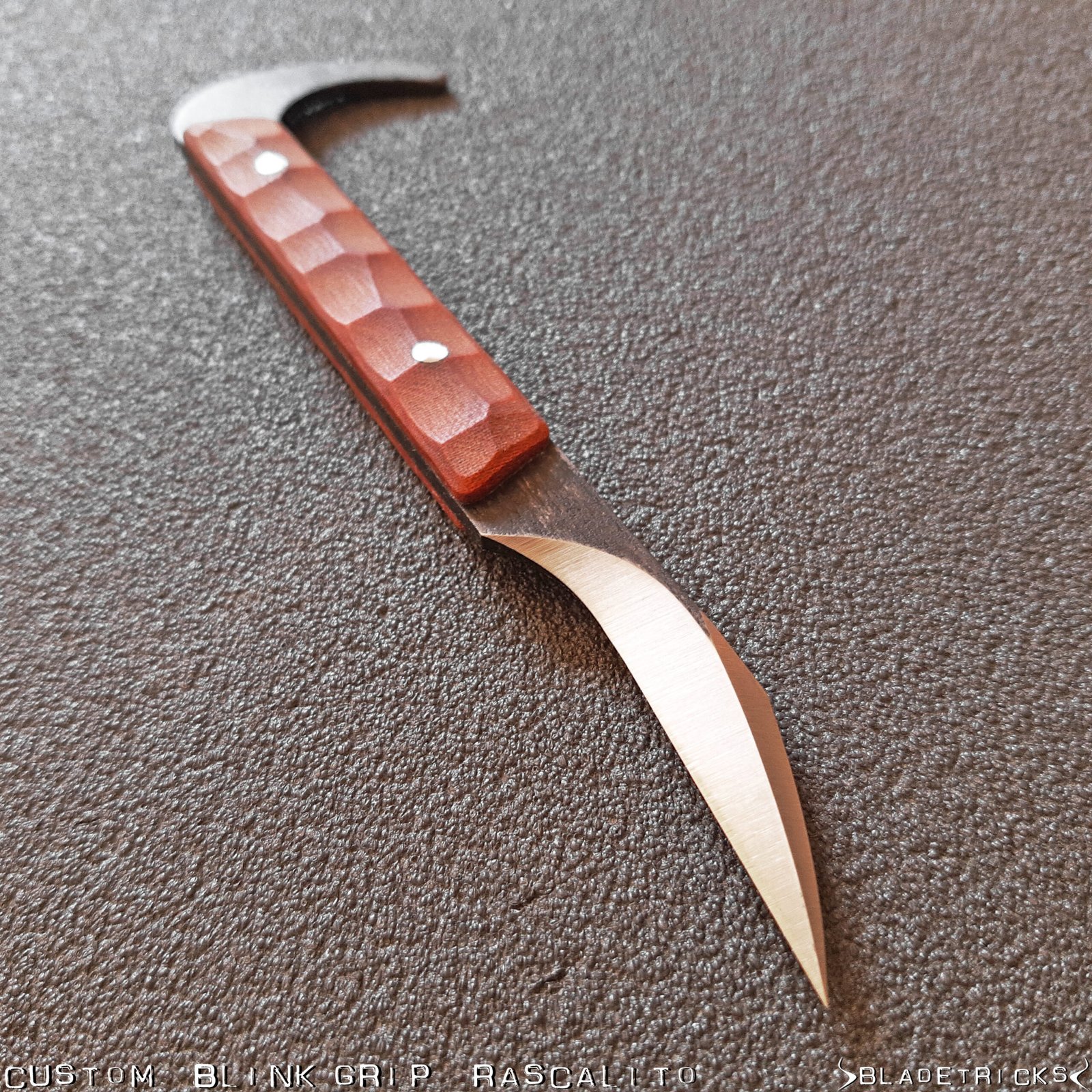
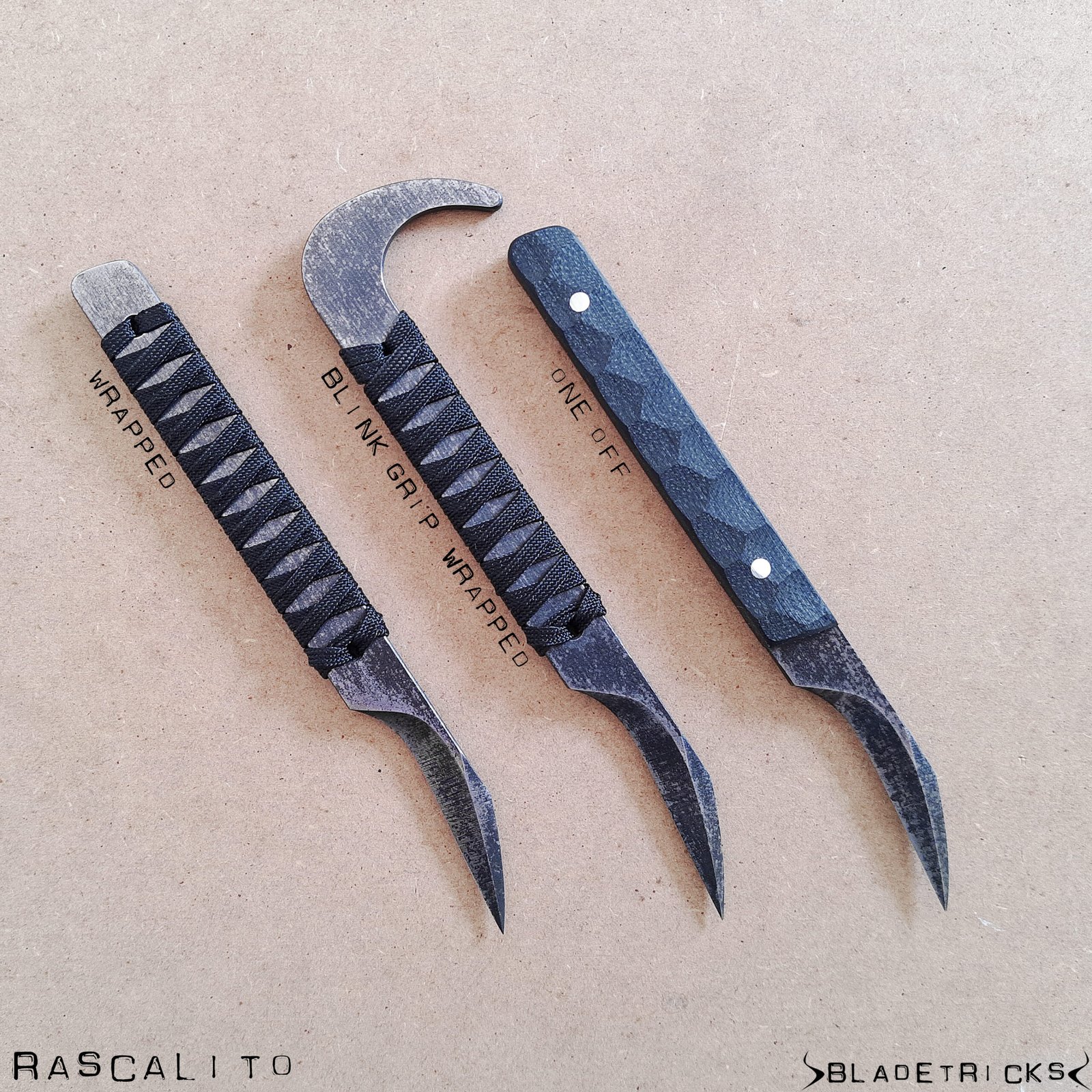
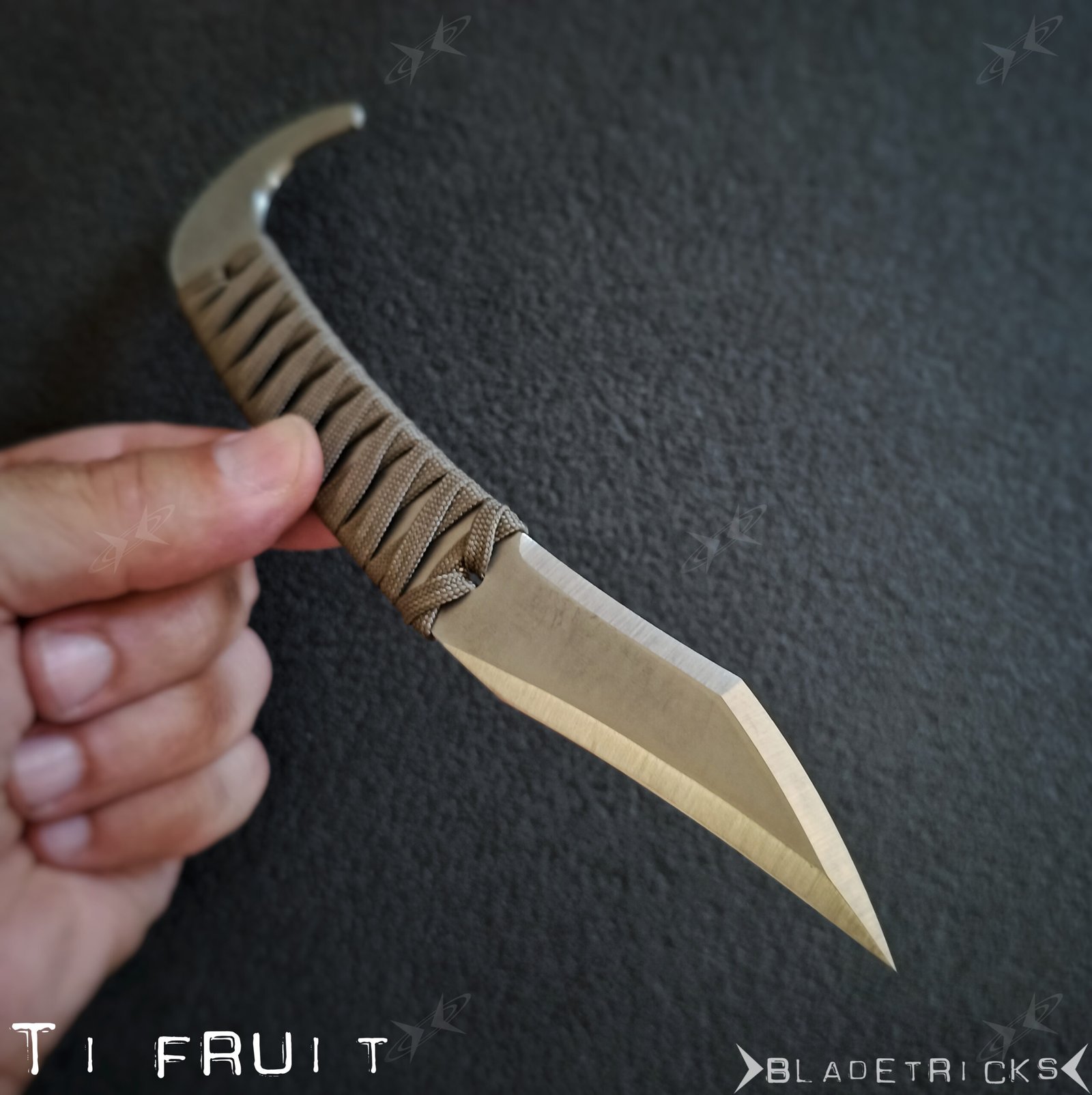
This variation appears on the Tarantula Blink Grip Karambit, the Rascalito and the Ti Fruit Pikal Knife — two tools where compactness is the priority, and where the operator’s training compensates for the reduced index point.
The Blink Grip was conceived for pikal deployment. What emerged as a secondary function was not planned — it was observed.
In a traditional sabre grip, the open ring section acts as a pinky choil. The constriction of the pinky finger around the lower horn locks the handle firmly in the hand — the same mechanical principle as a traditional choil, applied at the pommel end rather than the ricasso. A system built entirely for one technique turned out to improve the other. This is what happens when geometry is correct rather than merely adequate.
Custom F2 Dagger with Blink Grip Handle Sabre Grip
The Buzz: The Same Principle, Subcompact Scale
The same index finger reading principle that drives the Blink Grip extends into an entirely different format: the Buzz family of compact fast draw EDC tools.
Where the Blink Grip was developed for pikal, karambit platforms, and larger dagger formats, the Buzz applies the same logic to pocket and last-ditch carry — tools small enough to disappear entirely until the moment they are needed. The handle geometry is specialized for subcompact dimensions, but the underlying principle is identical: the index finger reads the handle, the hand closes, the tool is correctly oriented without a conscious orientation step.
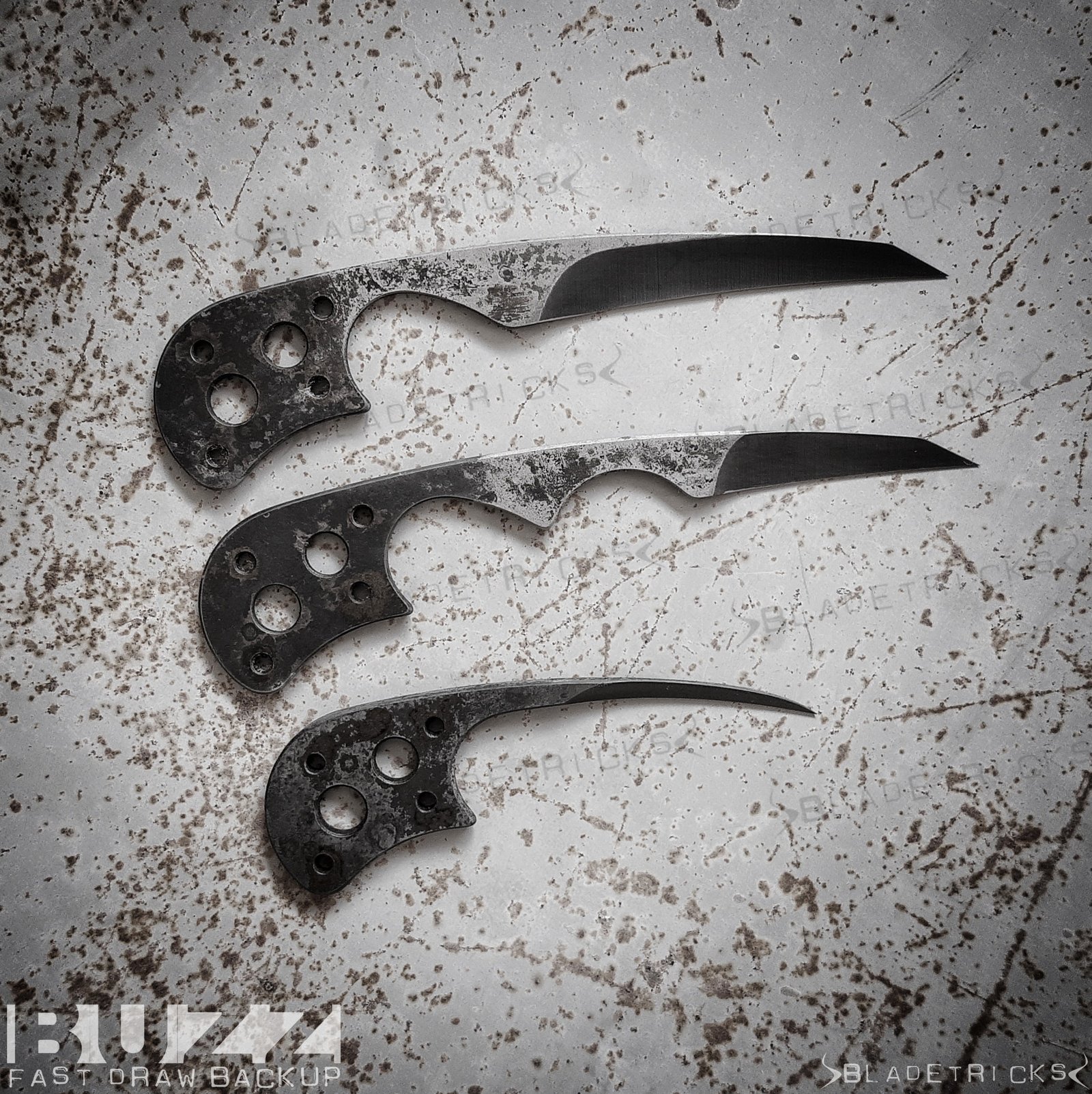
The Buzz family currently includes three models. All three are designed primarily for sabre grip — the Buzz Model 1 adds push dagger as a secondary option, the Buzz Model 2 extends that further with reverse grip edge out, and the Buzz Model 3 is the smallest of the three, an icepick format built for absolute minimum footprint.
Three tools. One principle. Different scales, different missions, same index finger doing the same work.
Buzz Fast Draw EDC Subcompact knives
A Note on Imitation
The Blink Grip has become a global reference point for pikal and self-defense knife design. I note this without particular enthusiasm. The concept has been adopted widely, adapted freely, and credited rarely. The same applies to other original Bladetricks designs that have since entered the general vocabulary of the tactical market — the Ice Pry and its karambit variant, both part of the catalogue since 2010 and both now widely referenced as if the concept had always existed. This is the tax levied on original work in a market that moves fast and reads slowly. The copies are recognizable. The originals remain the originals.
For a deeper understanding of the pikal system the Blink Grip was built to serve, the analysis of pikal biomechanics and anatomy is the place to start.
Tactical Icepick Design: The Bladetricks Approach to Simplicity and Performance
Every Bladetricks icepick is built around a single truth: under extreme duress, simplicity is the only thing that doesn’t fail you.
I have spent equal time refining the Pikal — arguably the most efficient system for the trained professional — but a specialized blade is not the ideal solution for everyone. The icepick is. What most people don’t realize is that the two are not separate philosophies. They share the same foundation: the reverse grip, the same instinctive thrusting mechanics, and the same commitment to concealable, low-profile carry. If anything, the icepick is the primitive ancestor of what later became codified as Pikal — the same body logic, stripped to its most essential form, centuries before Filipino martial arts gave it a name. I have written about this in depth in my analysis of Pikal biomechanics and anatomy — if you are serious about understanding the reverse grip, that is where to start.
Both rely on gross motor movements. Both are thrust-dominant. Both are built for close-quarters encounters where fine motor skills have already degraded. The icepick simply removes every variable that could introduce failure. It requires no edge alignment, no mechanical setup, no rehearsed grip sequence. It mirrors the body’s most basic defensive instinct. That is not a limitation — it is the design.
A Concept Unchanged. An Execution Refined.
The icepick was not designed as a weapon. That is worth stating plainly, because it is precisely what makes it interesting.
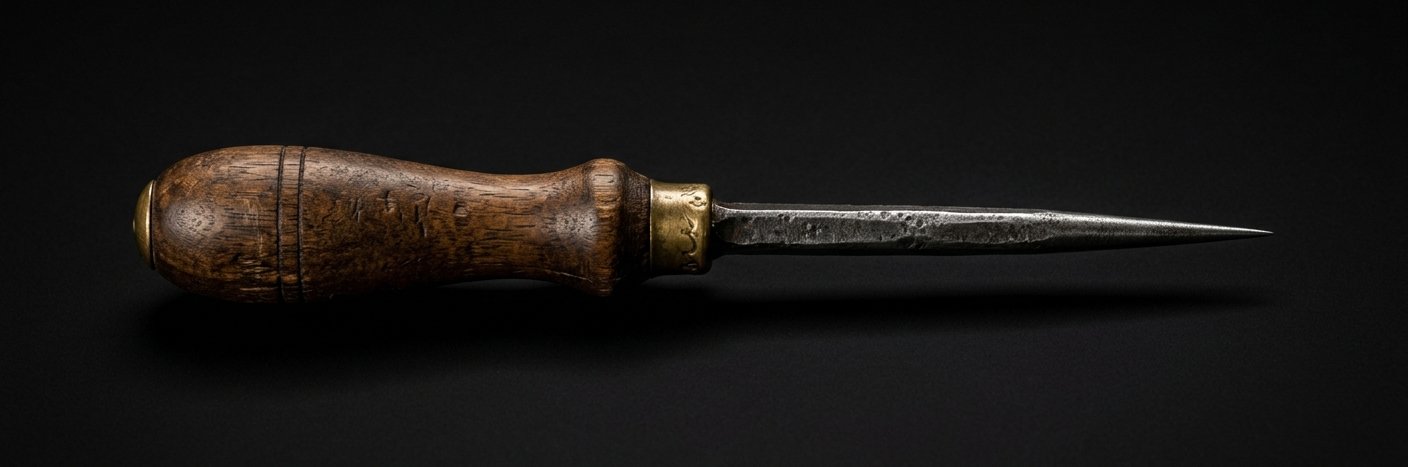
Vintage Traditional Ice Pick Tool
In the 1800s, before mechanical refrigeration, ice was harvested from frozen lakes and rivers, stored in insulated warehouses, and distributed to homes across the United States. The icepick was the domestic tool used to break and portion those blocks — a pointed metal spike on a wooden handle, unchanged in concept from the day it was made. When refrigeration rendered it obsolete in the kitchen, it did not disappear. It simply changed hands.
A single hardened point, aligned with the forearm, driven by the body’s most instinctive motion. The concept needed no revision. What it needed — and what over a decade of full-time making has been dedicated to — is an execution worthy of that concept.
The Historical Pedigree: Why the Icepick Has Always Worked
The icepick’s transition from domestic tool to weapon of choice required no modification whatsoever. That fact was not lost on professionals who understood what mattered in a close-quarters encounter.
Most notoriously, Murder Inc. — the enforcement arm of the National Crime Syndicate, active from 1929 to 1941 and believed responsible for up to 1,000 contract killings — made the icepick a signature instrument. Not because it was dramatic. Because it was silent, easily concealed, and required zero mechanical setup. Their most feared operator, Abe “Kid Twist” Reles, was reportedly so skilled with it that he could make victims appear to have died of natural causes. A brain hemorrhage, specifically. The medical examiners of 1930s Brooklyn were, on occasion, not looking for what they should have been looking for.
This was not aesthetics. It was a professional community’s cold conclusion that simplicity, concealment, and penetrating reliability outperformed complexity in every real-world scenario. Nobody handed Reles an instruction manual. Nobody needed to.
The Bladetricks icepick designs carry that same logic forward — stripped of ornamentation, optimized for the same purpose, and built for people who understand why that matters.
The Pikal Connection: One Grip, Two Expressions
The word Pikal comes from the Visayan dialect of the Philippines and literally means “to rip.” In the tribal fighting arts of the Philippines — specifically the Pekiti Tirsia system within Kali — it describes holding a knife in a reverse grip, also known as the icepick grip, with the edge inverted toward the user.
Bladetricks Fratello Pikal Knife Blade Detail
That detail is the one most people overlook: the icepick grip and the pakal grip are the same grip. The icepick predates the formalized Pikal system by centuries. It is the original expression of what Filipino martial arts later refined into a complete combat methodology — the same body mechanics, the same instinctive thrusting logic, the same gross motor reliance that holds up when the sympathetic nervous system has taken over and fine motor control is no longer a realistic expectation.
Voodoo ice pick, reverse grip
Both are thrust-dominant. Both are designed for close-quarters encounters. Both are built around the understanding that under life-threatening stress, the body will do what it knows how to do — and what it knows how to do is drive forward.
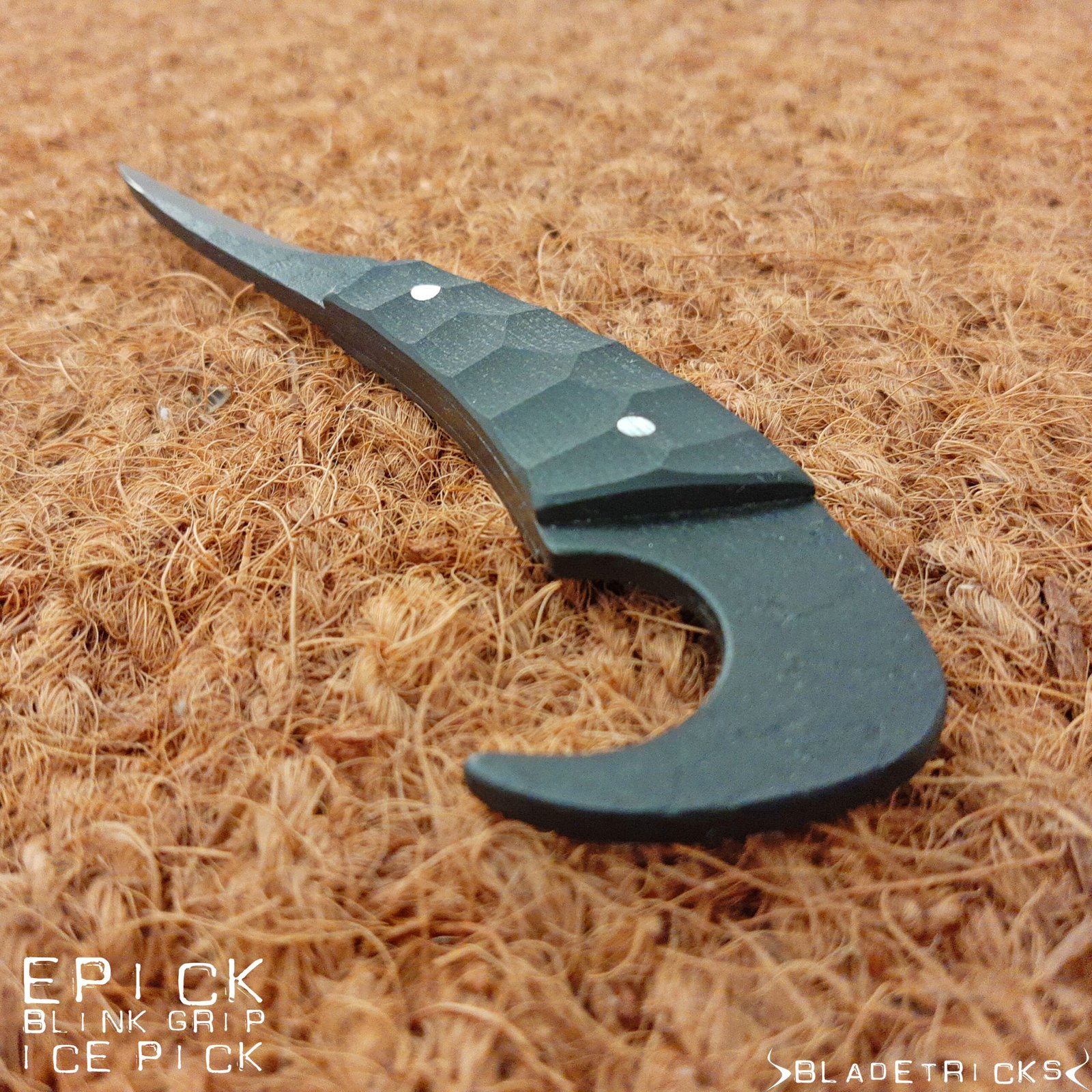
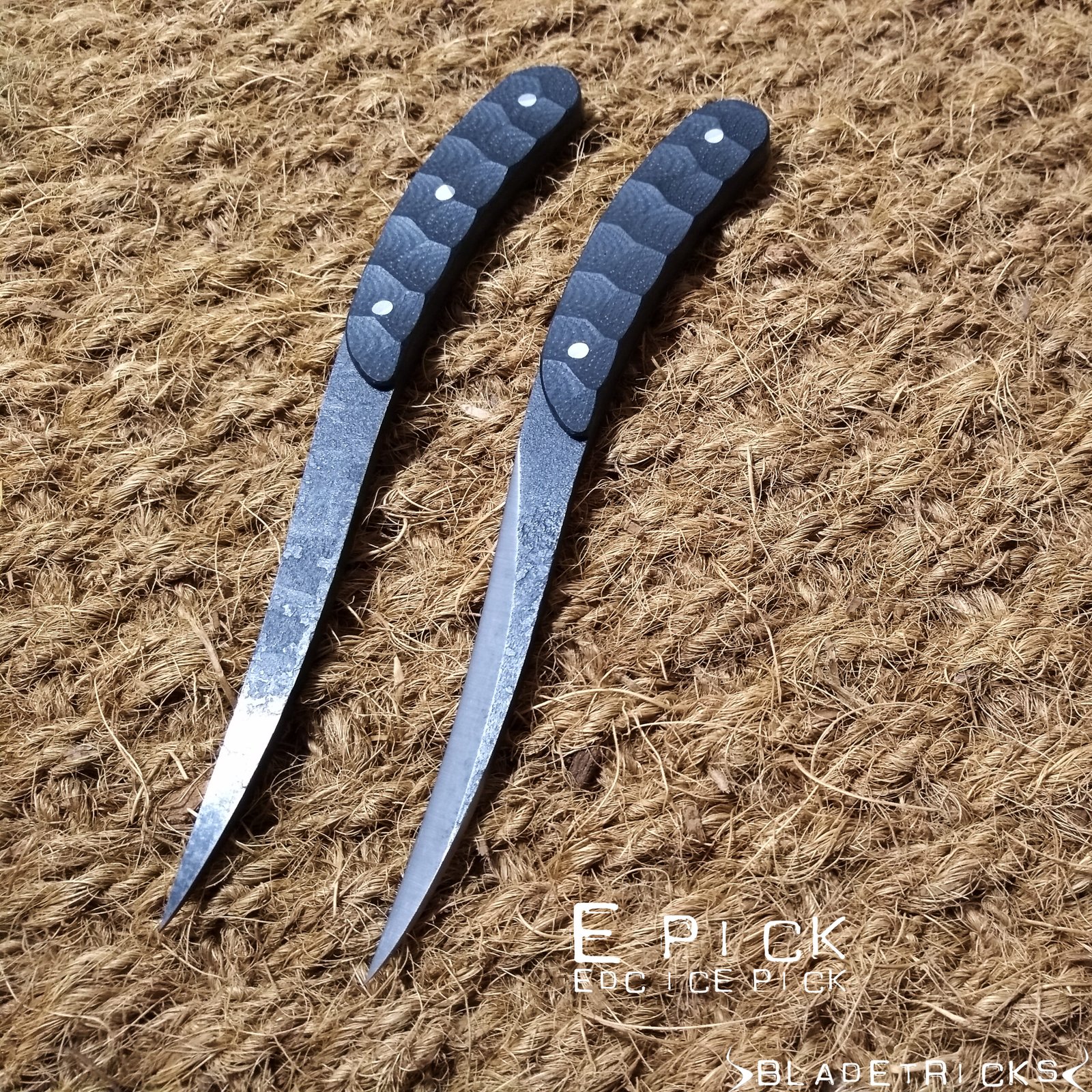
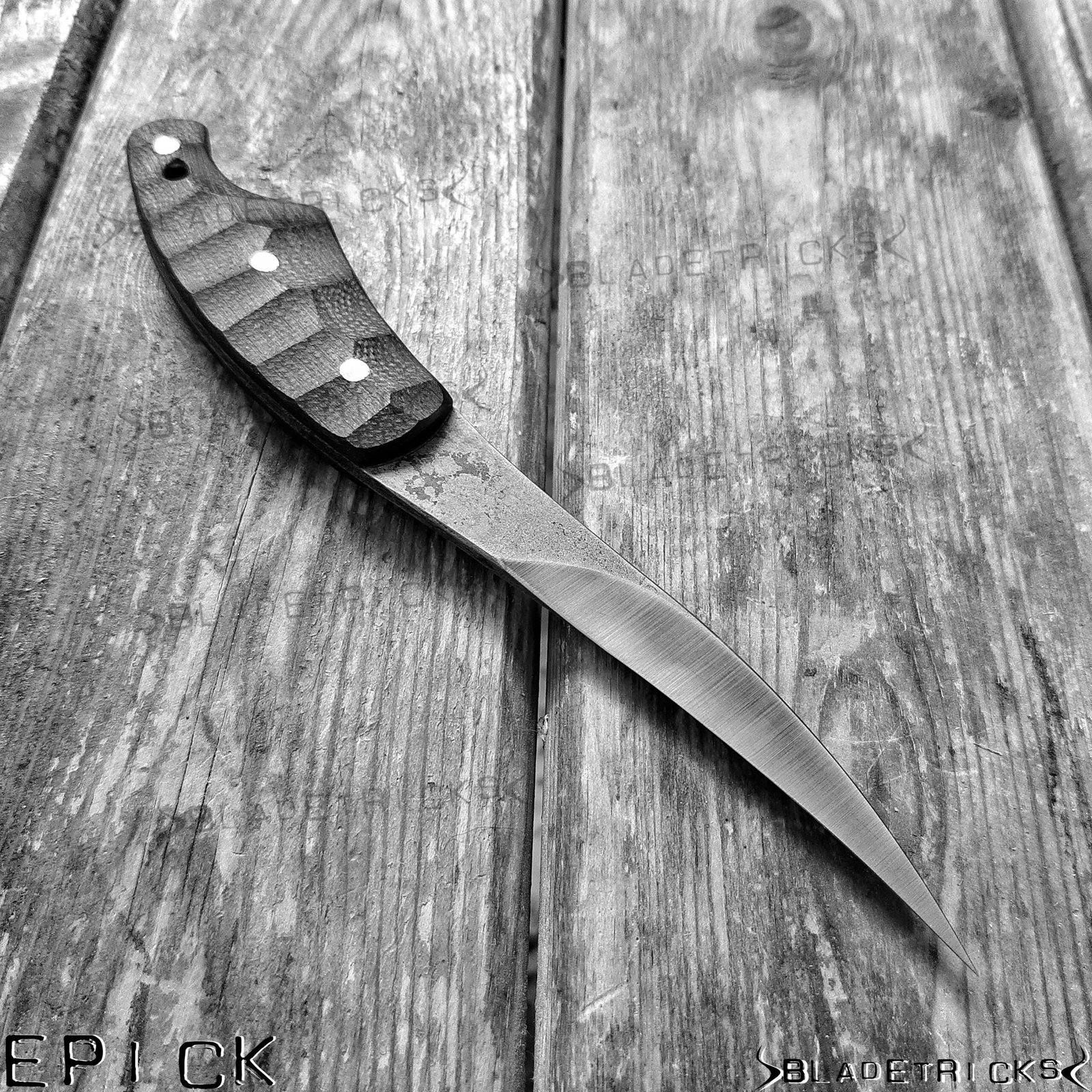
Bladetricks Epick Pikal Knife and tactical icepick
The Pikal adds an edge, a refined geometry, and a trained pulling mechanic. The icepick removes the edge entirely — and with it, every maintenance burden, legal complication, and training dependency. For the right user, that is not a downgrade. It is the point.
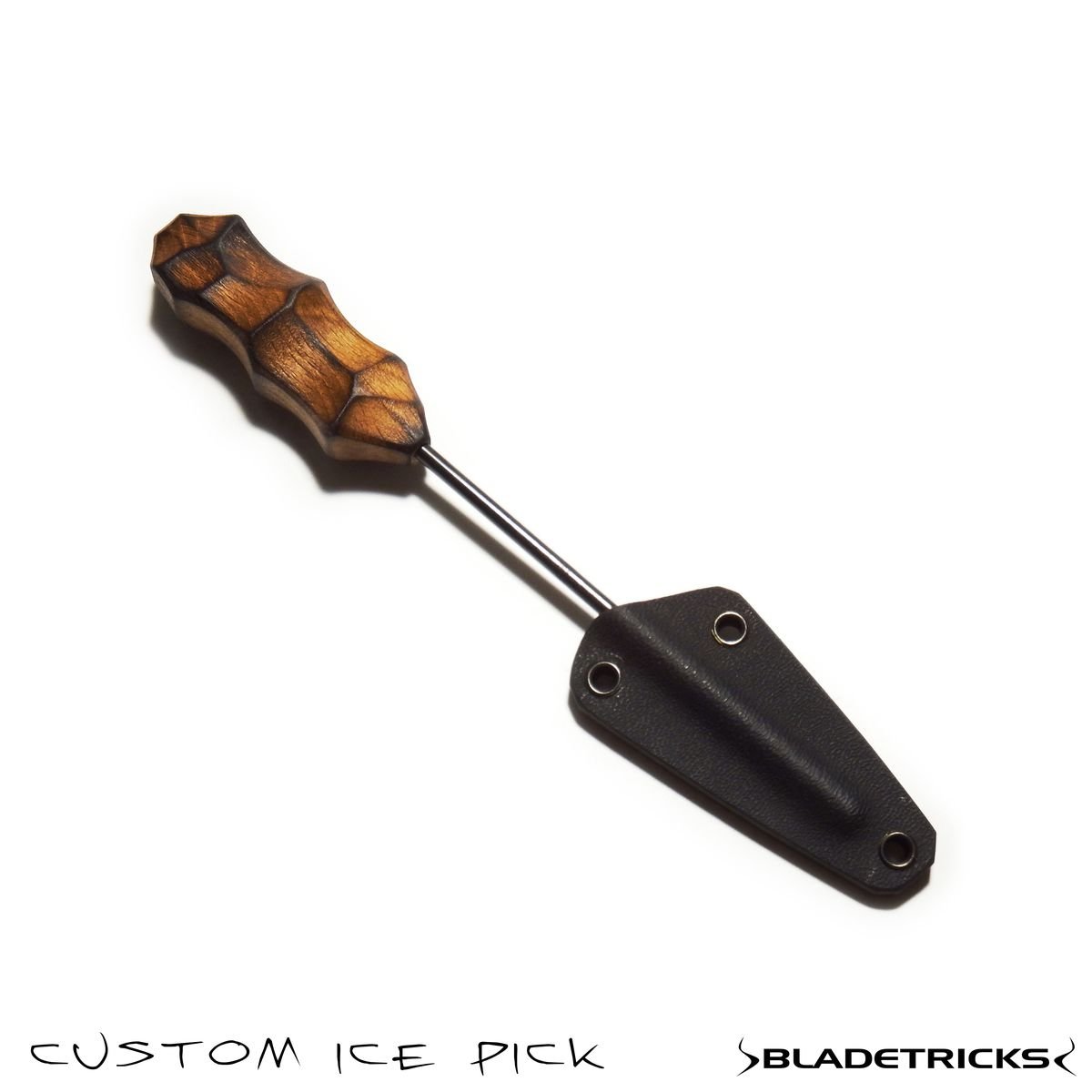
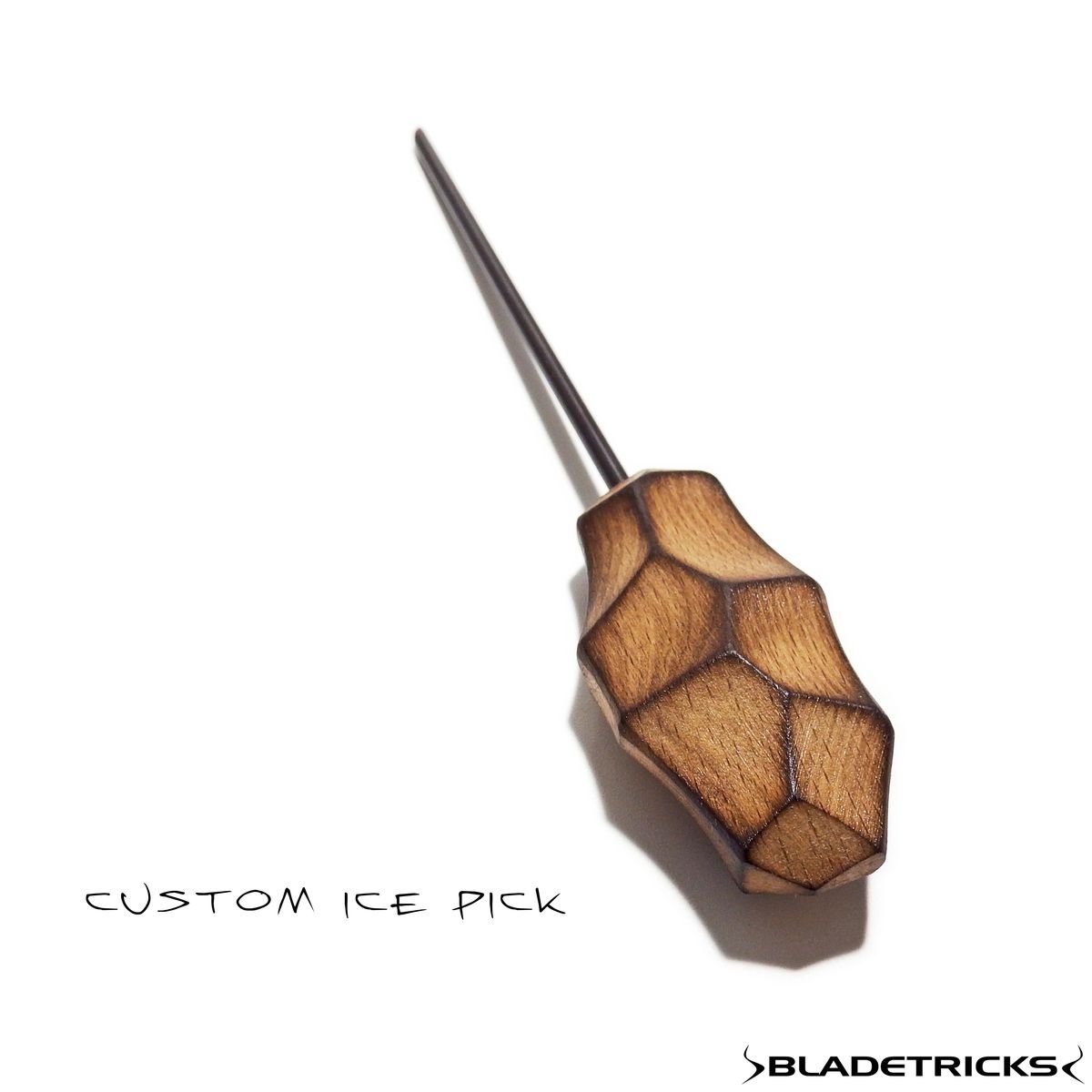
Bladetricks Custom Traditional EDC Icepick, Beech Wood Handle
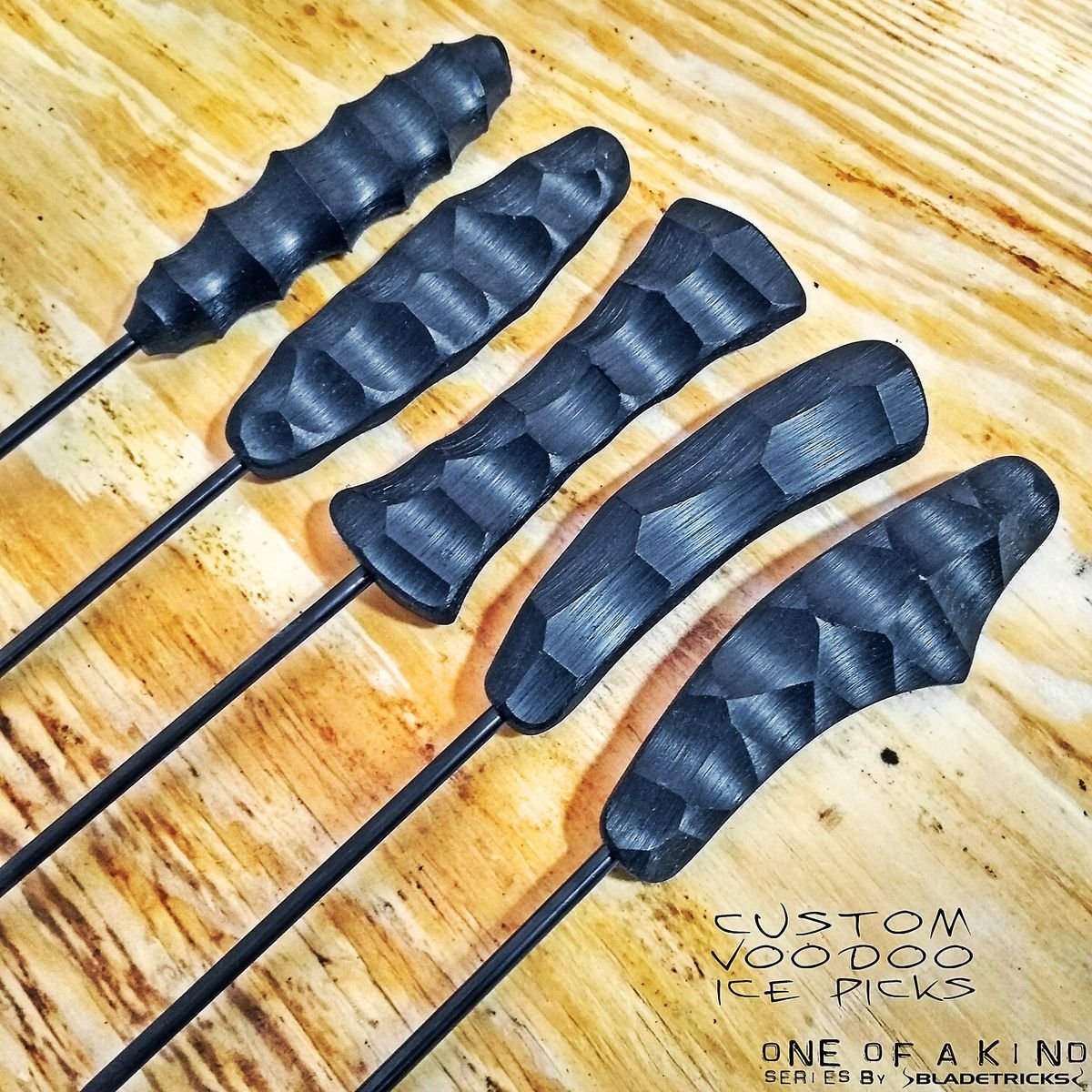
The Traditional Spike: Bladetricks Custom Voodoo Icepick Series
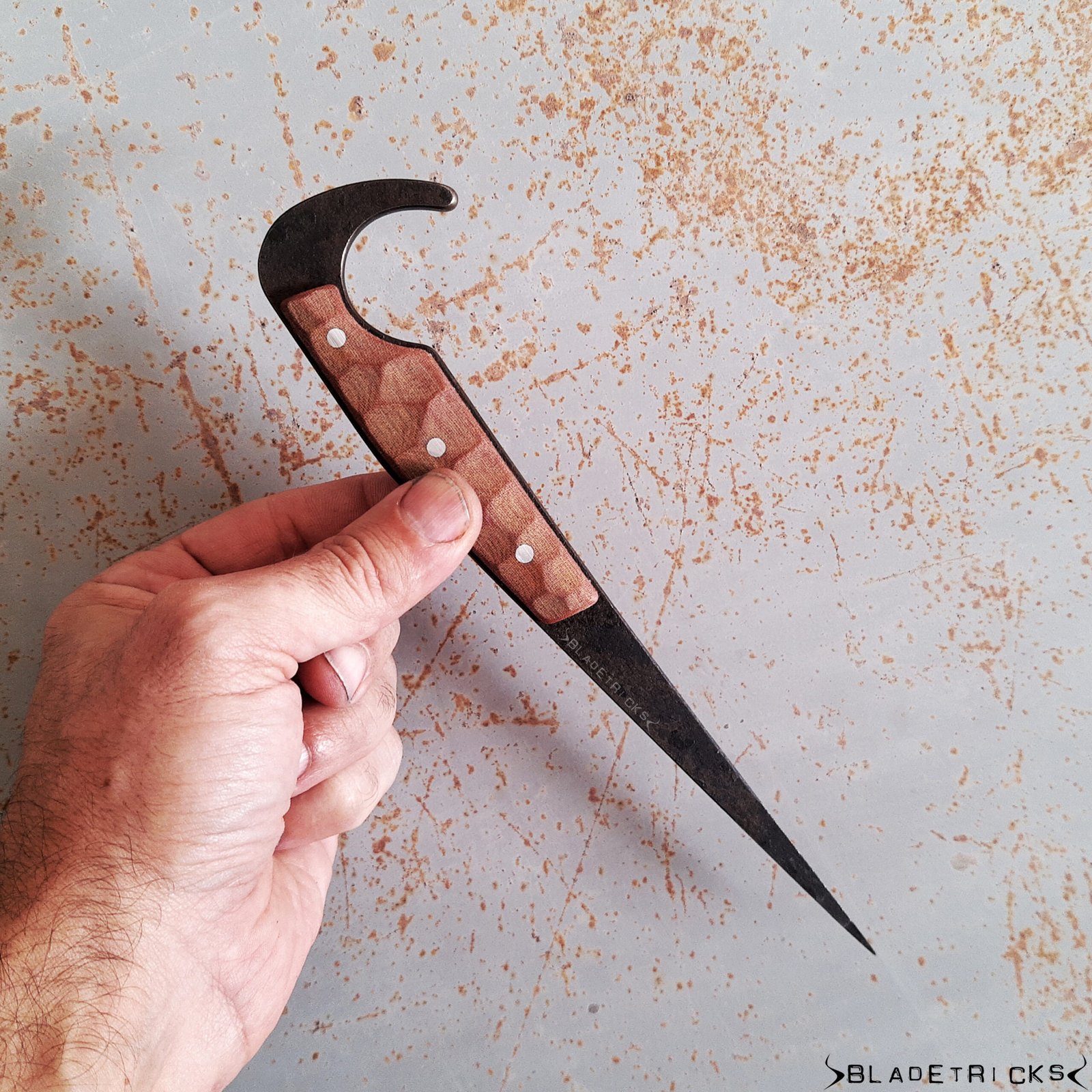
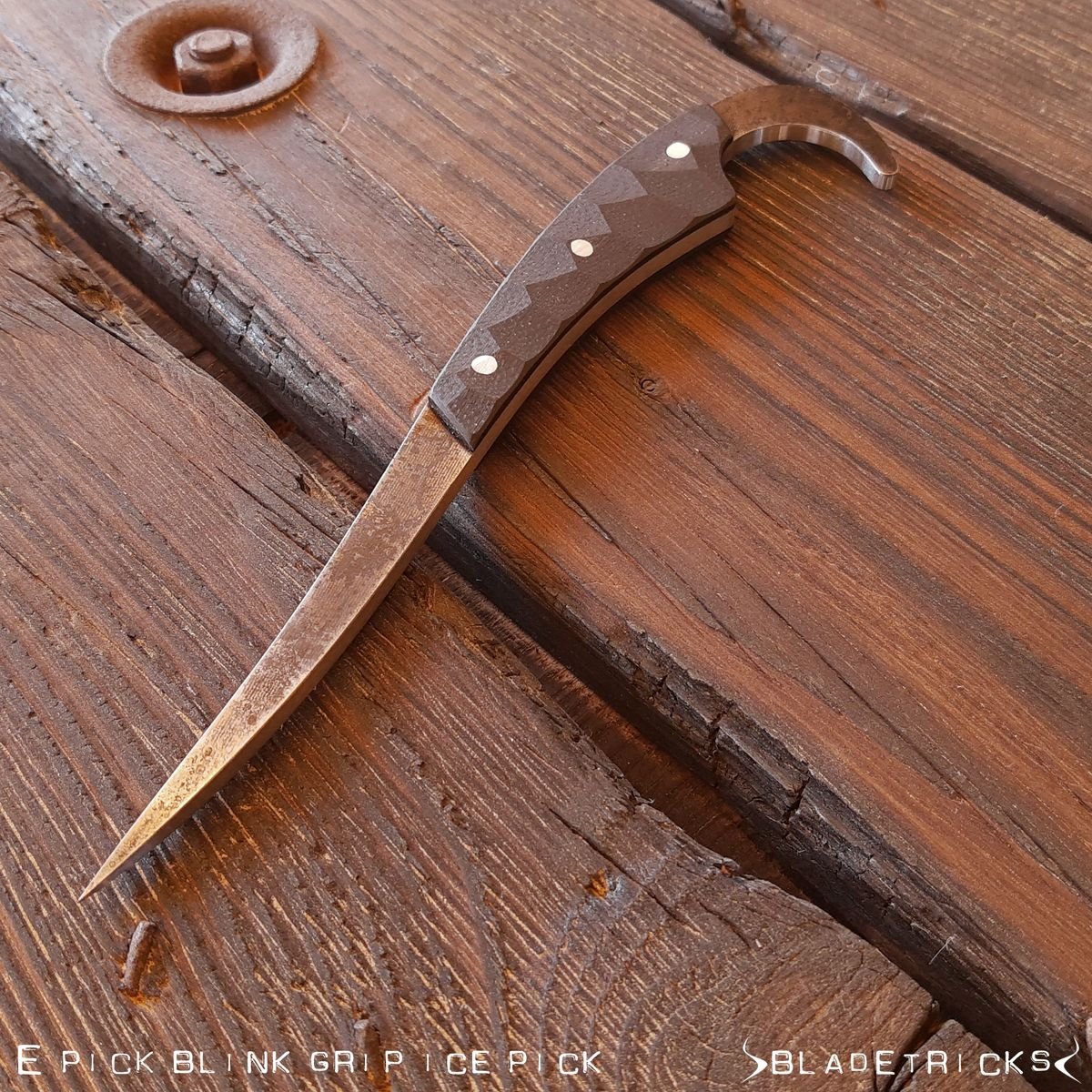
The Bladetricks lineup carries this lineage forward across several purpose-built designs: the Voodoo, the Epick, the Tusk, and the Tarantula Karambit Icepick. Each represents a specific application within the reverse-grip family — from the specialized reach of the Tusk Tarantula to the refined concealability of the Epick. No maintenance. No variables. No failure modes.
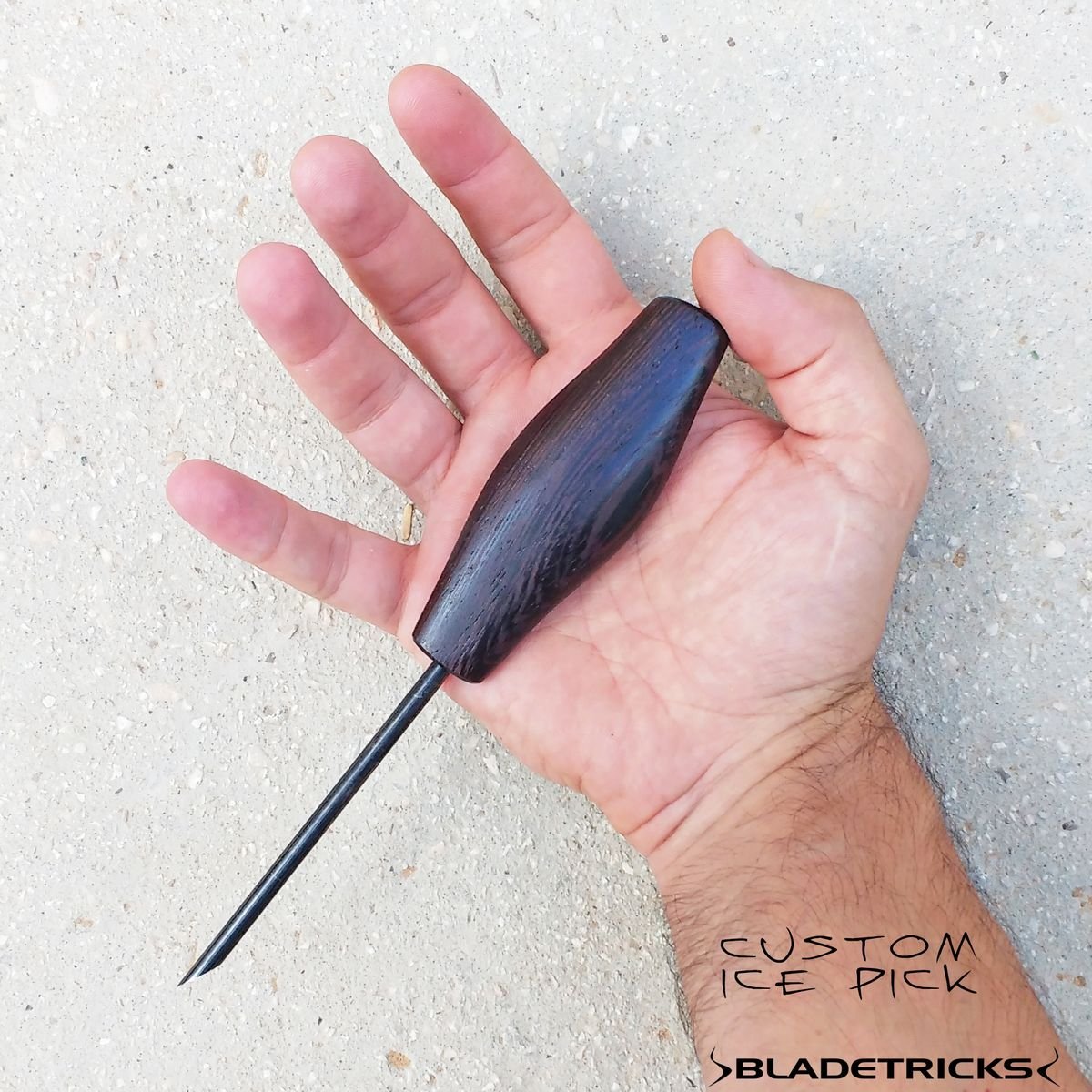
Wenge Handle, Bladetricks Custom Ice Pick
These are definitive last-ditch tools for both the trained professional and those new to defensive carry.
Bladetricks Custom Voodoo Icepick Polymer Handle
Bladetricks Polymer Icepick Handles
The Push Icepick: Power Through Structure
For those who prefer the ergonomics of a push dagger combined with the penetration of a spike, the Bladetricks Push Icepick family offers a distinct mechanical advantage. By aligning the spike with the forearm’s natural skeletal axis, these tools deliver power and retention that is extremely difficult to compromise.
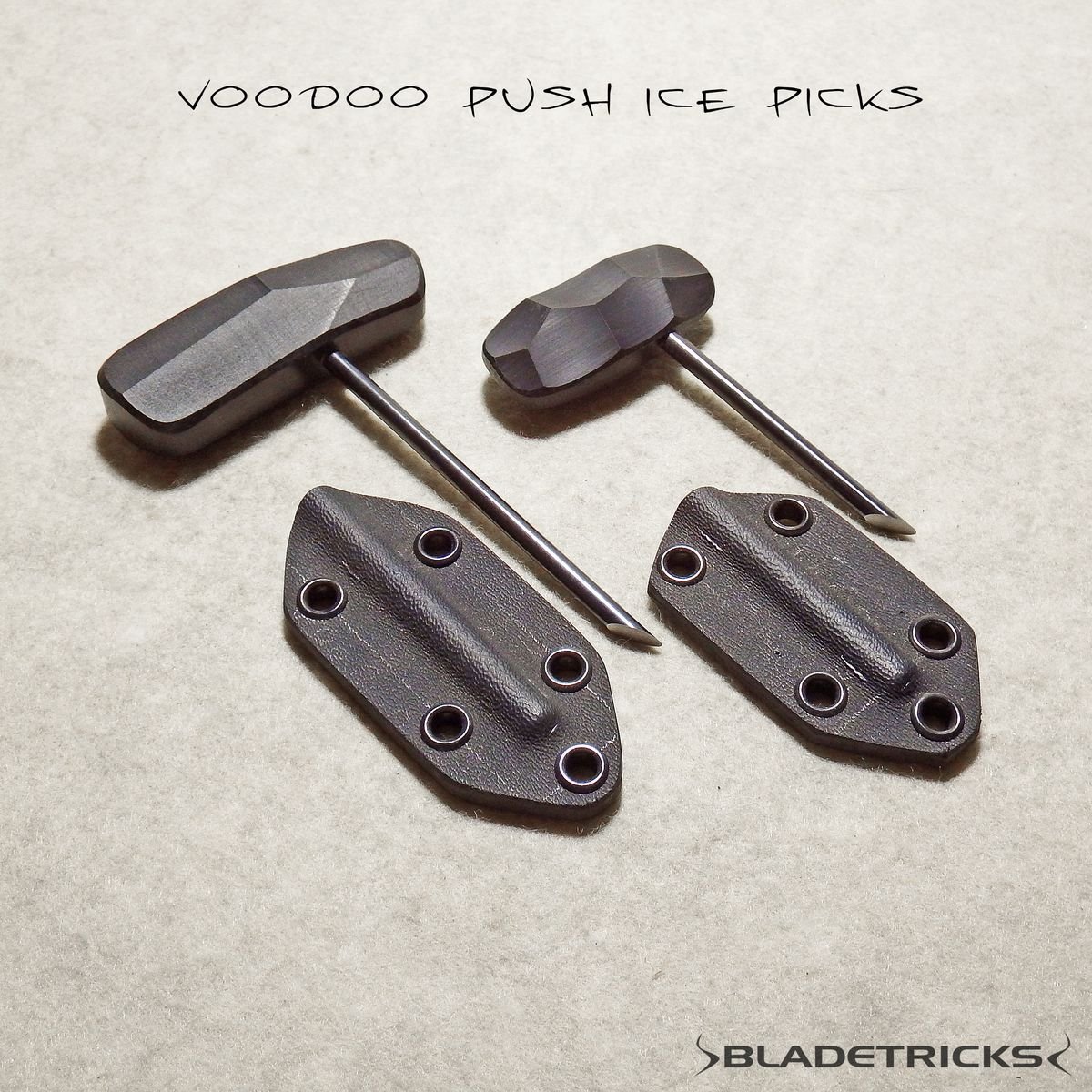
Bladetricks Voodoo Push Ice Picks
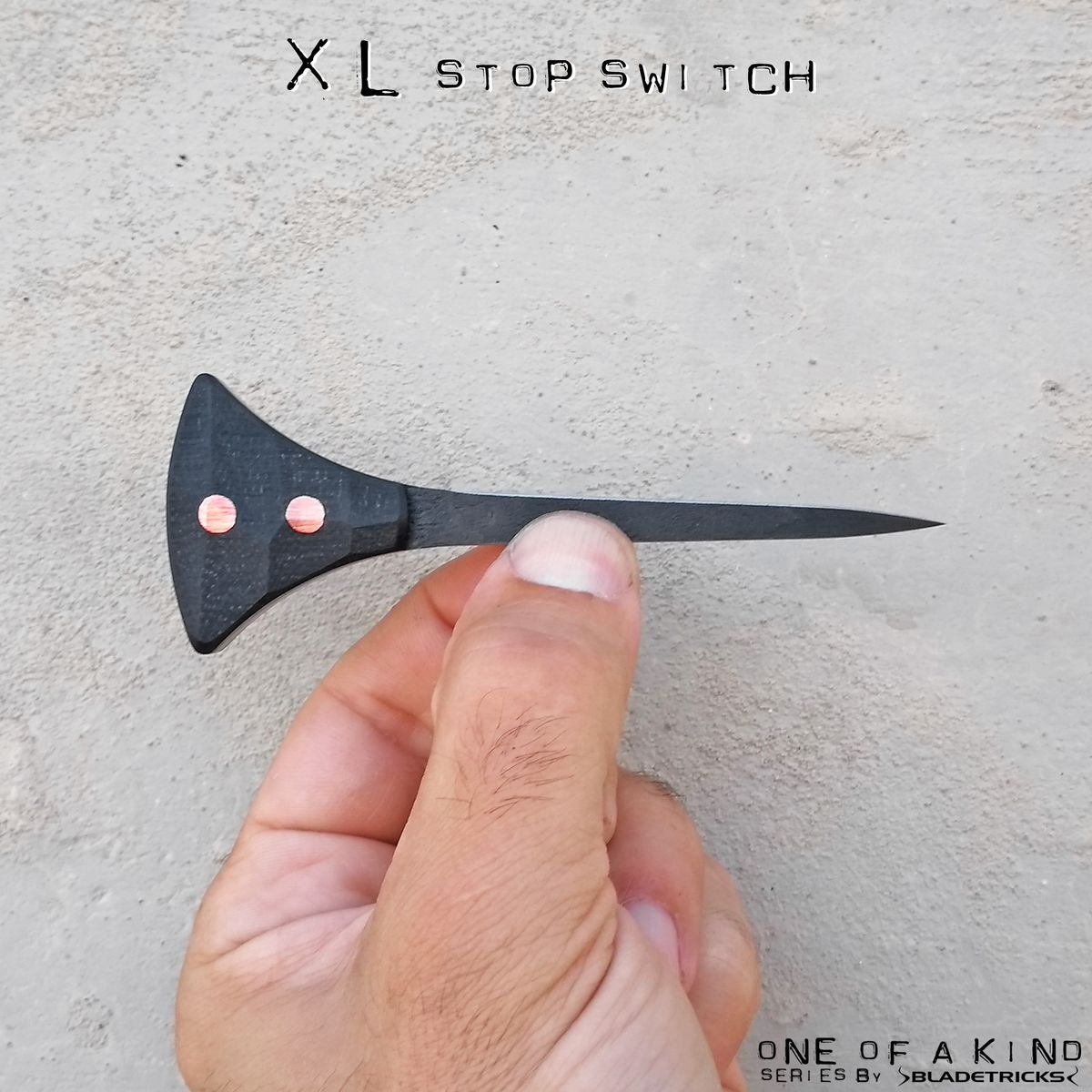
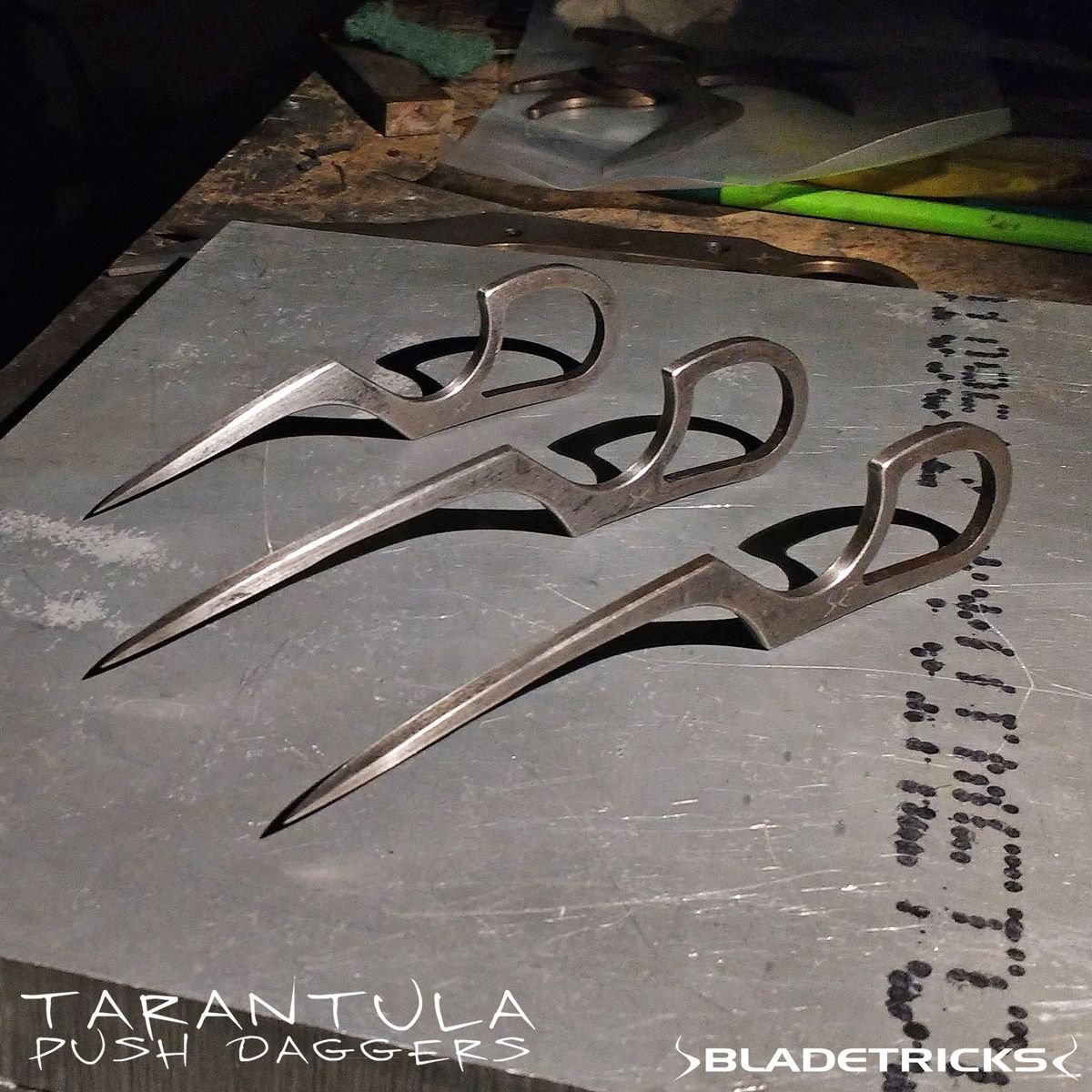
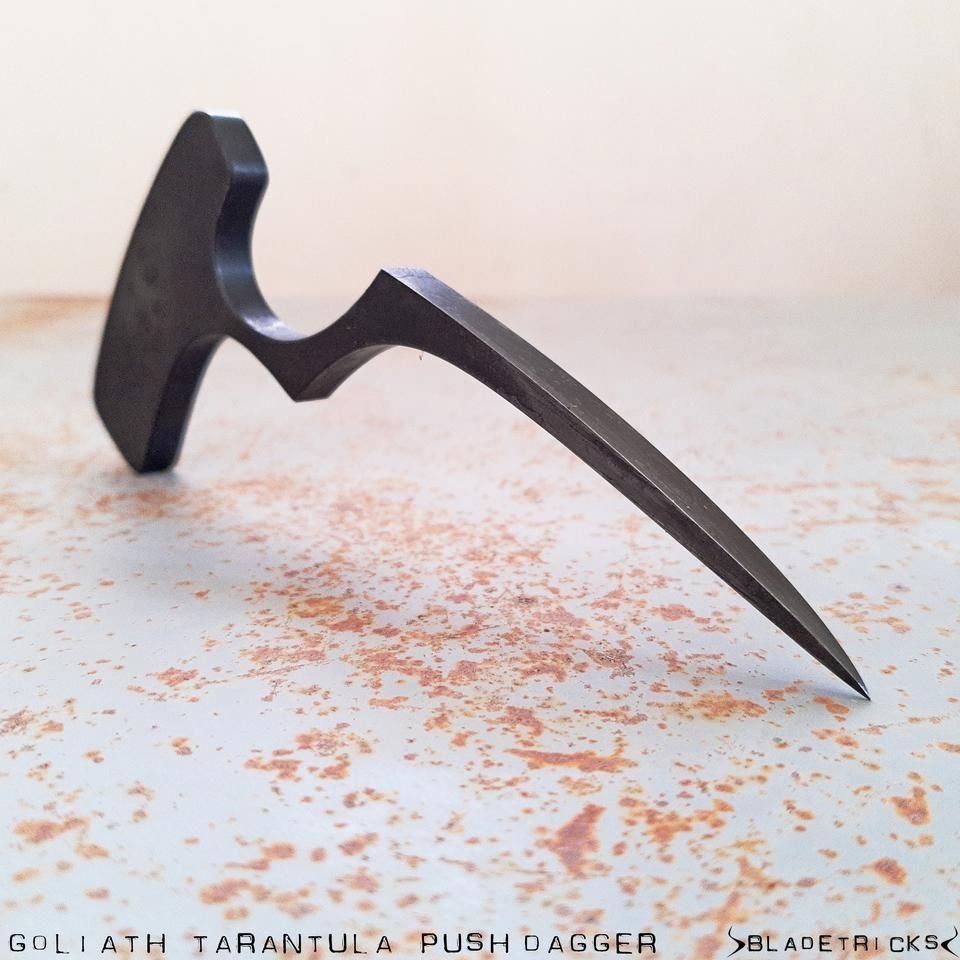
The family includes the Stop Switch, the Tarantula, the Goliath, and the Voodoo Push Icepick. They are all built as direct extensions of the fist — the most natural human movement becomes the most effective defensive motion.
AN Nash XL Stop Switch Push Icepick, Black G10 and Copper Pins
Chisel Tip Geometry: A Technical Standard Worth Understanding
While most icepick makers pursued the traditional conical tip, the chisel grind tip was a deliberate departure — a geometry I developed early in my work as a maker, one that is now gaining recognition as a performance standard.
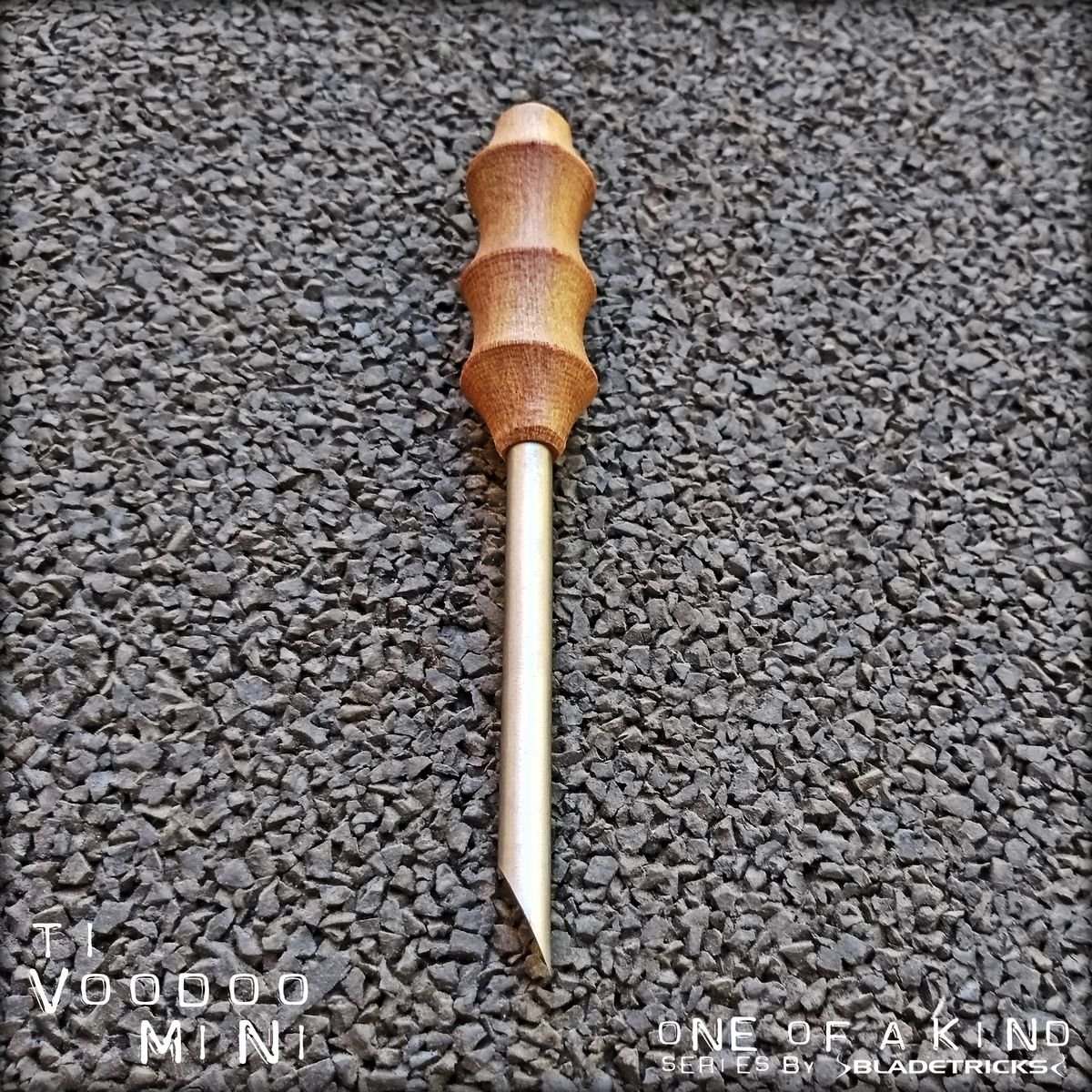
Bladetricks Mini Voodoo Icepick, Titanium and Micarta
Why chisel geometry outperforms the conical tip
The advantages are practical. A chisel tip is significantly easier to maintain and field-sharpen than a conical point. It also produces a mechanically distinct wound opening and subsequent wound channel: rather than displacing and compressing tissue — which can create friction and resistance on extraction — the chisel geometry creates a shearing effect. The result is a cleaner extraction stroke and more consistent stopping performance, findings supported by penetrating wound ballistics research specific to this configuration.
This geometry is now the foundation of an entire Bladetricks product philosophy.
The Ice Pry Family and Trauma Geometry
The Ice Pry tool family — including the Classic, the Mini, and the purpose-built Gen 2 — applies chisel tip logic to a dual-purpose platform. The flat tip enables high-leverage prying and delivers significant mechanical effect upon entry. Two functions, one tool.
Bladetricks Classic Ice Pry EDC Tools
Retention and fast-draw variants
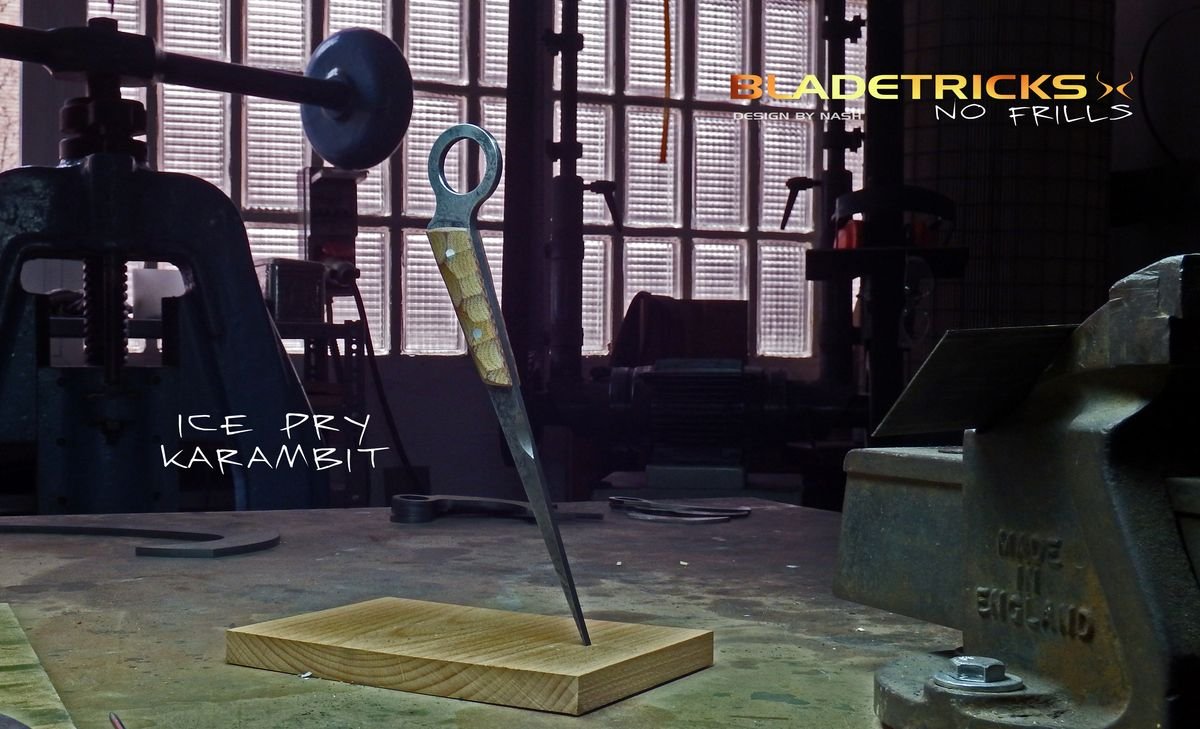
For those who prioritize secure retention and purpose-built combat geometry, the Ice Pry Karambit integrates a safety ring. The Blink Grip Ice Pry uses a proprietary blind-indexing system refined through continuous iteration — designed for extreme fast draw without looking, and now a reference point for the category.
Classic Ice Pry Karamit, Micarta
Bladetricks Tarantula Icepick Karambit
Bladetricks Ice Pry Karambit with Blink Grip Fast Draw Handle
Epick Blink Grip Fast Draw Icepick
The DAK Ice Pry: Same Logic, Dominant Hand
The DAK Ice Pry is what happens when the Classic Ice Pry’s proven utility meets a handle built for full presence rather than concealment. Where the Classic and Gen 2 are tools that disappear into the carry, the DAK makes no attempt to hide — it is sized and shaped like a full-grip knife, carried and held with authority. I conceived it by integrating the original Ice Pry platform with the ergonomic handle profile of the Bladetricks DAK Dagger — wider, slip-proof, more substantial. The hand has nowhere to go. Under force, it stays exactly where it is, with no risk of sliding toward the tip.
The same functions, the same chisel tip logic, the same reliability — in a format that prioritizes control over concealability.
Three versions address three distinct requirements: the Original at 224mm preserves the reach of the Classic; the Compact at 198mm reduces the footprint without sacrificing the handle character; the Max shares the Compact’s length but adds width, increasing robustness for more demanding applications. Same lineage. Different scales. The Ice Pry logic holds across all three.
The Micro Bevel series: edgeless, purpose-built
This principle of purposeful tip geometry extends into the Bladetricks Micro Bevel series. Tools like the XL Micro Bevel Karambit are entirely edgeless — eliminating maintenance requirements and legal carry concerns — while still delivering maximum penetrating effect through the multi-purpose tip. It is a refined transition from pure piercing to structural compromise.
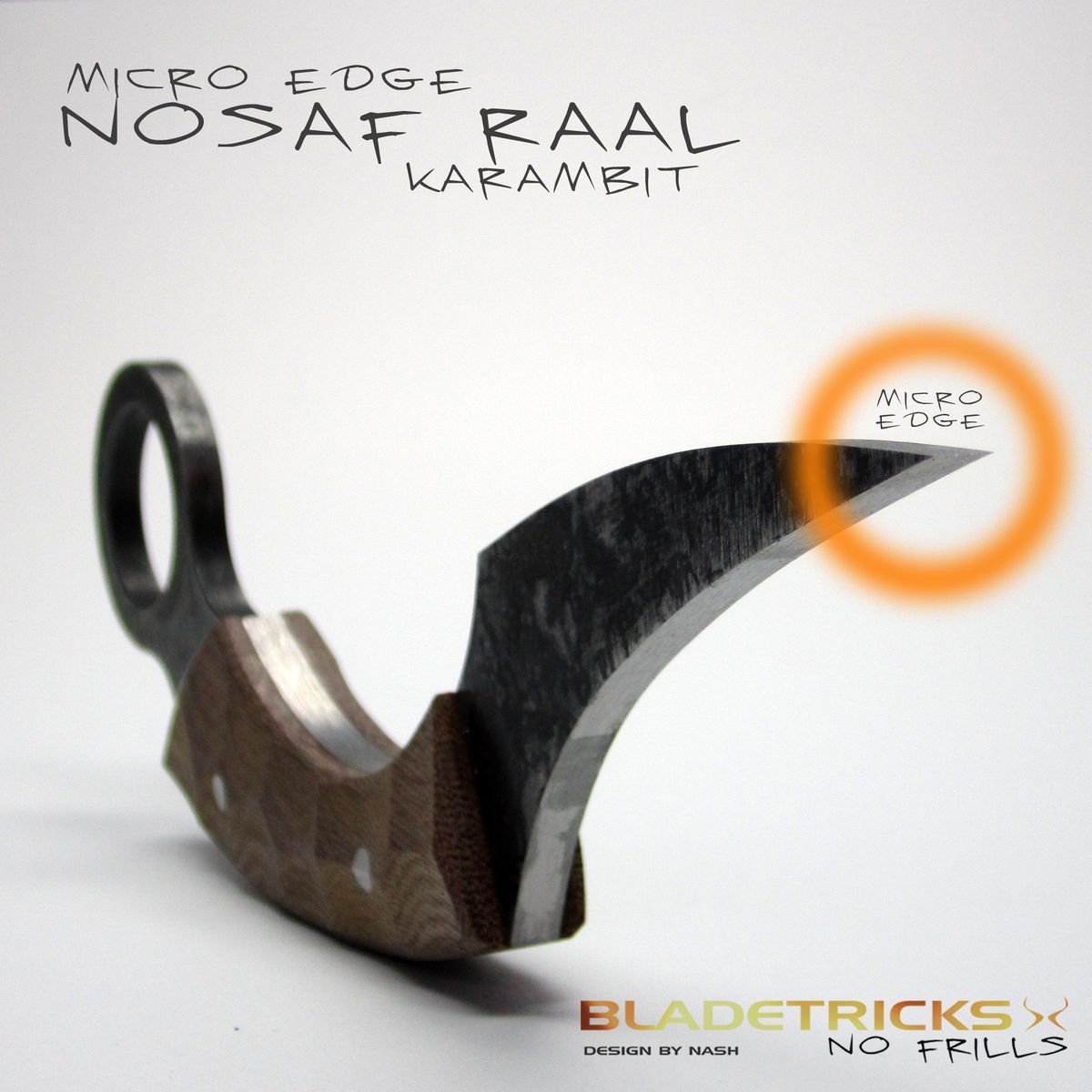
Bladetricks Micro Edge Nosaf Raal Karambit, Tip Detail
Who the Icepick Is For
I recommend icepick designs regularly to those with physical limitations, those still building their training base, or those who need a carry option that is virtually weightless and invisible. It is the equalizer for the less experienced and a reliable secondary for the professional.
In a market crowded with over-engineered solutions, the Bladetricks icepick is a case for doing one thing with complete precision. The 1800s got the concept right. The execution is what continuous refinement is for.
Innovating icepick design since 2010.— A.N. Nash | Bladetricks
Pikal System: The Best Mechanical Efficiency in Close Combat
It is not an aesthetic. It is beyond a fashion. It is a cold application of biomechanics. Derived from the Visayan term meaning “to rip,” this knife fighting technique uses a Reverse Grip Edge In (RGEI) orientation. While the market is currently saturated with derivatives, the foundation of the modern RGEI movement relies on a rigorous application of physics that I have advocated since founding Bladetricks in 2010.
The primary advantage of a pikal knife or tool is its alignment with the human body’s natural tendency to contract under extreme stress. Standard sabre grips rely on the extension of the tricep, which is prone to failure in a clinch. Conversely, this grip engages the latissimus dorsi and the biceps — the largest pulling muscles in the upper body. By drawing the blade toward the body, the operator generates a kinetic force that is difficult to intercept.
Research on sympathetic nervous system activation under life-threatening stress is unambiguous: above 115 beats per minute, fine motor skills begin to deteriorate; above 175, only gross motor functions remain reliably accessible. The RGEI draw and strike are gross motor movements — contracting, pulling, driving inward. They are built for the body that is already in fight-or-flight. A sabre grip technique requiring wrist rotation, controlled extension, and precise targeting is not.
In many scenarios, this creates a “lose-lose” situation for the opponent — to stop the movement, they must place themselves directly in the path of the edge. This hooking motion turns every RGEI strike into a deep incision by utilizing the torque of the core.
Small double edge pikal reverse grip knife and trainer
Epick Bladetricks Pikal Blade
Bladetricks Fratello Pikal Knife Blade Detail
Mechanical Advantage
Analytically, the RGEI configuration optimizes a kinetic strike by aligning the vector of force with the natural contraction of the arm. Unlike edge-out tools, a reverse grip edge-in knife utilizes the superior torque generated during inward movement. This mechanical advantage ensures the edge maintains contact through the entire arc of the strike, maximizing depth without requiring extra space for acceleration.
Bladetricks Custom Nosaf Raal Pikal Knife
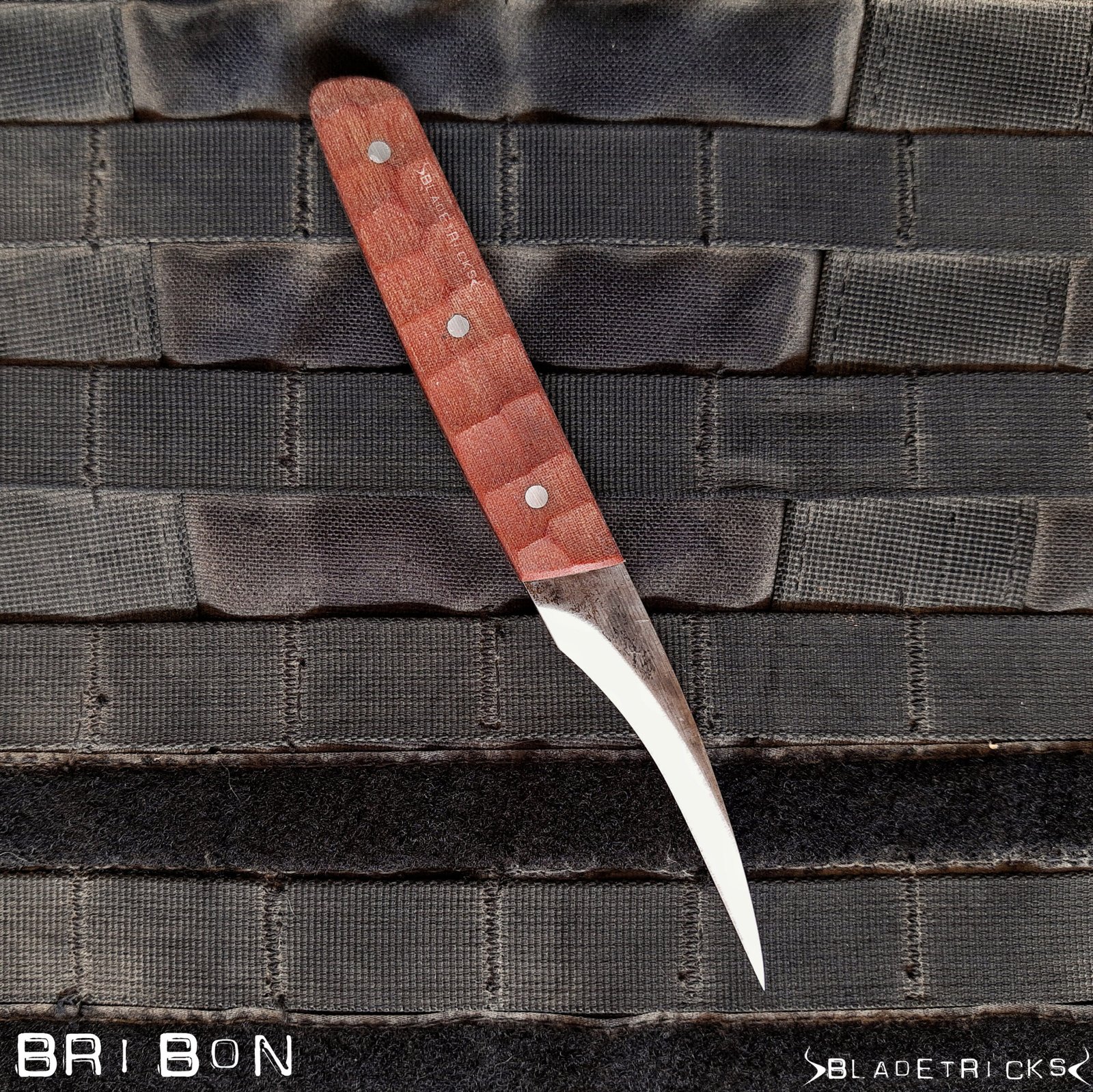
Bladetricks Bribon discreet EDC Pikal Knife
The Withdrawal: The Second Strike Built Into the First
Most discussions of this technique focus on the thrust. This is a mistake, and it reveals a surface-level understanding of what RGEI actually does. The thrust is the entry. The withdrawal is the consequence.
When a pikal blade achieves penetration, the inward pull expands the wound channel using the full force of the back and bicep, transforming a puncture into something that functions mechanically as a plow. Every structure in the blade’s path during that withdrawal — tissue, vessel, fascia — is addressed. The opponent faces a specific problem: to intercept the movement, they must place themselves directly in the path of the edge. There is no neutral option. This is the lose-lose architecture of a correctly executed reverse grip strike.
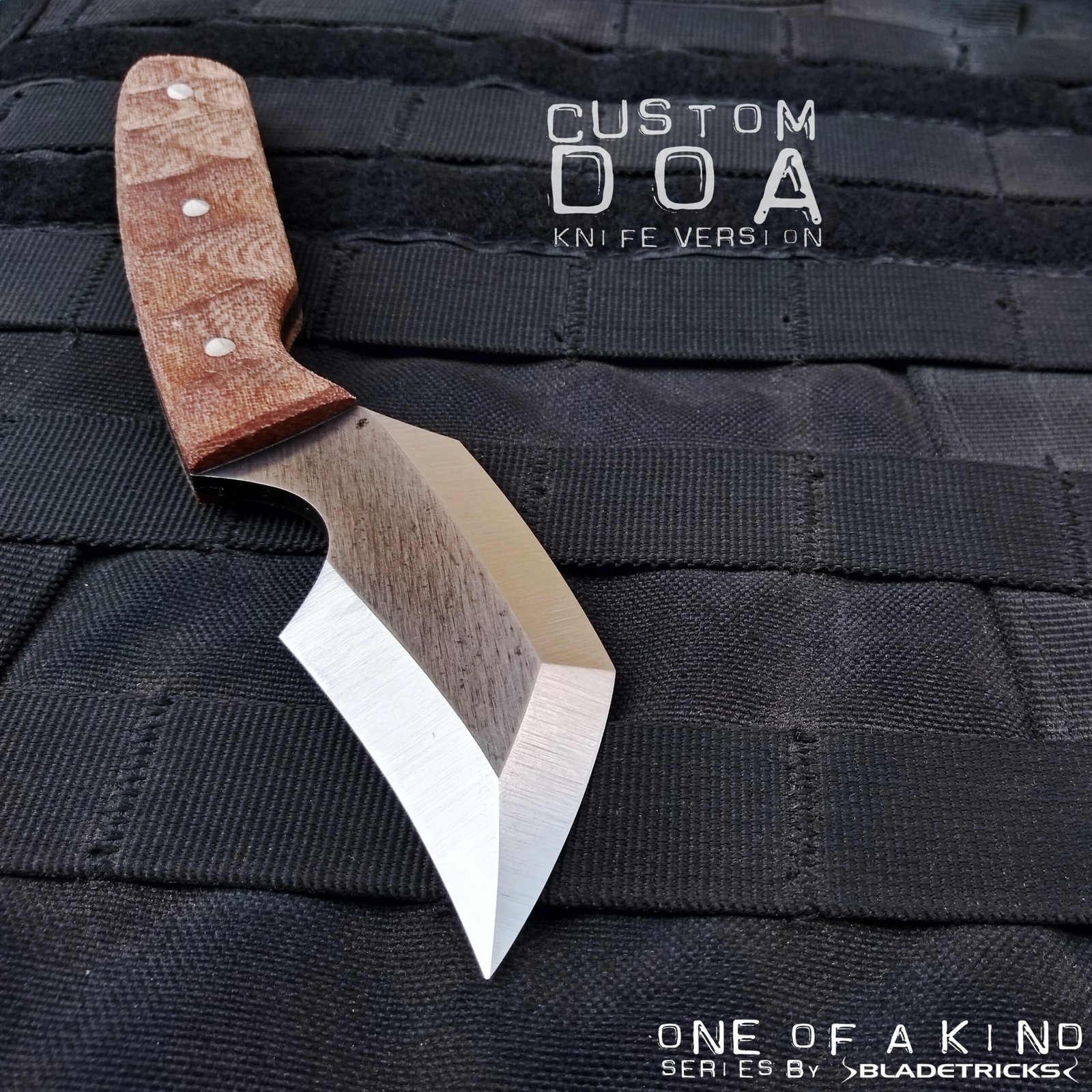
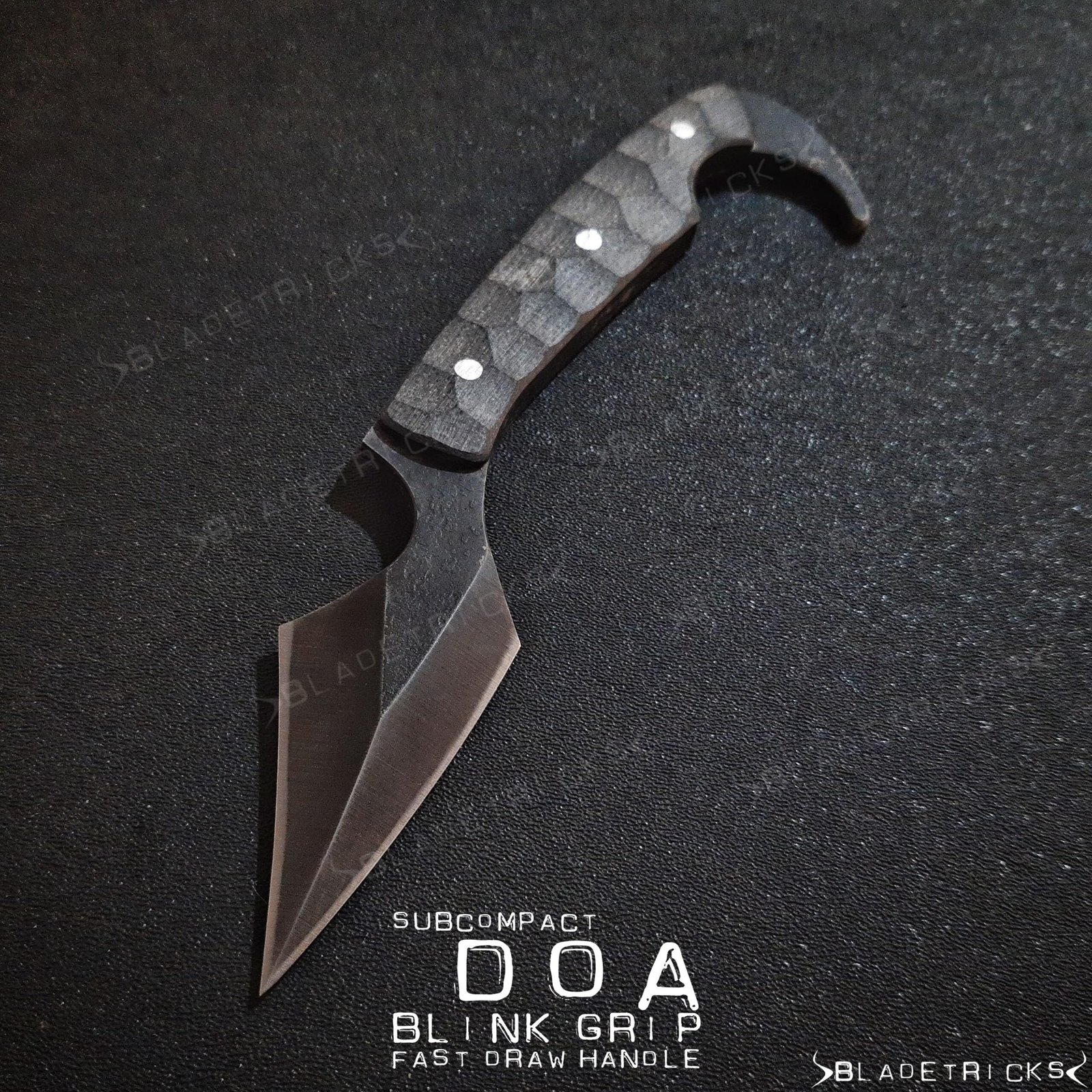
Bladetricks DOA Triple Edge Pikal Knife, Micarta
Forensic medicine confirms what the mechanics suggest. Tissue compression during a forceful thrust means the wound track is frequently greater in depth than the physical blade length: the chest and abdominal wall compress on impact and decompress on withdrawal, extending effective penetration beyond the blade’s actual measurement. A 3-inch blade, correctly placed, can produce a wound track of 4 to 5 inches. Skin provides the highest resistance to penetration. Once it is breached, underlying tissue and organs offer substantially less opposition to a moving edge. This is why tip geometry on a reverse grip knife is not decorative. It is the tool’s primary mechanical asset.
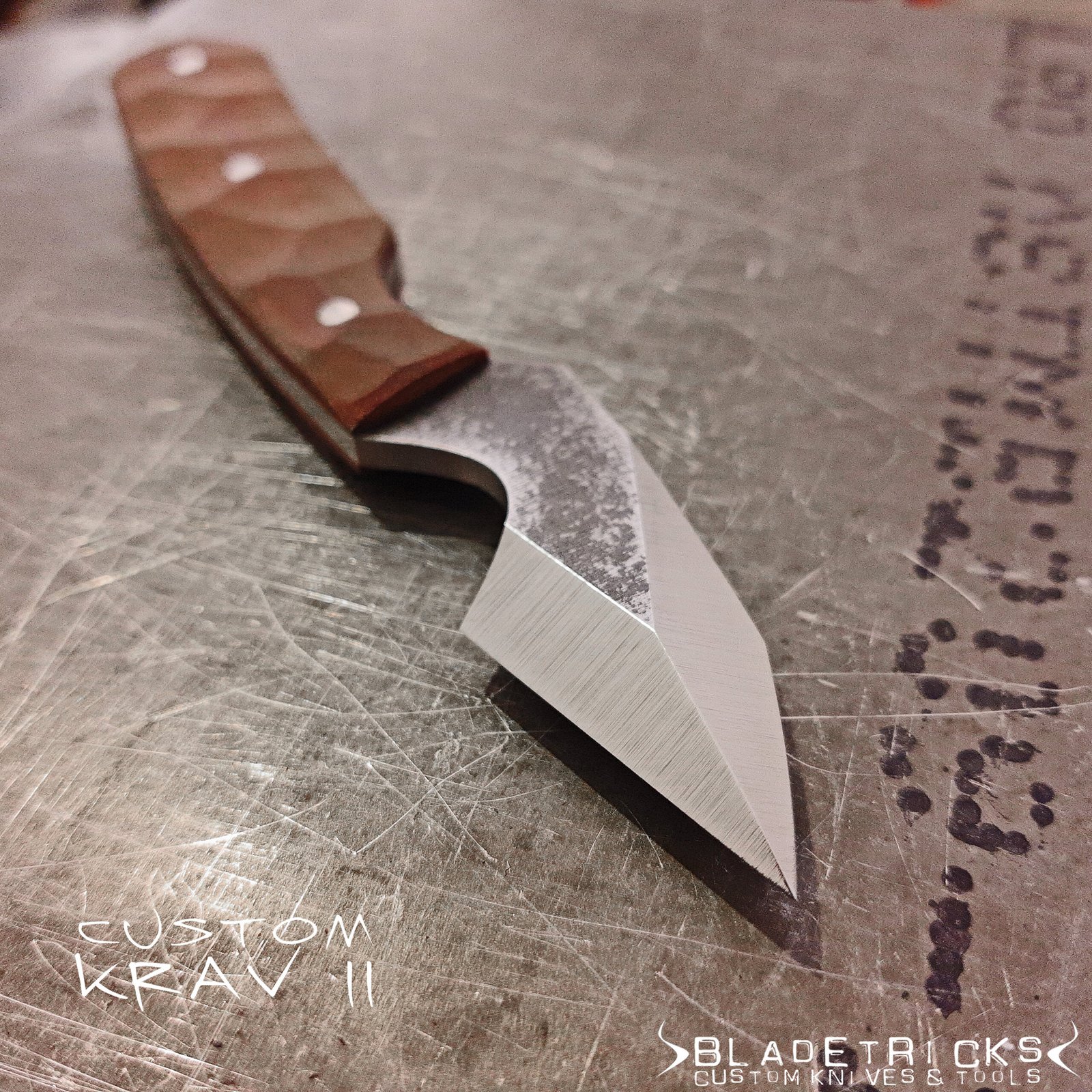
Bladetricks Custom Krav II Pikal double edge knife
Axial Force and the Reverse Grip Advantage
In a pikal grip, the skeletal structure of the forearm transmits total body force directly to the blade tip. This is mechanically superior to the sabre grip, where the wrist acts as a weak pivot point under heavy impact. In the RGEI orientation, force travels in a straight line from the shoulder through the forearm, making the tool an immovable extension of the arm. Anyone can verify this through a simple, safe test against a dead tree: the amount of pressure one can exert in reverse grip far exceeds what is possible in a standard forward grip.
Bladetricks Gen II Mini Ice Pry icepick
A.N. Nash and the Pikal Lineage (2010–Present)
I have been designing pikal knives and tools that prioritize function. My early work served as a catalyst for the current global interest in reverse grip tools. Many RGEI designs seen worldwide today are clearly influenced by original Bladetricks models from over a decade ago. A connoisseur will observe that the core geometries of modern reverse grip tools — focusing on tip strength and high-retention handles — bear the DNA of my early versions.
Bladetrickds Zikit single edge Pikal knife
Bladetricks custom made double edge Zikit Pikal Knife, Black G10 handle
Handle Ergonomics and Edge Alignment
A pikal knife handle must provide more than just a place to hold — it is the steering wheel of the edge. The width of the handle is a critical factor in edge control, preventing the blade from rolling in the hand during the massive resistance of an inward rip. Adequate traction is not a luxury — it is a requirement to manage the blood, sweat, or moisture common in high-stress environments.
Bladetricks custom made Reverse Grip Edge In Tanto Knife with a wide handle
Bladetricks Pecora RGEI Knife
Bladetricks Custom Krav III YAMAM Pikal Knife
Safety and Hybrid Designs
A proper thumb rest or dedicated index point provides the necessary safety to prevent the hand from sliding onto the blade during high-impact axial thrusts.
Bladetricks Krav III Pikal Knife, thumb rest detail
Bladetricks stainless Pikal knife, cord wrapped
Long ago, I also pioneered the combination of pikal and karambit elements on a single blade, offering a hybrid solution for those who require the retention of a ring with the aggressive geometry of RGEI.
Bladetricks Xikxak Pikal Karambit, Full Metal
Bladetricks Classic Nosaf Raal Karambit edge in Pikal version
The most critical component of this system is not the strike. It is the draw. Research on combat stress is clear: in a life-threatening encounter, fine motor skills are among the first casualties of sympathetic nervous system activation. Hesitation during deployment — fumbling a retention mechanism, misorienting the edge — is the actual failure point. Not technique. Not blade geometry.
To solve this, I developed the Bladetricks Blink Grip: a handle architecture that allows a near-instantaneous, blind-indexed draw from a Kydex sheath with no mechanical parts, no buttons, no conscious thought required. The edge is correctly oriented the moment the tool clears the sheath. It was designed for a body already in fight-or-flight — not for the calm, controlled environment of a training hall.
The Blink Grip has become a global reference point for pikal and self-defense knife design — a fact I note without enthusiasm, given how liberally the concept has been adopted without credit.
Bladetricks Balbala Collection of Pikal Reverse Grip Knives and Karambits
Geometry and Blade Profile: The Shift to Traditional Shapes
While the majority of dedicated RGEI knives feature a hooked or hawkbill profile — often reminiscent of karambit blades — I have shifted my focus toward more traditional shapes. While a hook excels at the rip, it can limit the tool’s versatility and increase the difficulty of sharpening.
On models like the Tusk Knife or the discreet Diplomat, I utilize straighter, more traditional geometries. These profiles maintain the pikal advantage in the reverse grip while providing a more robust tip and a cleaner path of entry. They are easier to maintain and offer the professional a more balanced tool that does not sacrifice the catastrophic potential of the inward strike for the sake of a curved aesthetic.
The pikal system is highly specialized. While it dominates in close-quarters confrontations and clinches, it inherently lacks the reach of a sabre grip. It is a tool of commitment, optimized for the ranges where most real-world edged weapon encounters actually occur — not the dueling distances where most knife training takes place. Blade length is generally kept compact, between 50 and 100 mm, to ensure the tool remains concealable, maneuverable, and fast to deploy. Understanding these limits is as important as understanding the advantages. A specialist who does not know where his tool ends is not a specialist.
I have built pikal knives and tools around these principles for over a decade. The geometries developed in those early years are now visible in the work of makers around the world. I take that as confirmation that the mechanical logic was correct — not as a compliment.
For centuries, the kiridashi has been a staple of Japanese craftsmanship: a small, chisel-ground utility blade designed for precision cutting. Traditionally used by artisans, woodworkers, and even schoolchildren for everyday tasks, this unassuming tool has stood the test of time due to its efficiency and simplicity.
In 2011, I crafted my own take on the kiridashi, keeping its essence intact while making it rugged enough for modern use. Now, I’ve revisited that design with a minimalist approach, refining it down to the essentials. The Bladetricks Mini Kiri is compact, versatile, and built for those who appreciate sharp, functional tools without unnecessary bulk.
What Makes the Kiridashi Unique? Unlike Western-style knives, the kiridashi typically features a single-bevel chisel grind, allowing for exceptionally fine cuts and controlled precision. This makes it an ideal tool for everything from opening packages to detailed crafting work.
Why a Minimalist Kiridashi? I’ve stripped the design down to its core: no embellishments, no excess weight, just a sharp, practical blade that fits seamlessly into your everyday carry setup. The included Kydex sheath allows for multiple carry options, whether in your pocket, on your keychain, or as a neck knife.
A Blade for Everyday Life Whether you need a precise cutting tool for work, a discreet EDC option, or simply appreciate the history of well-made blades, the Mini Kiridashi delivers. Handmade in my workshop, this limited batch won’t last long.
A Modern Take on a Timeless Blade The kiridashi has been around for centuries, and while tools evolve, the need for a reliable, sharp cutting instrument remains the same. My minimalist Mini Kiri (dashi) is my way of honoring that tradition while making it accessible for today’s users.
Available now in limited quantities. Get yours before they’re gone.
(All my knives can be customized to tailor customer’s needs)
Metallurgy of Necessity: The Bladetricks Stainless Steel Selection
Choosing a stainless steel for a blade is not an exercise in romanticism; it is a calculated, cold decision. In the workshop, I do not seek a soul for the metal; I seek a predictable response to stress. The decision-making process for every Bladetricks tool begins with a single, uncompromising question: will it perform as required under duress?
For my designs, that question generally begins and ends with toughness. A blade that cannot withstand real-world mechanical shock is not a tool—it is a liability. After a long, cautious, and practical evaluation of modern alloys, the data led me to two specific materials that now define the stainless branch of my work: 14C28N Sandvik and AEB-L steel.
Beyond the Rust: The Practicality of Stainless
I have built a reputation on traditional carbon and spring steels like 8670 and C67S. We value their resilience and their aggressive edge. However, carbon alloys demand a certain reverence; they require constant care to stave off the oxidation that is their inevitable destiny. For the professional operator in high-moisture, maritime, or humid environments, this maintenance is often a luxury they cannot afford.
The singular advantage of a high-tier stainless steel is its indifference to such concerns. It provides a level of corrosion resistance that frees the user from the burden of oiling and cleaning after every exposure. This fundamental practicality is the core reason I have integrated these alloys. In an industry obsessed with the marketing of the latest “supersteel,” I remain loyal to the principle of offering affordable, functional, and brutal tools. These two steels, while distinct in their chemistry, are nearly identical in their shared purpose and impressive performance.
Two Steels for the Same Professional Purpose
There is a common, and often expensive, misunderstanding that every blade requires a mythical, flawless alloy with exotic price tags. The truth is that a truly great steel is a well-balanced one. Both 14C28N and AEB-L epitomize this balance. Their value lies in a toughness that is both deliberate and professional.
These alloys possess an excellent ability to take and hold a very fine edge—a crucial property for pikal tools and defensive assets meant for serious cutting—but they do so without becoming brittle. Many “premium” steels achieve high hardness at the expense of impact resistance; they chip when they hit a hard target. AEB-L and 14C28N do not. Because of this practical parity, I utilize them interchangeably across new models like the Tusk or the Diplomat. A customer can be assured that a blade made from either material is built on the same foundation of unwavering mechanical integrity.
Technical Nuance: 14C28N vs. AEB-L
While they perform to the same standard in the field, it is worth noting the subtle technical deviations between the two. In a purely metallurgical sense, 14C28N is slightly tougher. The addition of Nitrogen in its chemistry allows it to reach a high hardness while remaining marginally more resilient against stress and hard impacts. It is also “more stainless” than AEB-L, offering a higher threshold against salt and chemical corrosion.
AEB-L, originally developed for razor blades, is prized for its ultra-fine grain structure. This allows it to achieve a terrifyingly sharp edge that is easy to maintain in the field. It behaves remarkably like a high-carbon steel during the heat treatment process, giving it a “bite” that few other stainless steels can replicate.
The Bladetricks Philosophy of Materials
These aren’t dramatic, life-altering differences, but subtle details that speak to the specific intent behind each tool. The choice was never about aesthetics or following the “flavor of the month” in the knife community. It was about function—the core tenet of Bladetricks.
What I prioritize is a sensible balance of toughness, edge retention, and corrosion resistance, weighed against availability, affordability, and ease of work for the maker. If a steel is impossible to source or so difficult to grind that it triples the price of the tool, it fails the practicality test. These stainless steels simply work, and they work well. This dedication to performance over pretense is how I consistently provide a better product and a more reliable experience for my customers.
Bladetricks Boning Chef Knife 14C28N Stainless Steel