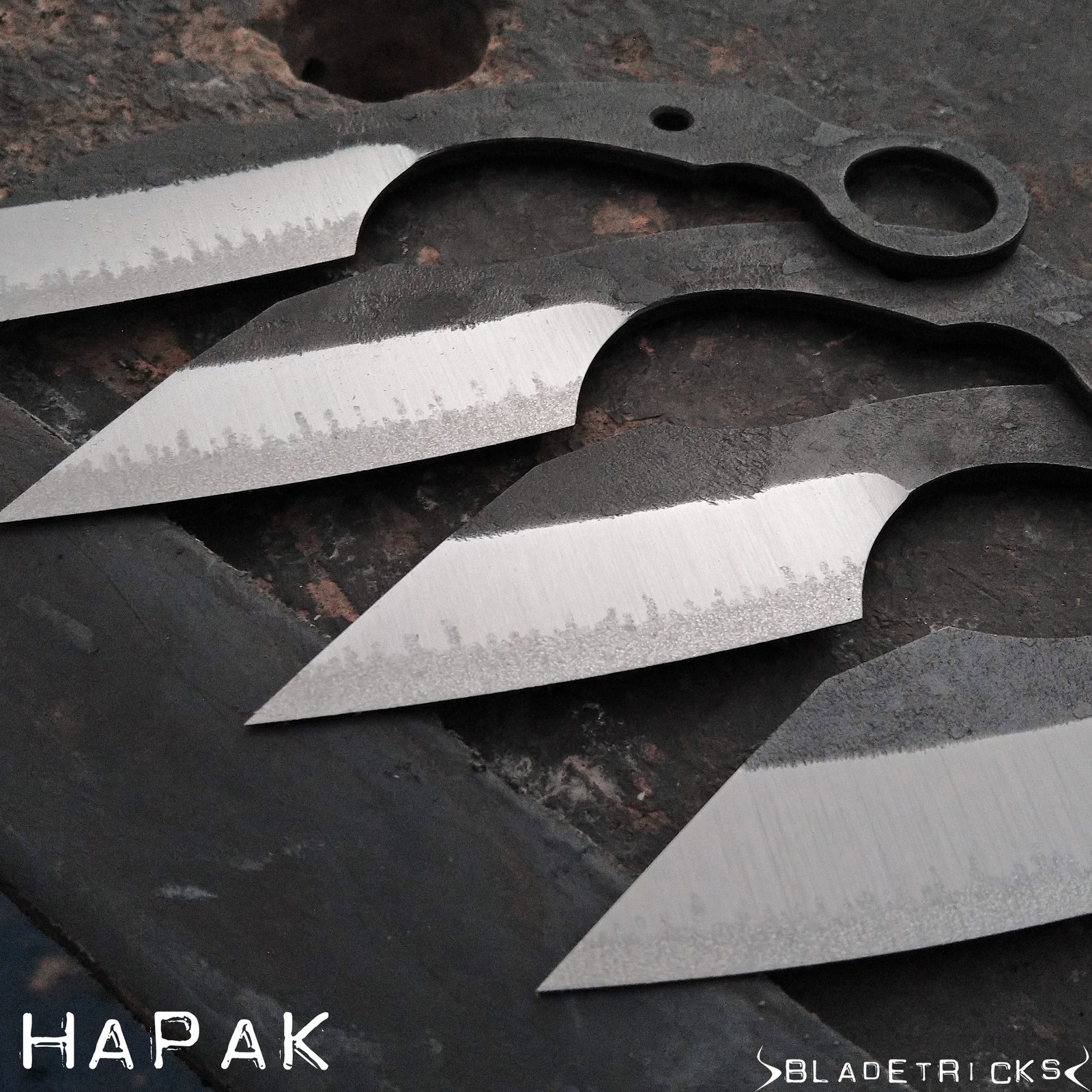
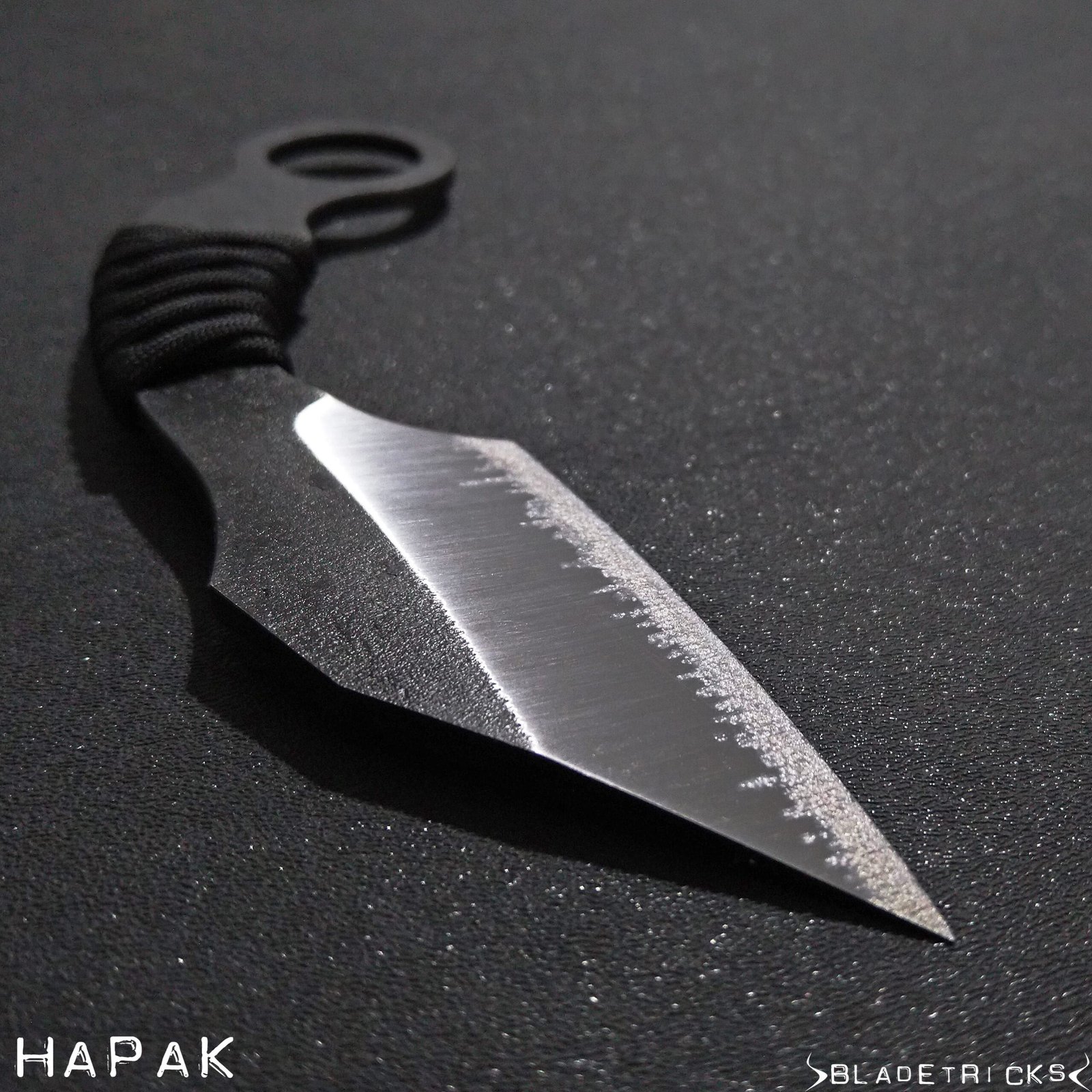
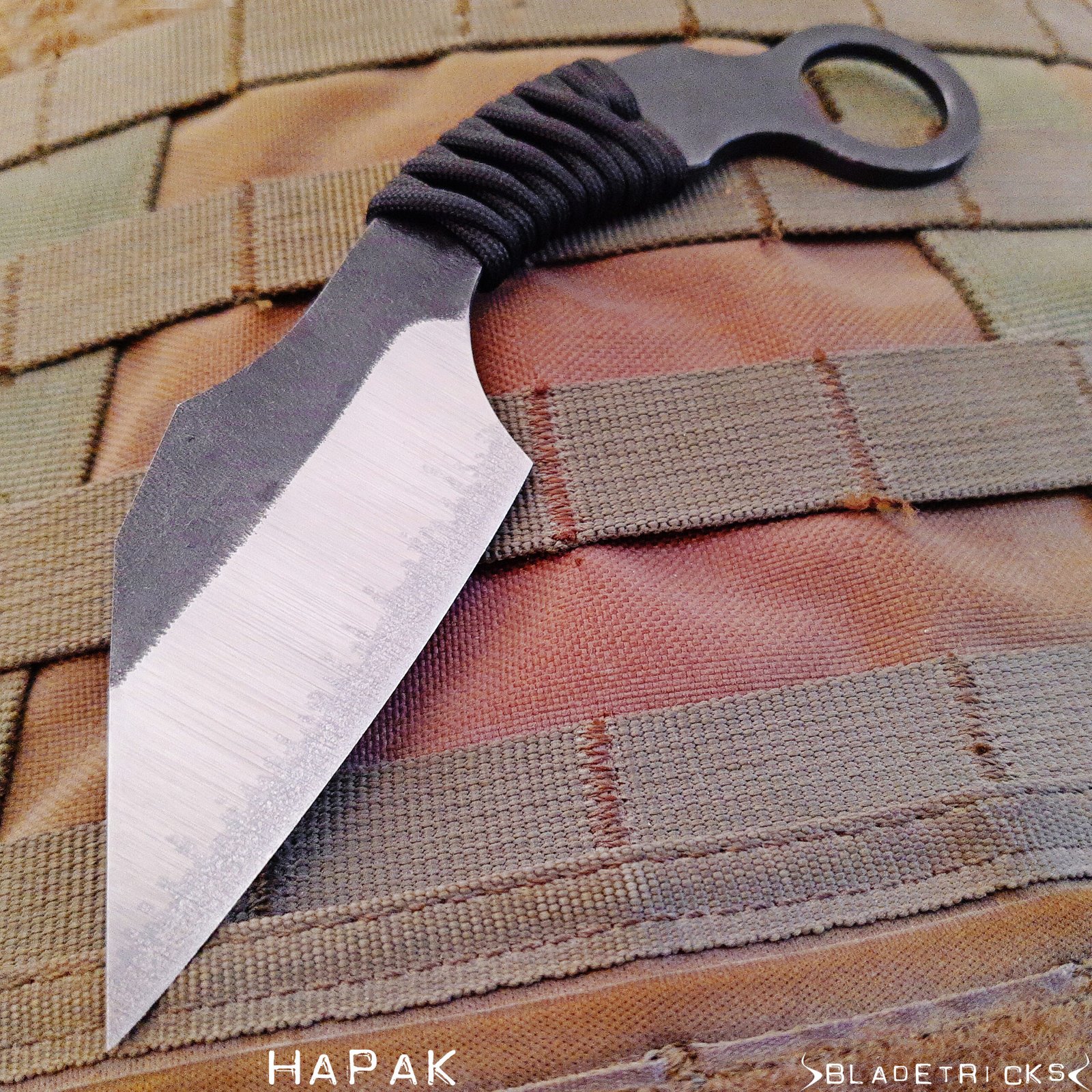
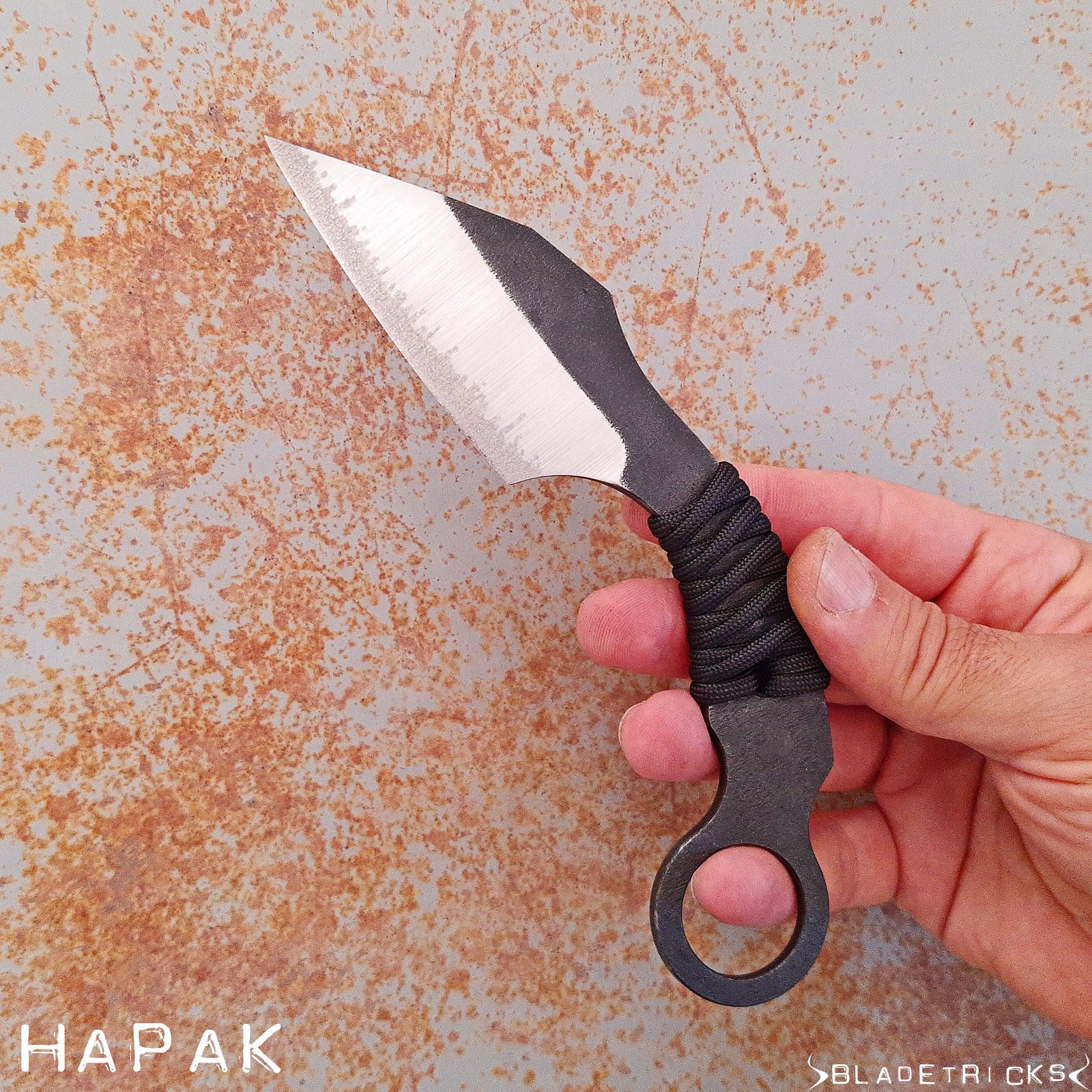
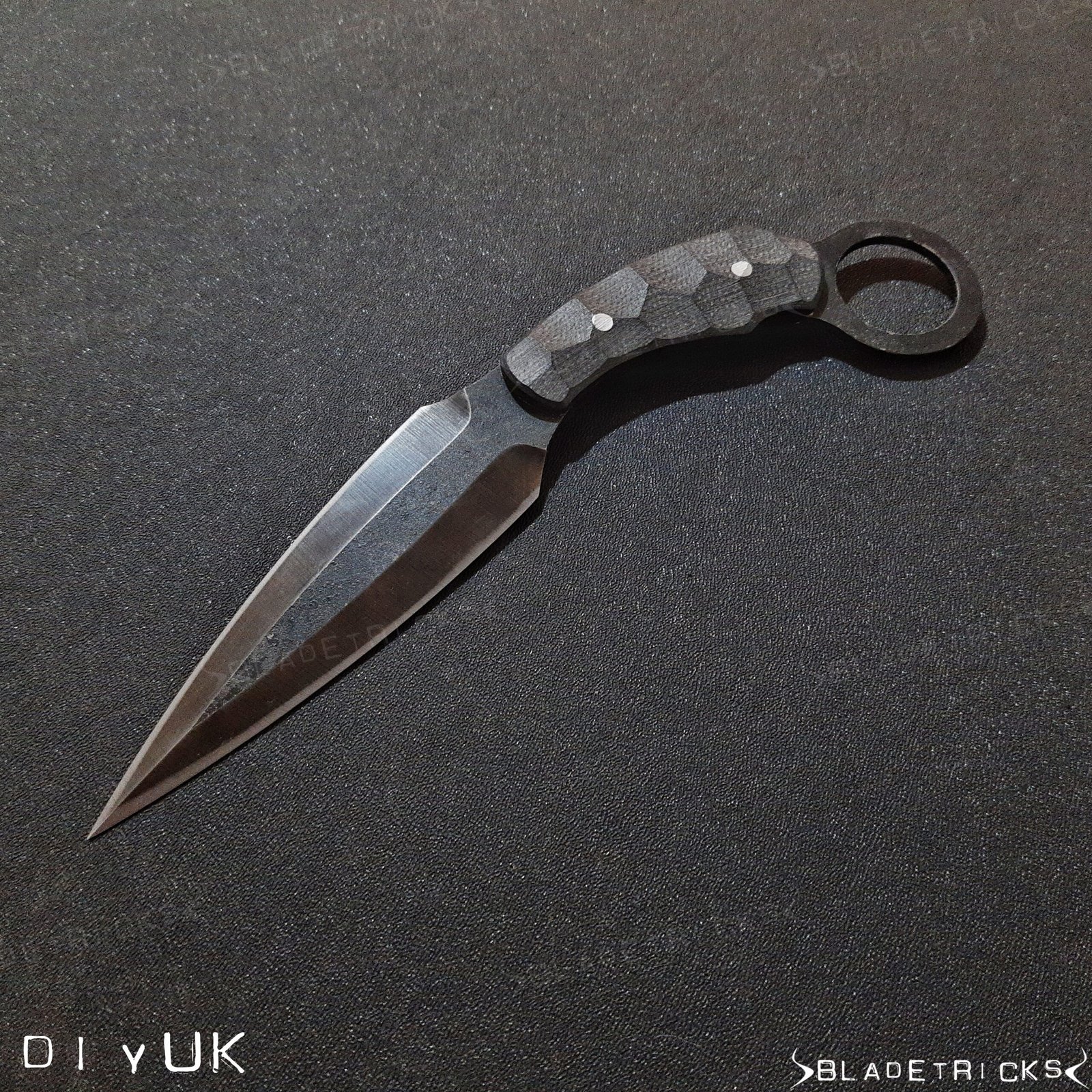
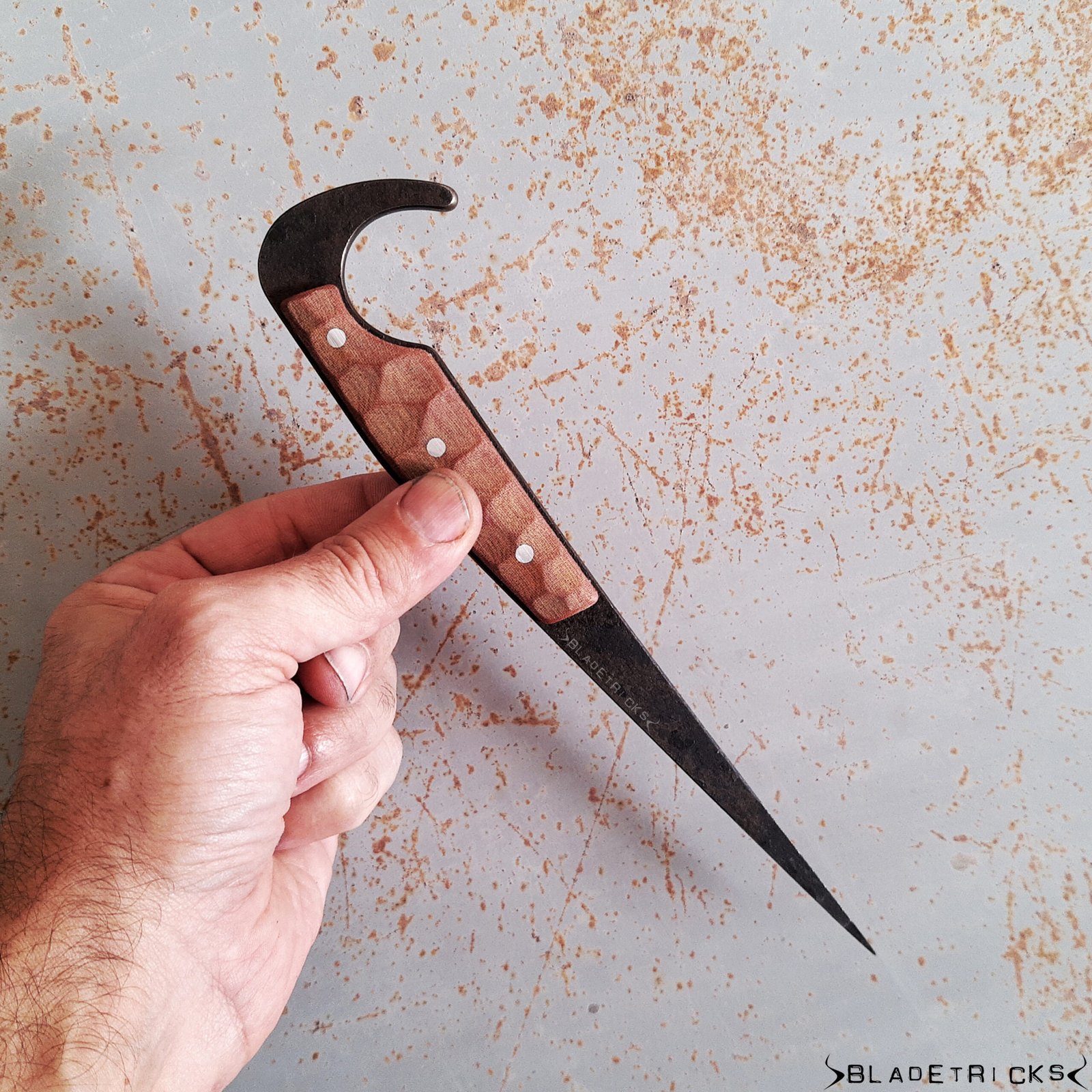
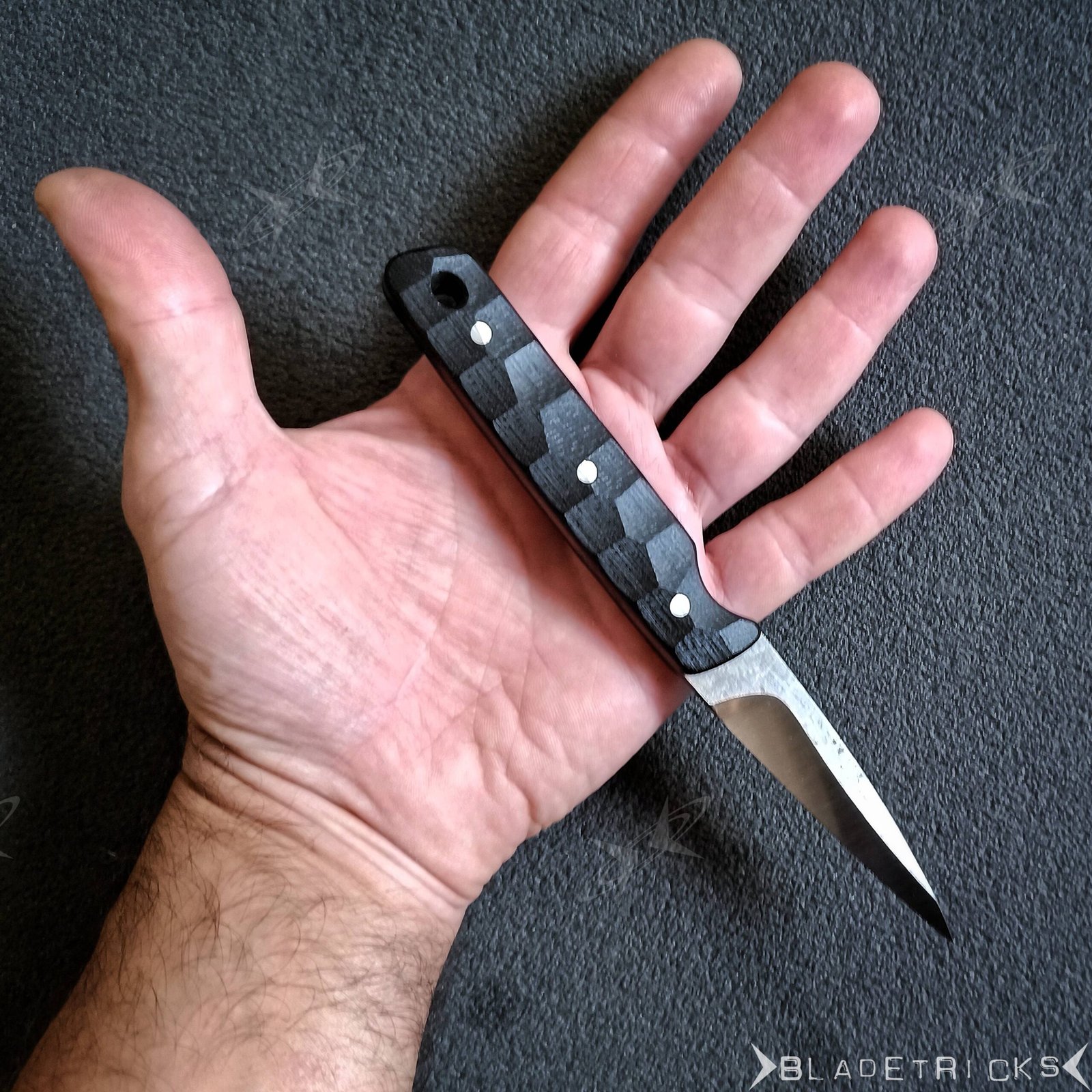
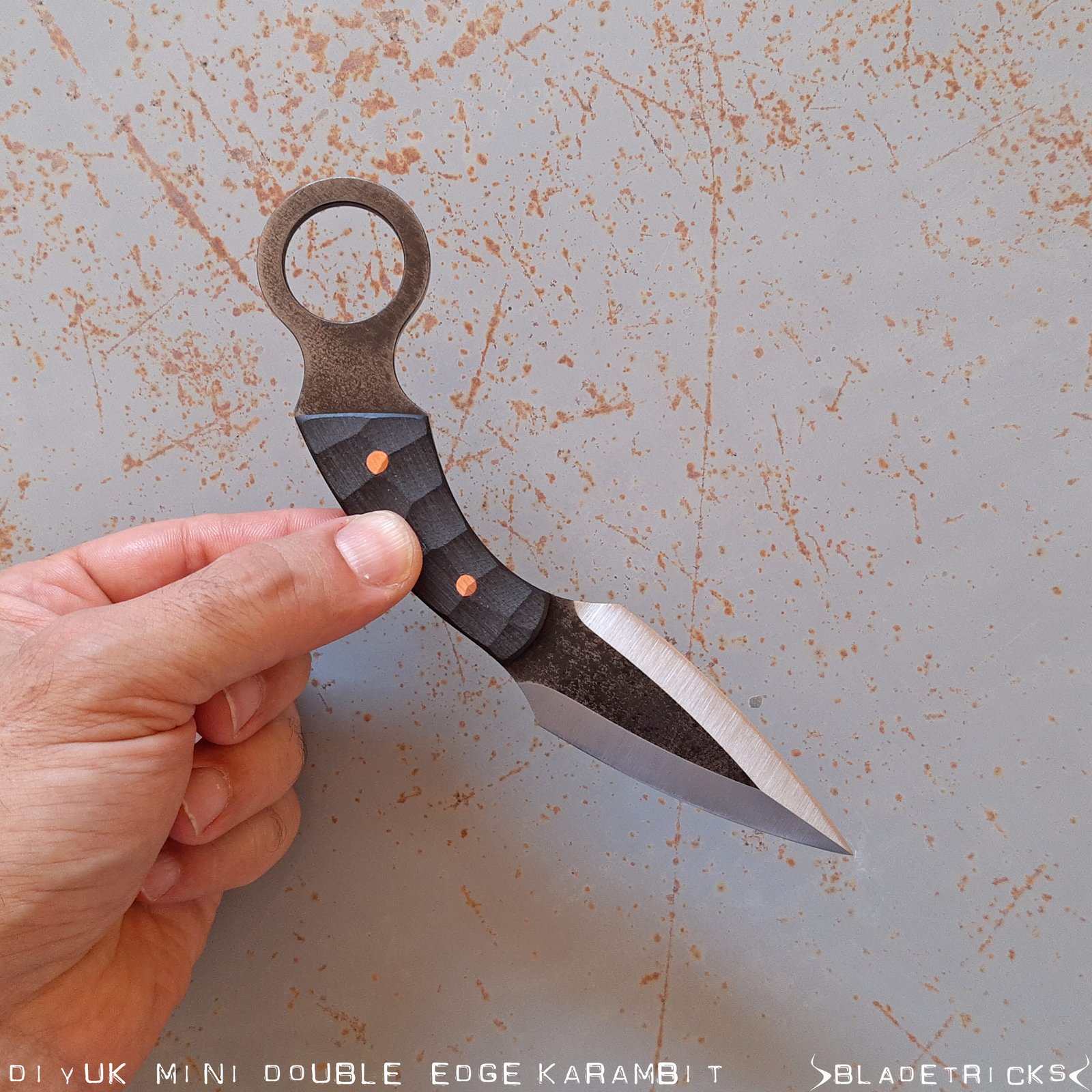
Some projects arrive with a specific brief. This one came from the HAPAK — the Home Front Command Squad — with a clear requirement: a simple, lightweight, hard-use field knife for daily carry. Reliable, tough, and purpose-built for the people using it.
The Geometry
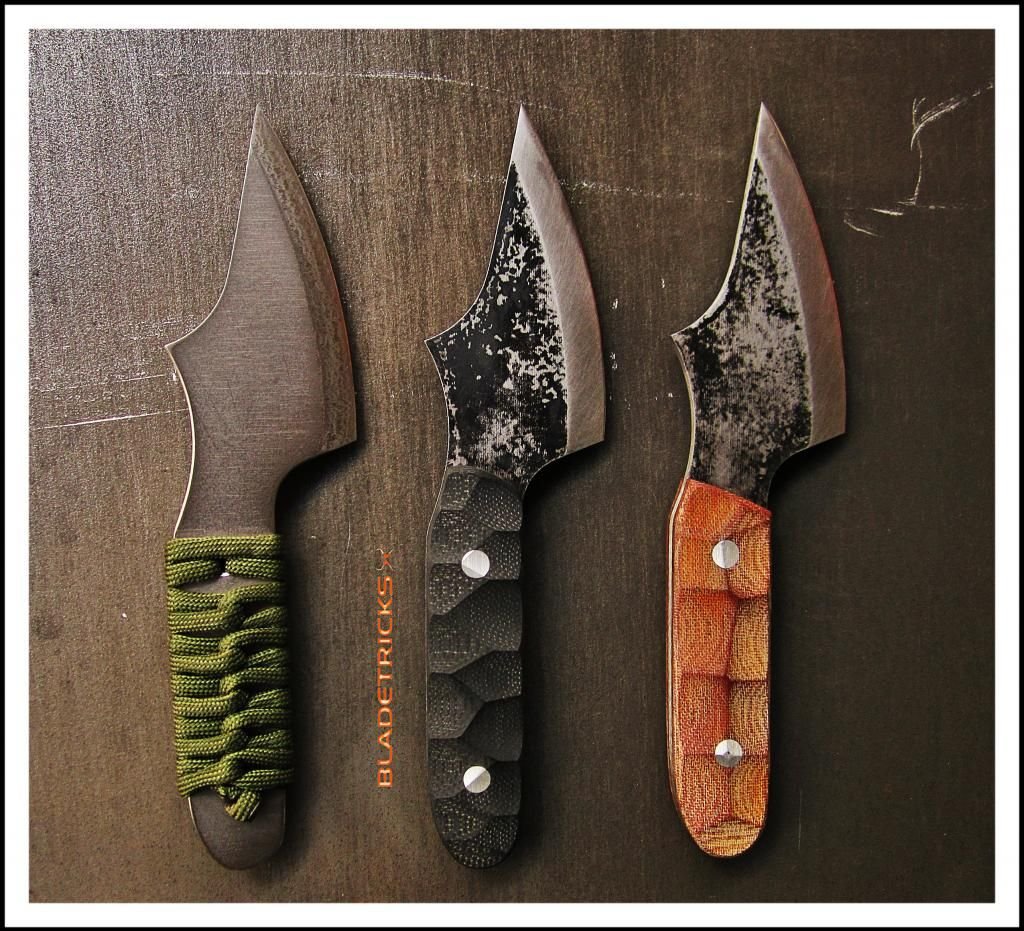
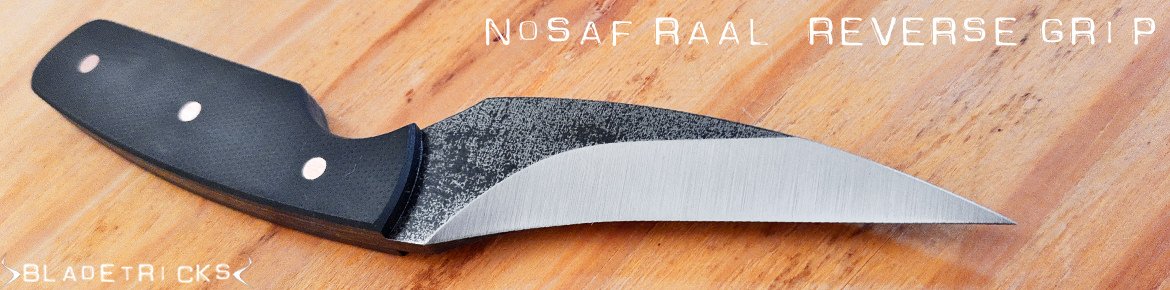
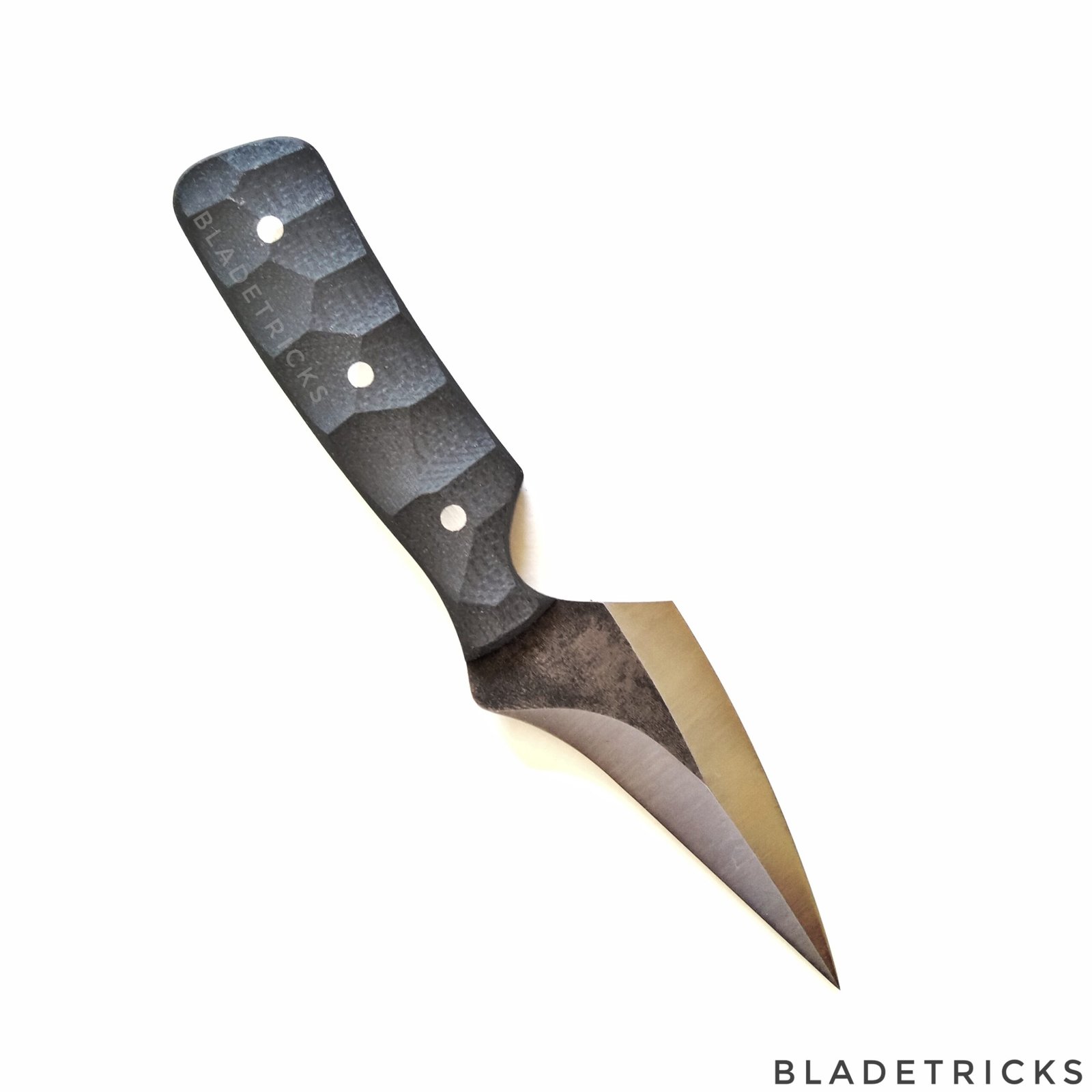
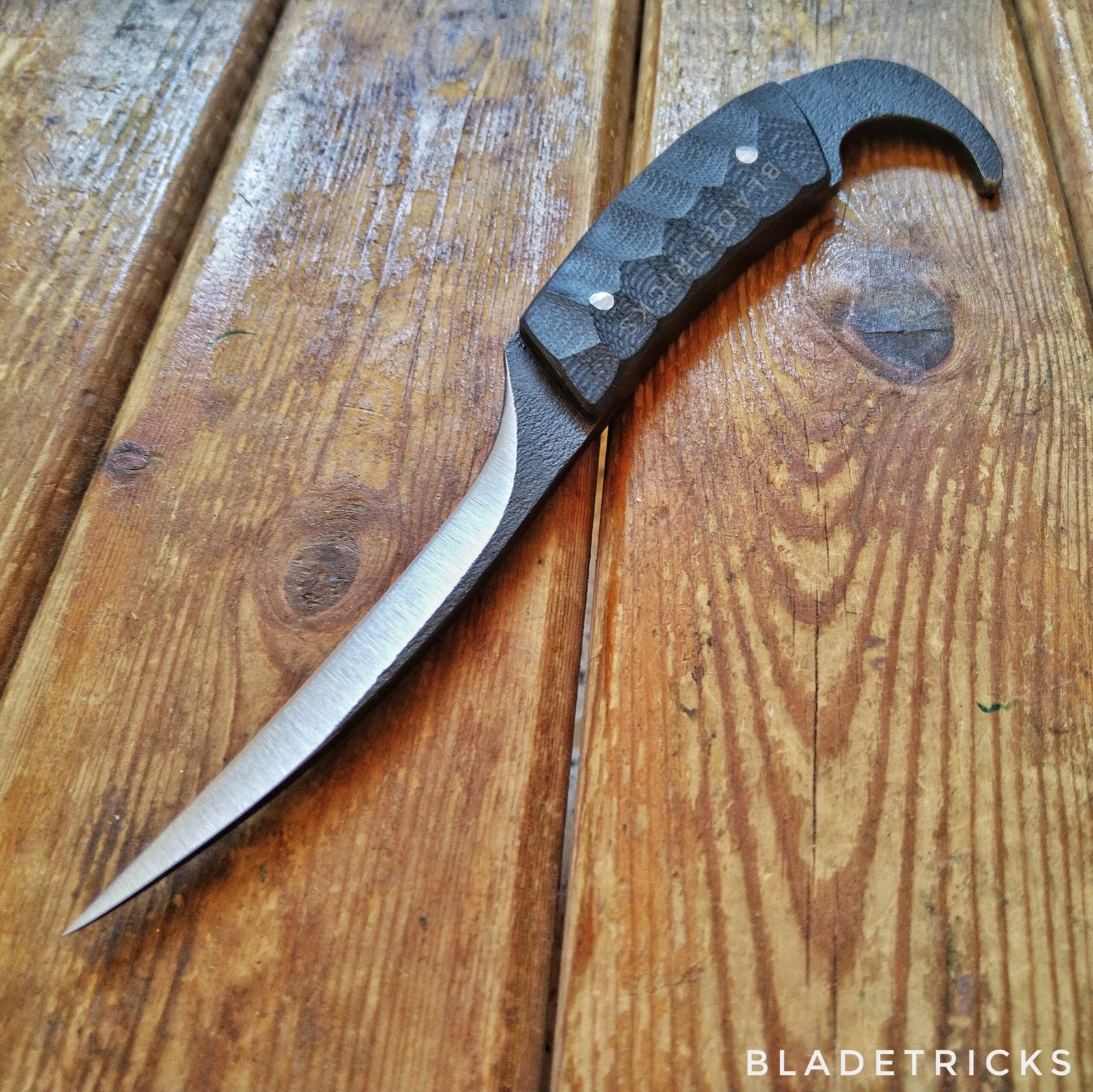
A wharncliffe blade was the logical choice. Its flat spine, strong tip, and full belly make it one of the most capable utility profiles available — precise under controlled cuts, robust enough to handle hard use without complaint.
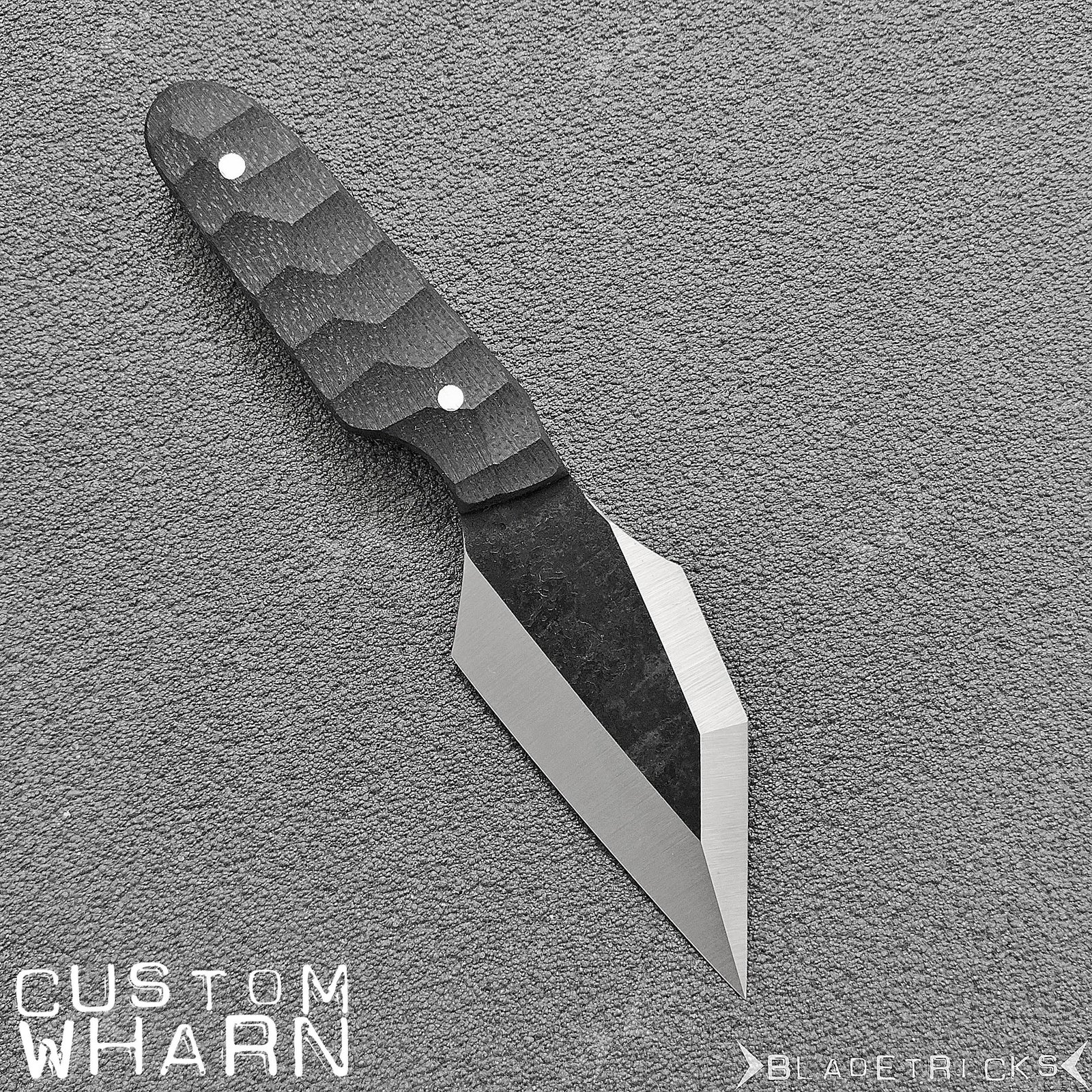
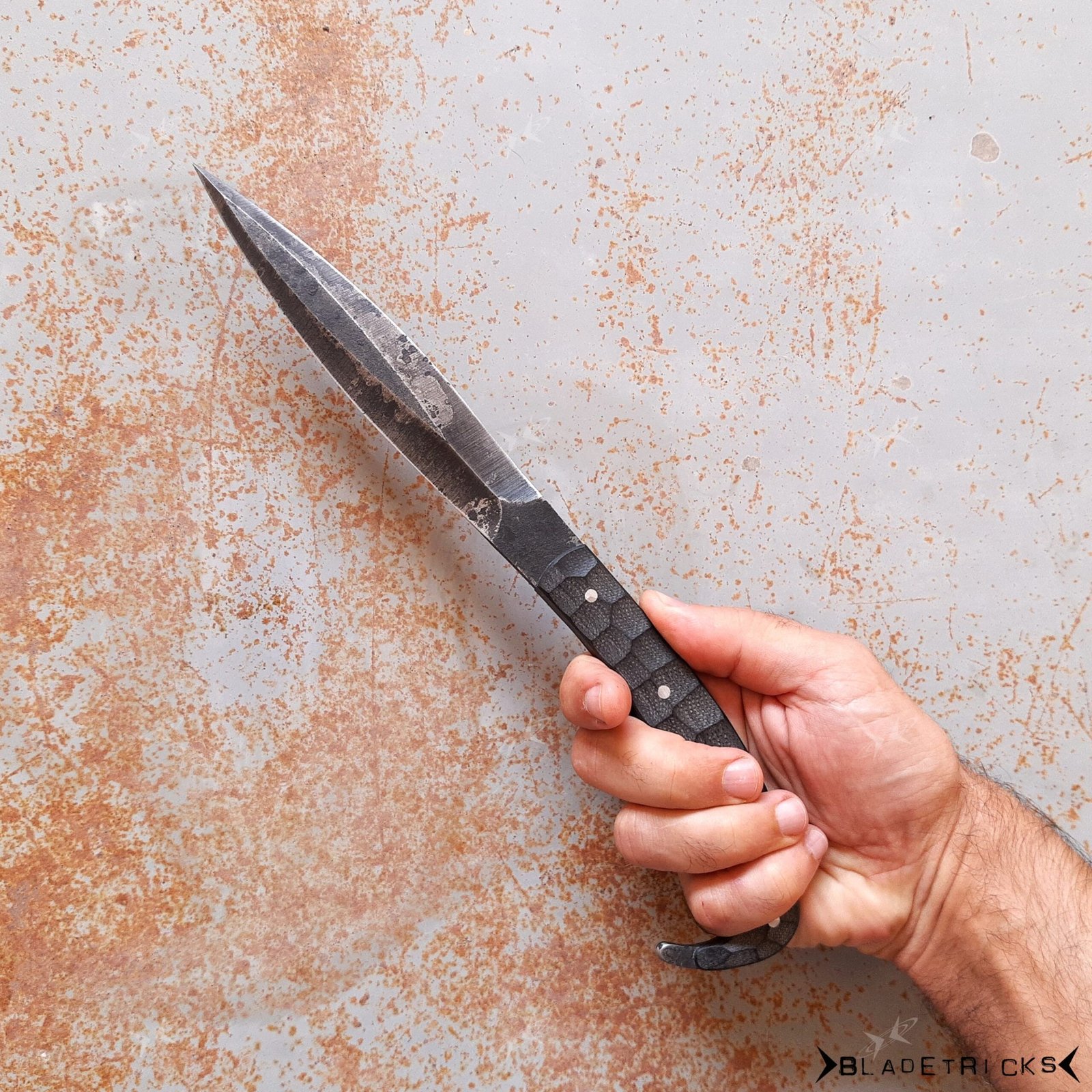
Bladetricks Custom wharncliffe Black G10 Handle
Combined with traditional Bladetricks karambit (ringed) handle, the result is a tool that carries like an EDC knife and transitions to a fighting grip when the situation demands it. The ring adds retention and capability without adding bulk.
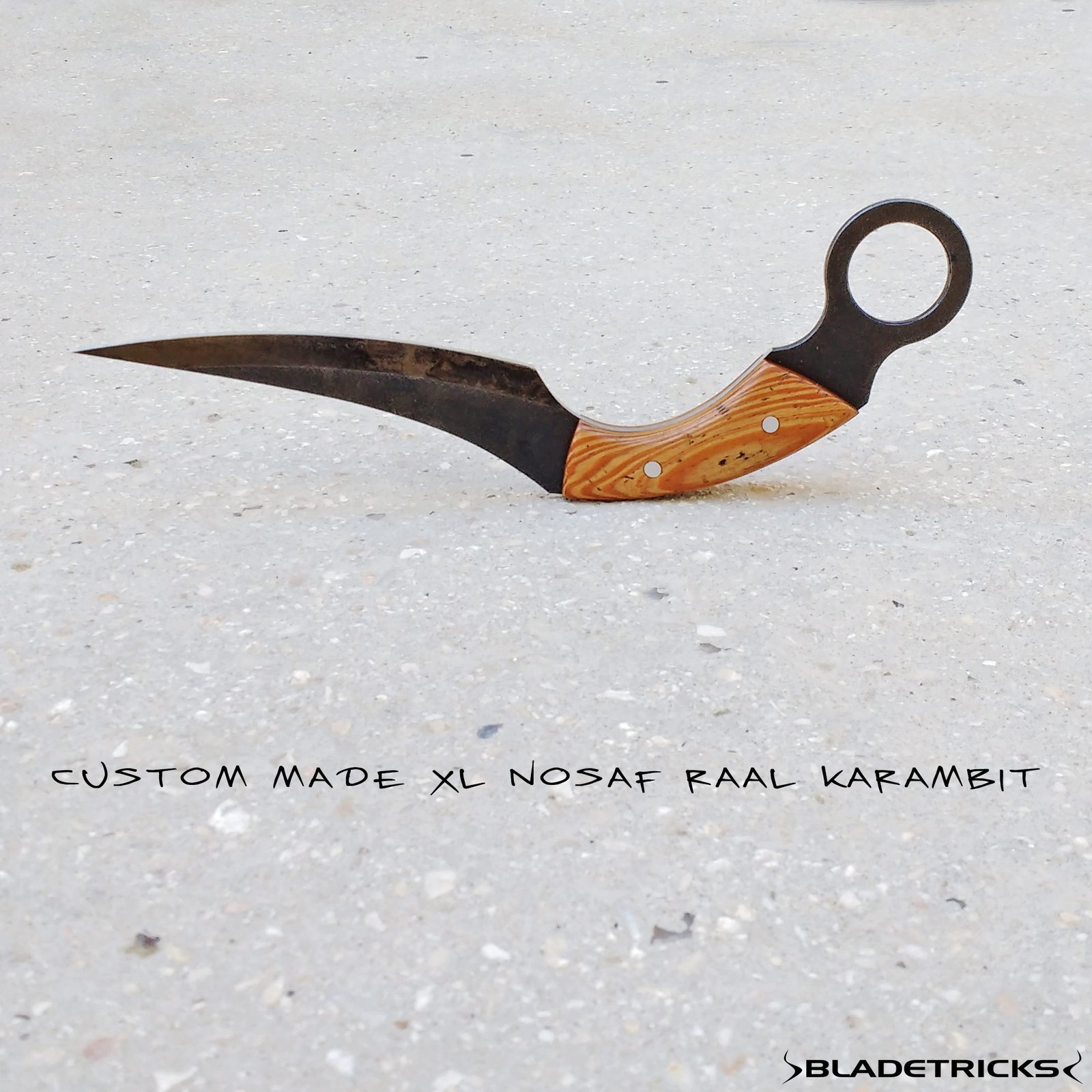
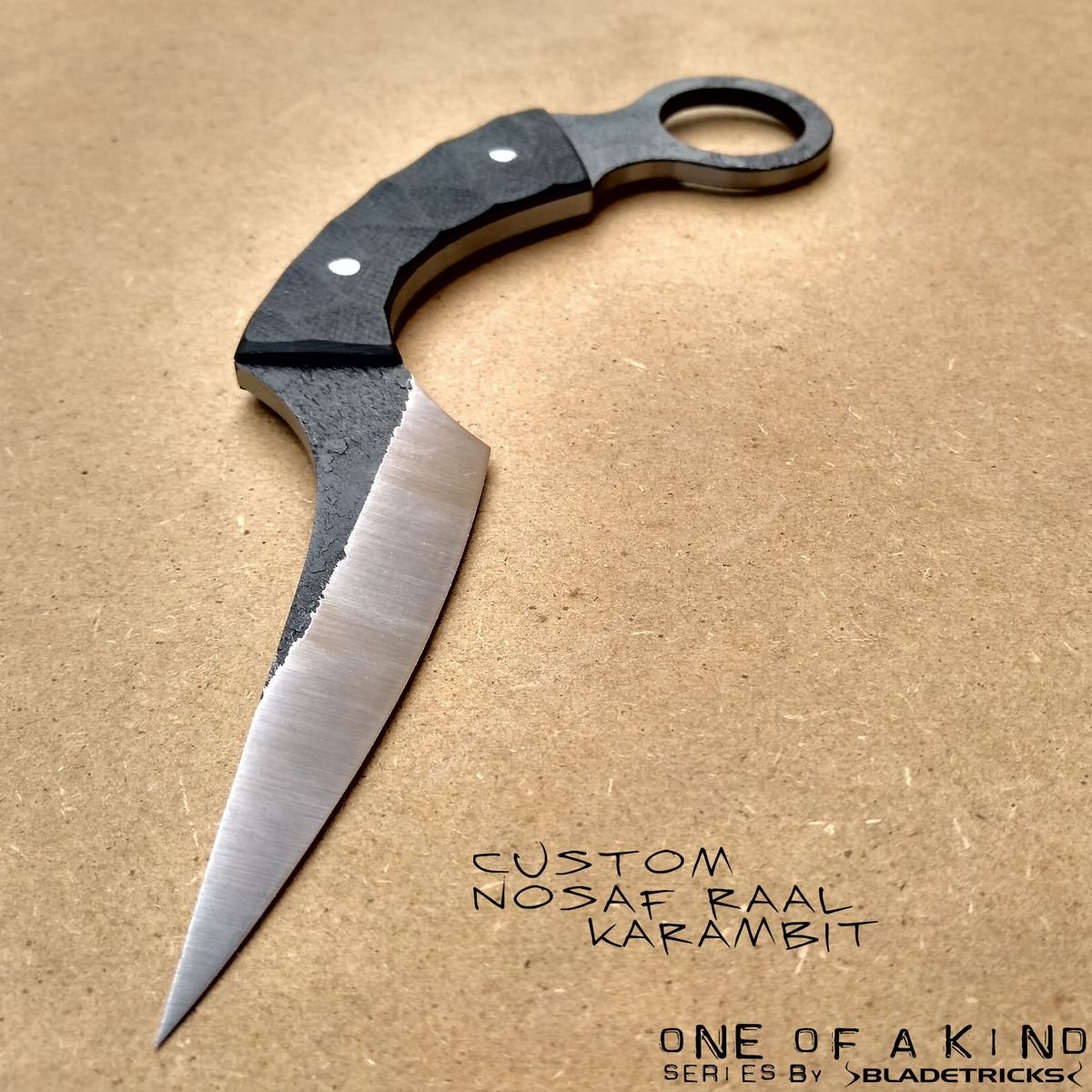
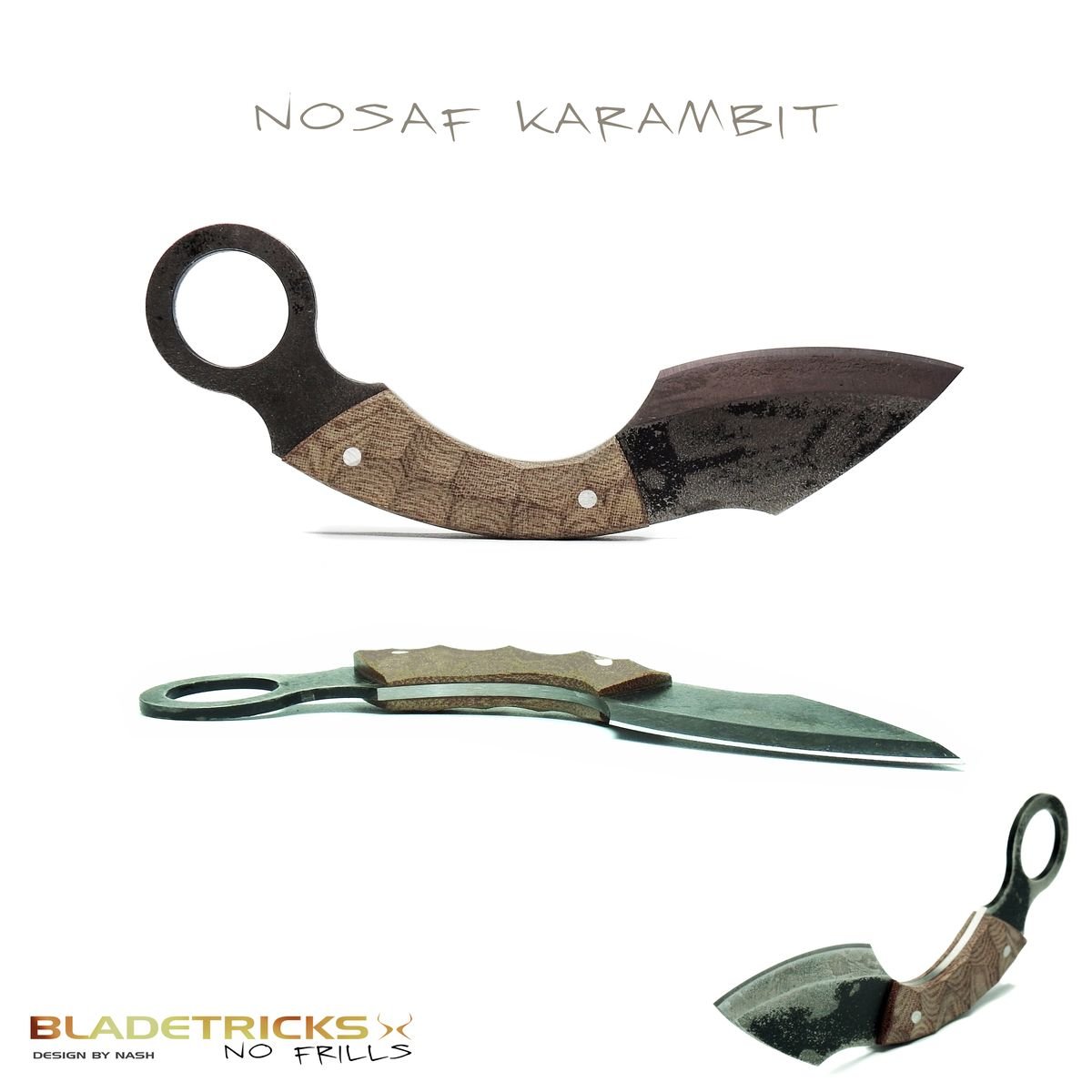
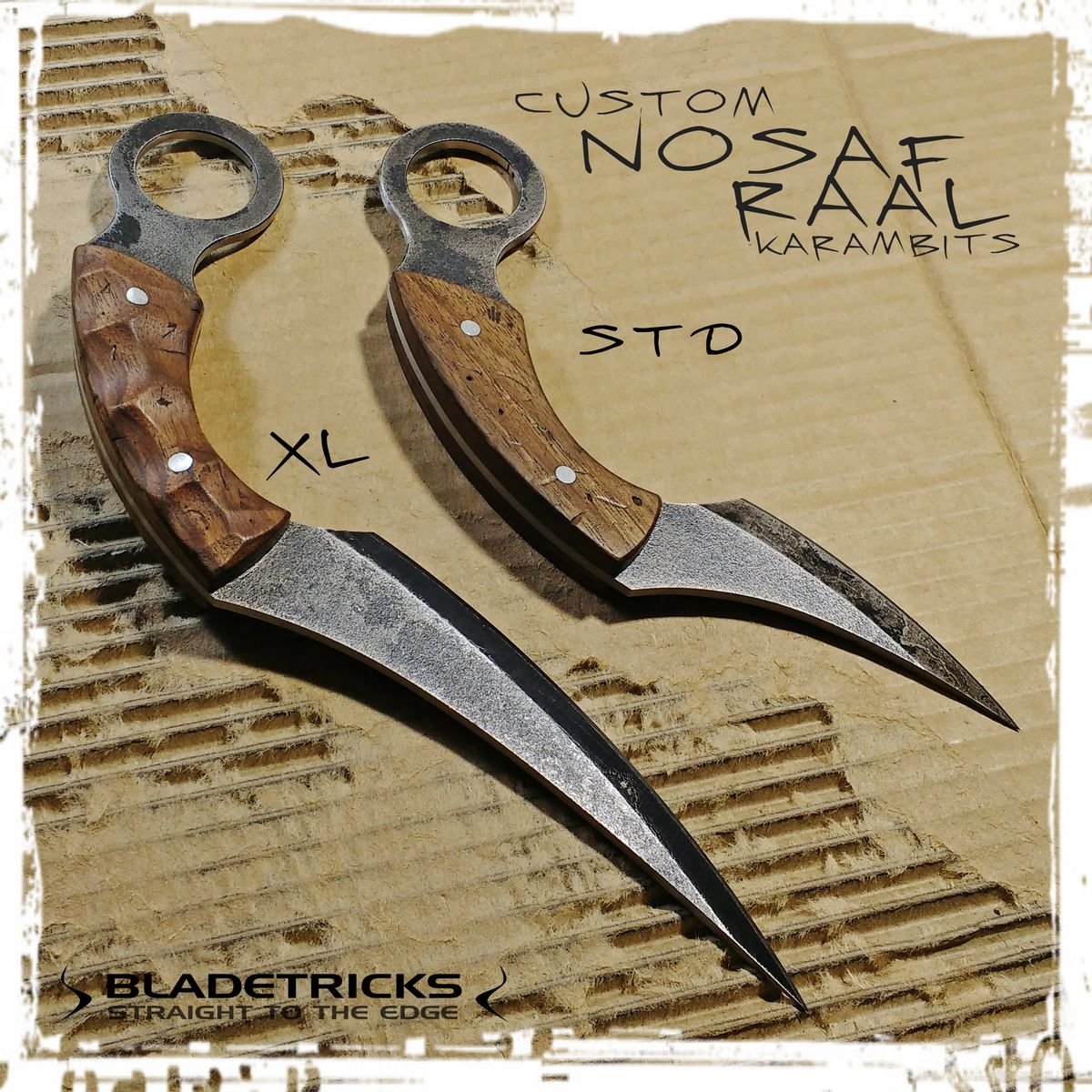
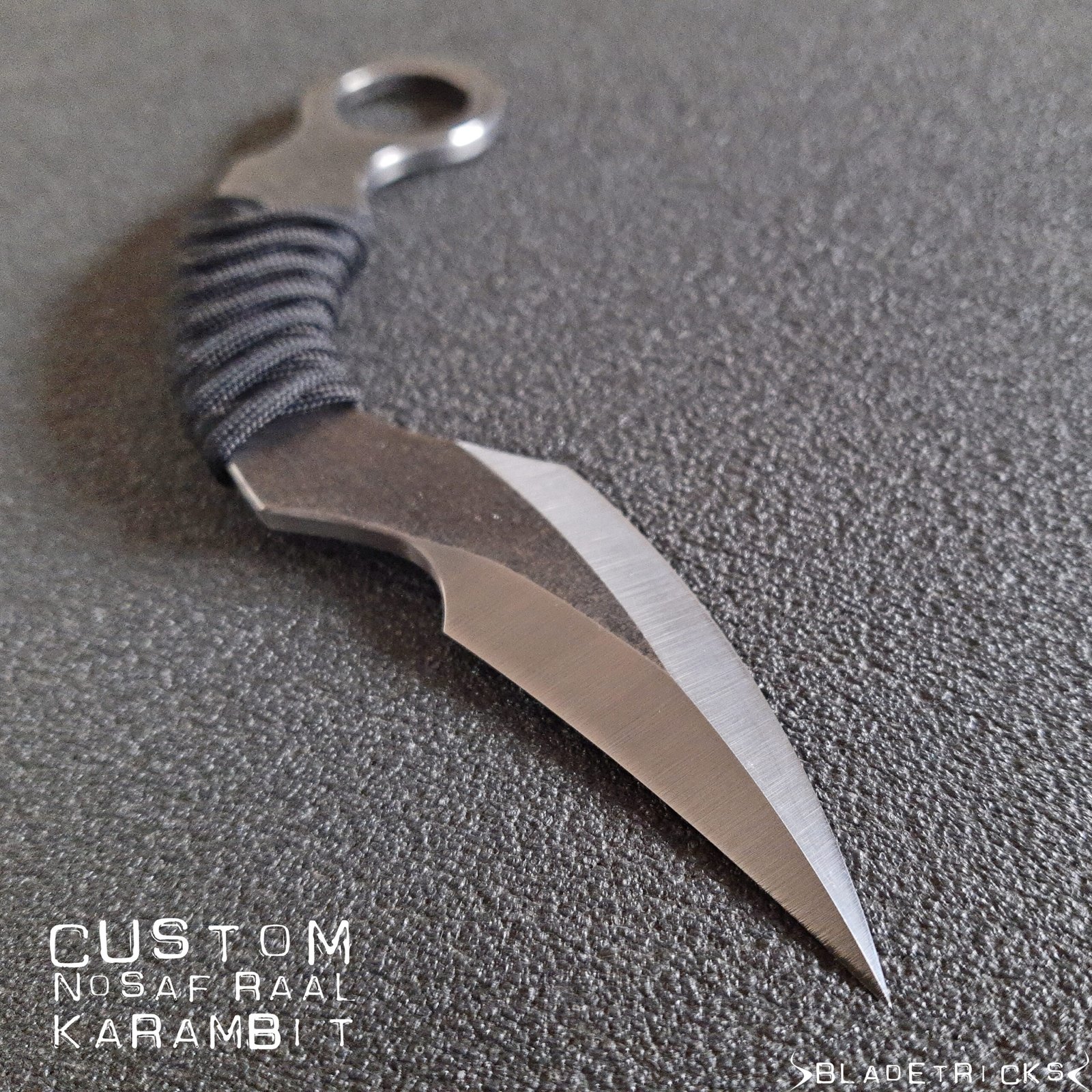
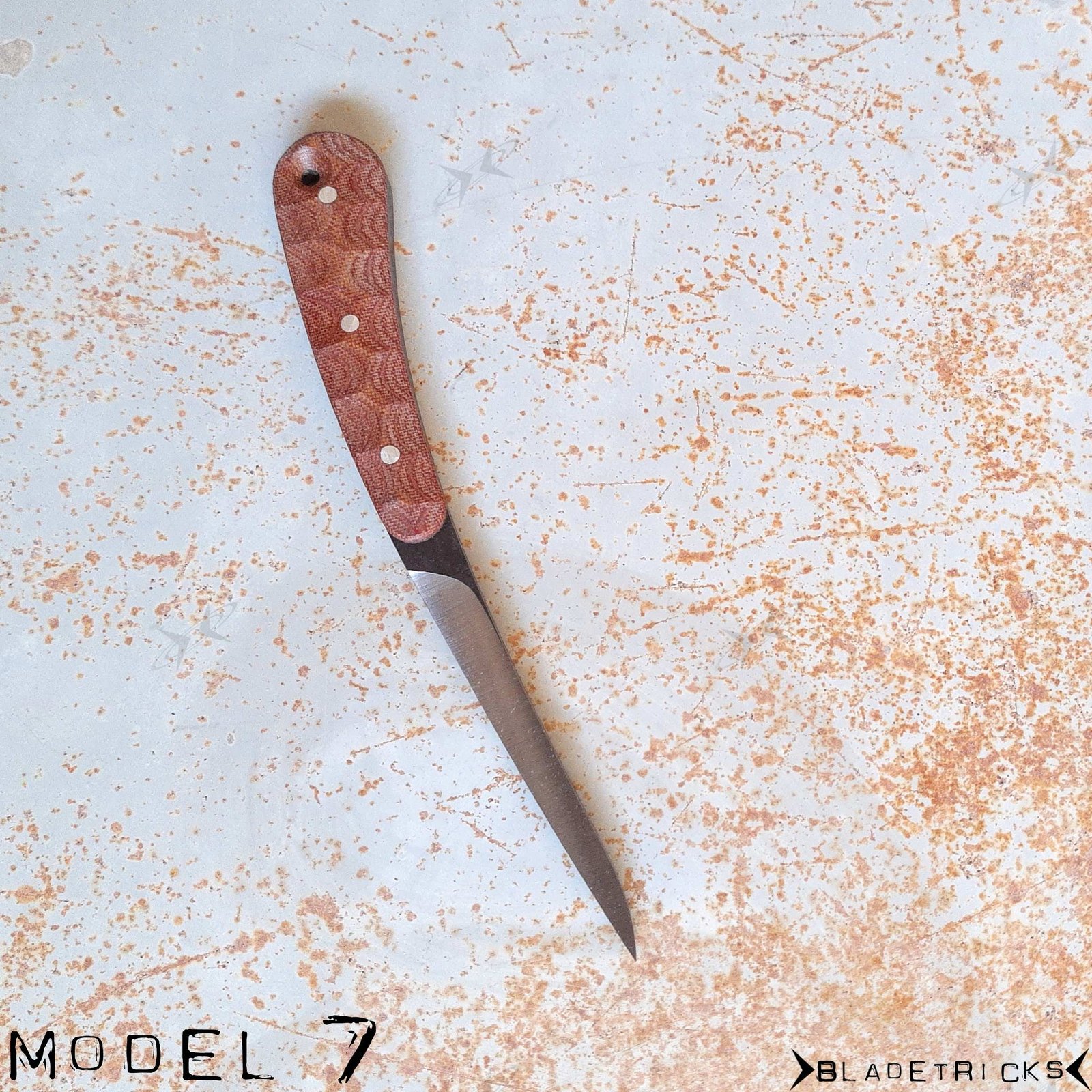
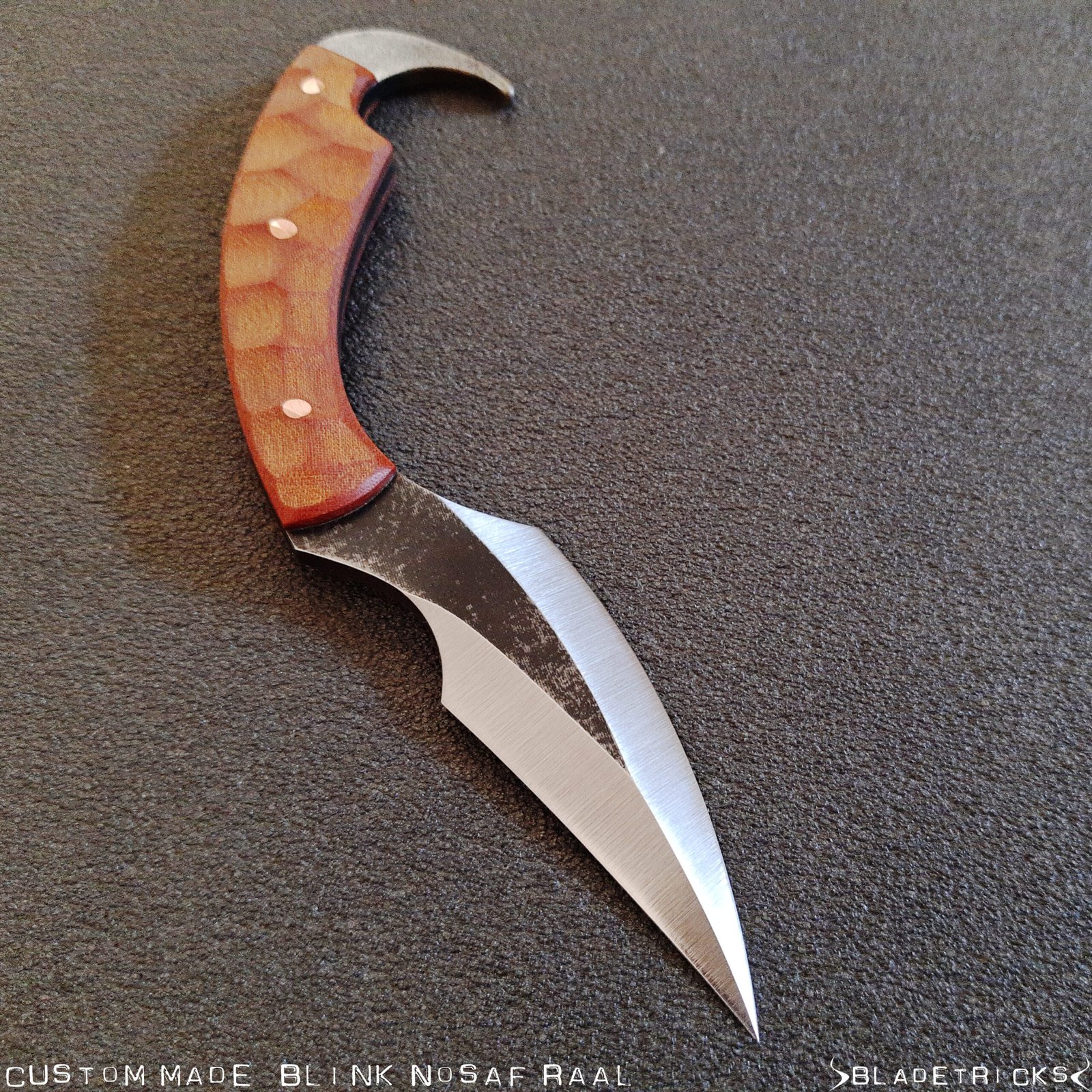
Custom made XL Nosaf Raal Karambit fir wood aged scales by A.N. Nash
The Steel
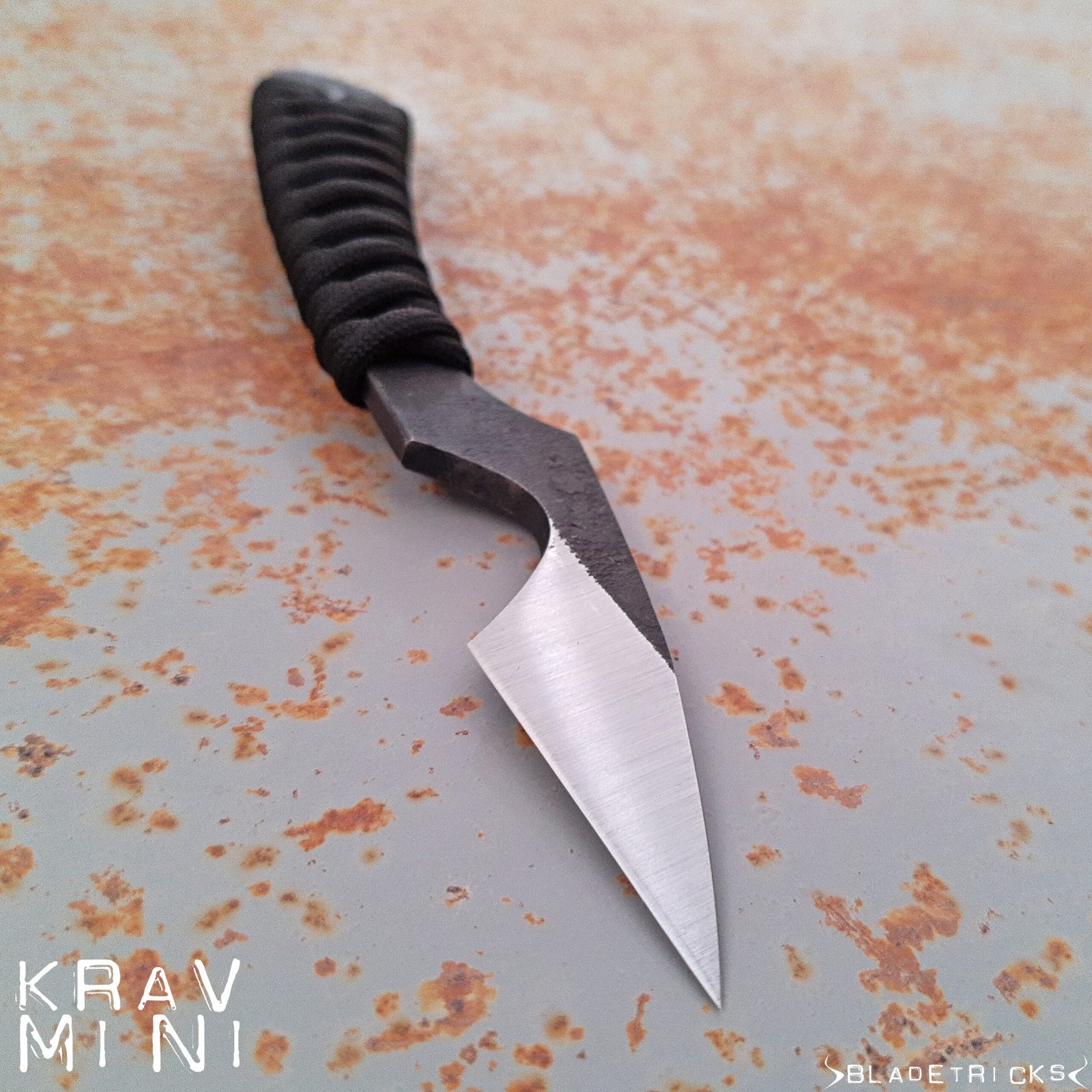
For this build I used my last reserve of thin stock 4340 alloy steel — a high-strength material used in military aircraft and heavy-duty industrial applications for its exceptional toughness and impact resistance. It is by far the toughest steel I work with.
Its only weakness is edge retention, which I addressed by microwelding a thin layer of tungsten carbide onto the edge — delivering the structural resilience of properly heat-treated 4340 with the cutting performance of a 70-80 HRC carbide edge. The result is a steel combination that has no right to perform as well as it does.
Tungsten Carbide on a 4340 Alloy Steel Blade
The Complete Tool
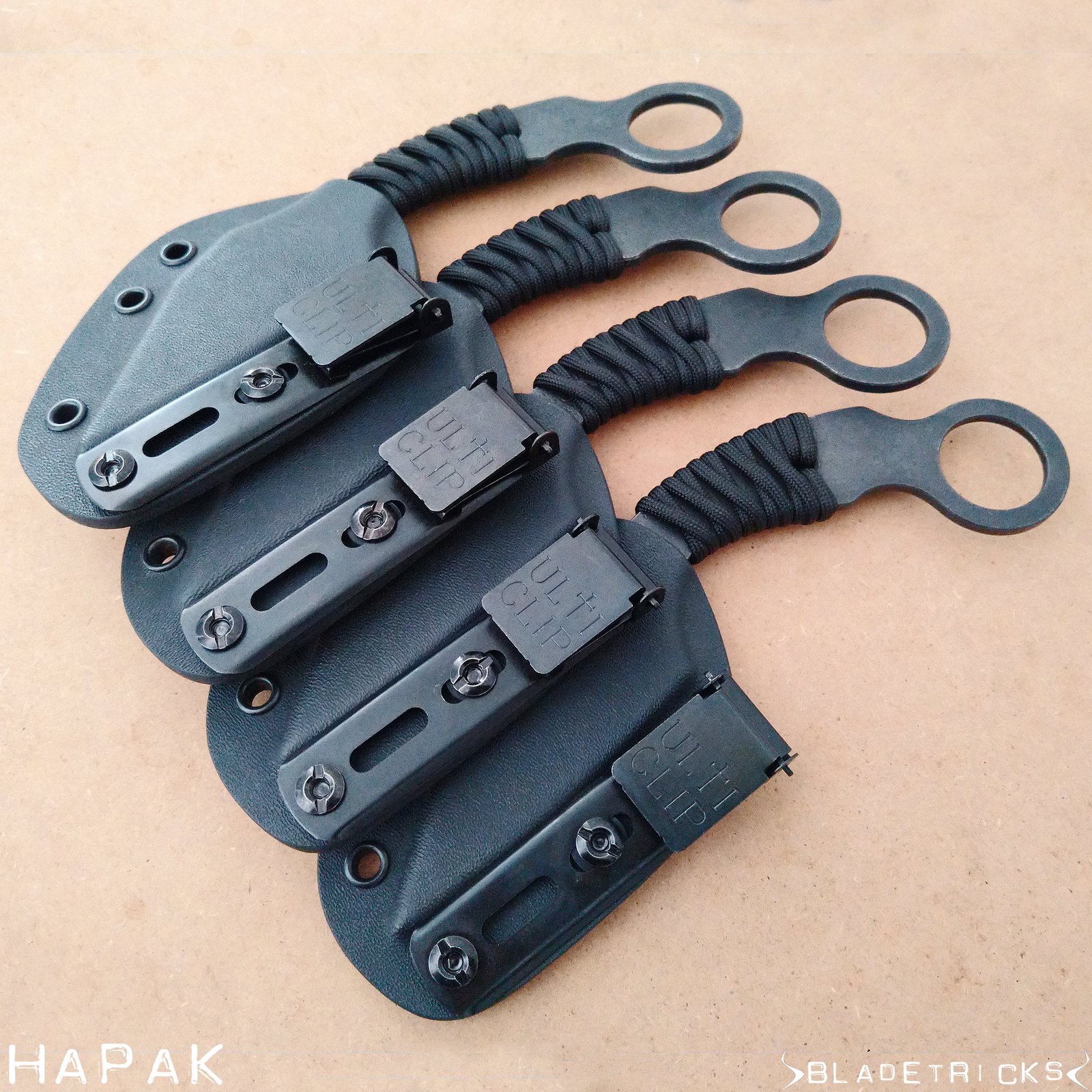
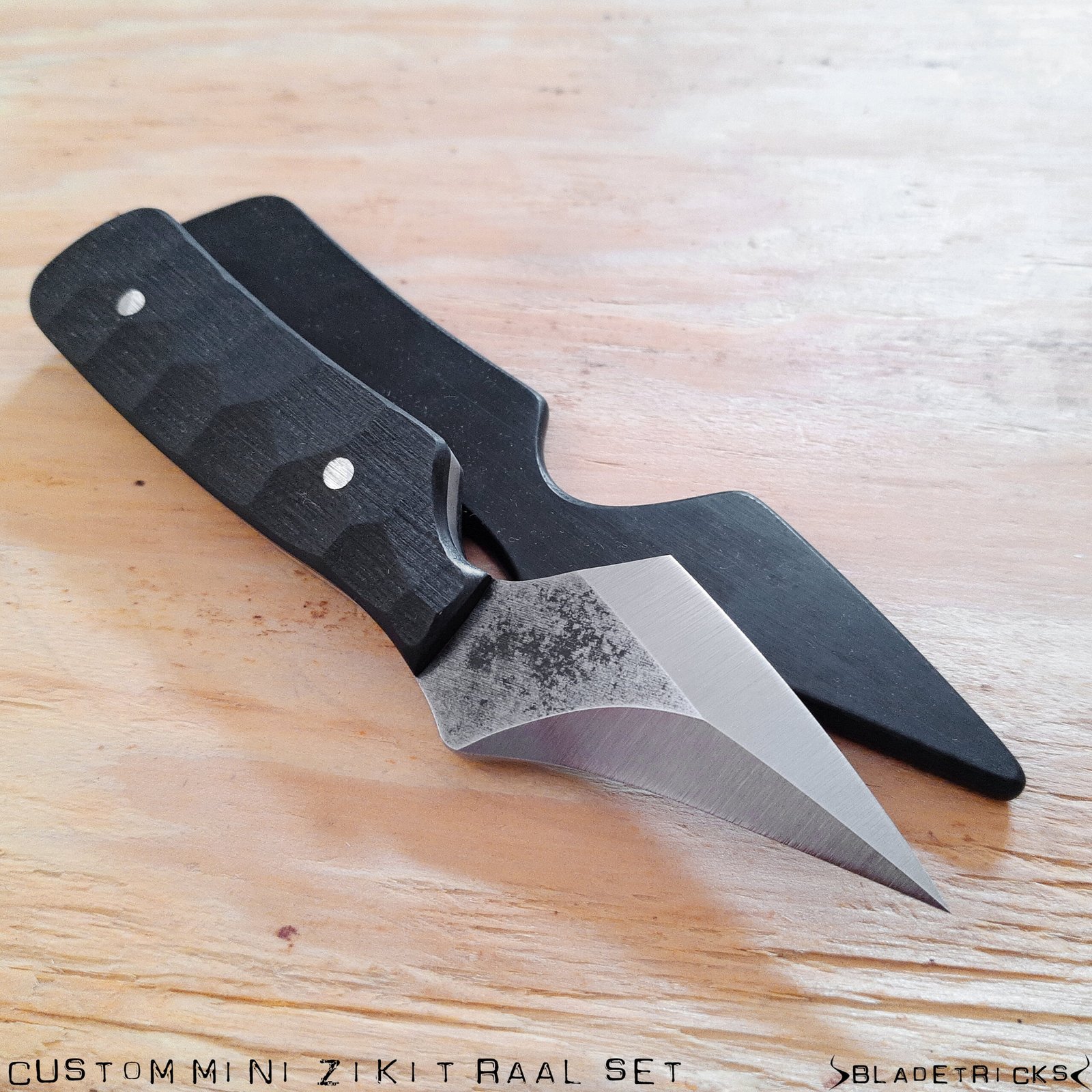
The HAPAK ships with a multi-position Kydex sheath and an Ulticlip retention clip — a carry system that keeps the tool accessible in any position without unnecessary bulk.
HAPAK Utility Karambit Knife
Bladetricks HAPAK Home Front Command Karambit
Ulticlip Sheath Clip mounted on the HAPAK Karambits Kydex Sheaths
The Custom Version
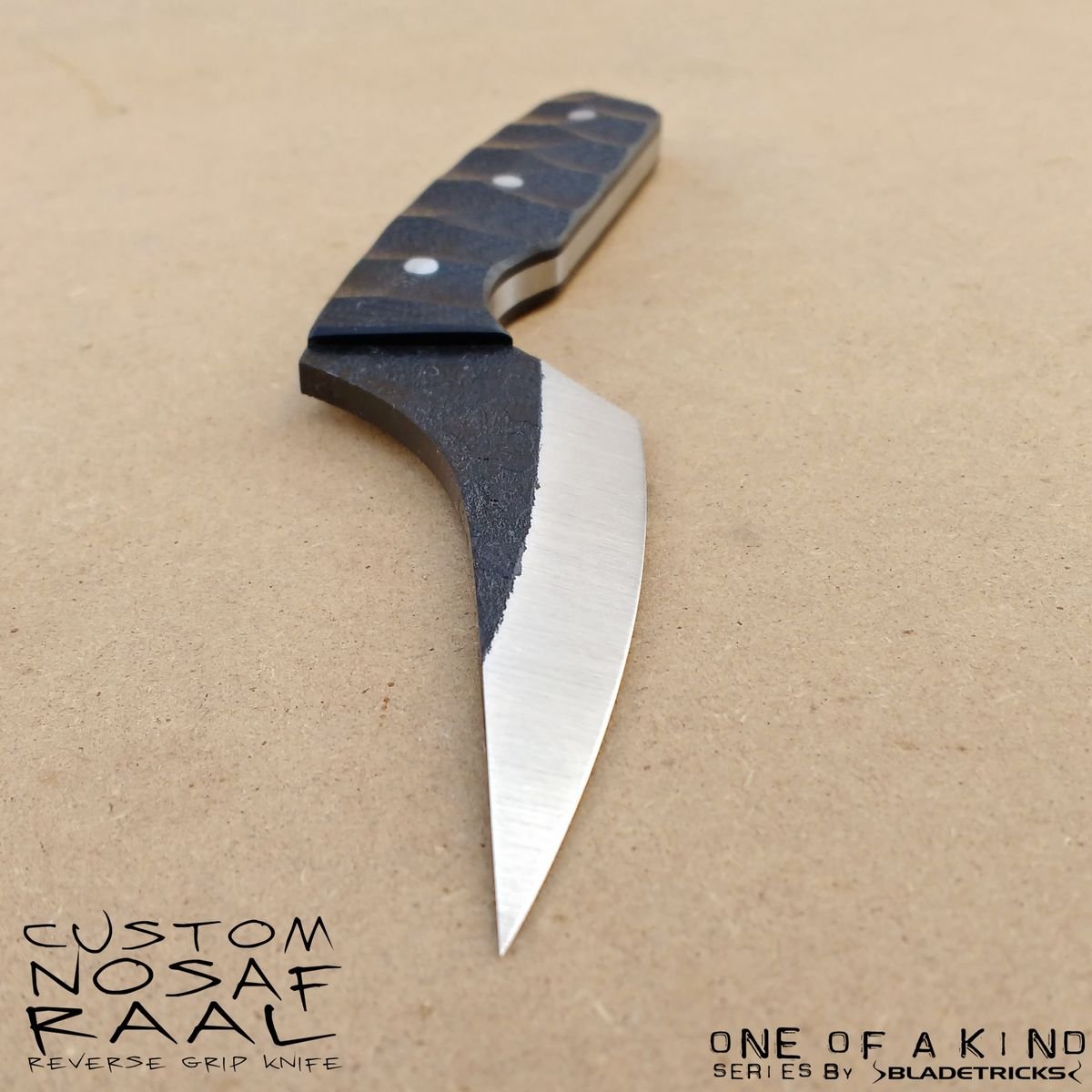
A custom interpretation of the HAPAK is currently in progress — longer blade, hand-sculpted black G10 recessed scales with a clean border of exposed steel around the handle. The customer asked for more. We obliged. Follow the build on Instagram.
The Nosaf Raal is a design concept that does not stay still — not because it is unresolved, but because it keeps feeling its own potential and demanding more of itself. It began as a traditional (straight knife), evolved into a refined karambit geometry, and has not stopped expanding since.
What follows is not a catalogue entry. It is an account of why this geometry exists, what it demanded across more than a decade of continuous refinement — subtle adjustments in proportions, angles, grinds, adapted to specific uses, specific budgets, specific customers, and wherever possible pushed forward aesthetically as well as mechanically. The decisions were not purely stylistic, but they were never purely mechanical either. A tool has to earn its appearance as much as its function.
The Foundation: Simple Knives with a Simple Rule
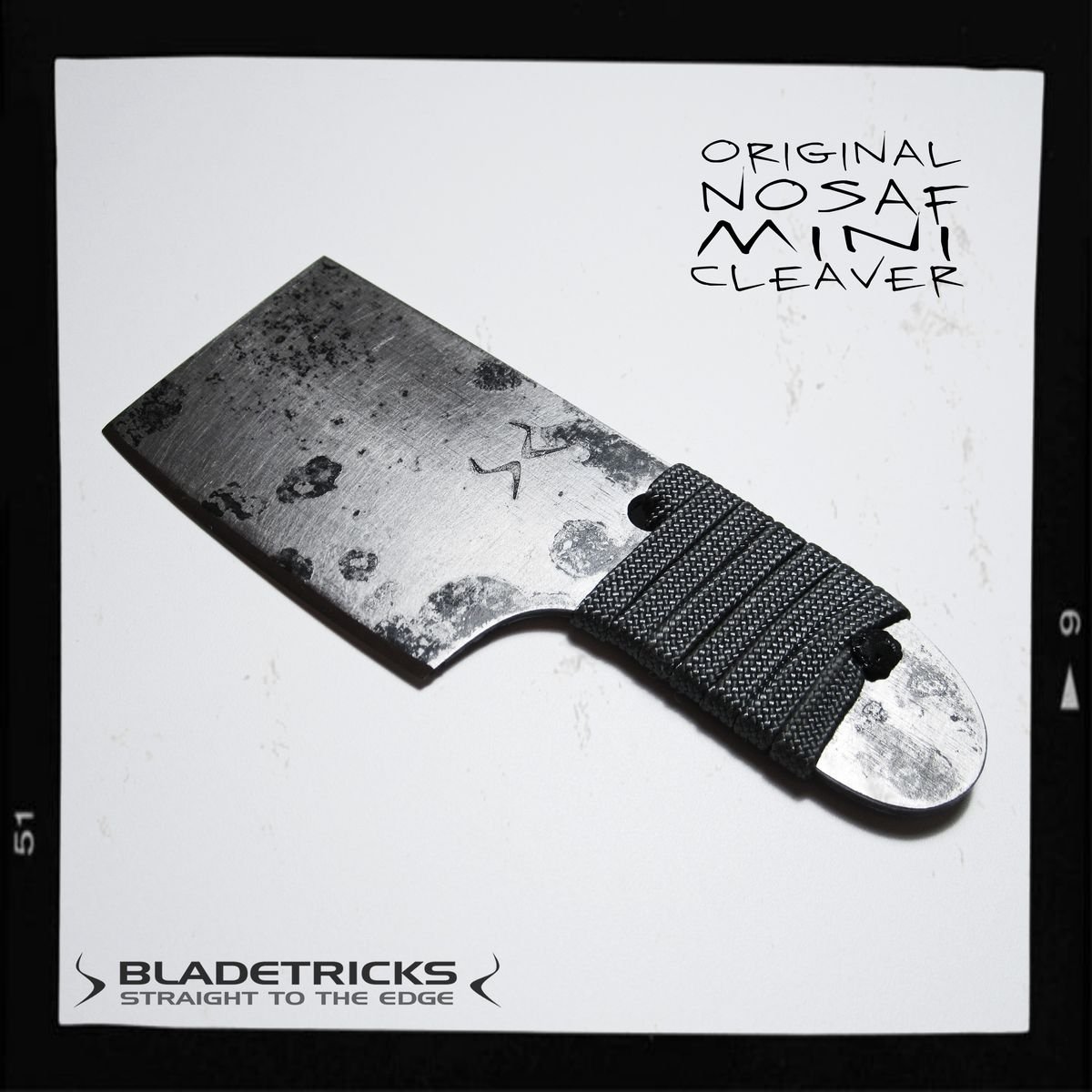
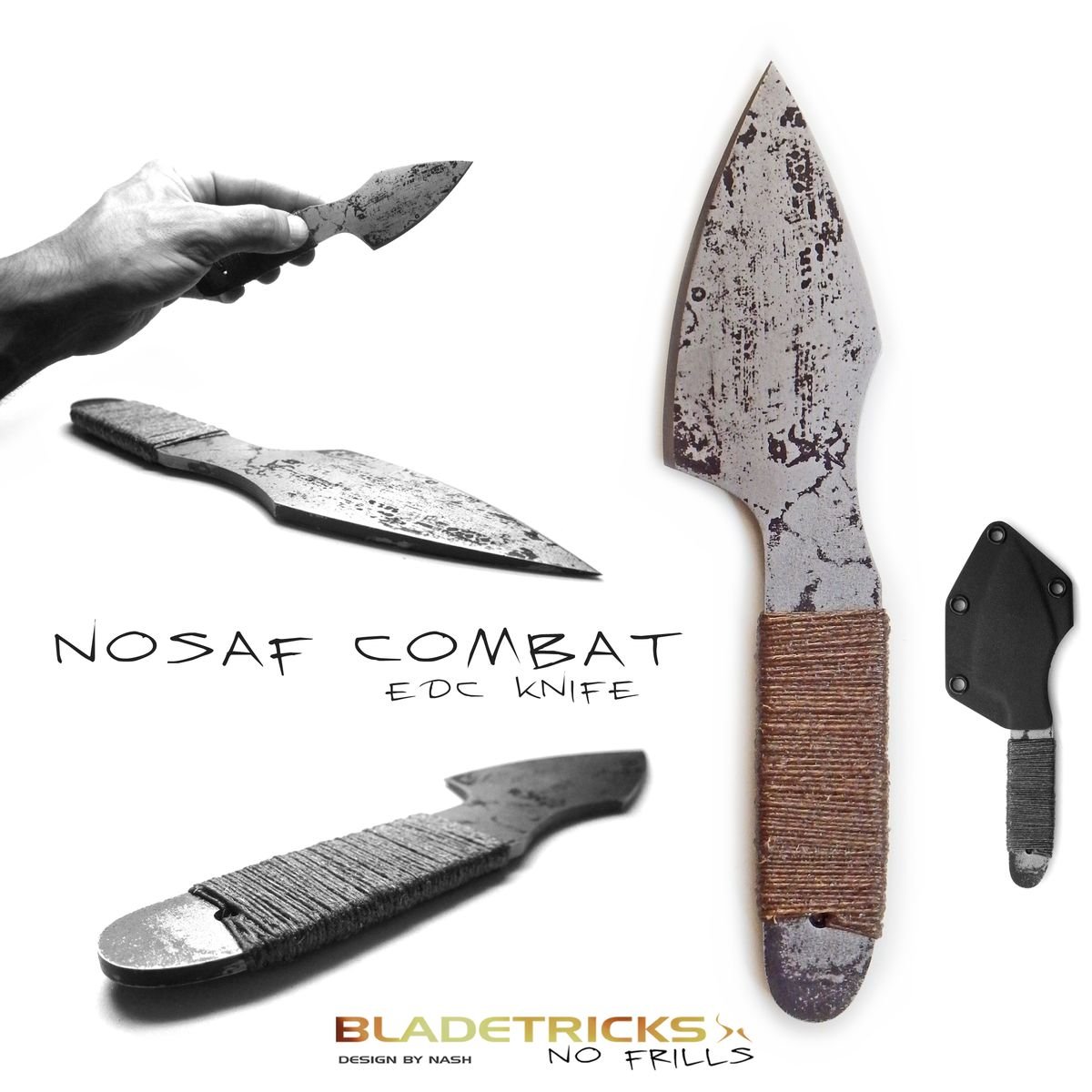
The Nosaf line began as a straightforward proposition. I wanted a series of very simple, compact knives — full hand and two-finger grip formats — utilitarian, versatile, honest in their construction. No rings. No curves. Two rules governed the entire early series: 2mm stock and simplicity. Those constraints were not limitations. They were a discipline. They kept every design honest, stripped of the unnecessary, true to the concept of a tool that disappears until it is needed.
Original Bladetricks Mini Cleaver
Bladetricks Original Nosaf Skin
Bladetricks Original Nosaf Bush Knife
Bladetricks Original Nosaf Combat Tribal Version
Bladetricks Nosaf Light Combat Knives
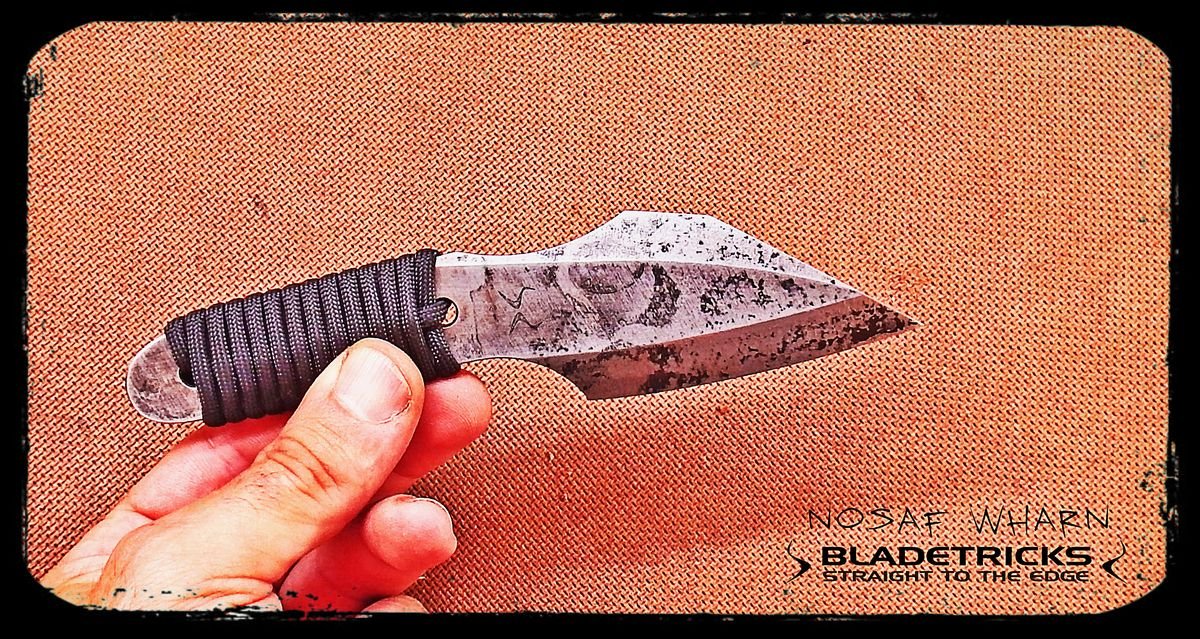
The Nosaf Wharncliffe emerged at the same time, another expression of the same philosophy applied to a different blade profile. Its flat spine and aggressive yet rugged tip gave it a distinct character within the family: a precise, controlled cutter that complemented the more aggressive profiles that would follow. It remains in the catalogue today, mostly unchanged in its essential purpose.
Bladetricks Original Nosaf Wharn Original Version
From that foundation, a customer request introduced the karambit format to the Nosaf. The result was the first Nosaf Karambit — and with it, an entirely new palette of geometric possibilities opened up.
The Karambit With a Belly
The karambit format traces its origins to the Minangkabau people of West Sumatra, where the curved blade began as an agricultural implement before becoming a weapon of last resort. In modern knife making, its most recognizable characteristic is the retention ring — the feature that defines the format more than the blade itself — and the hooked blade is its traditional signature.
The first Nosaf Karambit did something different: it used a traditional blade profile with a belly — a curved, slicing geometry rather than a hook. At the time, that was genuinely uncommon. I had not seen it done elsewhere. It was a deliberate departure from what the market understood a karambit to be, driven by the belief that the ring format was worth more than the hook it was always paired with.
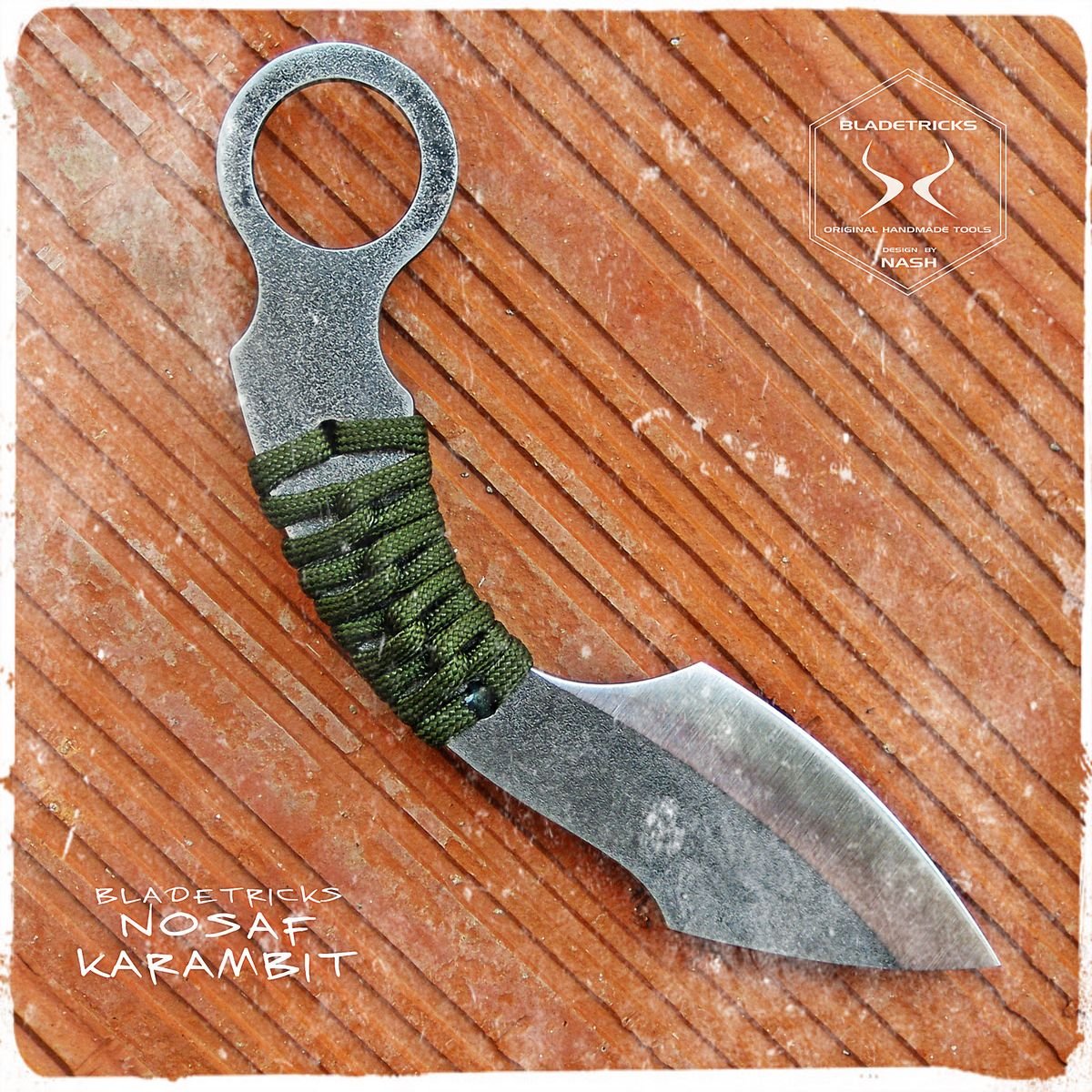
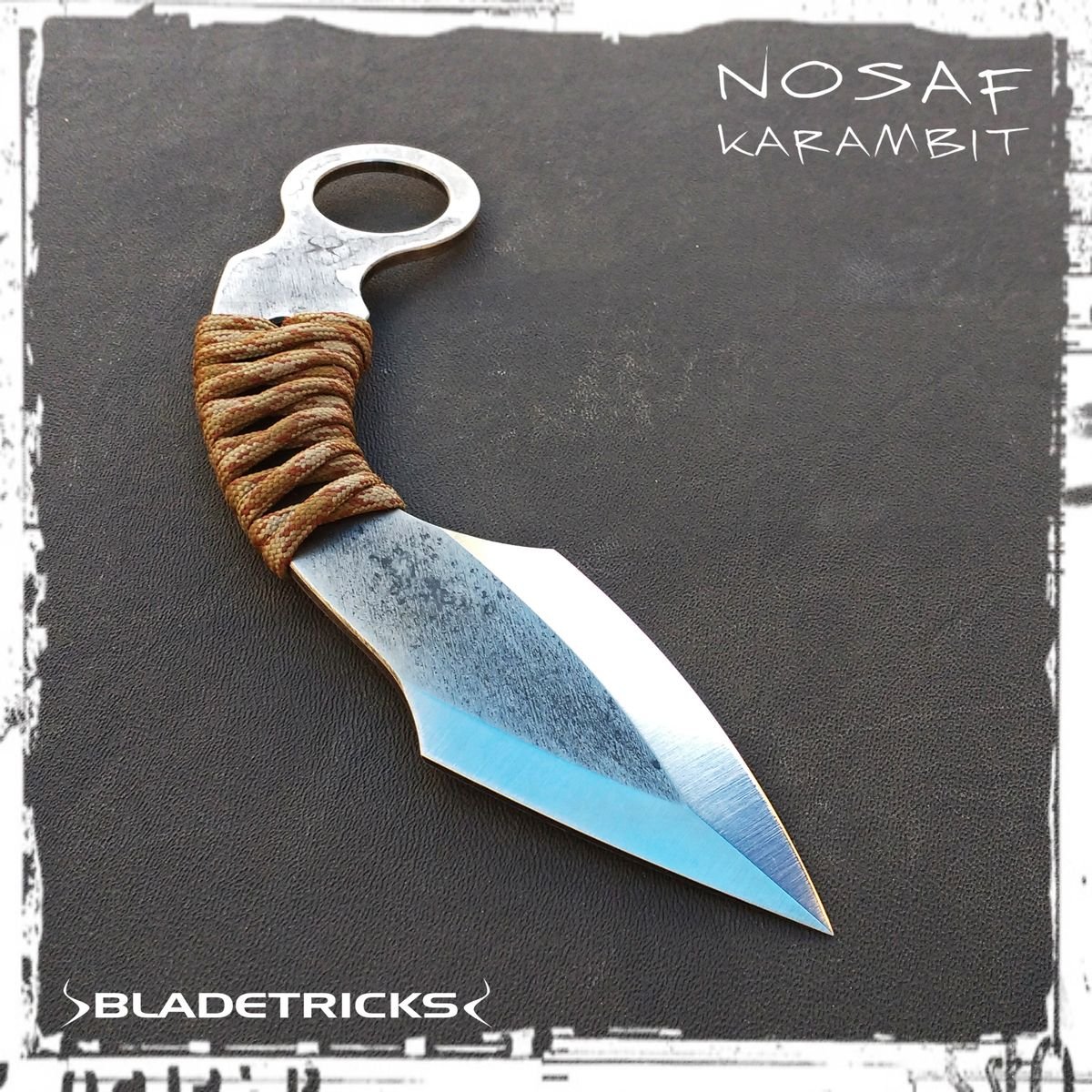
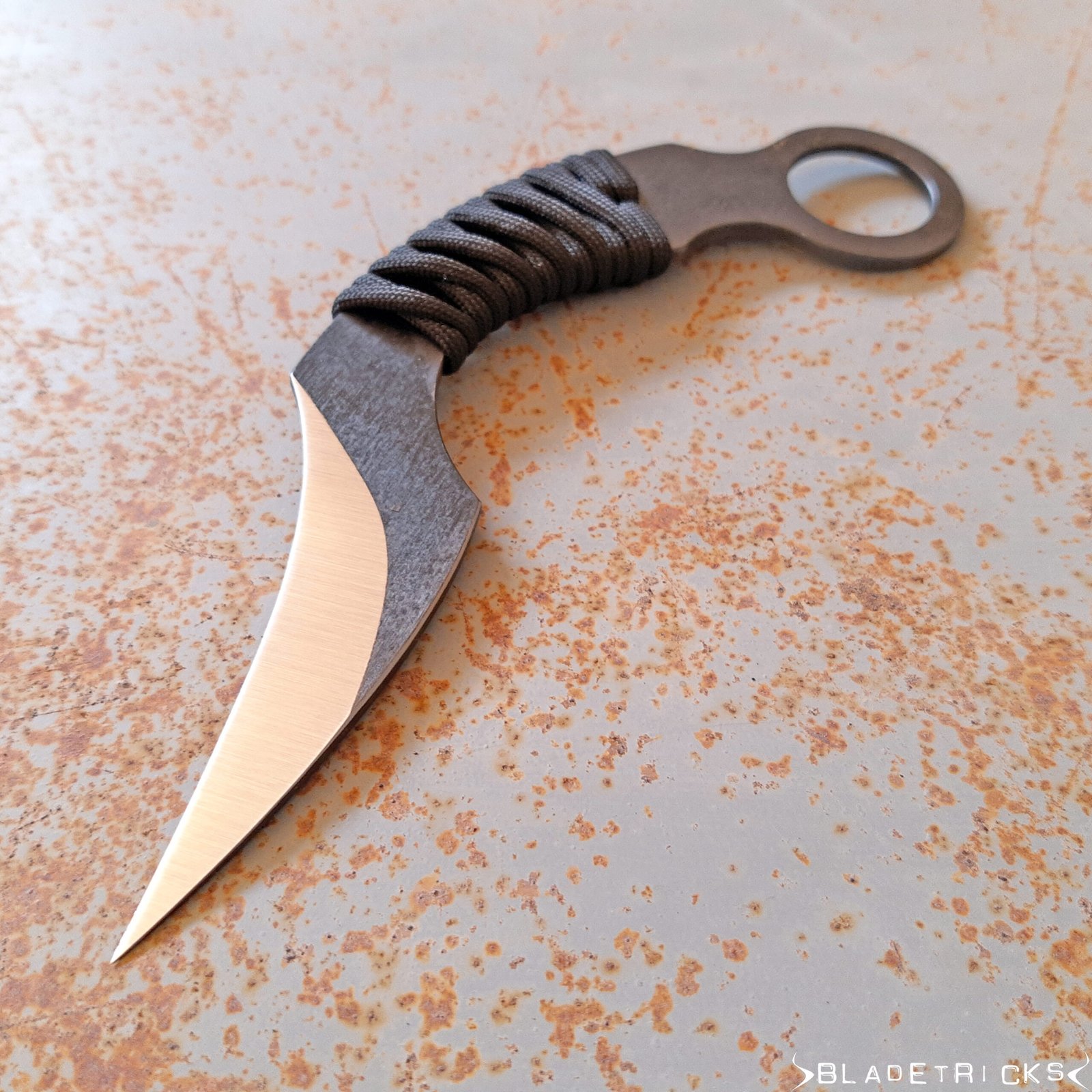
Bladetricks Original Nosaf Karambit Oiginal Version Cord Wrapped
Bladetricks Nosaf Karambit Original Micarta Version
Bladetricks Nosaf Karambit cord wrapped
That first version was made in steel and was built to prove the concept. Multiple versions followed — cord wrapped, micarta — each refining the proportions incrementally. But as I worked with the geometry, a specific limitation became clear. The standard Nosaf Karambit blade profile was capable, but not committed. It was a tool — somewhere between an aggressive EDC utility knife and a fighting blade — that could do many things adequately. I wanted a tool that did one specific thing with complete mechanical authority.
The answer was the Nosaf Raal.
Raal: The Geometry of Commitment
“Raal” is the designation I apply to the most aggressive version of any Bladetricks model. It means the slenderest blade, the sharpest tip, the most uncompromising geometry in the family. Pure poison, literally. On the karambit platform, it meant taking the existing external slicing edge curve and driving the tip geometry further — harder, more defined, built for penetration rather than general utility.
The result was a blade that operated differently from anything I had made before. The angle between the handle axis and the blade — the detail that many karambit makers treat as a stylistic choice — became a calculated mechanical variable. In a standard grip, that geometry drives a forward and downward thrust aligned with the forearm axis. The same grip, with a change of intent but no change of hand position, loads directly into the pulling arc of the pikal system for control and engagement. And from the same hold, the external edge is available for an upward or lateral slash without repositioning the hand.
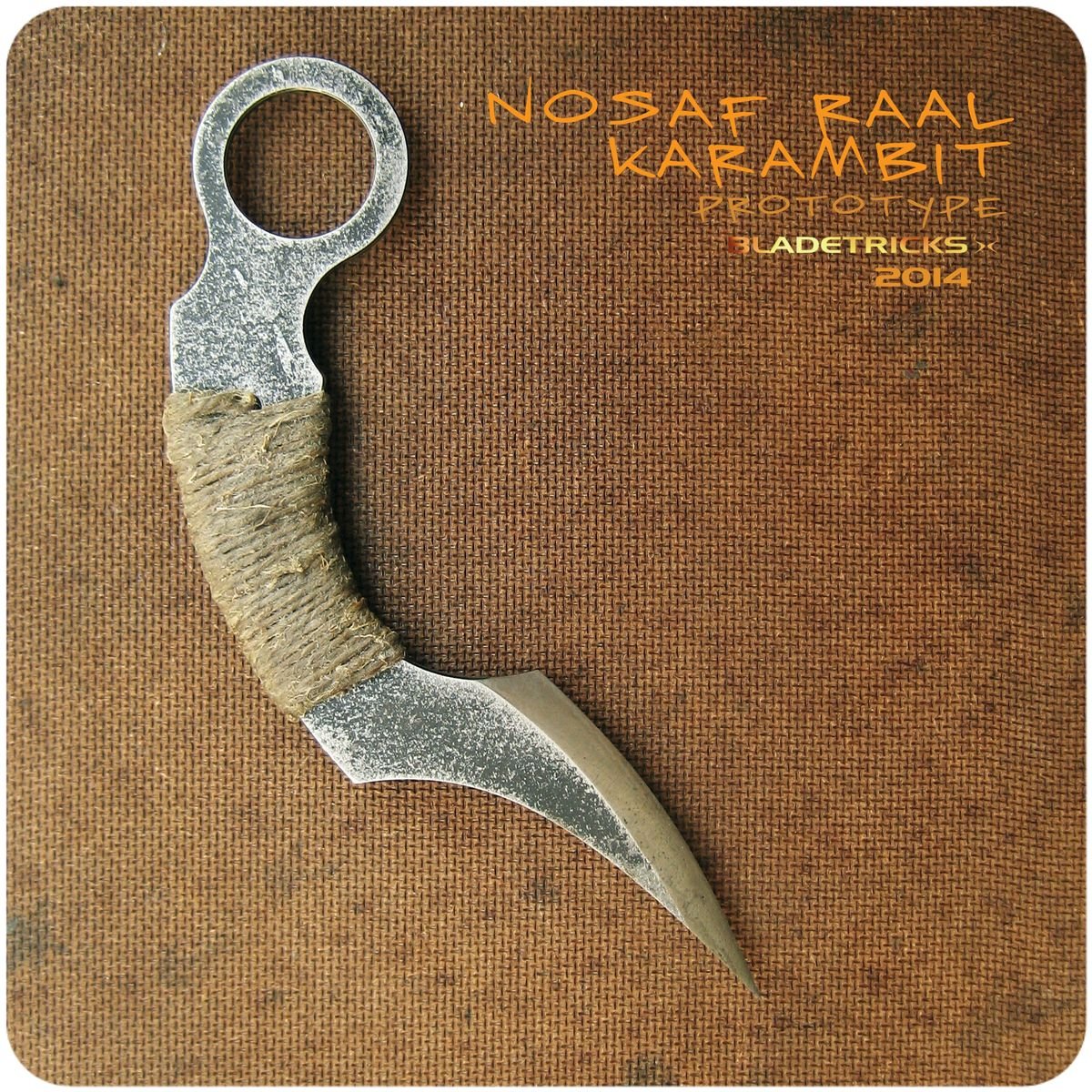
Bladetricks Nosaf Raal Karambit Tribal Version Prototype
Three vectors. One grip. The hand barely moves. The geometry does the work.
This is not a feature that was added to the Nosaf Raal. It is what the geometry produced when the proportions were finally correct. The model was subsequently made in steel, titanium, and G10 — each material imposing its own constraints, each version confirming that the geometry held regardless of what it was made from. Subtle refinements continued across versions, each one responding to a specific observation about how the tool performed in real hands.
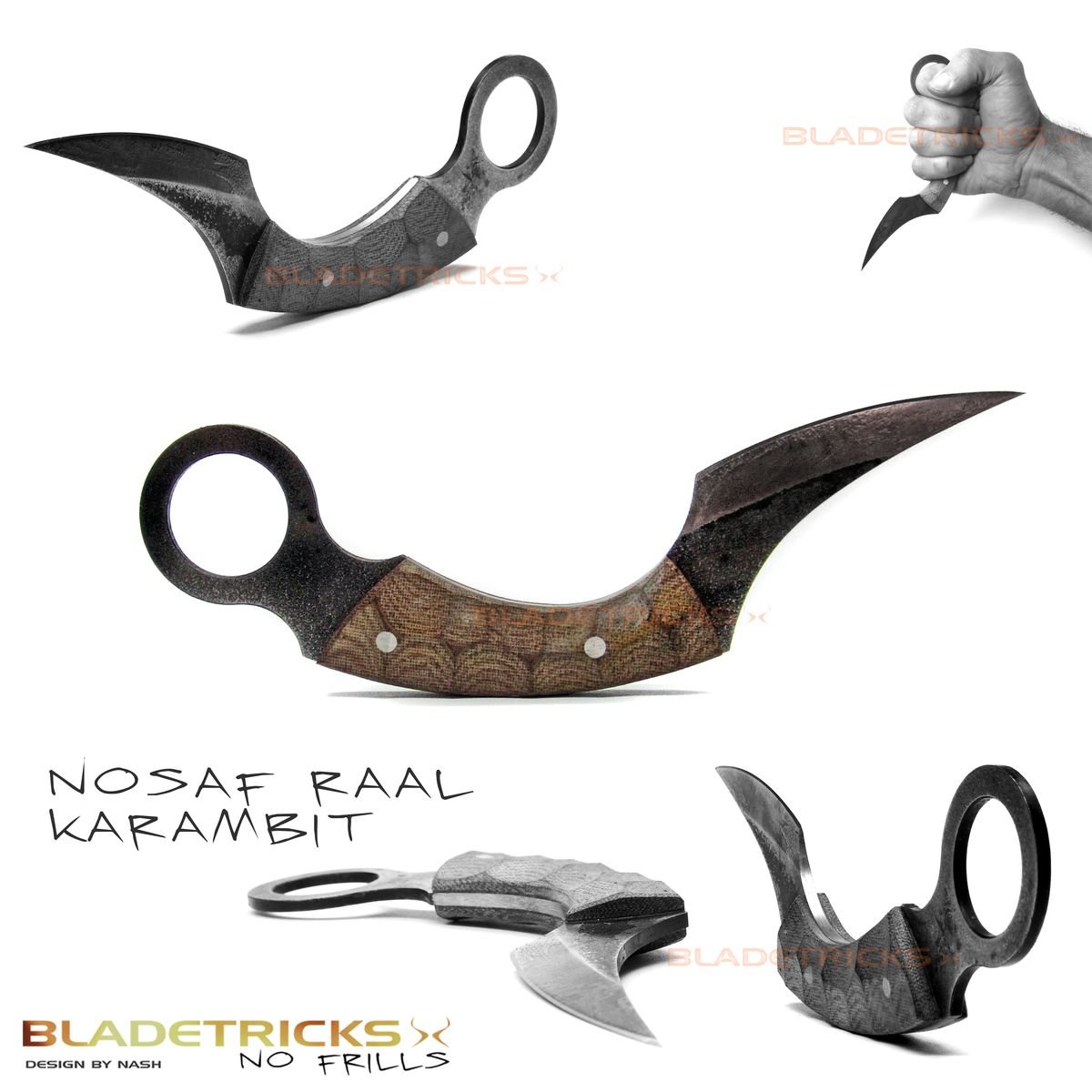
Bladetricks Nosaf Raal Karambit Micarta Version
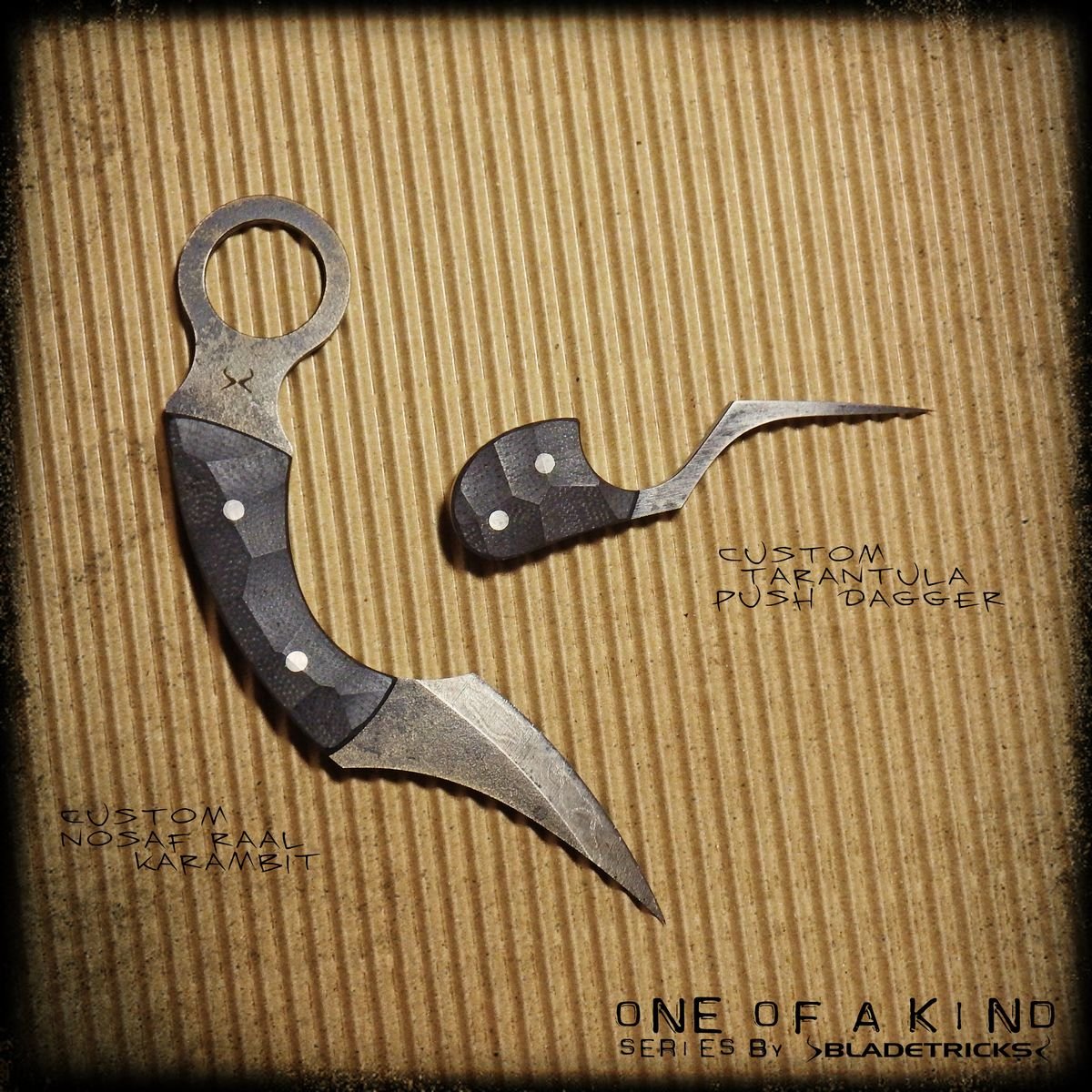
Bladetricks Custom Made Set Nosaf Raal Karambit and Tarantula Push Dagger
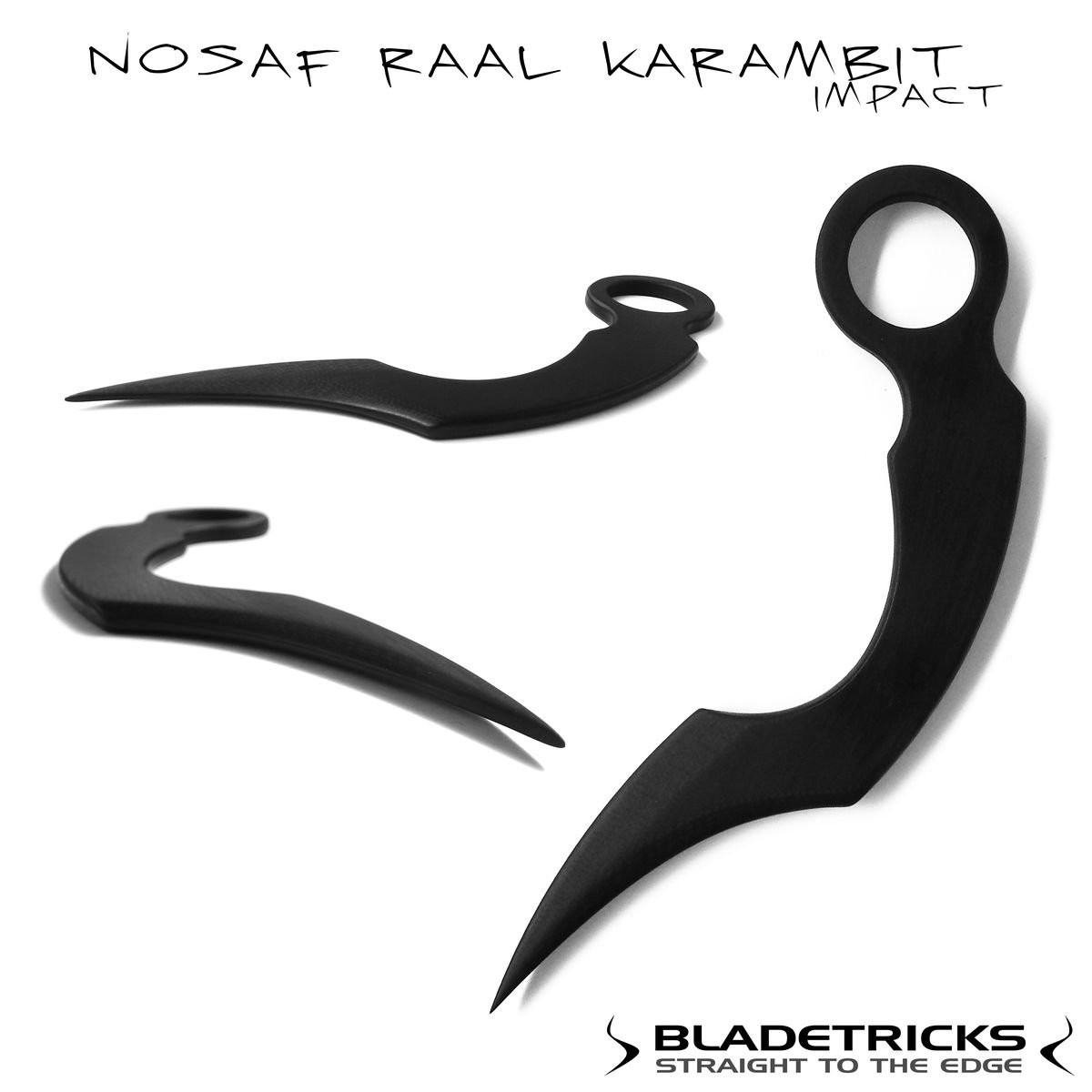
Bladetricks Nosaf Raal Karambit Black G10 Impact Version
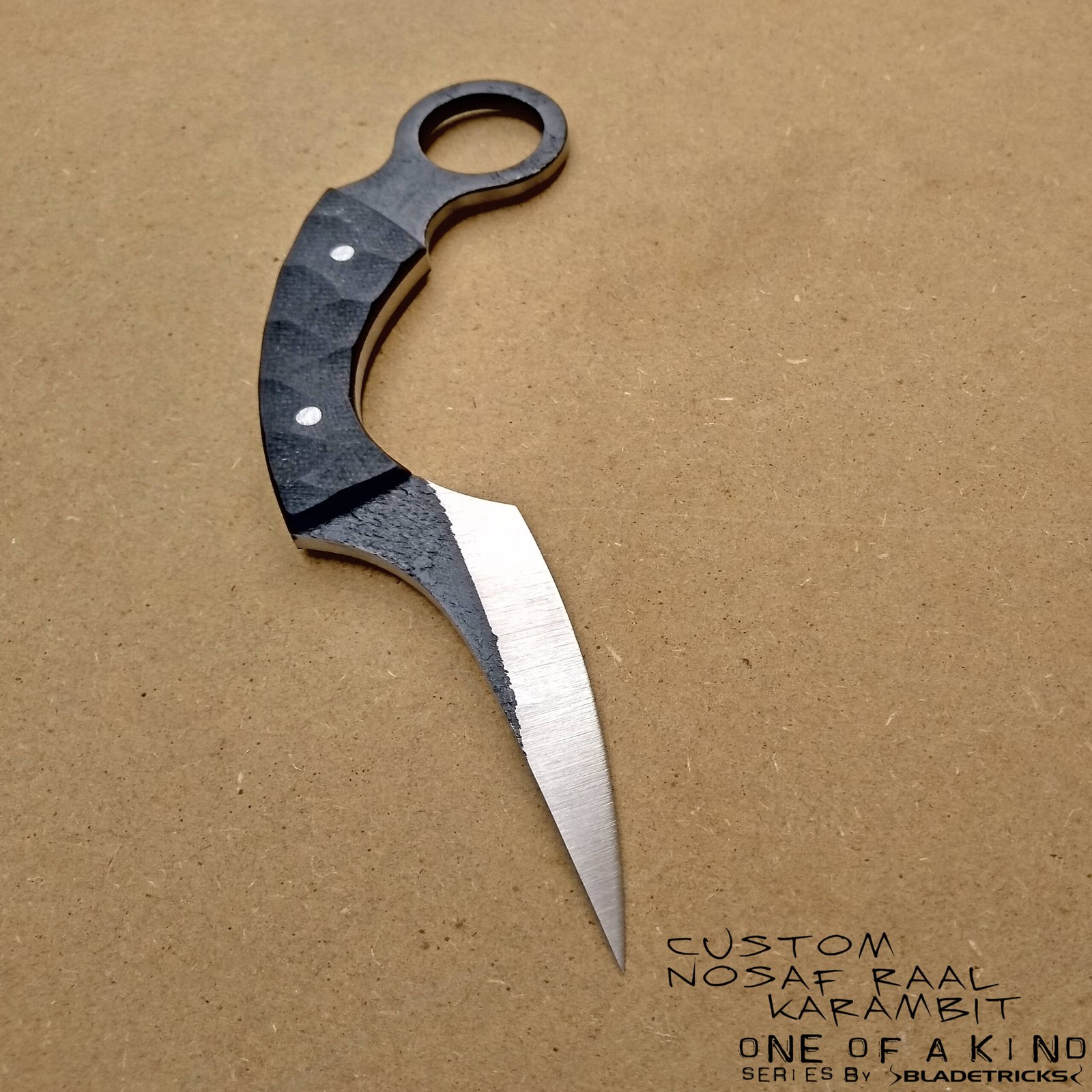
Bladetricks Nosaf Raal Karambit Black G10 Handle Version
The RGEI Question
At some point, the natural next question was obvious: what happens when you invert the edge?
The answer was the first pikal version of the Nosaf Raal — the RGEI configuration that takes the inside edge and turns it into the primary cutting surface. The pulling mechanics of the pikal system generate a kinetic force that is difficult to intercept, engaging the body’s strongest pulling muscles in a motion that is both instinctive and mechanically efficient. The Nosaf Raal’s handle-to-blade angle, already calculated to serve both push and pull mechanics, loaded into the RGEI orientation with a precision that confirmed the geometry had been correct from the beginning.
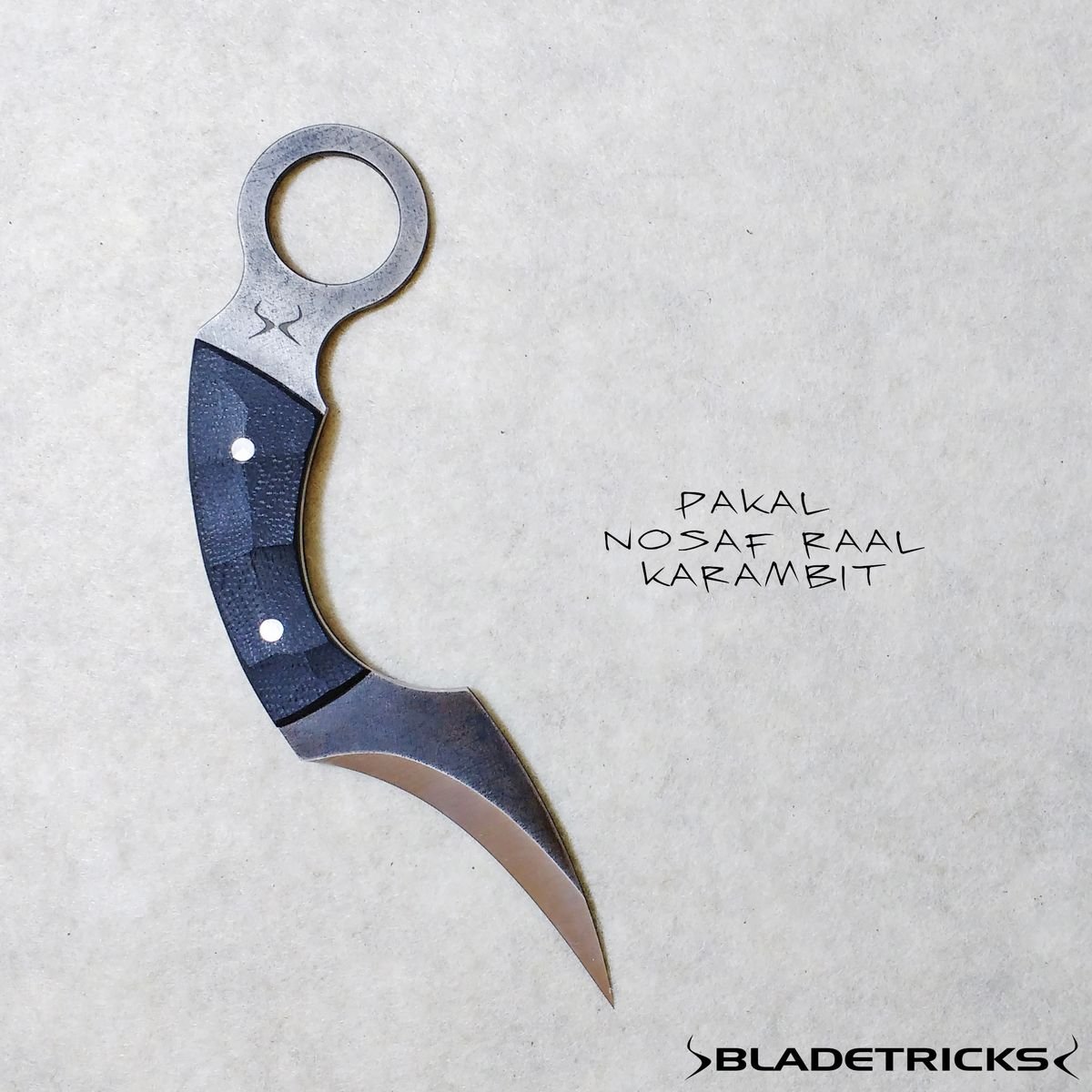
Bladetricks Nosaf Raal Karambit Pakal Version
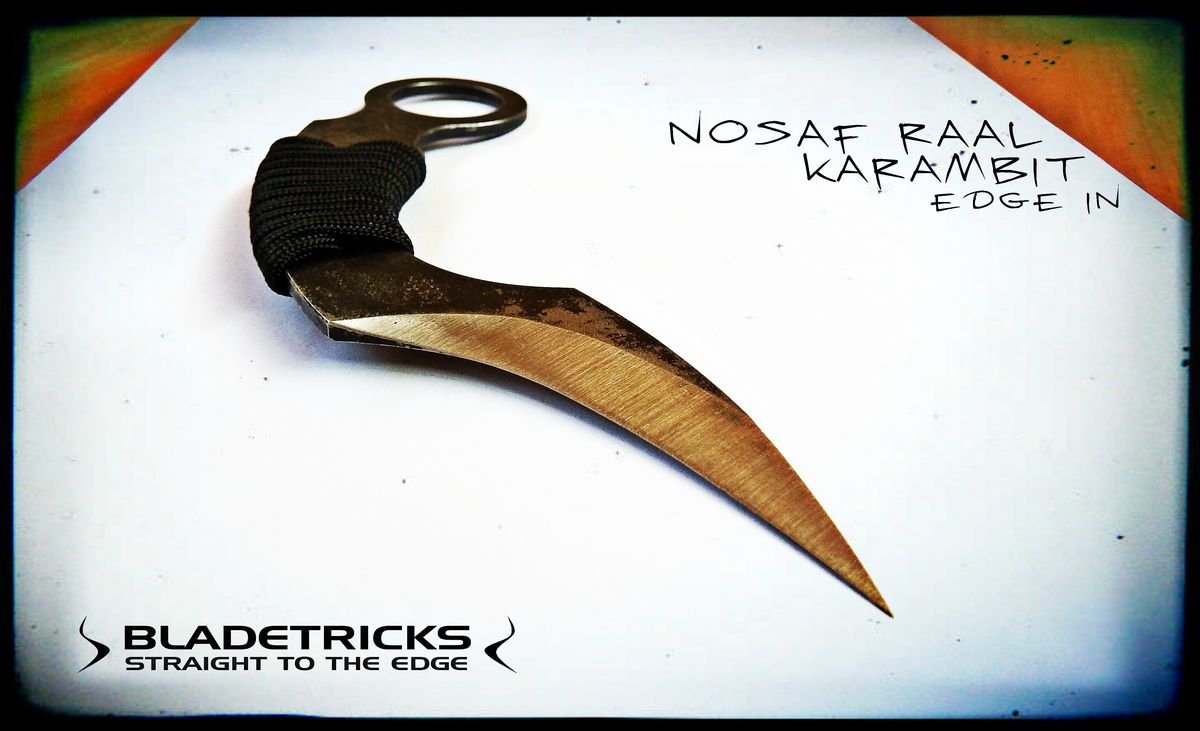
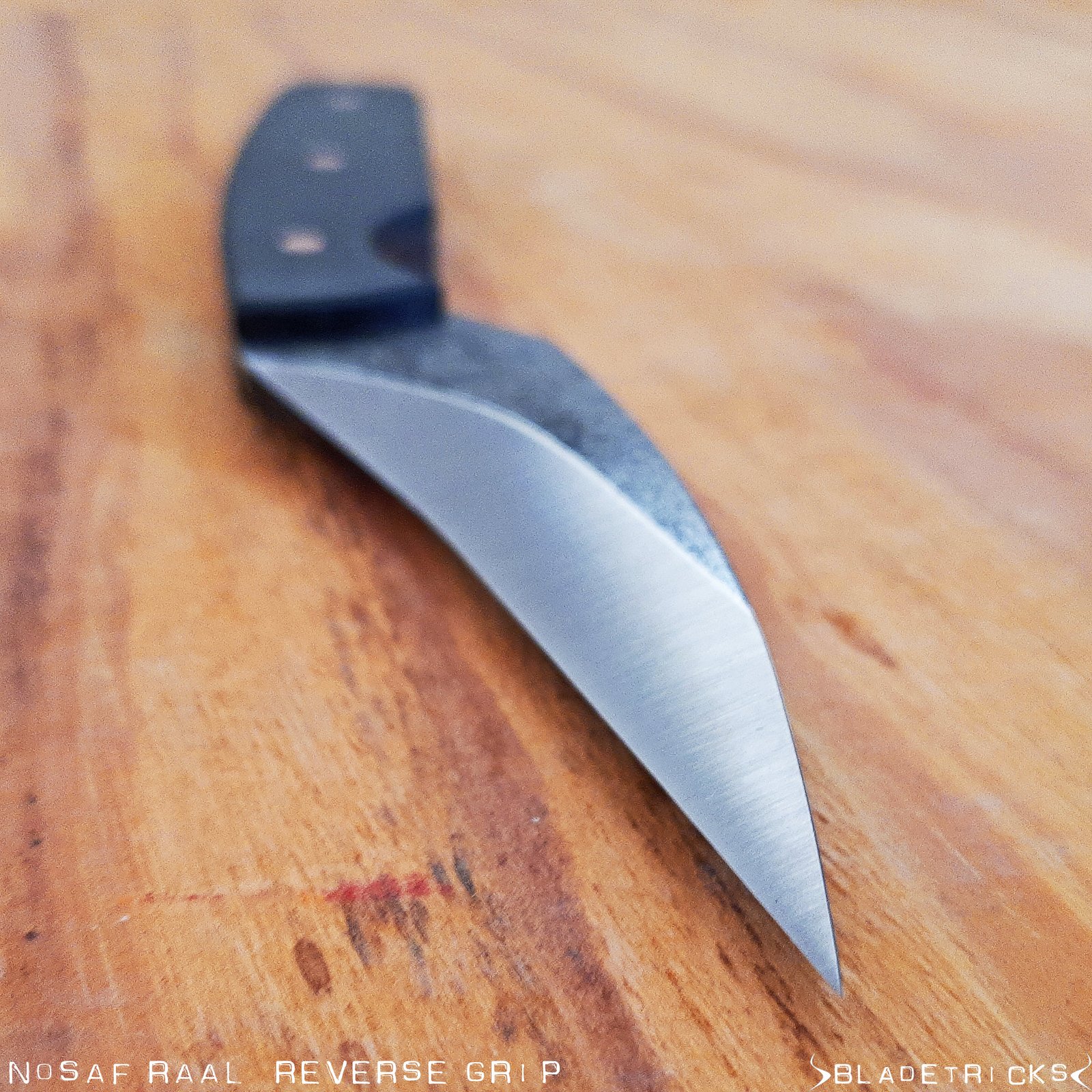
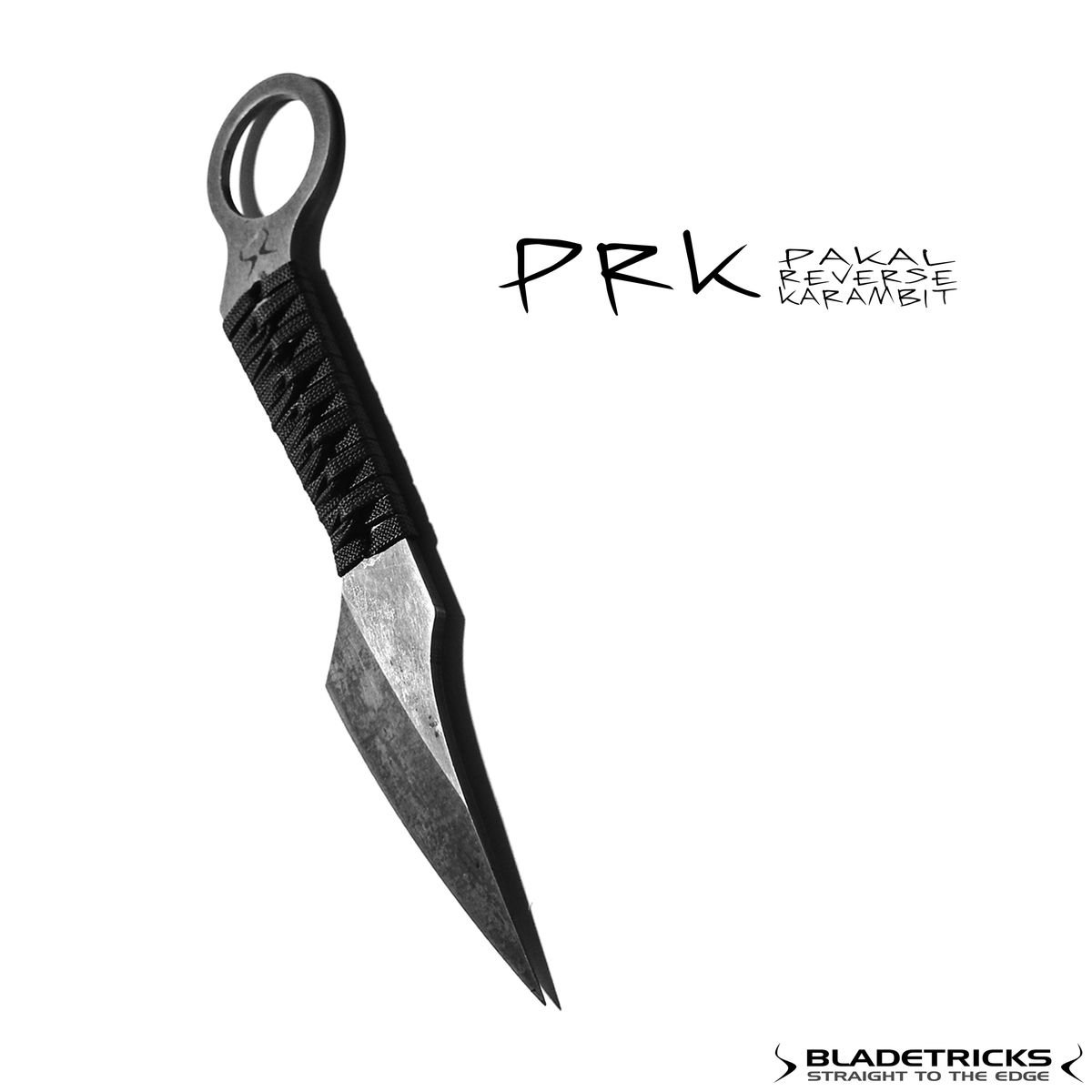
Bladetricks Nosaf Raal Karambit Reverse Grip Edge In RGEI Version
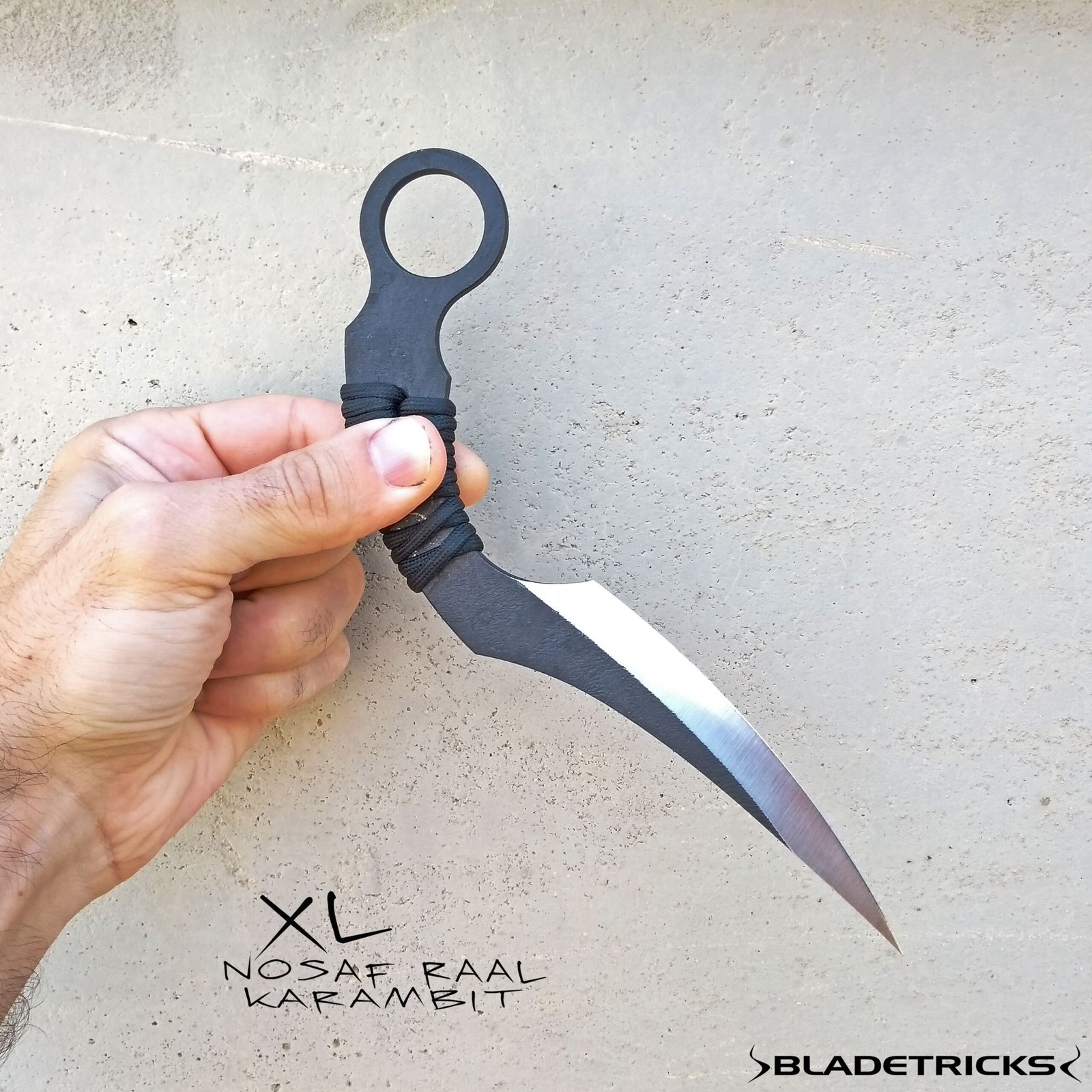
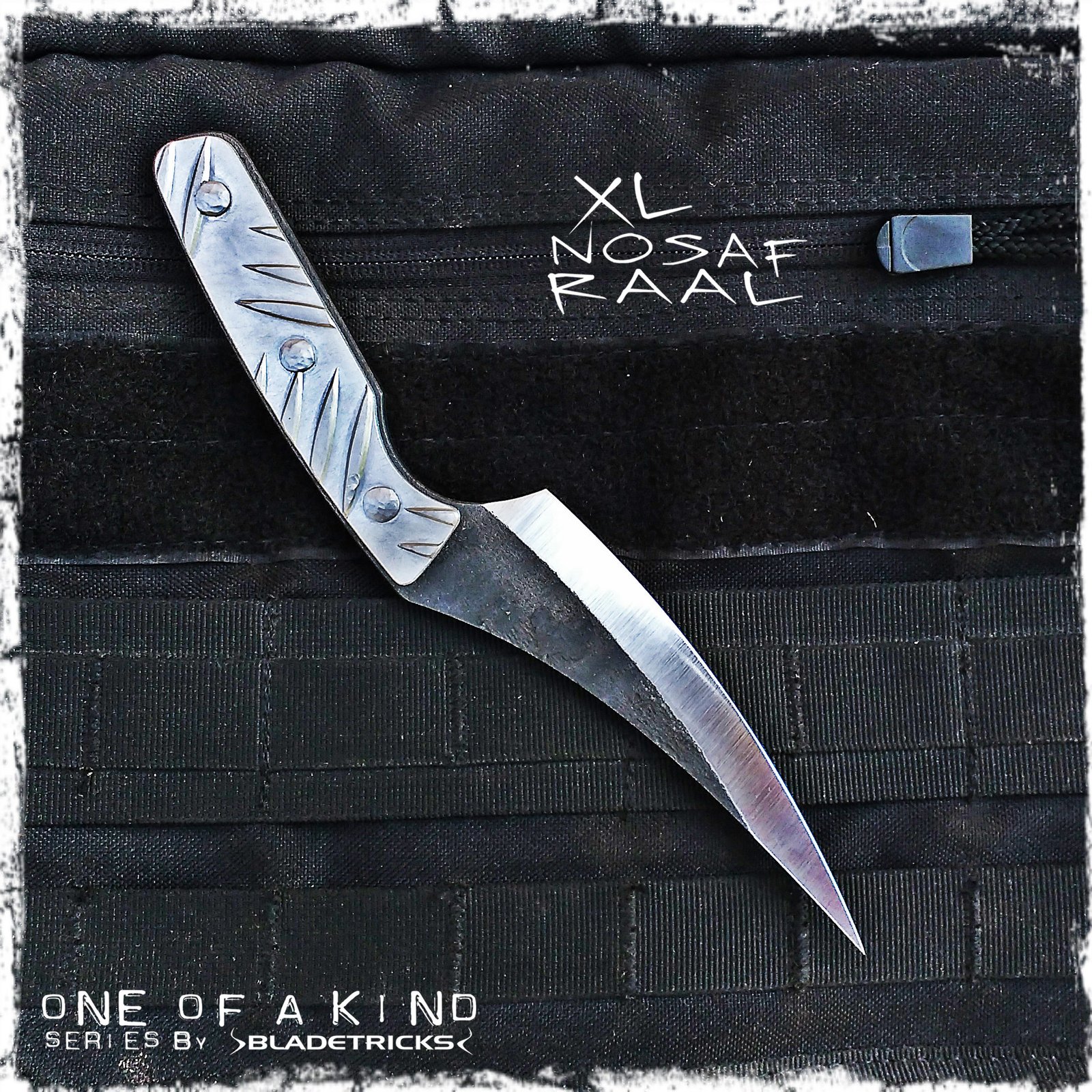
The XL version followed — a blade that nearly doubled the original length, extending reach without altering the fundamental proportions. Same geometry. Different scale. The logic held.
Bladetricks XL Nosaf Raal Karambit
Bladetricks Custom Made Nosaf Raal Karambits
The Knife Version: Removing the Ring Without Losing the Geometry
The ring is the karambit’s defining feature and its most significant constraint. It locks the blade in the hand under extreme stress. It also locks the user — mostly — into a specific carry profile, a specific draw sequence, and a specific deployment geometry.
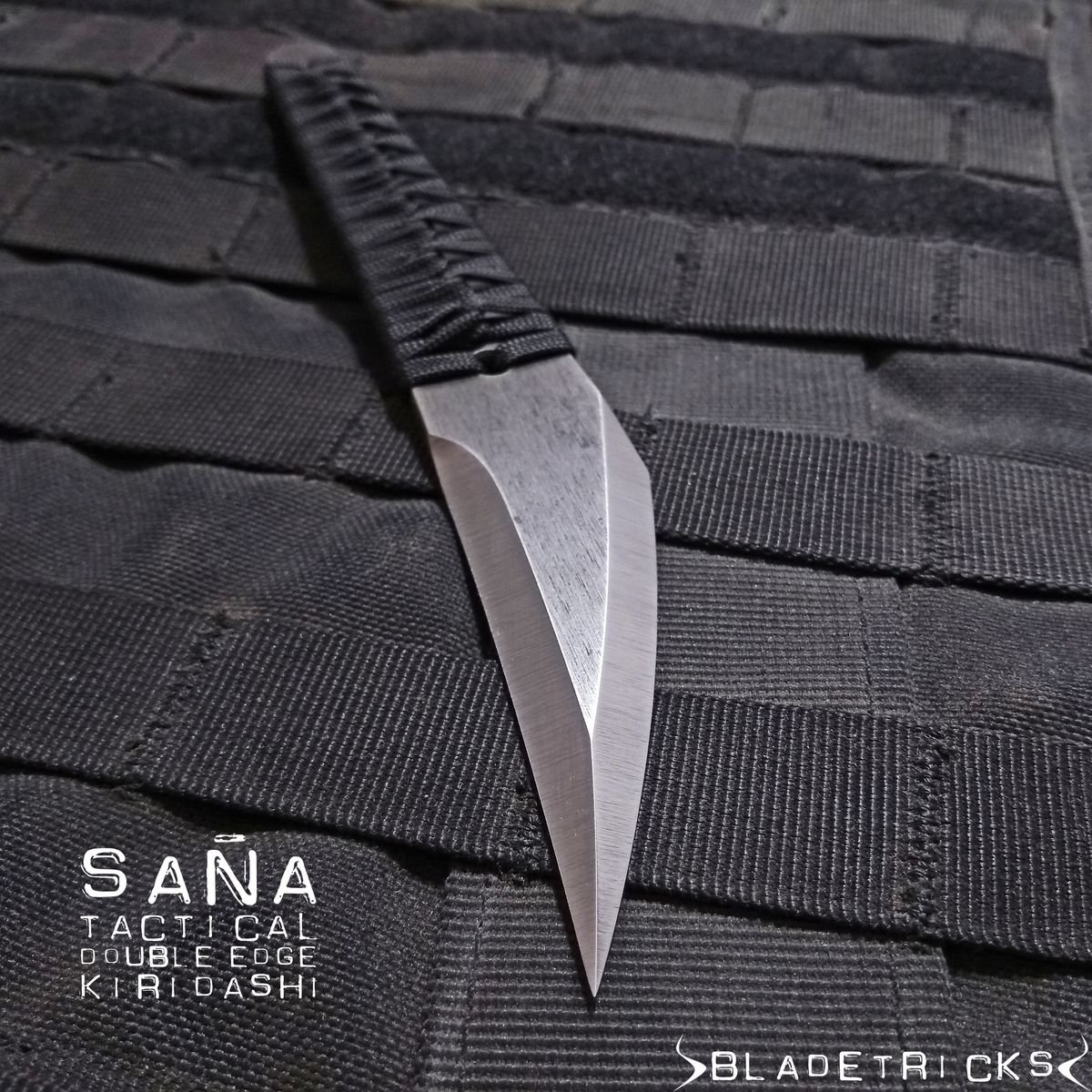
The Nosaf Raal Knife replaced the ring with a knife handle — same blade, same handle-to-blade angle, same mechanical relationships — but now accessible to users who carry and deploy differently. Not everyone works well with a karambit format in the hand. Some professionals prefer the familiarity of a straight handle, the cleaner pocket profile, the less conspicuous carry, and in some jurisdictions, the more straightforward legal status that a conventional knife profile carries over a ringed blade. The Nosaf Raal Knife answers that preference without asking them to give anything up mechanically. The geometry did not change. The platform did. The knife version performed identically — both as a pikal tool and in edge-out XL configurations.
Custom Nosaf Raal Knife by AN Nash
Bladetricks Pikal Nosaf Raal RGEI Knife Back G10
XL Nosaf Ral Knife Smilodon by AN Nash
The Double Edge: Three Vectors Become More Consequential
Adding a second edge to the Nosaf Raal Karambit was not an aggressive gesture. It was a structural decision with a specific mechanical outcome.
The double edge is wider than the single edge version — a necessary accommodation for structural integrity across both cutting surfaces. What it sacrifices in slenderness it recovers in capability. The same three vectors available in the single edge version — downward thrust, inside pulling arc, outside upward slash — now carry consequence on both sides of the blade. There is no neutral angle. There is no dead side. Every position of the blade in motion is a working position.
The double edge Karambit was the first expression of this. It retained the ring. The geometry it established became the foundation for everything that followed.
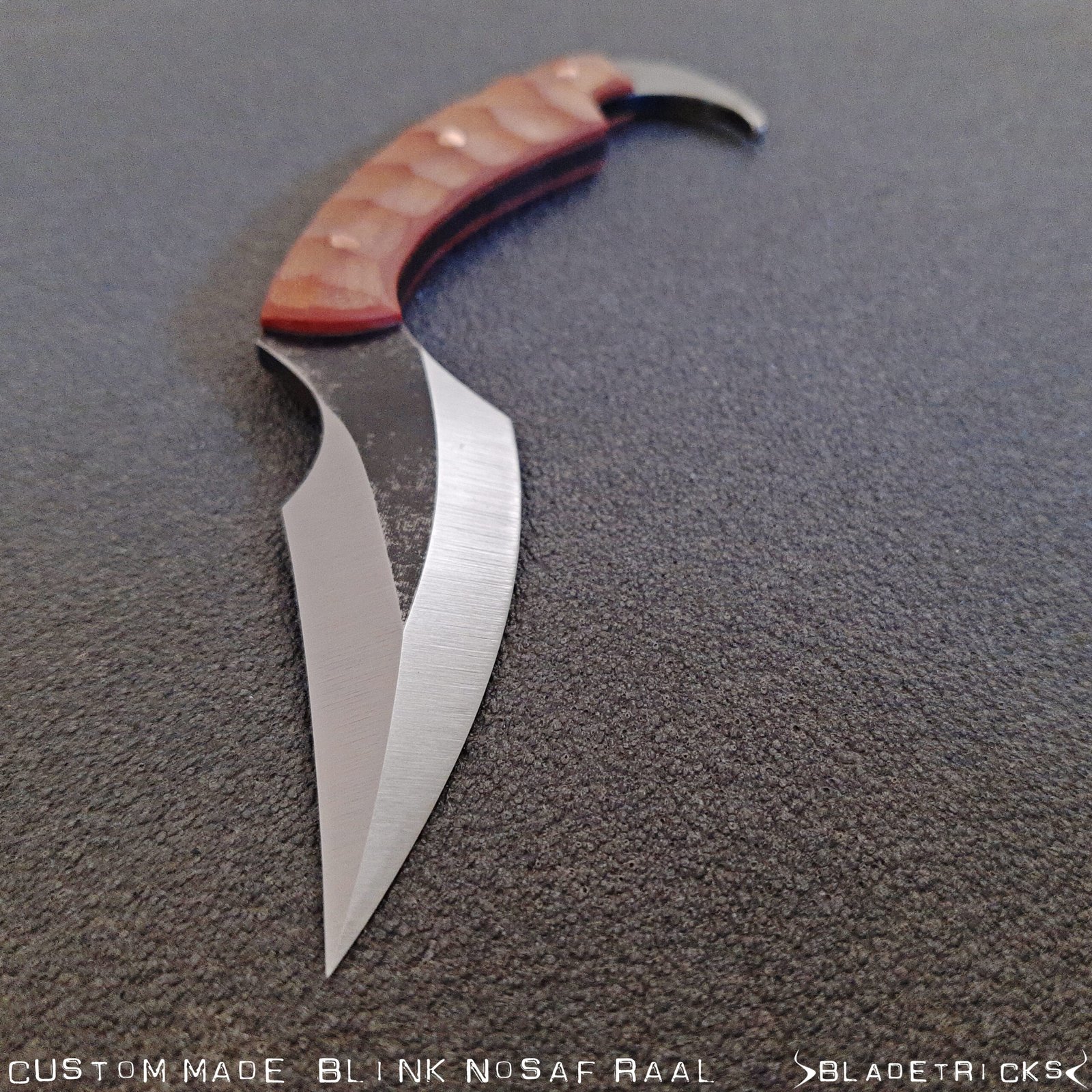
The Blink Grip was created to solve a specific problem: draw speed. In a life-threatening encounter, fumbling a draw and / or failing to establish a secure grip immediately are the real failure points — not technique, not blade geometry. The Blink Grip allows a near-instantaneous, consistent, blind-indexed draw from the Kydex sheath with no mechanical parts and no conscious adjustment required. The index finger reads the geometry, the hand closes, and the result is a fast, secure grip every time — regardless of conditions. It is worth noting that chronologically, no single edge Blink Nosaf Raal was ever produced. The Blink Grip system was introduced directly on the double edge platform — the most mechanically complete version of the geometry — and has remained there.
It is worth noting that chronologically, no single edge Blink Nosaf Raal was ever produced. The Blink Grip system was introduced directly on the double edge platform — the most mechanically complete version of the geometry — and has remained there (at least for the moment).
The Blink Nosaf Raal is that platform: the full mechanical capability of the double edge Nosaf Raal, combined with the fastest possible deployment system and a handle built without compromise.
The Kadesh Handle: The Latest Development
The most recent chapter in the Nosaf Raal lineage introduces the adapted Kadesh handle to the double edge Nosaf Raal blade. The Kadesh handle profile — proven across several Bladetricks models for its exceptional grip security and seamless transition between pikal and sabre positions — brings a new ergonomic and flexible dimension to the Nosaf Raal geometry without altering the blade that has defined it. Same blade. New handle language. The geometry continues to find new expressions.
Cardboard prototype for the “Kadesh” Double Edge Nosaf Raal Knife
Bladetricks P-578511 Pikal Nosaf Raal Knife
What the Evolution Confirms
A geometry that survives more than a decade of refinement — across materials, handle formats, blade configurations, and deployment systems — is not one that arrived by accident. It is one that was refined through a consistent discipline: is there room for improvement? Can this angle be optimized? Can this grind be pushed further? Can this version serve a specific user better than the last one did?
The Nosaf Raal has been asked those questions in steel, titanium, G10, single edge, double edge, ringed, knife handle, Blink Grip, and Kadesh handle configurations. The proportions have held across all of them. The geometry works. The evolution is not finished.
Keyword: karambit
The Bladetricks Nosaf Raal — a decade of karambit geometry refined across steel, titanium, double edge, Blink Grip, and Kadesh handle. The full lineage.
A.N. Nash on the Nosaf Raal lineage — how one karambit geometry evolved across a decade into the most complete pikal platform Bladetricks has built.
Explore the full Bladetricks Nosaf Raal family — karambit, knife, double edge, Blink Grip. A pikal geometry refined across more than a decade of refinement.
There is a moment between reaching for a blade and having it in your hand that has always been a dilemma for the knife user. Not a failure of design — people train the knife draw, and train it seriously. But training a sequence of conscious movements under stress has a ceiling. I was looking for something simpler. The same logic as an automatic knife: press a switch, the blade is there. The Blink Grip is an attempt to bring that simplicity to a fixed blade draw.
The Blink Grip is not a feature added to a handle. It is the handle, built around a single purpose.
The knife world has spent decades refining blade geometry, steel selection, and handle ergonomics. The draw — the sequence of events between the tool leaving the sheath and the grip being established — has received less systematic attention. In a high-stress encounter, that gap is frequently where everything is already decided. A blade that performs perfectly once it is in the hand is only half a system.
The other half is what happens before that.
The Problem Nobody Was Solving Simply Enough
The inspiration was not another knife. It was a handgun draw.
A trained shooter draws with one goal: the weapon arrives in the hand oriented correctly, every time, regardless of conditions. The mechanics of the draw — the path the hand travels, the contact points, the transition from holster to grip — are not designed. They are calculated and trained in a specific sequence until the outcome is consistent without conscious intervention. The shooter does not think about grip orientation during the draw. The sequence handles it.
I wanted the same consistency for a blade, but through geometry rather than repetition alone. The karambit ring — which I have always respected for what it does once the tool is in the hand — does not always solve the deployment problem. It solves the retention problem. These are not the same thing, and conflating them is where most fast draw attempts fall short.
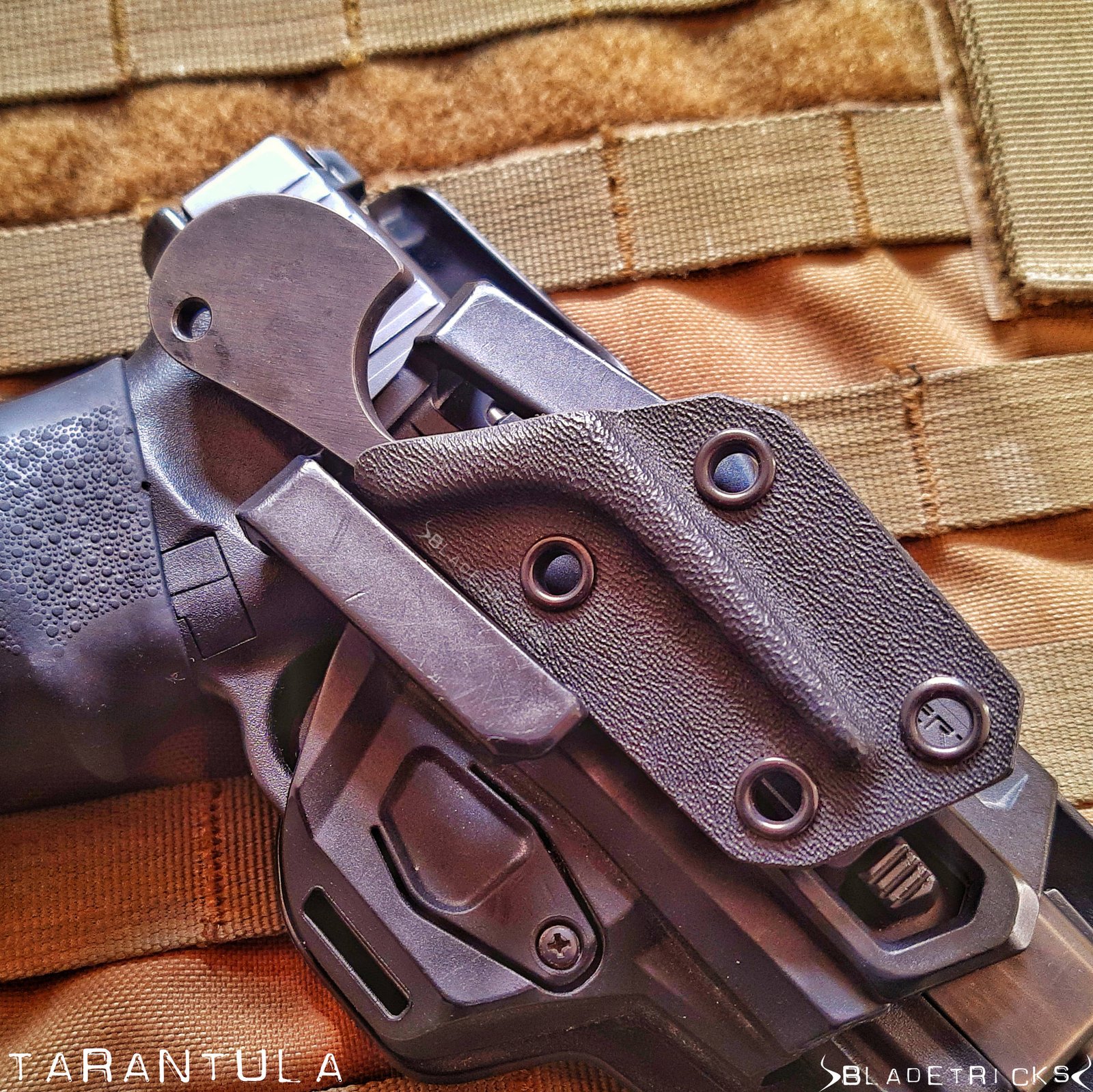
Glock holster draw and Tarantula Push Dagger sheath draw
The Index Finger
I did not approach this through biomechanical analysis. I asked myself a simpler question: who reads the space in the hand?
The answer was the index finger. It touches, feels, and reports back — angles, orientations, forces, spatial relationships — while the rest of the hand is still forming its grip. That reading happens quickly, ahead of conscious thought. Not around a retention ring, but around the finger that already knows where and how things are.
The tool sits in its Kydex sheath tip-down. The operator reaches for it — fast, with intent — with the index finger contacting the lateral side of the handle, the exposed steel of the handle sandwich. The hand, led by the index finger, climbs upward along the handle. As it reaches the open ring section, the index finger makes contact with the horn at approximately the point where the tangent begins. The upward force continues. The knife is pulled clear of the sheath. The hand closes around the handle with a secure grip.
The geometry does the hard work for you.
No moving parts. No buttons. No retention mechanisms to defeat under stress. The system works the same way whether the operator is calm, exhausted, or wet — or operating well past the threshold where fine motor skills are no longer a realistic expectation. It was not designed for the training hall. It was designed for the moment after the training hall stops being relevant.
The Horn and the Index Rest
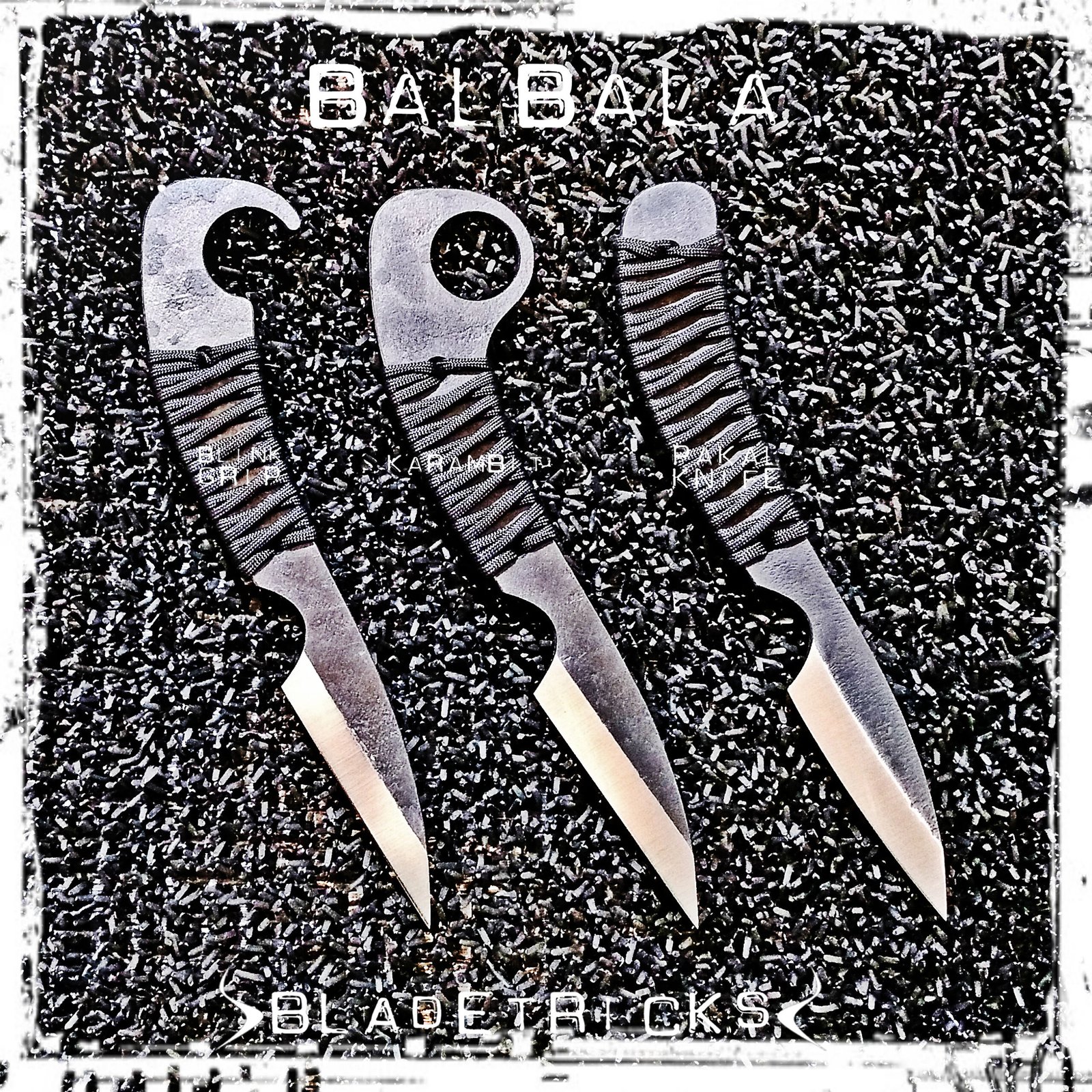
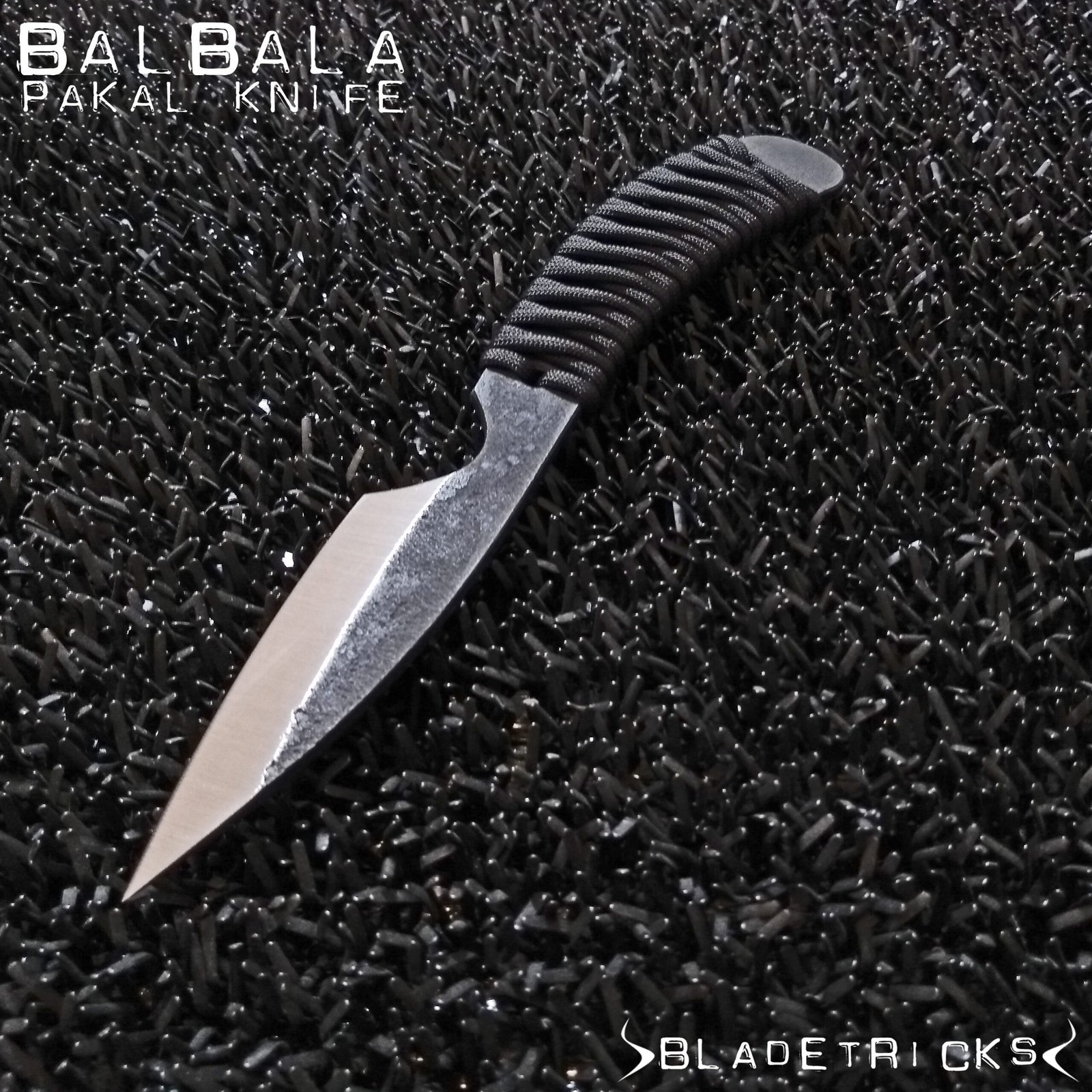
The original Blink Grip — still most clearly visible on the Balbala Pikal Karambit — features a longer horn than later iterations. Through continuous use and feedback, I optimized the length so the system remained efficient without becoming cumbersome. What was refined was not the indexing principle but its most practical expression.
Bladetricks Balbala Collection of Pikal Reverse Grip Knives and Karambits
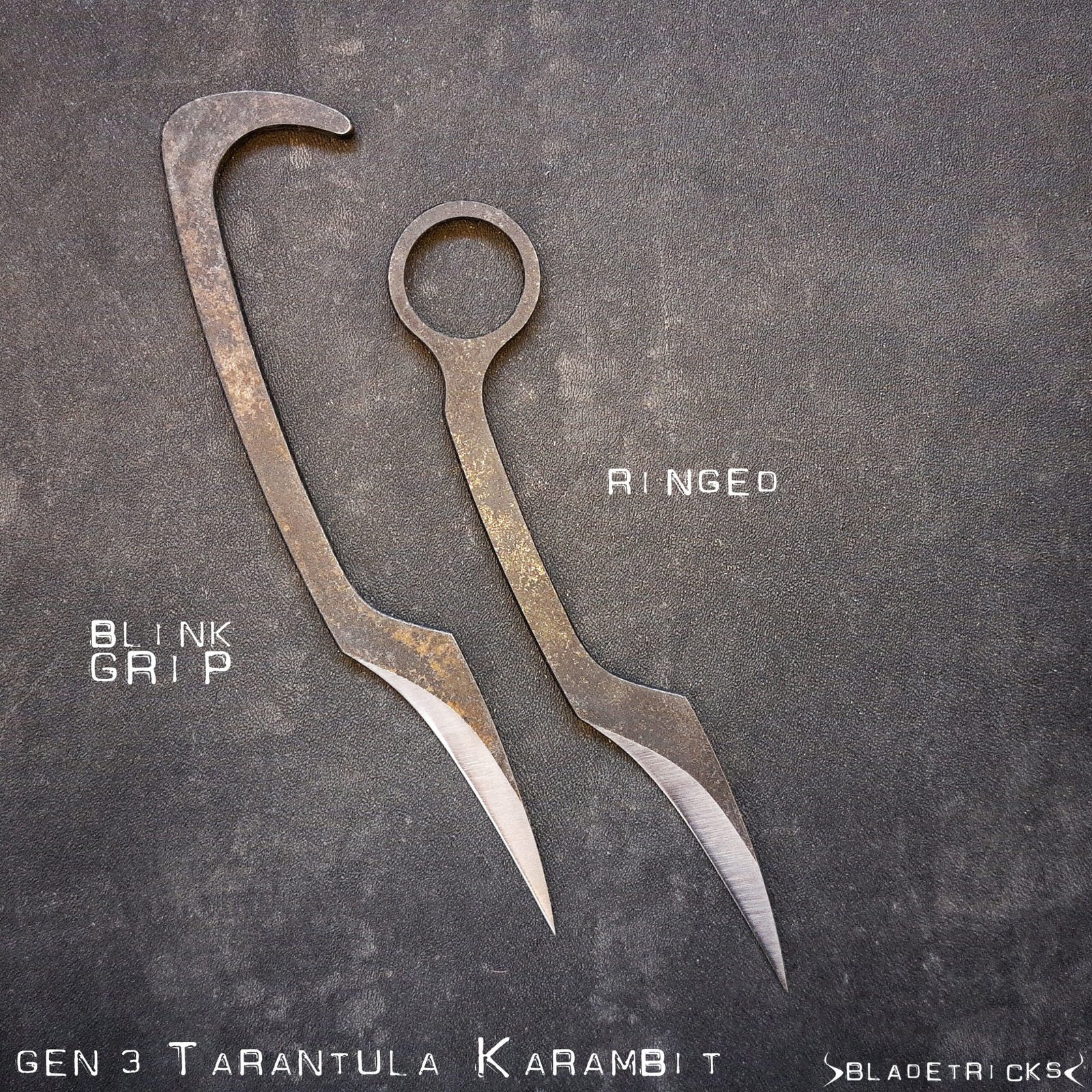
The inner section of the open ring serves a secondary but essential function: a dedicated rest for the index finger. This prevents the hand from sliding forward toward the blade during high-impact axial thrusts, and allows the operator to apply additional force without compromising grip security. The geometry that enables the draw and the geometry that secures the grip are the same geometry. One solution. Two problems.
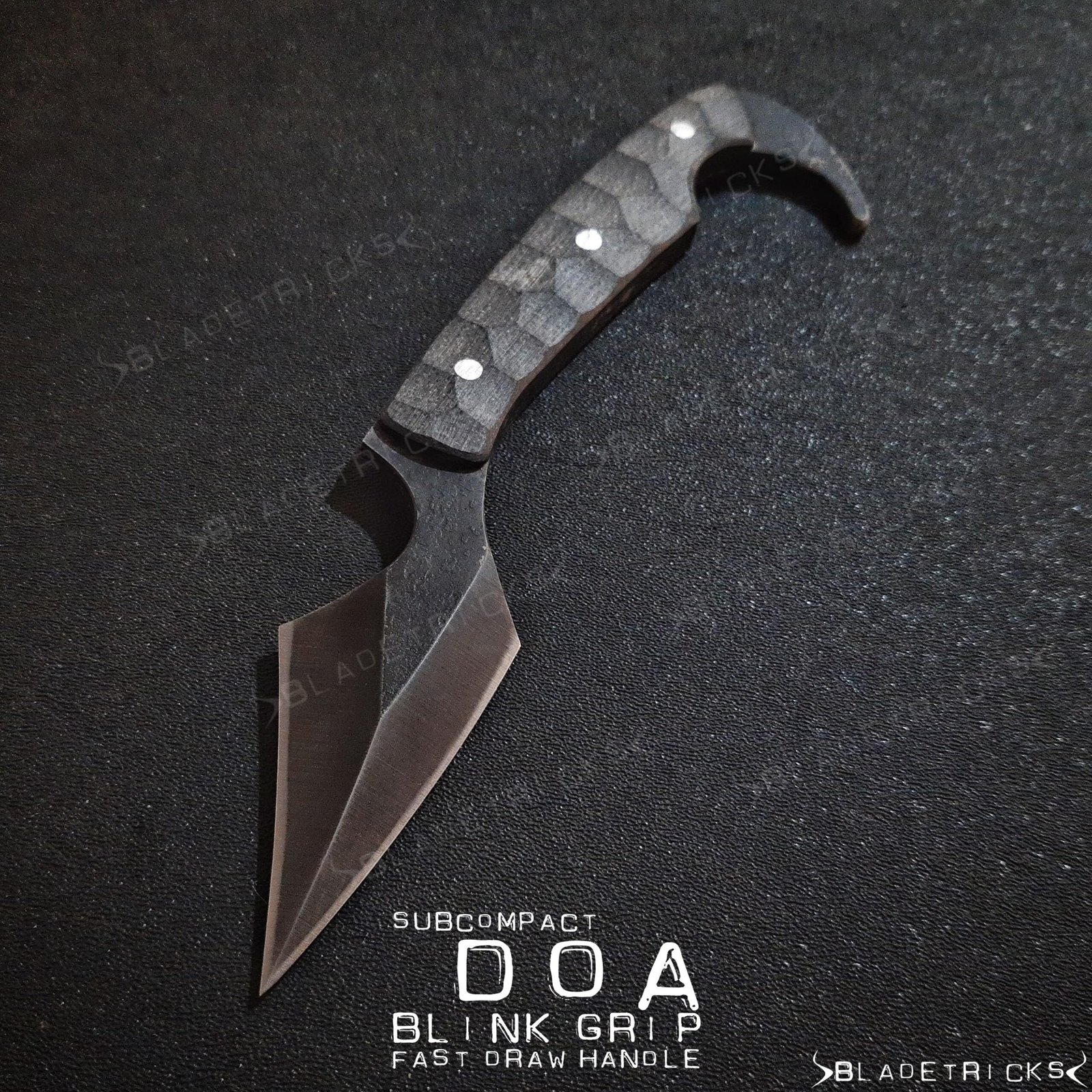
Detail of Blink Grip Fast Draw Knife and tool Handle
The Compact Variation
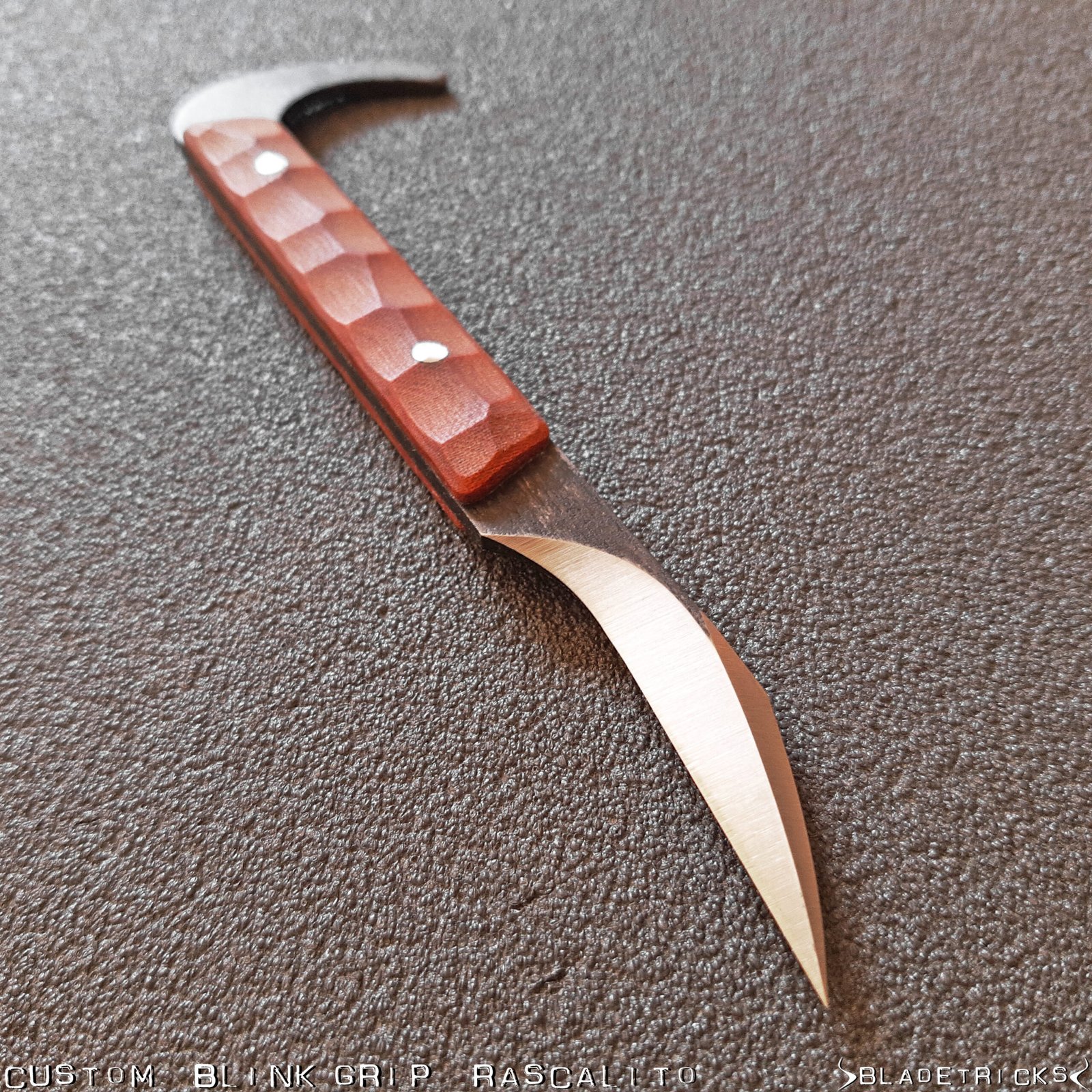
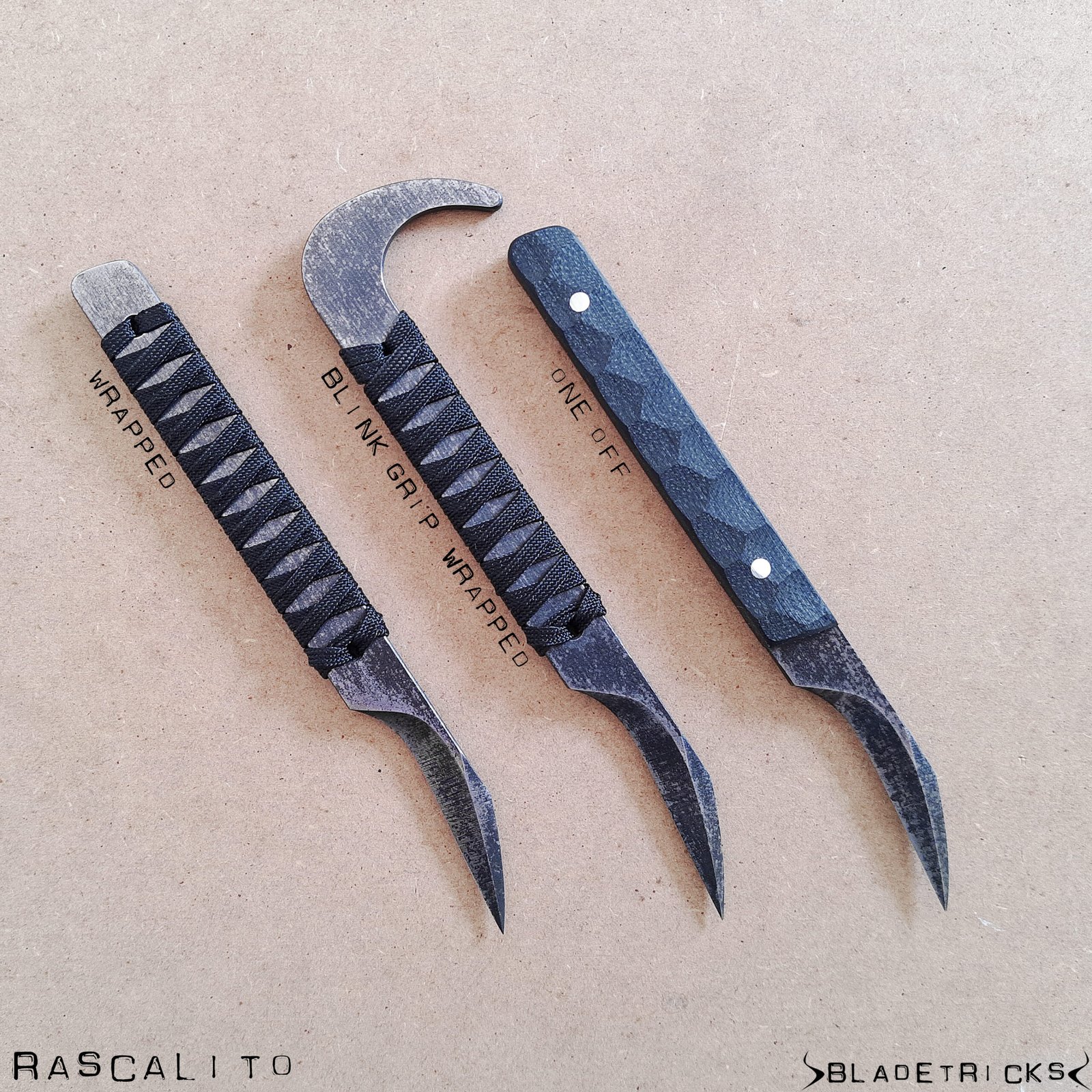
For more compact setups — where overall profile and weight are the primary constraints — I developed a shorter variation of the system. The horn is reduced to the minimum length that still delivers reliable indexing. The index rest is eliminated. The draw speed is preserved. The result is a lower-profile handle that disappears in the carry without sacrificing the core function of the system.
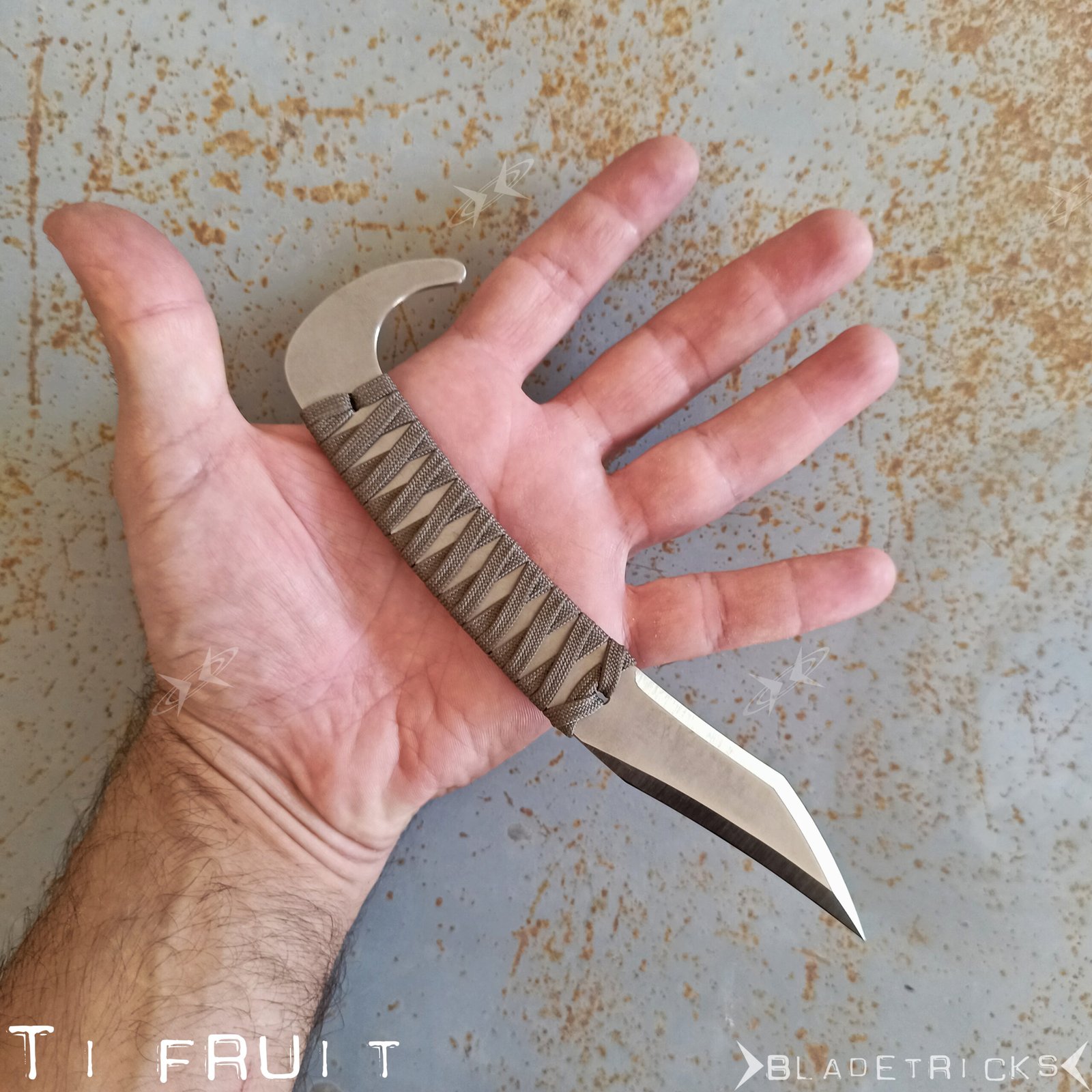
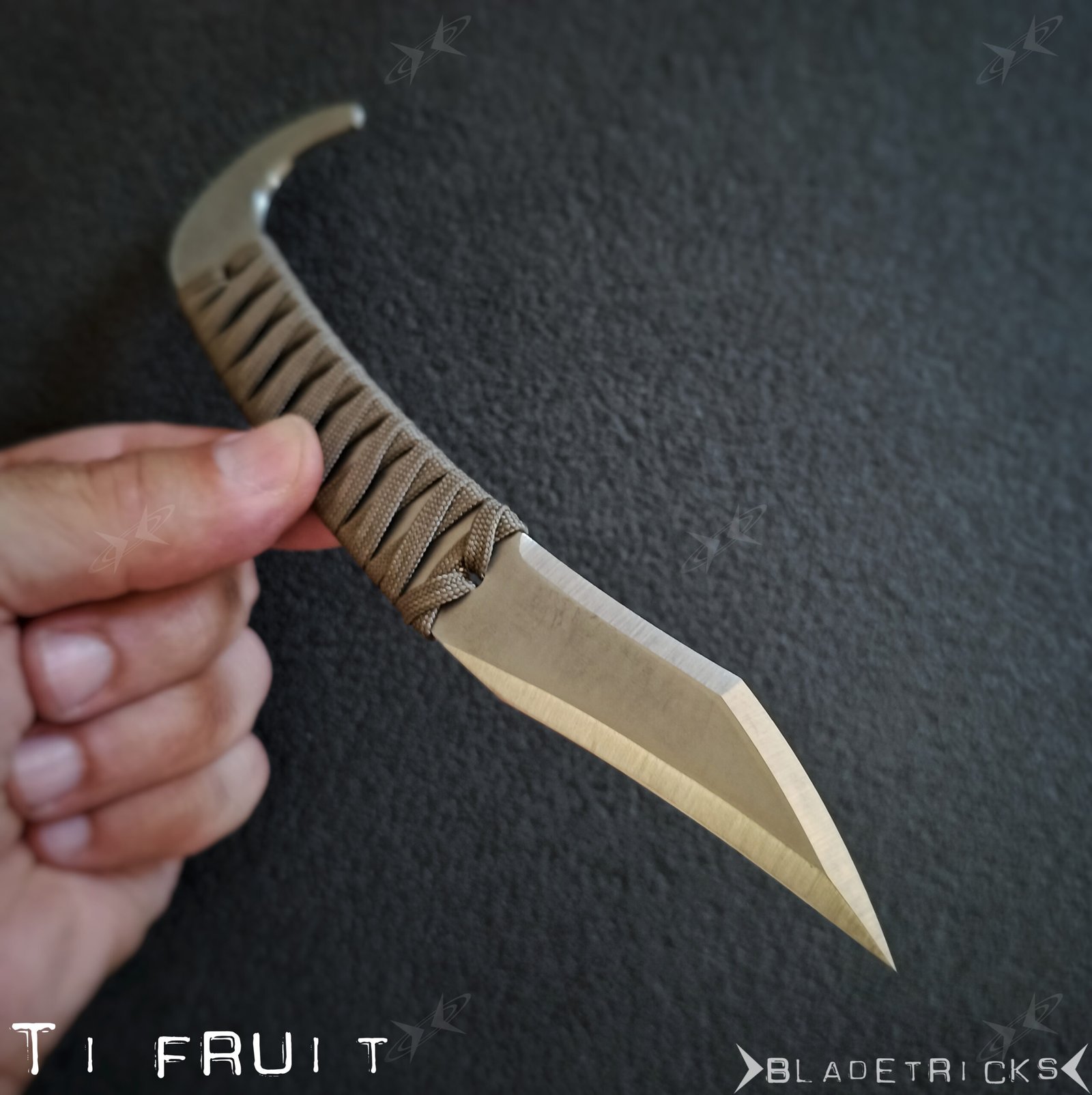
This variation appears on the Tarantula Blink Grip Karambit, the Rascalito and the Ti Fruit Pikal Knife — two tools where compactness is the priority, and where the operator’s training compensates for the reduced index point.
The Blink Grip was conceived for pikal deployment. What emerged as a secondary function was not planned — it was observed.
In a traditional sabre grip, the open ring section acts as a pinky choil. The constriction of the pinky finger around the lower horn locks the handle firmly in the hand — the same mechanical principle as a traditional choil, applied at the pommel end rather than the ricasso. A system built entirely for one technique turned out to improve the other. This is what happens when geometry is correct rather than merely adequate.
Custom F2 Dagger with Blink Grip Handle Sabre Grip
The Buzz: The Same Principle, Subcompact Scale
The same index finger reading principle that drives the Blink Grip extends into an entirely different format: the Buzz family of compact fast draw EDC tools.
Where the Blink Grip was developed for pikal, karambit platforms, and larger dagger formats, the Buzz applies the same logic to pocket and last-ditch carry — tools small enough to disappear entirely until the moment they are needed. The handle geometry is specialized for subcompact dimensions, but the underlying principle is identical: the index finger reads the handle, the hand closes, the tool is correctly oriented without a conscious orientation step.
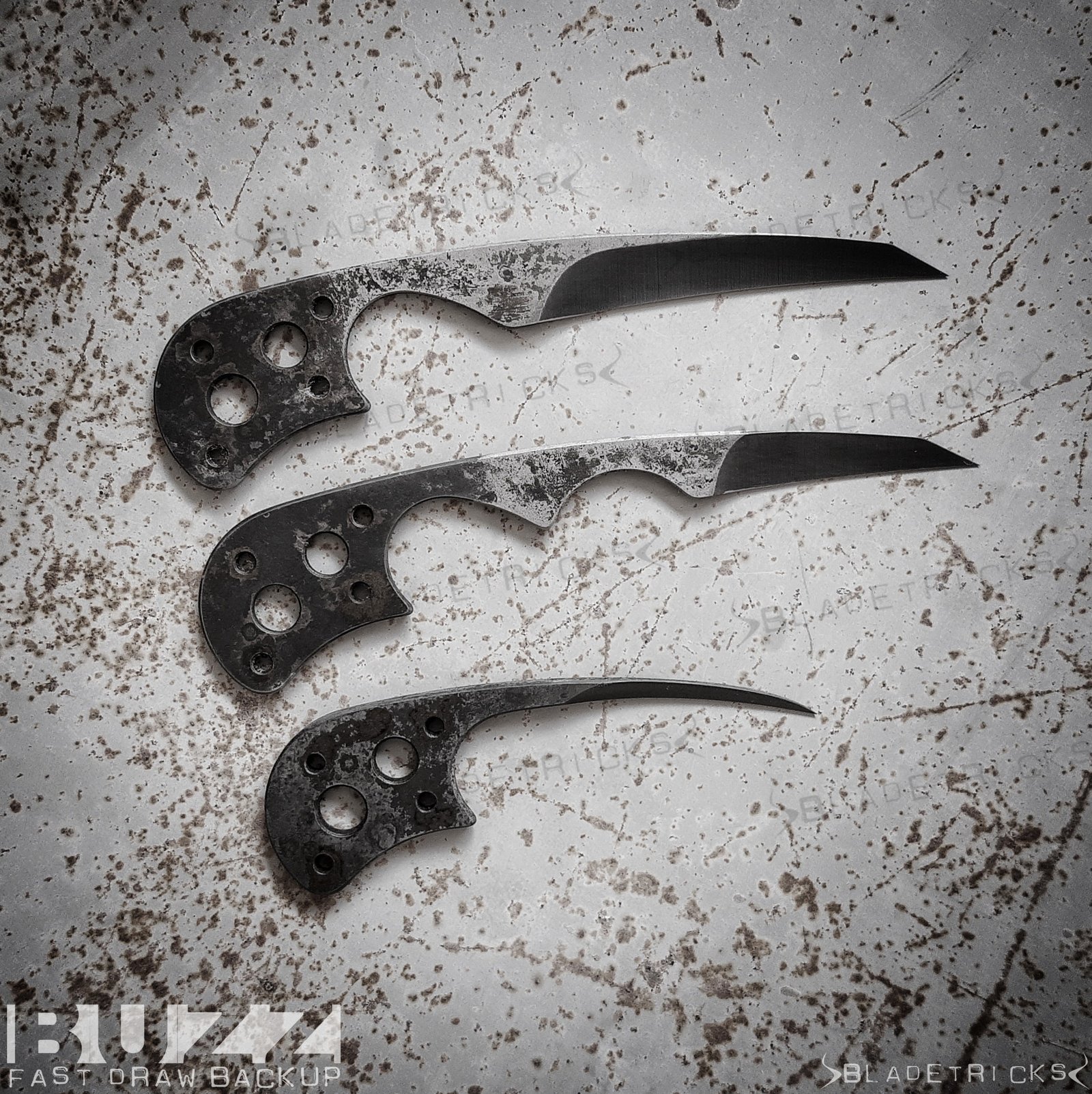
The Buzz family currently includes three models. All three are designed primarily for sabre grip — the Buzz Model 1 adds push dagger as a secondary option, the Buzz Model 2 extends that further with reverse grip edge out, and the Buzz Model 3 is the smallest of the three, an icepick format built for absolute minimum footprint.
Three tools. One principle. Different scales, different missions, same index finger doing the same work.
Buzz Fast Draw EDC Subcompact knives
A Note on Imitation
The Blink Grip has become a global reference point for pikal and self-defense knife design. I note this without particular enthusiasm. The concept has been adopted widely, adapted freely, and credited rarely. The same applies to other original Bladetricks designs that have since entered the general vocabulary of the tactical market — the Ice Pry and its karambit variant, both part of the catalogue since 2010 and both now widely referenced as if the concept had always existed. This is the tax levied on original work in a market that moves fast and reads slowly. The copies are recognizable. The originals remain the originals.
For a deeper understanding of the pikal system the Blink Grip was built to serve, the analysis of pikal biomechanics and anatomy is the place to start.
Pikal System: The Best Mechanical Efficiency in Close Combat
It is not an aesthetic. It is beyond a fashion. It is a cold application of biomechanics. Derived from the Visayan term meaning “to rip,” this knife fighting technique uses a Reverse Grip Edge In (RGEI) orientation. While the market is currently saturated with derivatives, the foundation of the modern RGEI movement relies on a rigorous application of physics that I have advocated since founding Bladetricks in 2010.
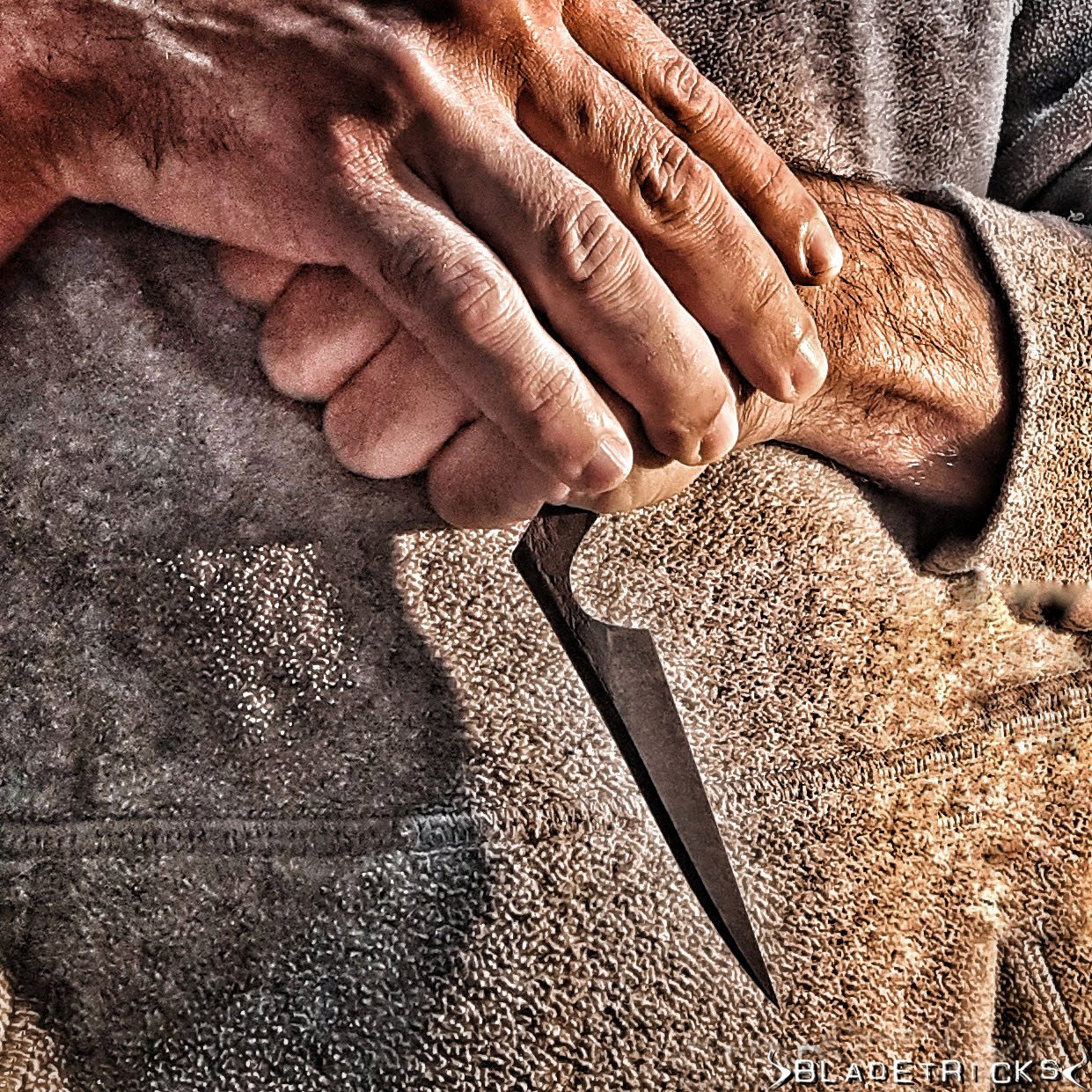
The primary advantage of a pikal knife or tool is its alignment with the human body’s natural tendency to contract under extreme stress. Standard sabre grips rely on the extension of the tricep, which is prone to failure in a clinch. Conversely, this grip engages the latissimus dorsi and the biceps — the largest pulling muscles in the upper body. By drawing the blade toward the body, the operator generates a kinetic force that is difficult to intercept.
Research on sympathetic nervous system activation under life-threatening stress is unambiguous: above 115 beats per minute, fine motor skills begin to deteriorate; above 175, only gross motor functions remain reliably accessible. The RGEI draw and strike are gross motor movements — contracting, pulling, driving inward. They are built for the body that is already in fight-or-flight. A sabre grip technique requiring wrist rotation, controlled extension, and precise targeting is not.
In many scenarios, this creates a “lose-lose” situation for the opponent — to stop the movement, they must place themselves directly in the path of the edge. This hooking motion turns every RGEI strike into a deep incision by utilizing the torque of the core.
Small double edge pikal reverse grip knife and trainer
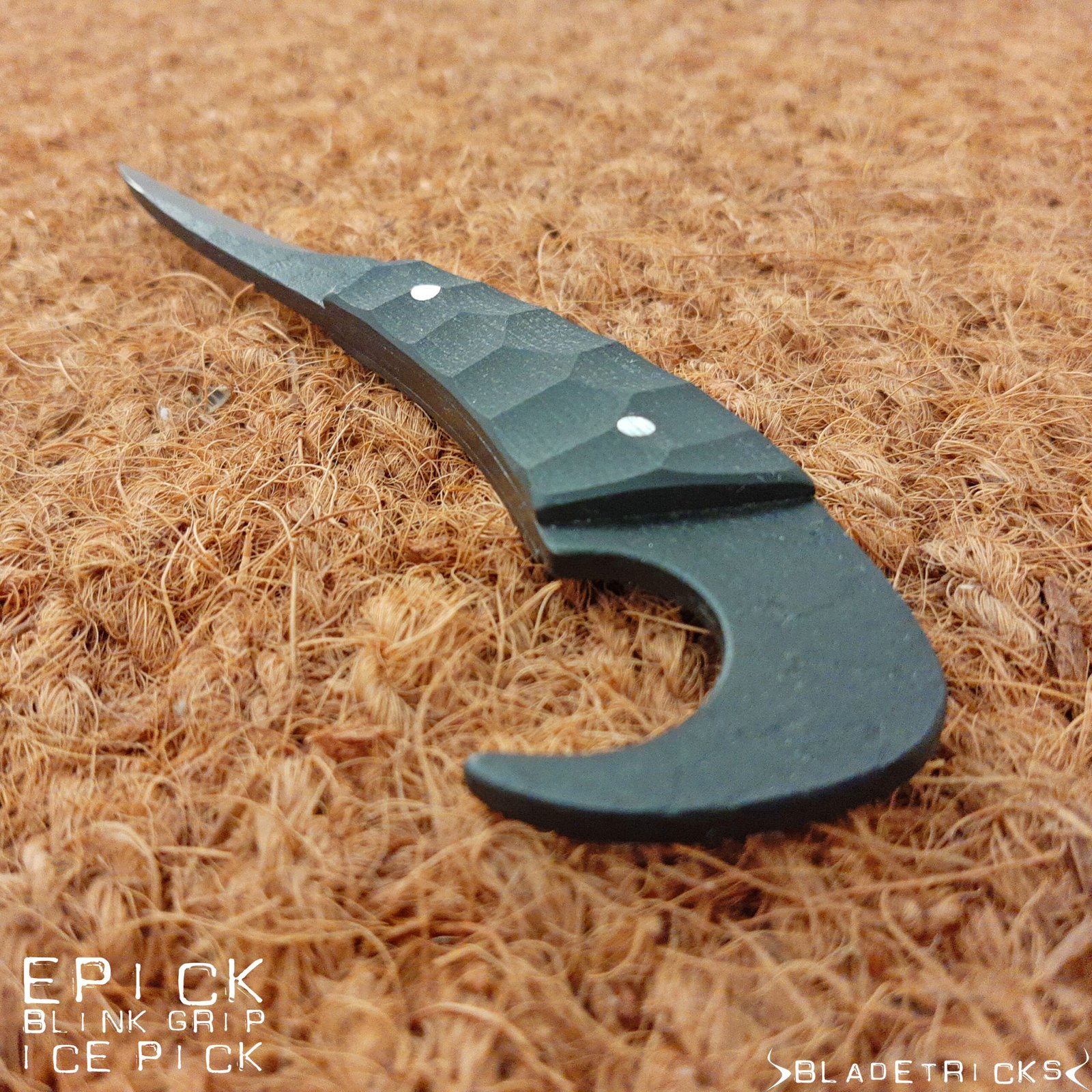
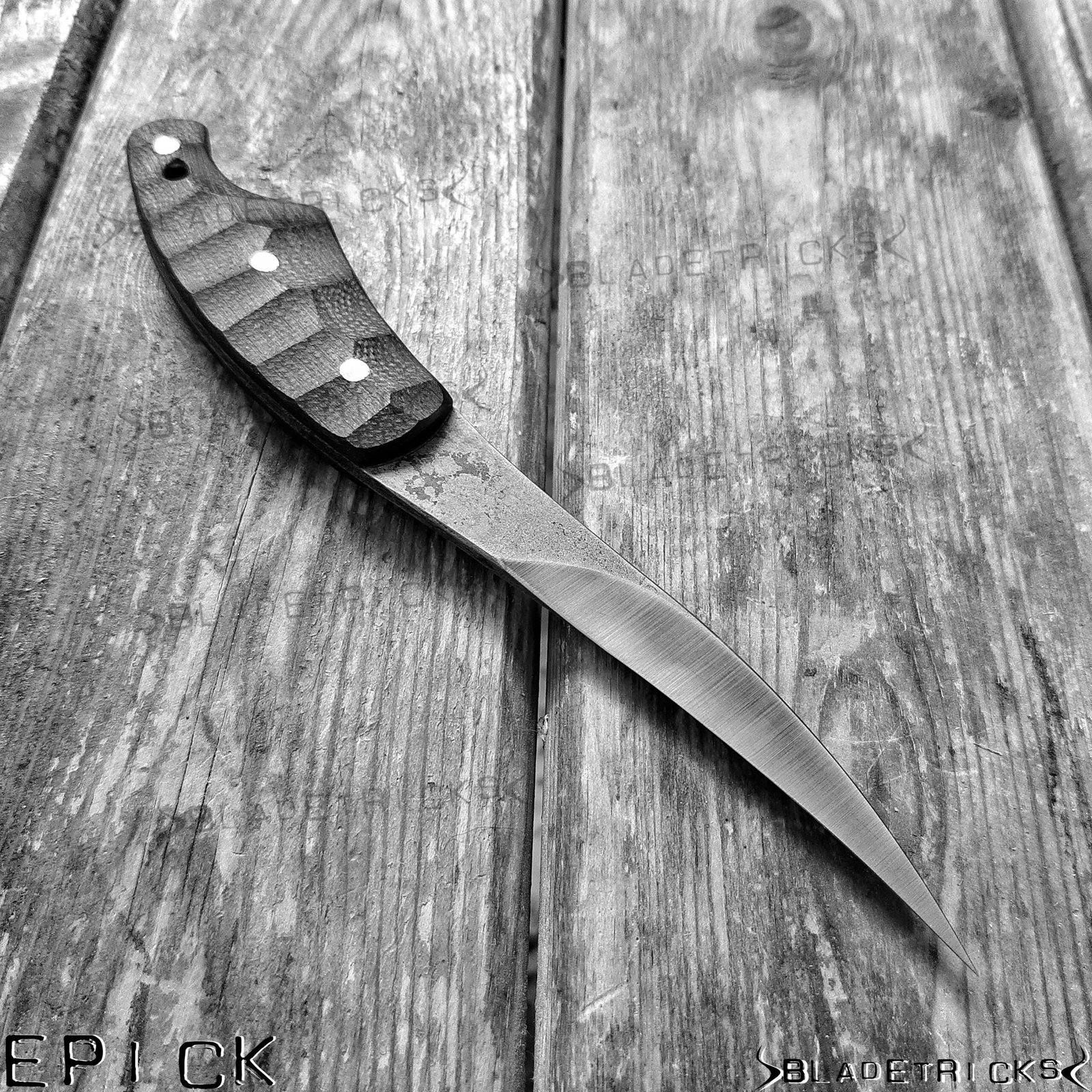
Epick Bladetricks Pikal Blade
Bladetricks Fratello Pikal Knife Blade Detail
Mechanical Advantage
Analytically, the RGEI configuration optimizes a kinetic strike by aligning the vector of force with the natural contraction of the arm. Unlike edge-out tools, a reverse grip edge-in knife utilizes the superior torque generated during inward movement. This mechanical advantage ensures the edge maintains contact through the entire arc of the strike, maximizing depth without requiring extra space for acceleration.
Bladetricks Custom Nosaf Raal Pikal Knife
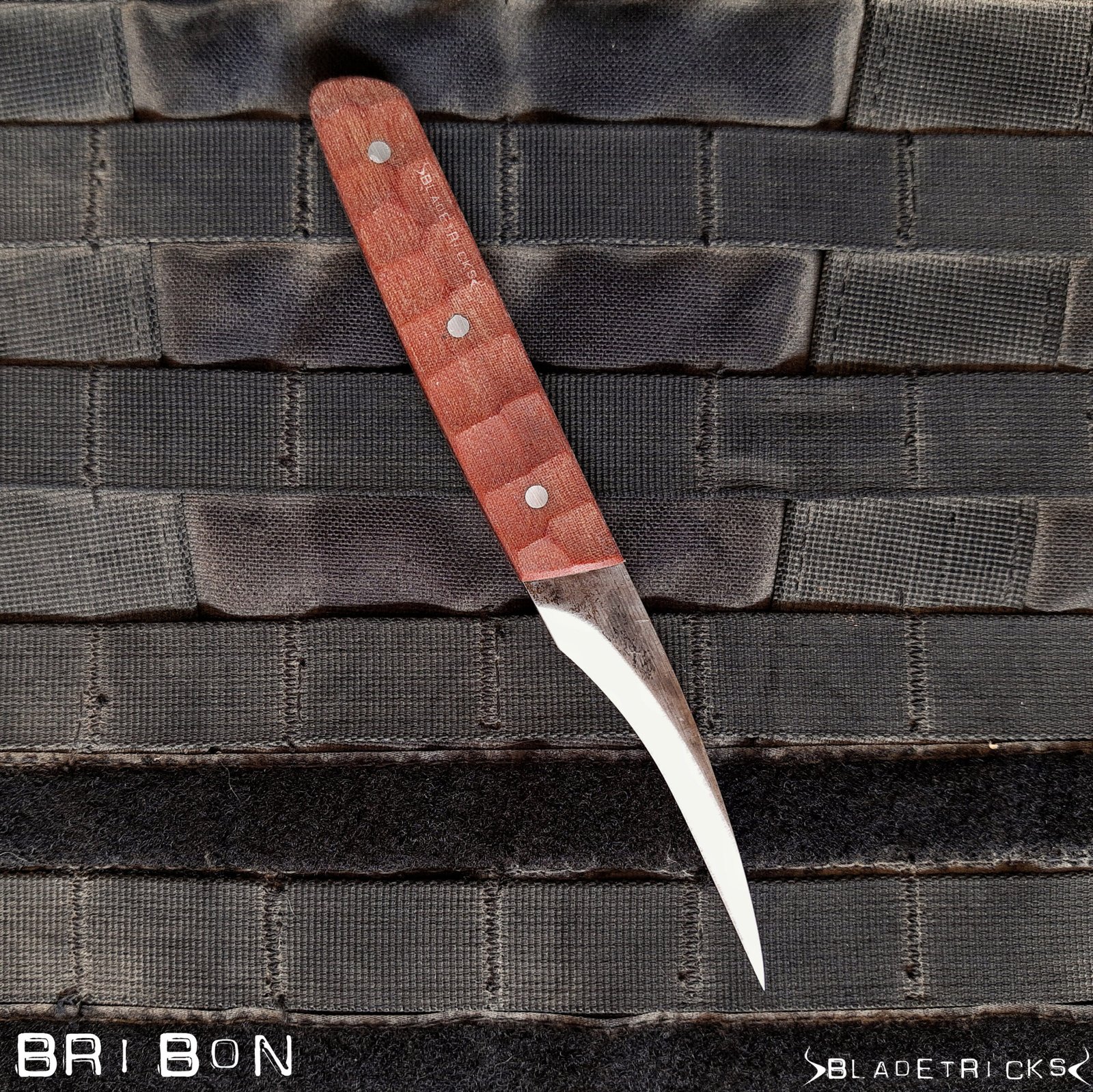
Bladetricks Bribon discreet EDC Pikal Knife
The Withdrawal: The Second Strike Built Into the First
Most discussions of this technique focus on the thrust. This is a mistake, and it reveals a surface-level understanding of what RGEI actually does. The thrust is the entry. The withdrawal is the consequence.
When a pikal blade achieves penetration, the inward pull expands the wound channel using the full force of the back and bicep, transforming a puncture into something that functions mechanically as a plow. Every structure in the blade’s path during that withdrawal — tissue, vessel, fascia — is addressed. The opponent faces a specific problem: to intercept the movement, they must place themselves directly in the path of the edge. There is no neutral option. This is the lose-lose architecture of a correctly executed reverse grip strike.
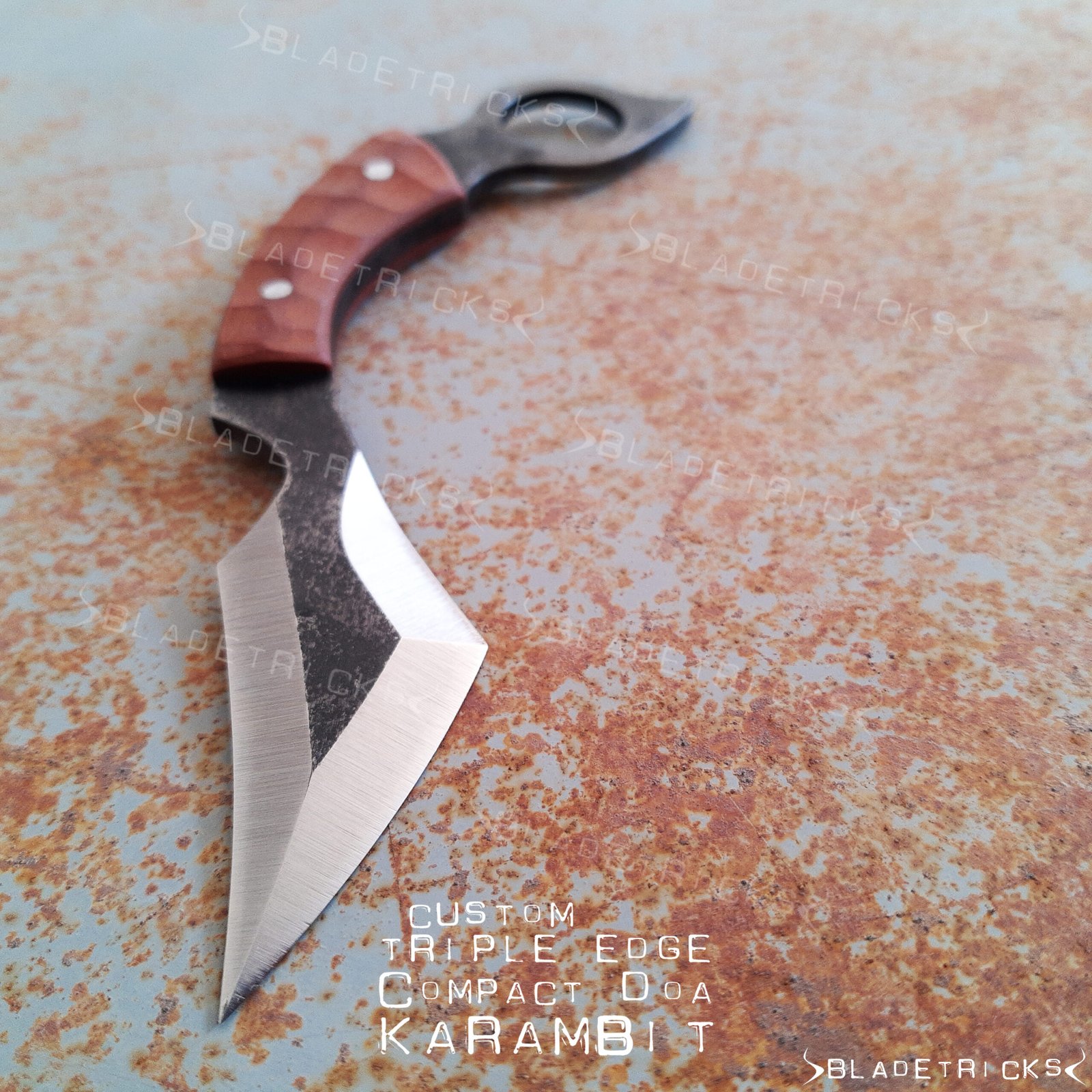
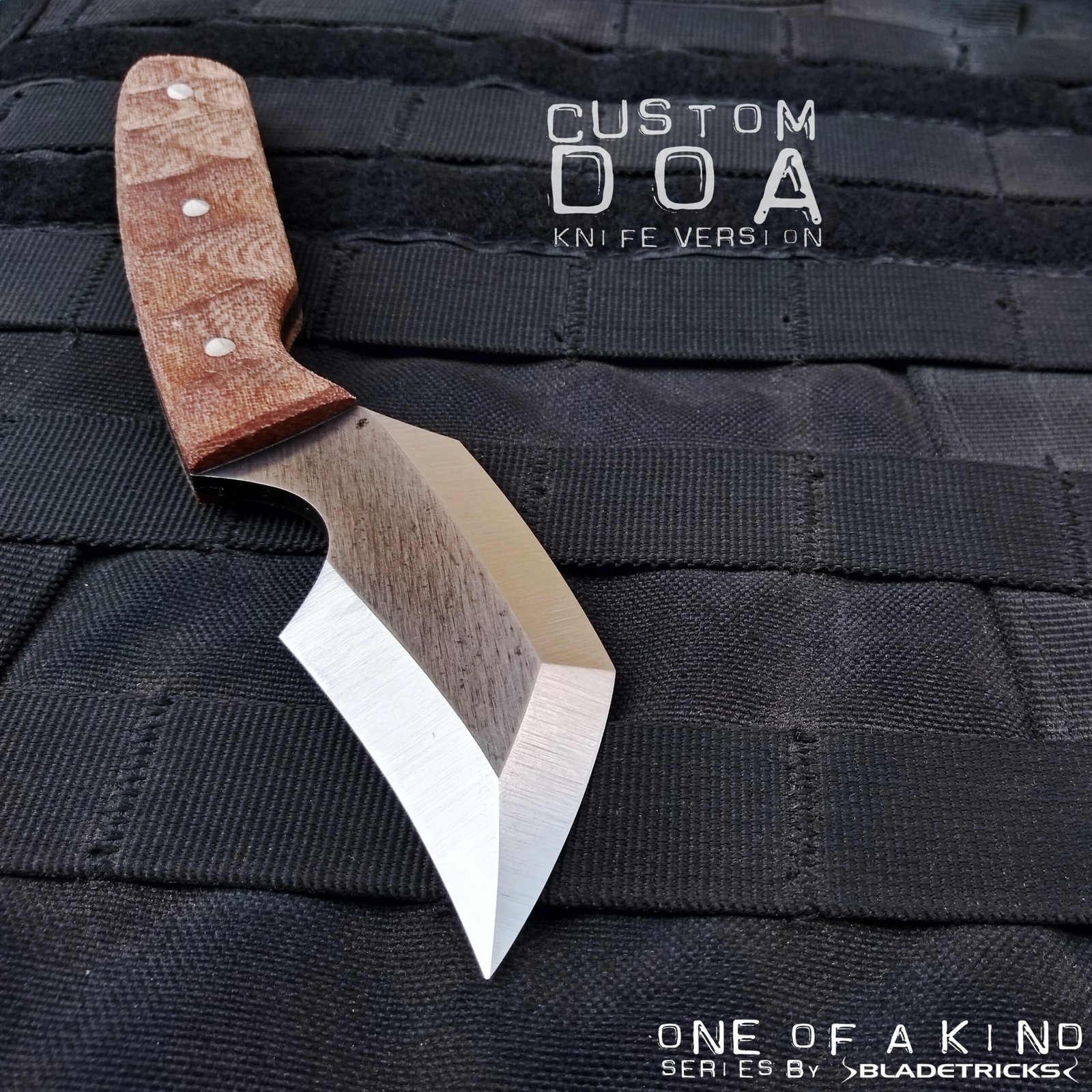
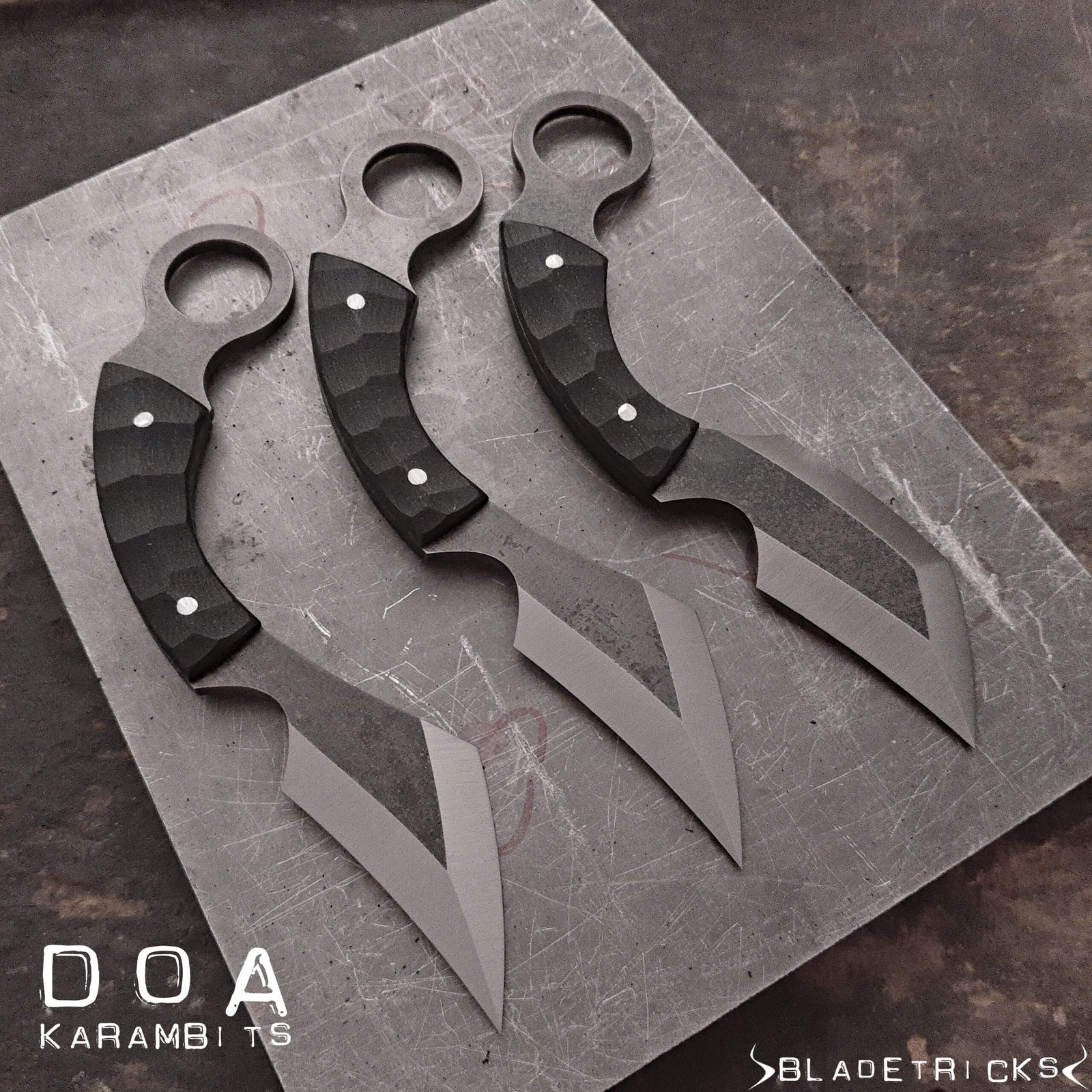
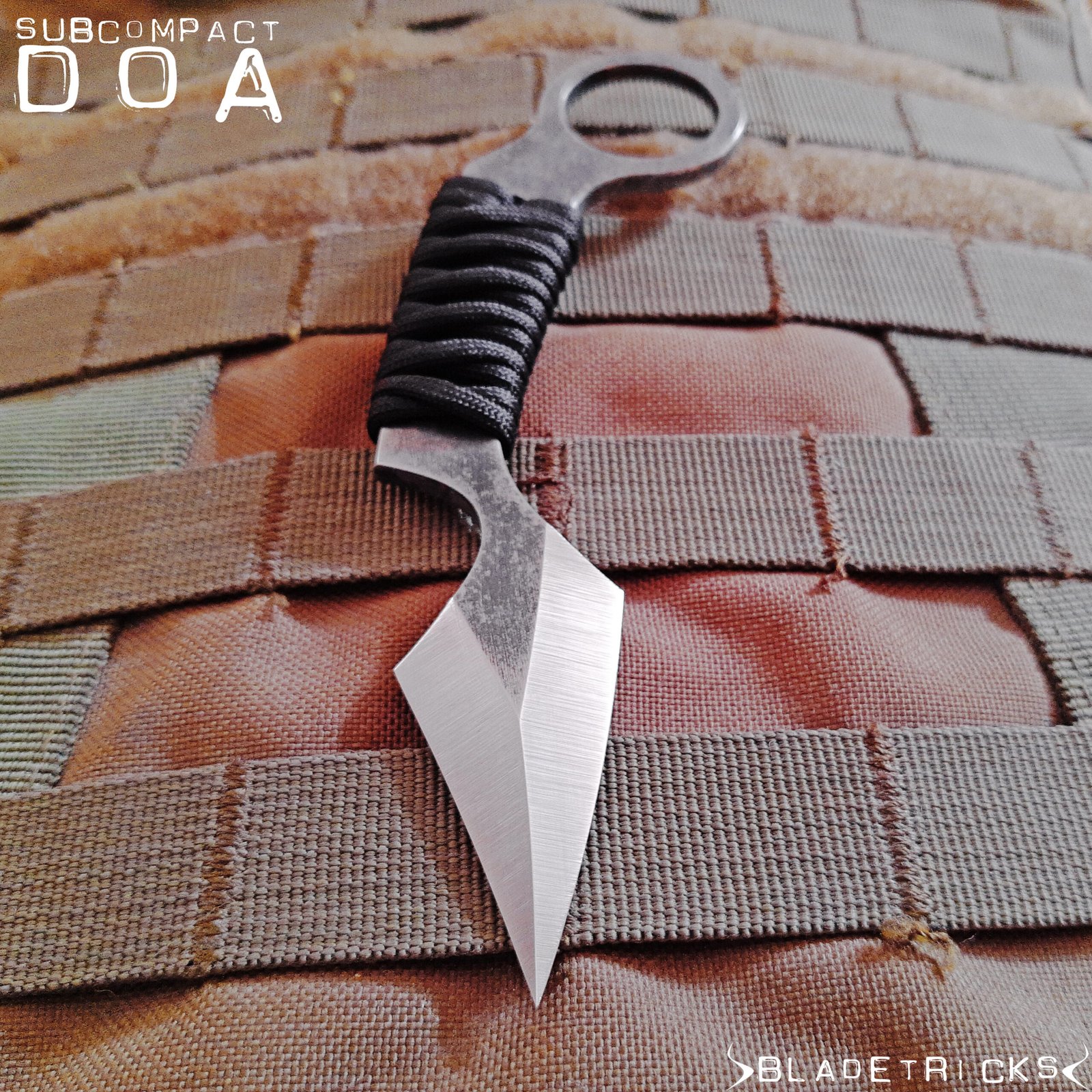
Bladetricks DOA Triple Edge Pikal Knife, Micarta
Forensic medicine confirms what the mechanics suggest. Tissue compression during a forceful thrust means the wound track is frequently greater in depth than the physical blade length: the chest and abdominal wall compress on impact and decompress on withdrawal, extending effective penetration beyond the blade’s actual measurement. A 3-inch blade, correctly placed, can produce a wound track of 4 to 5 inches. Skin provides the highest resistance to penetration. Once it is breached, underlying tissue and organs offer substantially less opposition to a moving edge. This is why tip geometry on a reverse grip knife is not decorative. It is the tool’s primary mechanical asset.
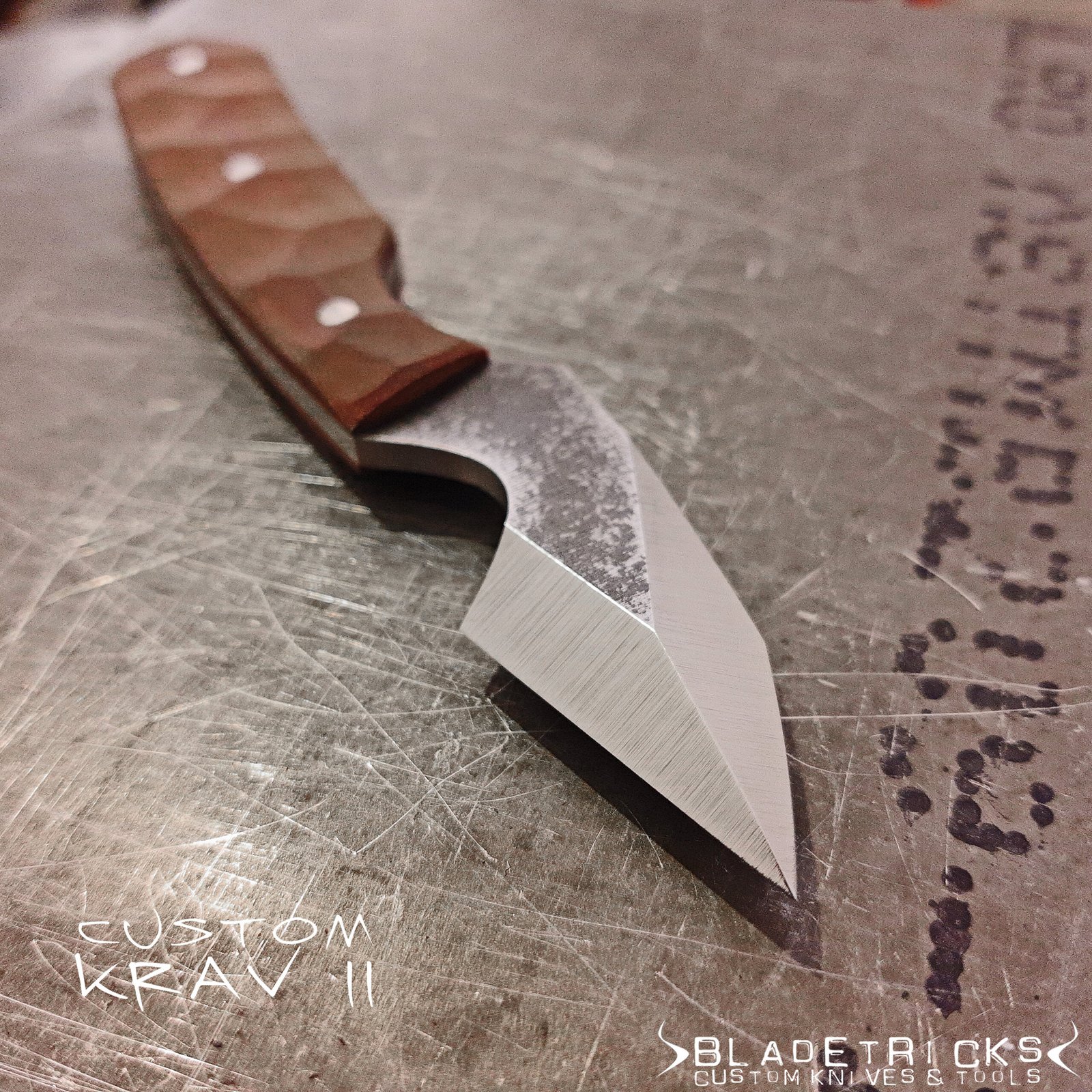
Bladetricks Custom Krav II Pikal double edge knife
Axial Force and the Reverse Grip Advantage
In a pikal grip, the skeletal structure of the forearm transmits total body force directly to the blade tip. This is mechanically superior to the sabre grip, where the wrist acts as a weak pivot point under heavy impact. In the RGEI orientation, force travels in a straight line from the shoulder through the forearm, making the tool an immovable extension of the arm. Anyone can verify this through a simple, safe test against a dead tree: the amount of pressure one can exert in reverse grip far exceeds what is possible in a standard forward grip.
Bladetricks Gen II Mini Ice Pry icepick
A.N. Nash and the Pikal Lineage (2010–Present)
I have been designing pikal knives and tools that prioritize function. My early work served as a catalyst for the current global interest in reverse grip tools. Many RGEI designs seen worldwide today are clearly influenced by original Bladetricks models from over a decade ago. A connoisseur will observe that the core geometries of modern reverse grip tools — focusing on tip strength and high-retention handles — bear the DNA of my early versions.
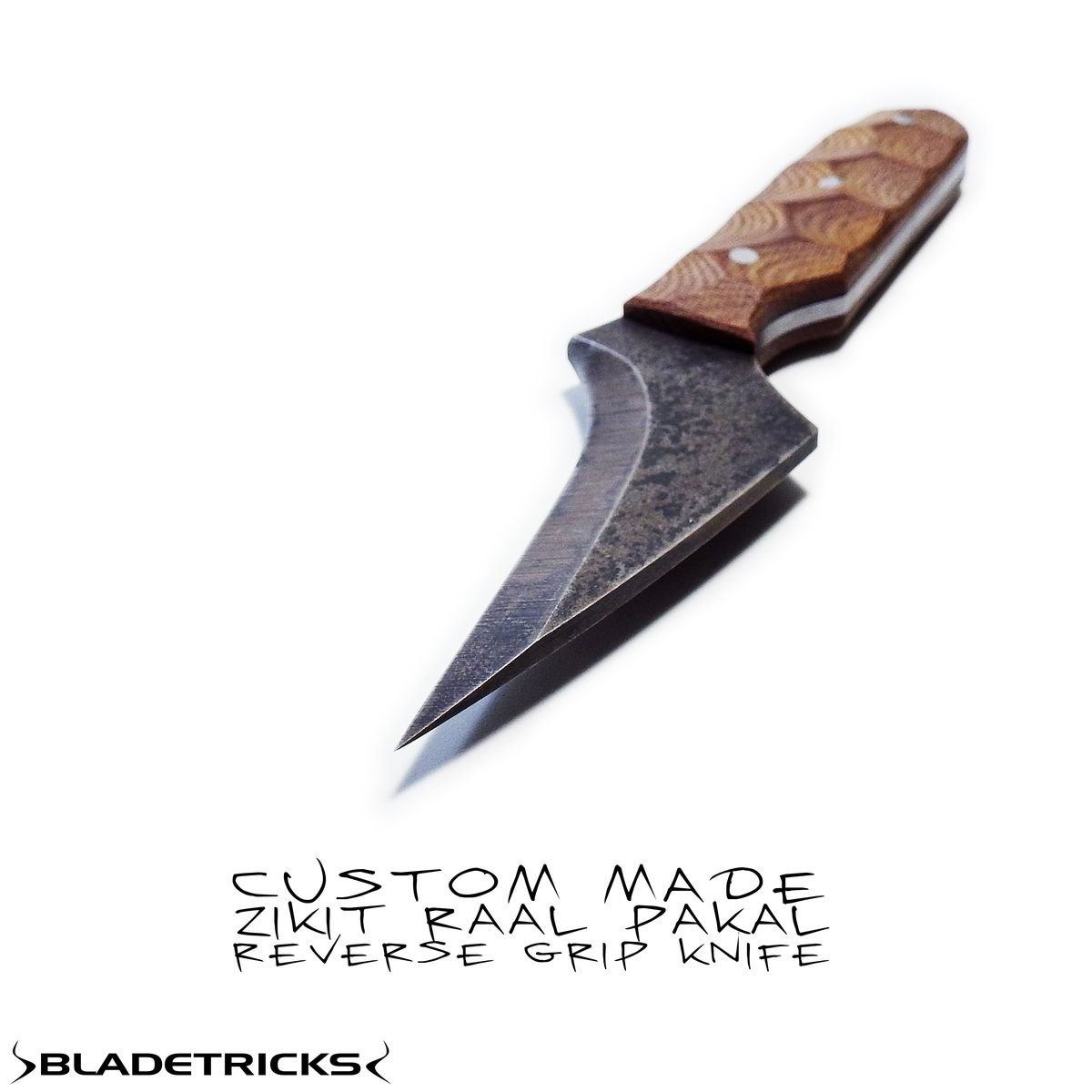
Bladetrickds Zikit single edge Pikal knife
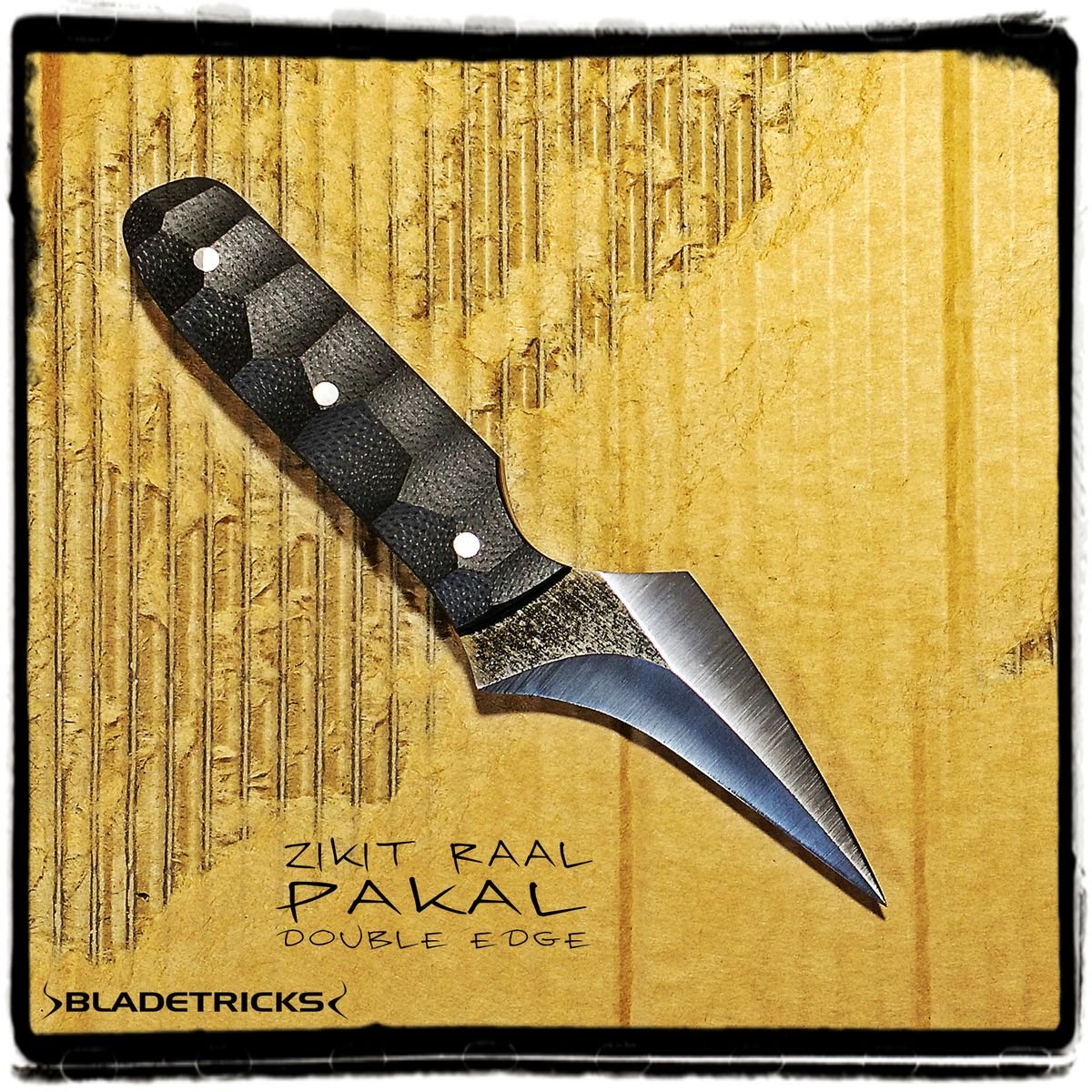
Bladetricks custom made double edge Zikit Pikal Knife, Black G10 handle
Handle Ergonomics and Edge Alignment
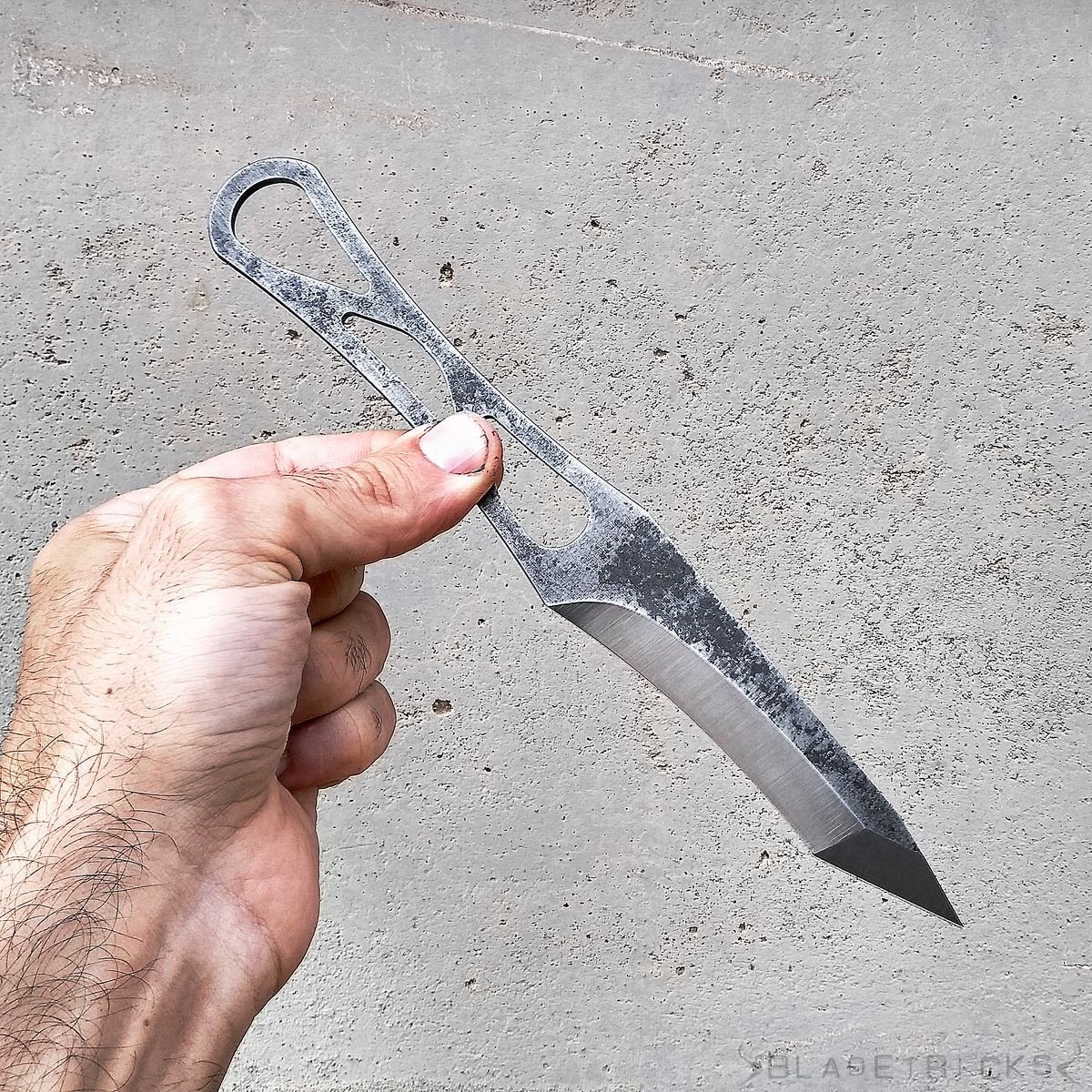
A pikal knife handle must provide more than just a place to hold — it is the steering wheel of the edge. The width of the handle is a critical factor in edge control, preventing the blade from rolling in the hand during the massive resistance of an inward rip. Adequate traction is not a luxury — it is a requirement to manage the blood, sweat, or moisture common in high-stress environments.
Bladetricks custom made Reverse Grip Edge In Tanto Knife with a wide handle
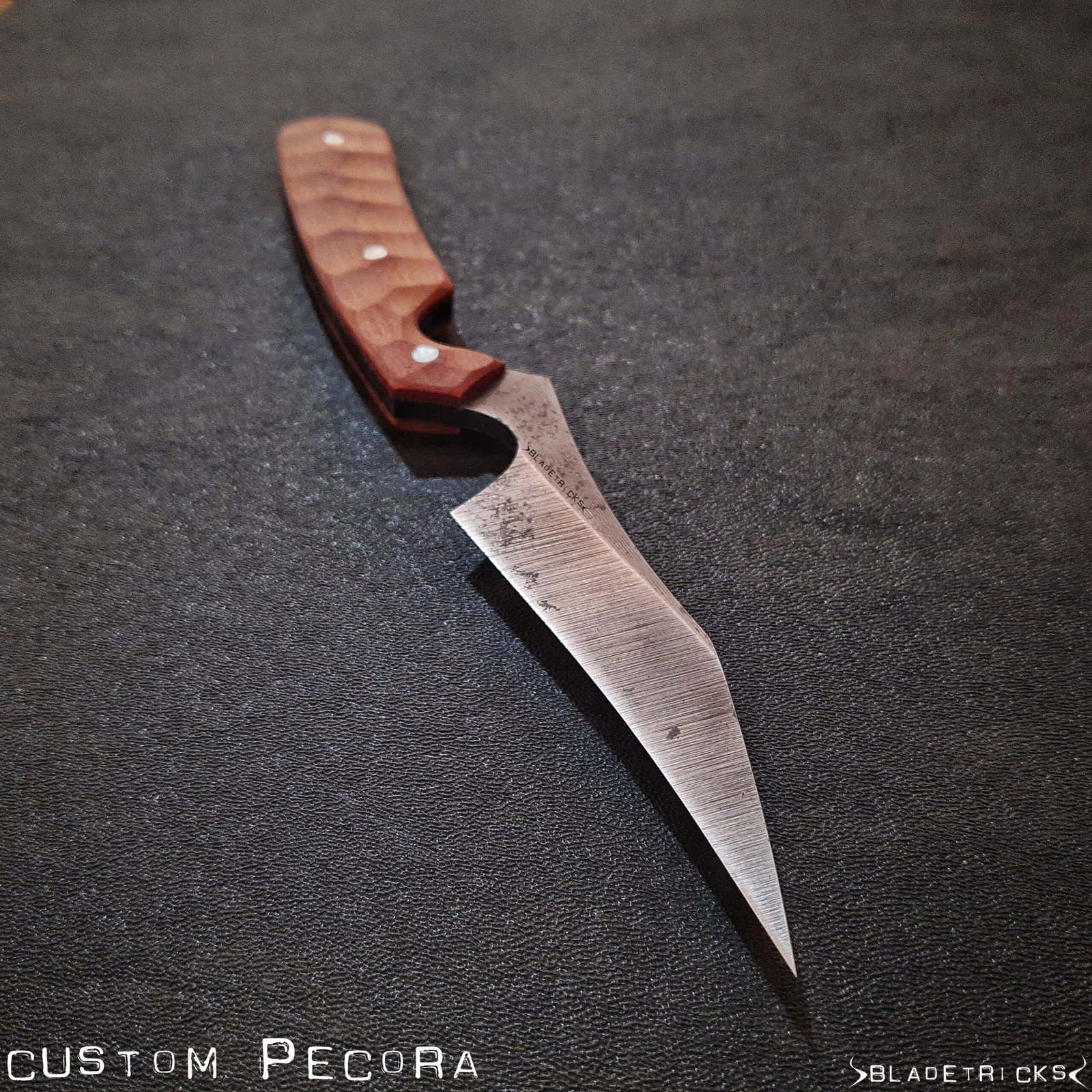
Bladetricks Pecora RGEI Knife
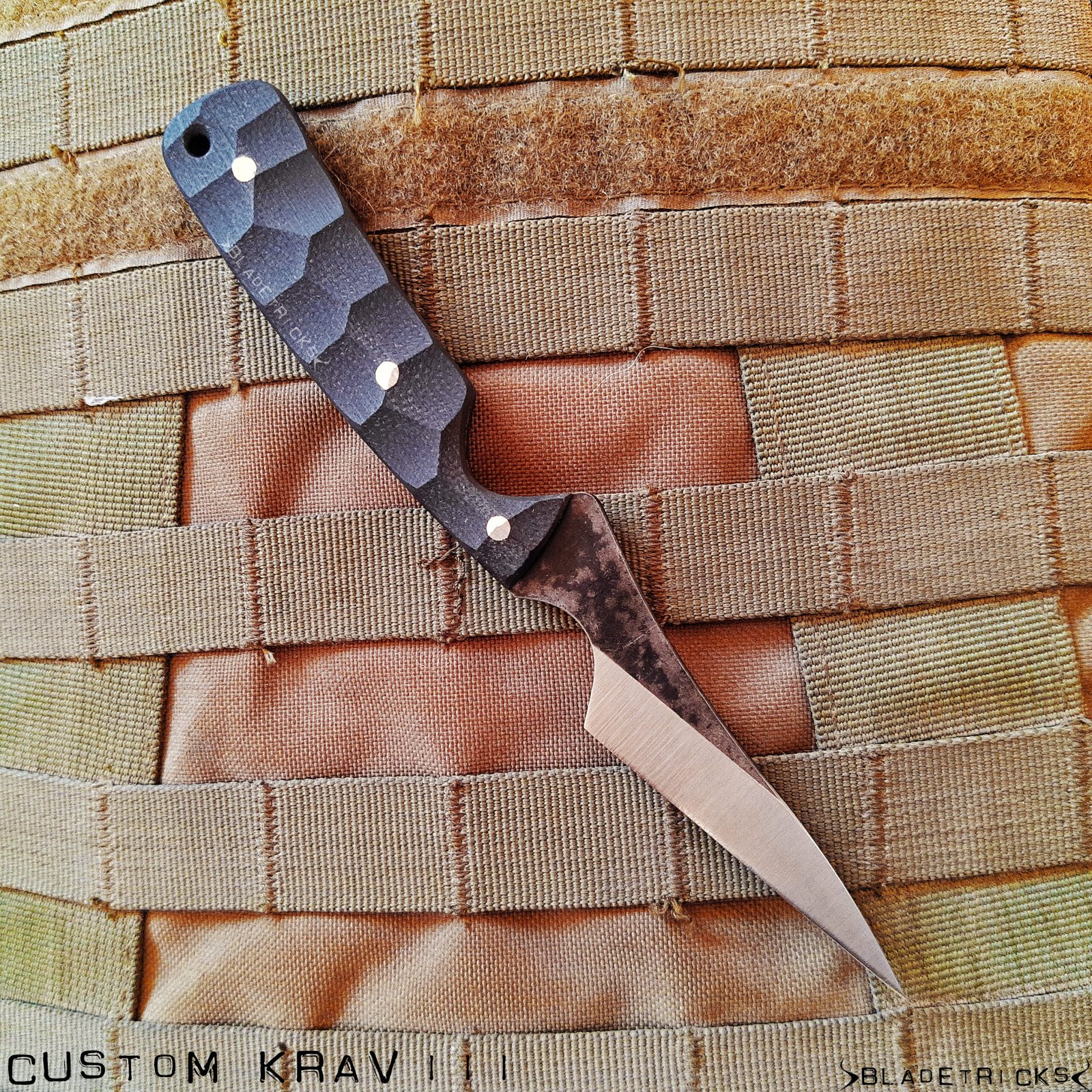
Bladetricks Custom Krav III YAMAM Pikal Knife
Safety and Hybrid Designs
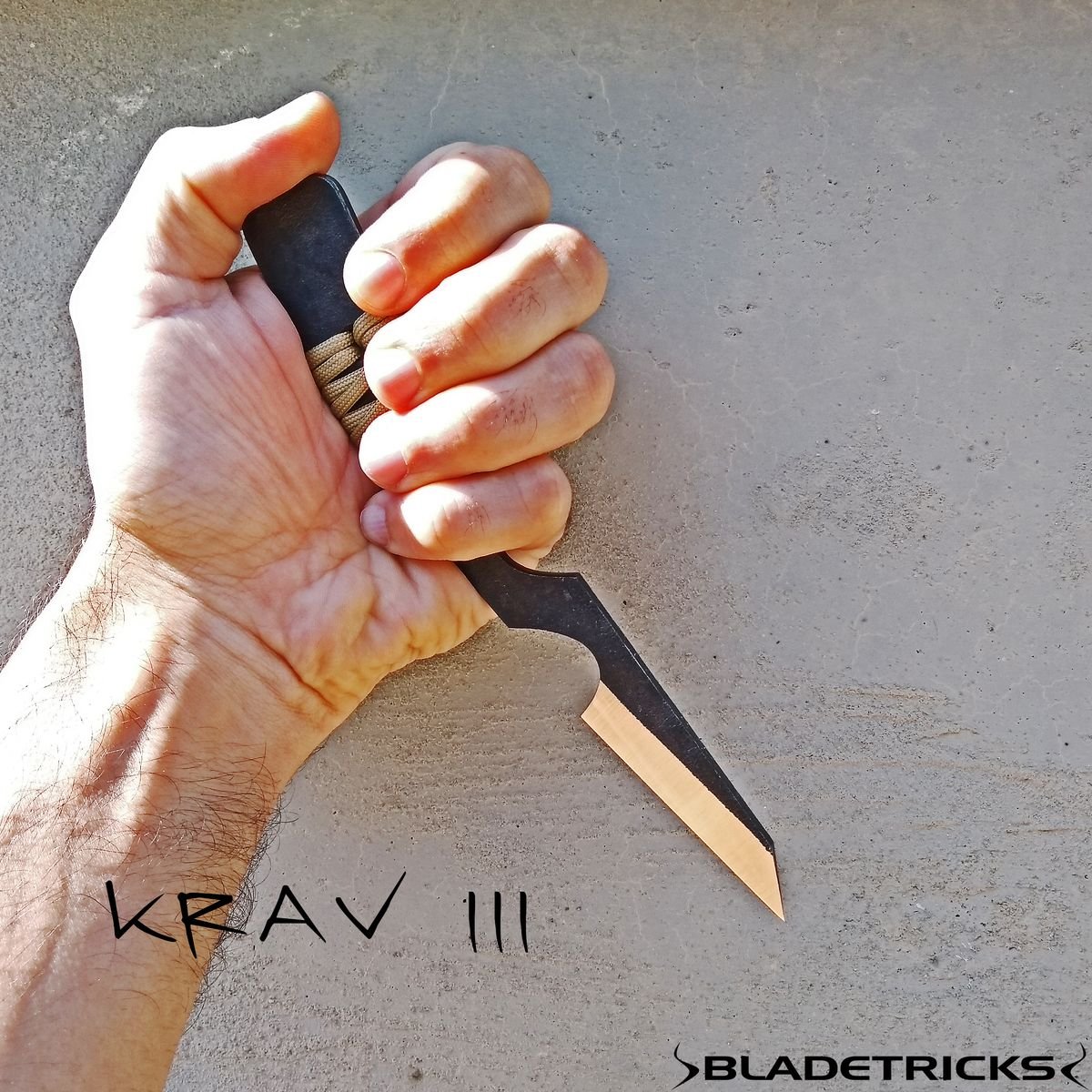
A proper thumb rest or dedicated index point provides the necessary safety to prevent the hand from sliding onto the blade during high-impact axial thrusts.
Bladetricks Krav III Pikal Knife, thumb rest detail
Bladetricks stainless Pikal knife, cord wrapped
Long ago, I also pioneered the combination of pikal and karambit elements on a single blade, offering a hybrid solution for those who require the retention of a ring with the aggressive geometry of RGEI.
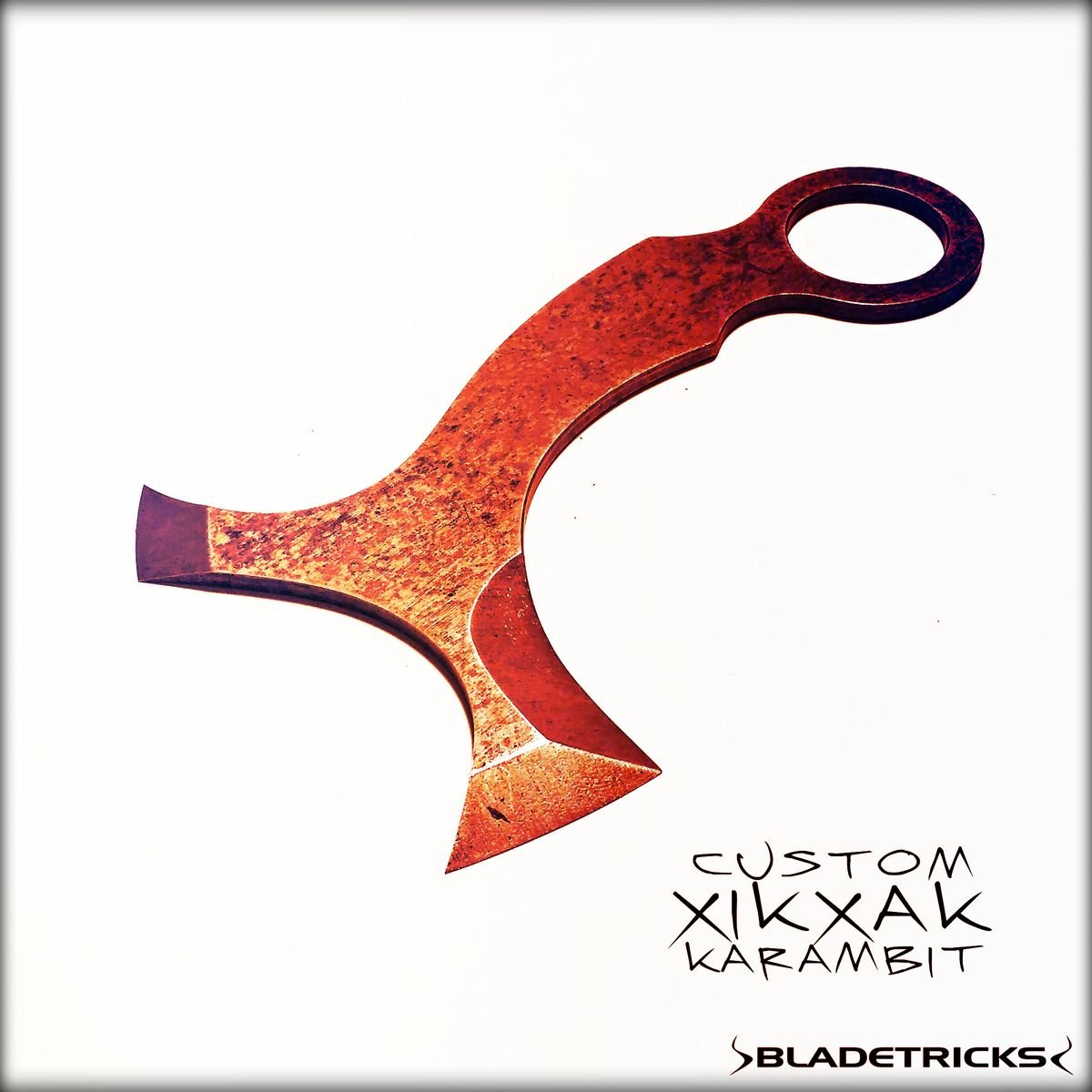
Bladetricks Xikxak Pikal Karambit, Full Metal
Bladetricks Classic Nosaf Raal Karambit edge in Pikal version
The most critical component of this system is not the strike. It is the draw. Research on combat stress is clear: in a life-threatening encounter, fine motor skills are among the first casualties of sympathetic nervous system activation. Hesitation during deployment — fumbling a retention mechanism, misorienting the edge — is the actual failure point. Not technique. Not blade geometry.
To solve this, I developed the Bladetricks Blink Grip: a handle architecture that allows a near-instantaneous, blind-indexed draw from a Kydex sheath with no mechanical parts, no buttons, no conscious thought required. The edge is correctly oriented the moment the tool clears the sheath. It was designed for a body already in fight-or-flight — not for the calm, controlled environment of a training hall.
The Blink Grip has become a global reference point for pikal and self-defense knife design — a fact I note without enthusiasm, given how liberally the concept has been adopted without credit.
Bladetricks Balbala Collection of Pikal Reverse Grip Knives and Karambits
Geometry and Blade Profile: The Shift to Traditional Shapes
While the majority of dedicated RGEI knives feature a hooked or hawkbill profile — often reminiscent of karambit blades — I have shifted my focus toward more traditional shapes. While a hook excels at the rip, it can limit the tool’s versatility and increase the difficulty of sharpening.
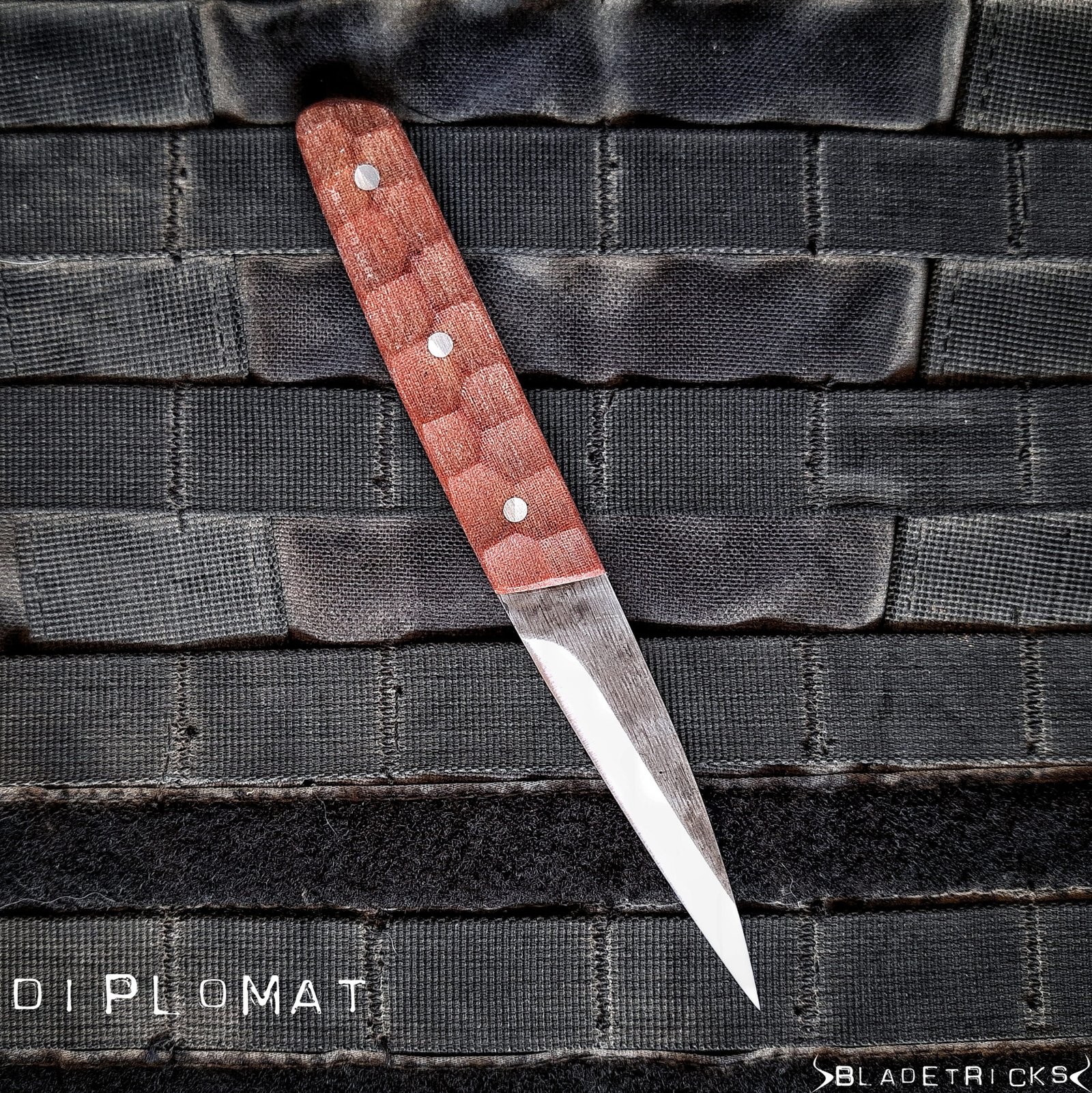
On models like the Tusk Knife or the discreet Diplomat, I utilize straighter, more traditional geometries. These profiles maintain the pikal advantage in the reverse grip while providing a more robust tip and a cleaner path of entry. They are easier to maintain and offer the professional a more balanced tool that does not sacrifice the catastrophic potential of the inward strike for the sake of a curved aesthetic.
The pikal system is highly specialized. While it dominates in close-quarters confrontations and clinches, it inherently lacks the reach of a sabre grip. It is a tool of commitment, optimized for the ranges where most real-world edged weapon encounters actually occur — not the dueling distances where most knife training takes place. Blade length is generally kept compact, between 50 and 100 mm, to ensure the tool remains concealable, maneuverable, and fast to deploy. Understanding these limits is as important as understanding the advantages. A specialist who does not know where his tool ends is not a specialist.
I have built pikal knives and tools around these principles for over a decade. The geometries developed in those early years are now visible in the work of makers around the world. I take that as confirmation that the mechanical logic was correct — not as a compliment.
The best test of a design philosophy occurs when it is asked to challenge its very purpose. The idea of applying a brutal geometry to a purely domestic tool sat in my workshop for years. A client’s specific request for a tactical pizza cutter finally gave me the operational green light to execute the concept.
The result is The Bladetricks Pizzabit: a specialized cutting instrument that I see not as a novelty, but as a commitment to design.
Execution and the Dominant Grip
Its structure is built around the reverse grip—a stance chosen because it’s inherently efficient for gaining control. This structure doesn’t just let the user drive substantial downward force, which is exactly how this tool performs; it also results in an ergonomic grip that feels natural and comfortable.
Its functional, curved cutting edge, featuring a long blade, and its characteristic, calculated geometry bring to mind the effectiveness of the ancient Ulu knife, but with a different mission. The Pizzabit makes sure force drives straight down, enabling a consistent, deep rocking motion for a strong, clean cut.
The Essential Material
Material selection is a calculated part of the process. For a tool that demands reliability, I make a cold decision. For the Pizzabit, built for an environment where corrosion resistance and low maintenance are key, I chose AEB-L stainless steel.
This steel perfectly balances toughness, edge retention, and the cleaning requirements of a culinary setting, delivering top performance without compromise. The AEB-L blanks are precision-cut using a waterjet process, supplied by the professionals at New Jersey Steel Baron—the quality foundation I require.
My selection standards are always high; to better understand why AEB-L is the base material I use, check my previous analysis on stainless steel selection.
The Blade Finish
I hold a foundational belief: A tool shouldn’t be polished and has to be used. I generally avoid mirror finishes and high-gloss aesthetics in favor of a look that speaks to purpose. The Pizzabit’s blade reflects this philosophy.
I manually hand-sanded and hand-brush the steel. This process gives the blade a functional, matte look that is both natural and instantly recognizable as handmade. The result is a deliberate invitation: it is a blade meant to be picked up, used, and integrated into your daily life.
Tactical Lineage and Finish
The Pizzabit’s connection to my tactical work is more than deliberate. The handle uses my typical Bladetricks hand sculpted black G10 handle scales to guarantee a secure, positive grip.
This connection is completed with the custom Kydex sheath that comes with it.
The Bladetricks Pizzabit is not a tool to be hidden away. It is the product of precise execution and a demanding philosophy. It belongs on the countertop, visible, ominous, awesome, and always ready for action.