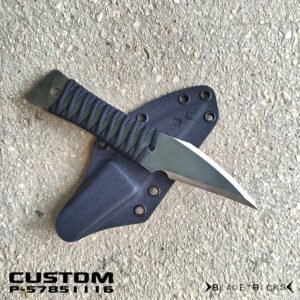
PIKAL REVERSE GRIP COMBAT KNIVES
THE METHODOLOGY OF RGEI ENGAGEMENT
The Pikal combat technique is a specialized methodology for close-quarters engagement. Defined by a reverse-grip, edge-in (RGEI) orientation, it is a system built on economy of motion and devastating efficiency. While its roots trace back to traditional Filipino methodologies, its modern application is a response to the brutal realities of urban defense.
A LEGACY OF FUNCTIONAL DESIGN
Since establishing Bladetricks as a full-time maker in 2010, I have focused on perfecting the Pikal platform. Many of the designs seen in the current market share a clear lineage with original Bladetricks (BT) concepts. My work has always been about setting a functional foundation rather than following industry trends. These knives are the result of over fifteen years spent analyzing and refining how a blade must behave when the distance has closed and the environment is unforgiving.
DYNAMICS OF USE AND THE PULLING MOTION
The Pikal technique excels where traditional grips fail. By placing the edge toward the user, the knife becomes an extension of a natural pulling motion, utilizing the strongest muscles of the arm and back. It is a deceptive, high-leverage system that allows for rapid penetration and ripping cuts in confined spaces.
CQC VERSATILITY AND THE URBAN TRENCH
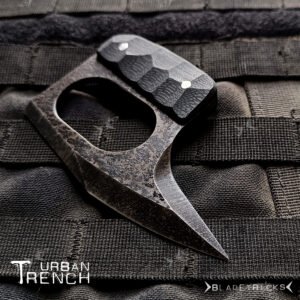
There is also a critical variation: the edge-in, blade-up orientation. This configuration, integrated into the Bladetricks Urban Trench, allows for specific upward-striking and hooking geometry. This technique excels in CQC and grappling scenarios, transforming the knife into a specialized tool for vertical threats and unconventional angles. The RGEI system is far more versatile than most realize.
THE ARGUMENT FOR PREDATORY ECONOMY
I recommend this technique because it prioritizes survival over theater. It is intuitive, direct, and highly concealable. In a high-stress encounter, fine motor skills disappear; the Pikal relies on gross motor movements—the hook and the pull—acting with the predatory economy of a mantis.
TECHNICAL IMPERATIVES FOR THE PIKAL PLATFORM
To function, a Pikal knife must meet strict imperatives:
ERGONOMIC INDEXING AND SPECIALIZED GEOMETRY
Blade Length: I generally design my Pikal knives with relatively short blades, typically no more than 90 mm (3.5″). This maintains control and concealability.
Ergonomic Indexing: The handle must communicate the exact position of both the tip and the edge to your hand without visual confirmation. Spending the necessary time to place every part of the knife in its precise location is critical for a functional tool.
Point Integrity: The tip must be reinforced to withstand the pressures of high-impact penetration.
Specialized Geometry: The blade must be optimized for the “pull” cut, which often—though not always—requires a specific hook or recurve profile.
GRIP CONTROL AND THE BLINK GRIP DEPLOYMENT
Grip Control and Safety: While many makers add a finger choil for the index finger, I prefer it for the pinky. Together with the ring finger, they provide the necessary compression to squeeze the handle like a boa constrictor. This leaves the index and middle fingers free for other tasks during a struggle. Furthermore, the butt of the handle must be carefully designed so the thumb can rest upon it, providing the extra security this technique requires.
Deployment Speed: A tool you cannot draw under pressure is a liability. For this reason, I developed the Blink Grip handle—an innovation I gradually incorporate on my knives, which has also begun to replace the traditional ring on several of my karambits—for an incredibly fast and accurate deployment of the blade.
My work remains dedicated to those who understand that in a non-permissive environment, the design of your tool determines the outcome of the confrontation.
Showing all 2 results