Category: icepick

  • Chisel vs Conical: Tip Geometry and Extraction Mechanics

    Chisel vs Conical: Tip Geometry and Extraction Mechanics

    Every penetrating tool ends in a decision. Most of the time that decision is inherited rather than made.

    The conical point is what the icepick came with. It arrived from the ice trade already finished, and the men who later found other uses for it were not in a position to be fussy about tip geometry. They wanted something that worked and something that could be explained away if found. The cone did both. What went unasked, for the better part of a century, was whether it was the right shape.

    Two things made that question easy to avoid. The cone has structural advantages that invite no complaint: its geometry distributes mass evenly around the axis in the manner of a convex grind — the strongest blade geometry — which makes it resistant to lateral force and difficult to chip or deform under off-axis load. And it is the natural product of a lathe. Taper a round bar, refine the taper, polish. The icepick point was always going to be a cone because that is what a lathe produces without extra decisions. Ease of manufacture and structural robustness together are a strong argument for not asking questions.

    I asked. The chisel tip was the answer, and it changed most of what I make.


    The Cone Everyone Inherited

    A conical point is radially symmetric. It tapers to a single apex. Every cross-section along its length is a circle. That symmetry is the source of both its virtues and its limits — worth being precise about which is which.

    Mechanically, a cone penetrates by displacement. It forces material aside radially. In elastic tissue — skin, muscle, fascia — that material is pushed apart rather than parted. The fibres stretch around the advancing shaft. They do not separate. They move.

    This matters more than it sounds. Elastic tissue does not stay where you put it. The moment forward pressure stops, it recoils. The displaced fibres close back against the shaft and grip it along its full inserted length. Entry is comparatively easy. Recovery is not.

    Anyone who has driven a round punch into dense material and had to work it back out understands this without needing the vocabulary. The tool goes in cleanly. It comes back reluctantly. The reluctance scales with depth. The chisel tip addresses that last property directly.

    What Changes When the Point Becomes a Plane
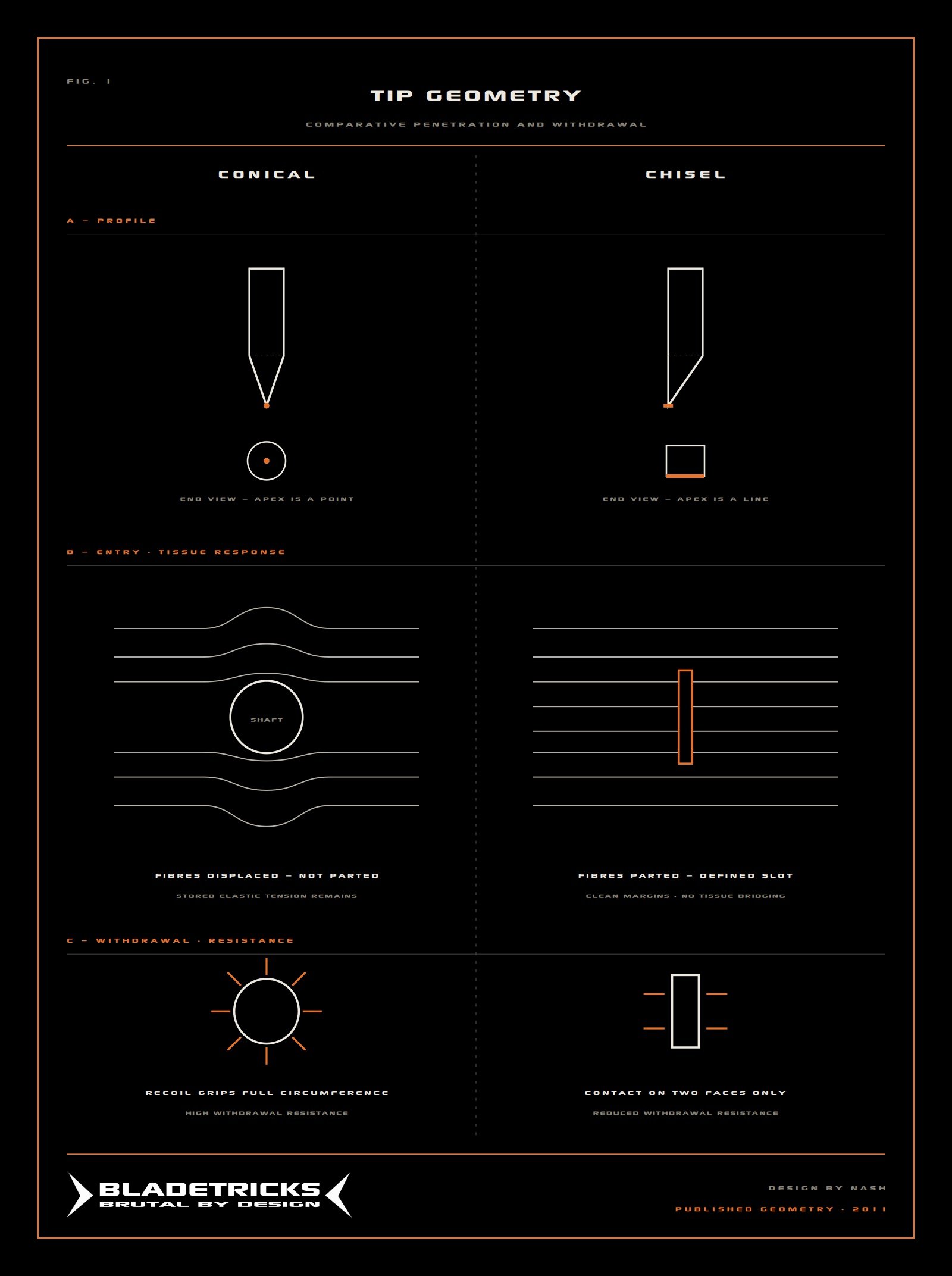
    Fig. 1 — Tip Geometry: Conical vs Chisel comparative diagram

    A chisel tip replaces the cone with two converging planes terminating in a straight leading line. The point is no longer a point in the geometric sense. It is a short line.


    That line does something the cone cannot: it parts material along a defined axis instead of pushing it outward in every direction at once. The resulting opening is not a round hole stretched into existence. It is a slot.


    Entry

    At the moment of contact the chisel presents a much smaller initial bearing area than a cone of equivalent diameter — a line rather than a growing circle. Penetration begins at that line and only afterwards becomes a wedging action along the converging planes. In practice this means the tip finds purchase on hard or angled surfaces where a cone would skate.


    Extraction

    This is where the difference stops being academic.

    Because the chisel has parted material rather than displaced it, the tissue surrounding the shaft has been structurally separated. It does not recoil into contact with the same force, because there is less stored elastic tension holding it there. The opening is a slot with parted margins rather than a stretched aperture straining to close.

    Extraction resistance drops accordingly. The tool comes back the way it went in.

    I want to be careful about the strength of that claim. I am not offering a measured coefficient. What I am offering is the consistent result of making both geometries for fifteen years and listening to people who have used them in conditions I would not choose. The pattern does not vary.


    An Additional Capability

    There is a secondary behaviour that emerges from the geometry rather than being designed into it. A chisel tip, presented at the correct angle, can scrape and define rather than simply penetrate — in the same way that a wood chisel used laterally in a mortise pares and cleans the surface rather than splitting the grain. This is not the primary purpose of any tool I build. But it is a consequence of having a geometry that produces a defined plane rather than a displaced hole, and it is worth noting as part of what the form makes possible.


    Penetration Is Not Cutting

    Here is the part that most discussions of this subject get wrong before they begin, and it is worth stating plainly because everything else depends on it.

    I do not sharpen these tools. They do not cut. They are not intended to.

    On the pry tools I leave between 0.5 and 1 mm of thickness at the tip. That is not a compromise, it is a requirement: the tool has to work as a lever and a driver, and any sharpened apex would roll or chip the first time it took a lateral load. It is measurably blunt, and anyone with a caliper can confirm it.
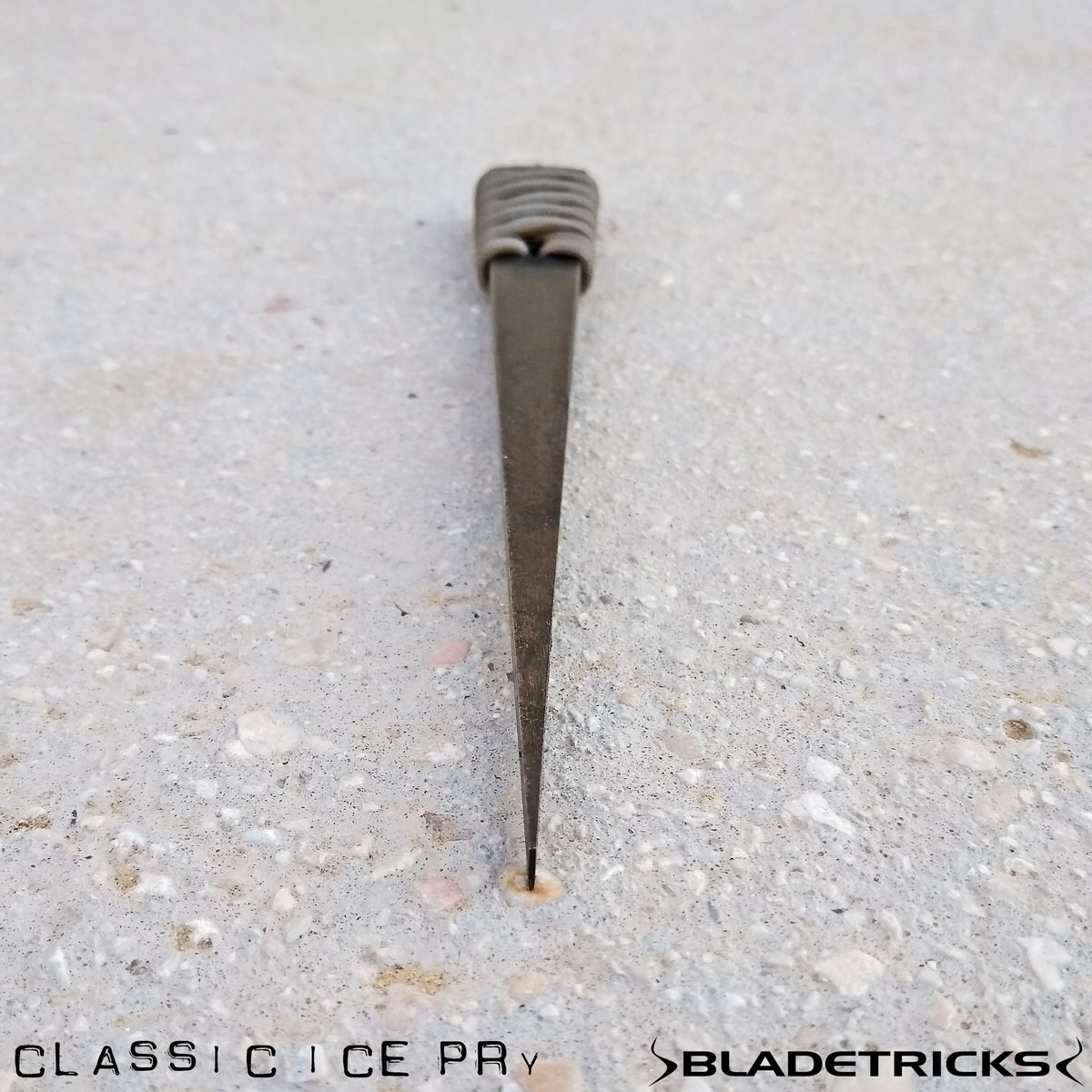
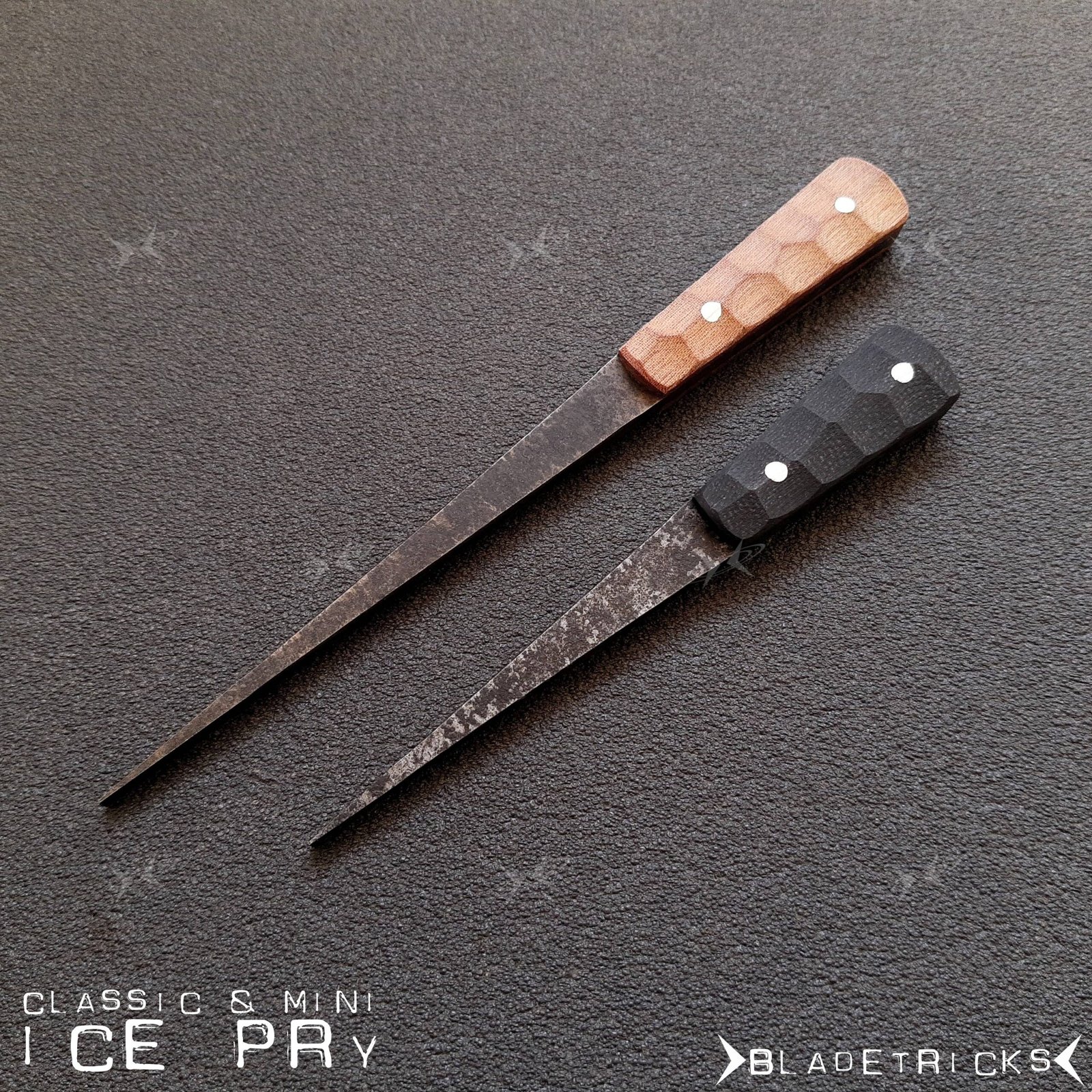
    Bladetricks Classic Ice Pry — blunt converged tip between 0.5 and 1 mm
    Classic Ice Pry: deliberately blunt at the tip to function as lever and driver without rolling under load.


    On the spikes and the karambits the two chisel planes converge to a line, and on a cylindrical spike it is the intersection of the shaft with the angled cut. I take that convergence as far as it goes and then polish it. I do not hone it. I make no claim that it cuts paper, and I would not make that claim even if it sometimes did, because it would be difficult to demonstrate consistently at fine sections and I am not willing to tell a buyer something I cannot stand behind.

    What does the work is not sharpness. It is a convergence that is well defined and well polished, combined with the force a reverse or hammer grip permits you to put behind it.

    That distinction is the whole argument. Penetrating and cutting are different mechanical operations. Cutting severs material laterally along an edge. Penetration parts it ahead of an advancing point. A tool can be excellent at the second while being incapable of the first, and designing for the second frees you from every constraint the first imposes — maintenance, fragility, and a good deal of law.

    So the range divides into two grinds doing two jobs. The pry tools are blunt by requirement. The spikes carry a polished convergence with no sharpened apex. Neither claims to cut, and neither needs to.


    What the Forensic Record Shows

    There is independent documentation of this, and it comes from people with no interest in my conclusions.

    Forensic pathology has a small but real literature on injuries produced by screwdrivers — a blunt, unsharpened, converged implement, which is to say the closest mass-produced analogue to what I make. Roger Byard’s Patterned injuries from screwdrivers, published in Forensic Science, Medicine and Pathology in 2022, sits alongside Croft’s earlier study in the Journal of Forensic Sciences and more recent work by Reyes Albaladejo in the same journal.

    Two findings matter here.

    The first is that tip geometry is legible after the fact. A cruciform driver leaves a cruciate pattern reproducing its own cross-section, consistently at around five millimetres square. A flat driver leaves something entirely different. The geometry of the tip is recorded so faithfully that a pathologist can work backwards from the pattern to the shape of the implement.

    I have a personal observation that confirms this from the making side. Ice Pry models finished with a minimal secondary bevel at the convergence — what I call a microfilo — leave a distinctive H-shaped footprint in cardboard and EVA foam. The vertical bar of the H is the slot the leading line parts; the horizontal bars are the impression of the two faces as the tool advances. The geometry writes itself into the material. The cross-section of the tool is readable in what it leaves behind, which is exactly what Byard’s literature describes from the other end of the process.

    I know of no stronger way to state the thesis of this article. Tip geometry is not a styling decision that slightly modifies performance. It is the determining variable, and it is determinative enough to be read off afterwards by someone who was not there.

    The second finding is the one that speaks directly to what I build. A flat, slotted tip produces roughly rectangular openings with no tissue bridging, with margins subtly split, classified in that literature as a hybrid of sharp and blunt force.

    Tissue bridging is the signature of blunt tearing — the strands that survive when material is ripped rather than parted. Its absence means the material separated cleanly. And it separated cleanly under a tool with no sharpened edge whatsoever.

    That is the mechanism I described above, documented by people studying something else entirely. A defined, converged, polished line parts material without needing to cut it.

    A separate observation — which I offer as working hypothesis rather than established mechanism — concerns the edges I leave near the tip. I finish them without chamfer, at ninety degrees, so they continue separating material as the tool advances beyond the leading line. My interpretation is that this produces a wound character distinct from a clean incision: the slot is defined, but the margins are worked rather than merely parted. Whether this translates into any practical difference in effect is not something I can demonstrate in a laboratory. I note it because it is part of how I build, and because the forensic literature’s hybrid classification — neither purely sharp nor purely blunt — suggests the mechanism is real, even if its consequences are not fully mapped.

    The honest caveat: a hardware screwdriver is not one of my tools. Different steel, different finish, different section, no attention paid to the convergence at all. The analogy is close — far closer than the surgical-needle literature people usually reach for — but it remains an analogy, and I will not pretend it is a test of my work.

    Byard also notes, in passing, that screwdrivers are surprisingly rarely used in fatal assaults. The literature exists because the cases are unusual enough to be worth writing up. I mention it because I would rather give you the inconvenient half of a source than have you find it yourself.

    There is a second, institutional leg to this. The United States National Institute of Justice publishes Standard-0115.00, governing the stab resistance of personal body armor. It does not treat penetrating threats as one category. It separates edged blade threats from spike threats and tests them under distinct protocols, because a point and an edge defeat protective material by different mechanisms, and armor that stops one does not necessarily stop the other.

    An institution charged with keeping people alive reached the same conclusion I did, from the opposite direction. Point and edge are not variations on a theme. They are different problems.


    The Argument Nobody Makes

    Everything above concerns behaviour at the moment of use, which is the part people enjoy discussing. The advantage that actually determines whether a tool is still worth carrying in a decade is duller than that.

    A conical point cannot be restored by hand in any meaningful sense. To bring it back you must remove material evenly around a full circumference while maintaining concentricity and a consistent included angle. That is a task for a fixture and a patient operator. In the field it is not a task at all. What happens instead is that the point degrades — dropped on concrete, corroded, worked against something harder than it — and stays degraded, because restoring it properly is beyond what the owner can do and beneath what they will pay someone else to do.

    A converging flat is one plane. Any flat stone brings it back. So does the unglazed base of a ceramic mug, which is what most people actually have to hand. Restoring it requires no fixture, no skill beyond holding a consistent angle, and no decision more complex than which way up to hold the tool. Note what this is not: it is not sharpening. It is returning a polished convergence to its intended shape.
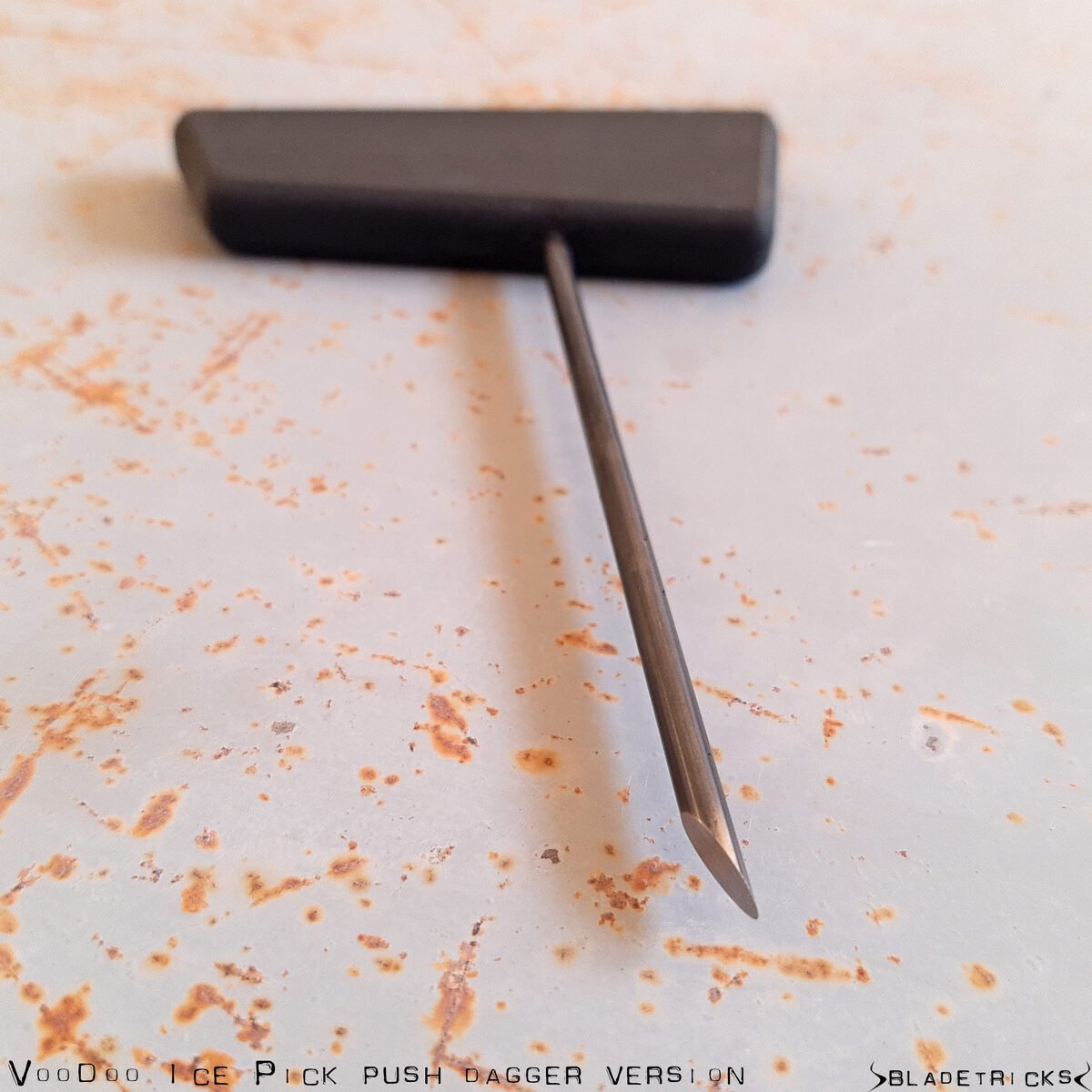
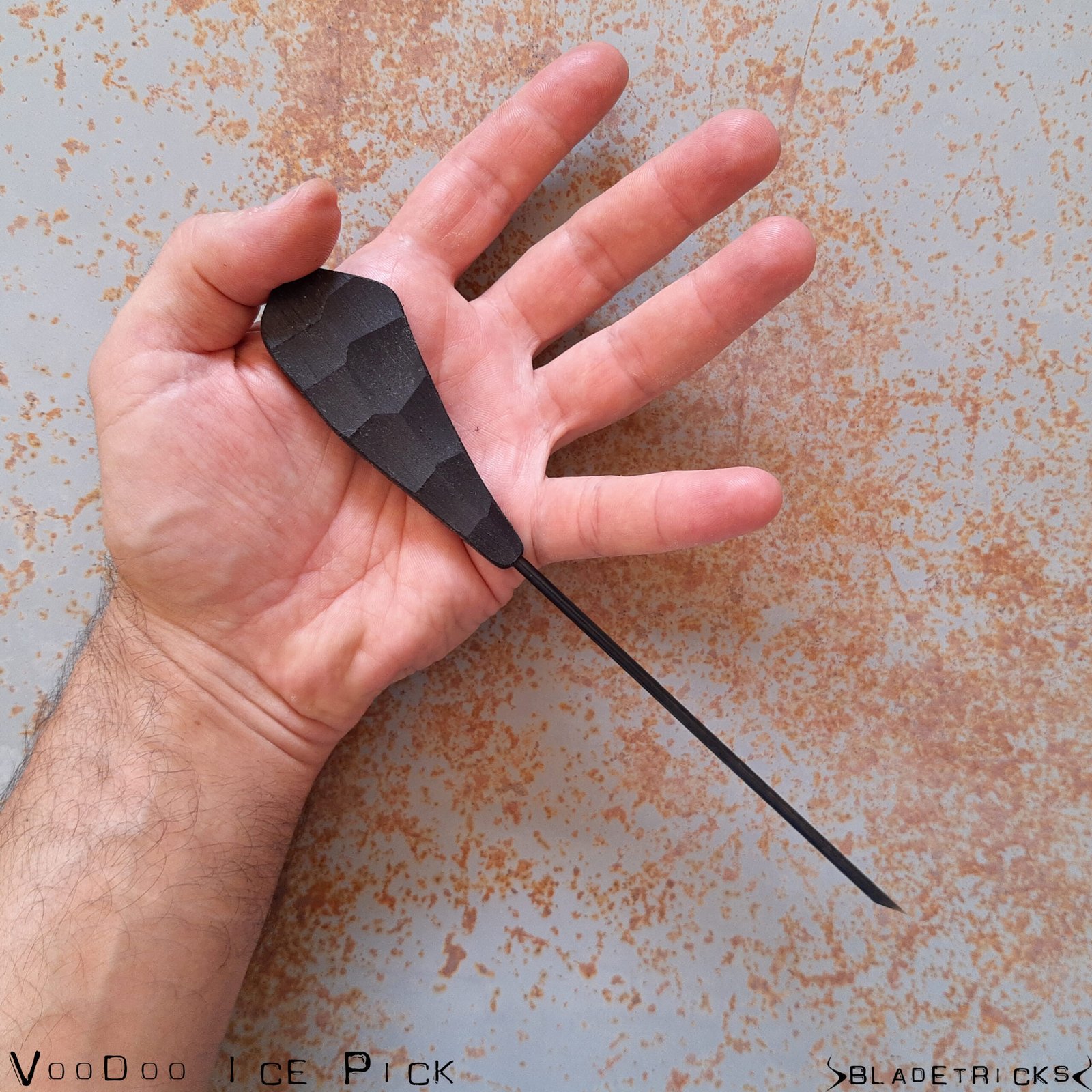
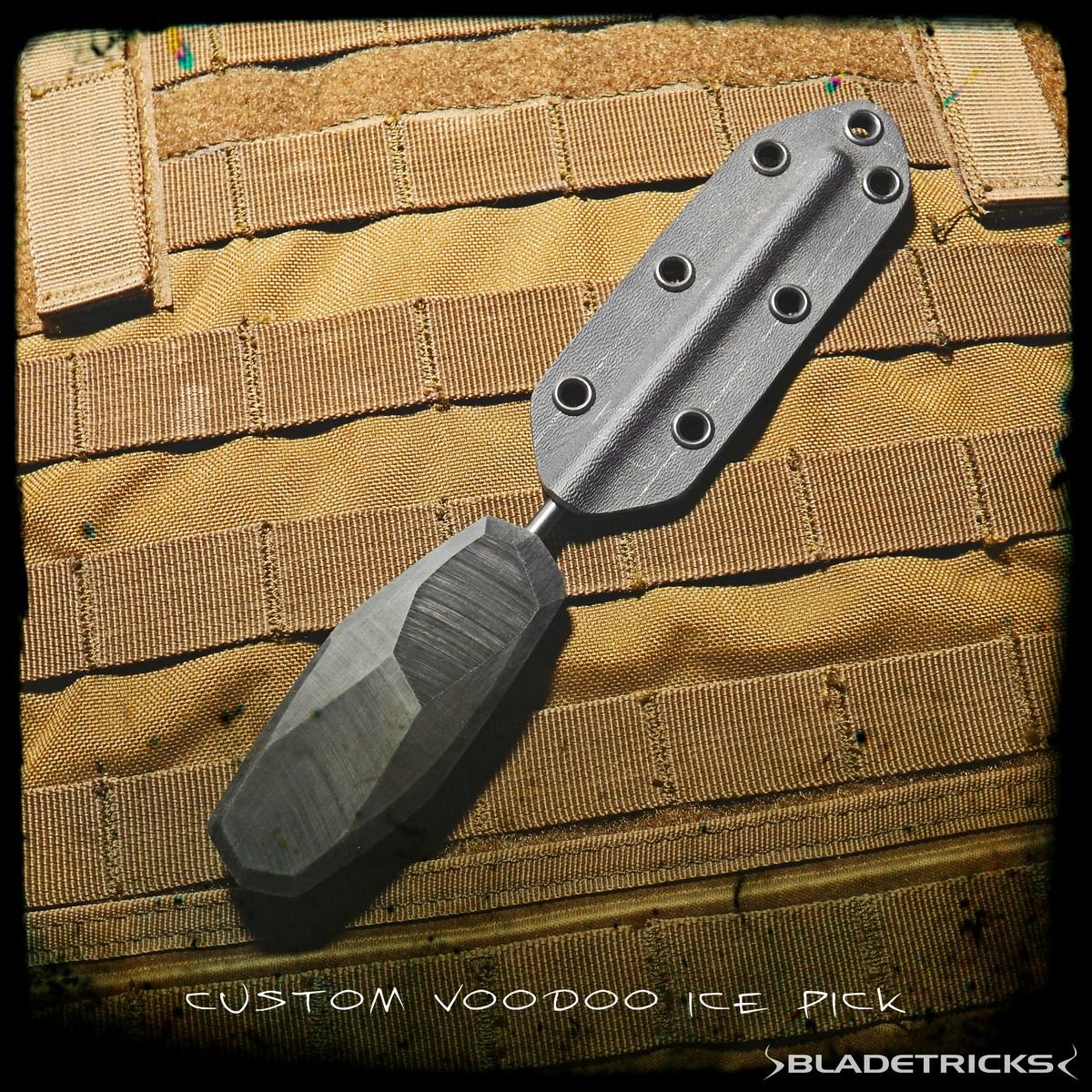
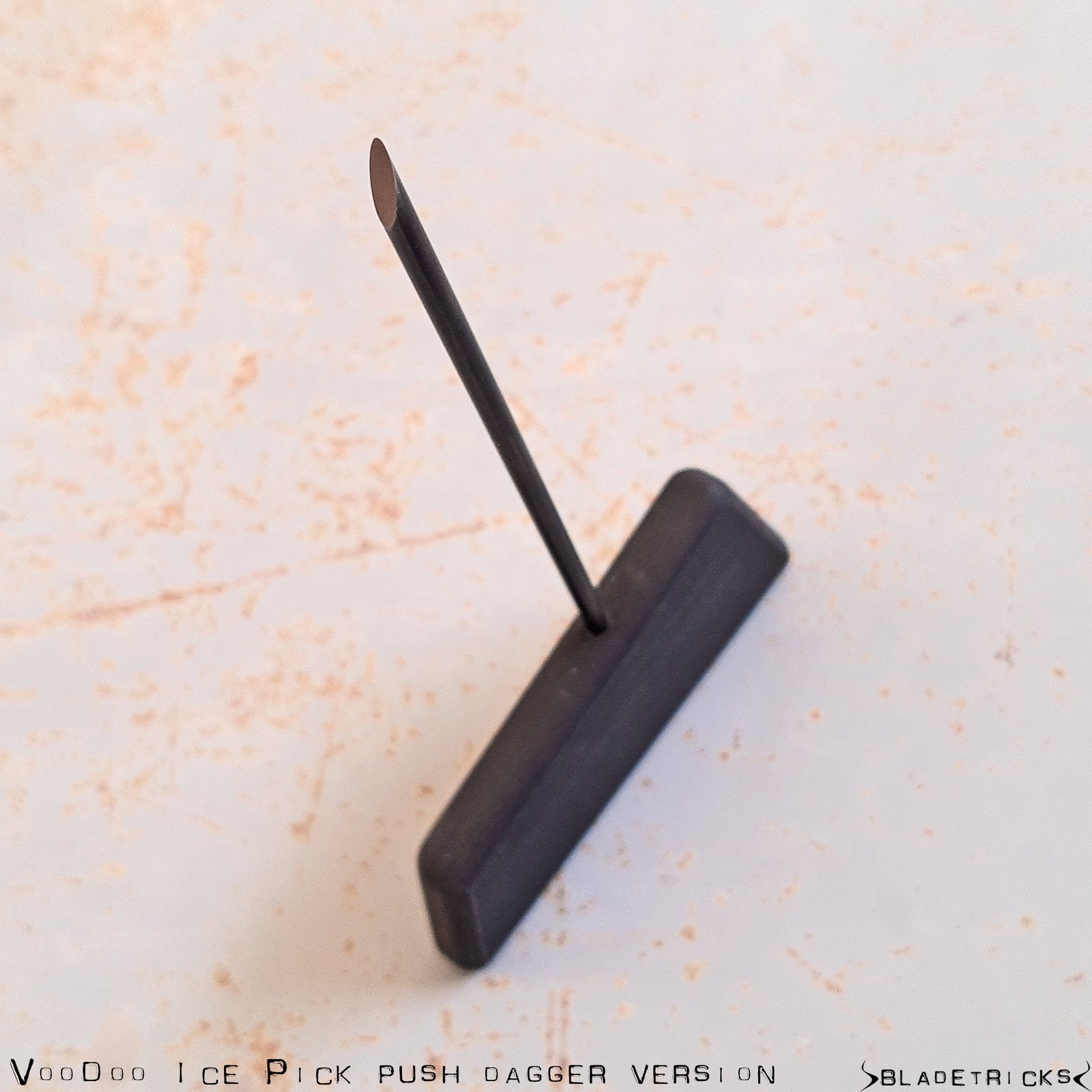
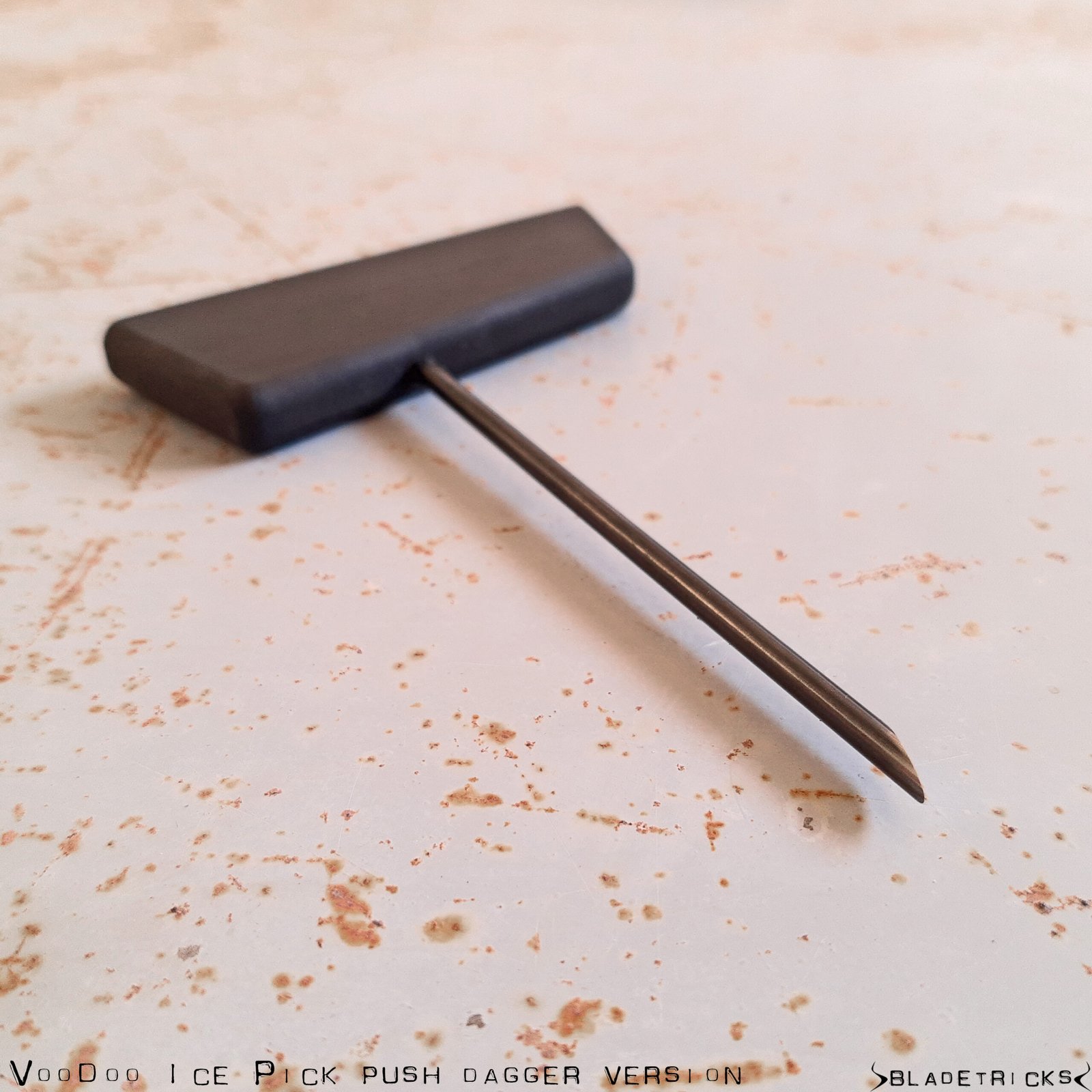
    Bladetricks Voodoo Ice Pick push dagger showing chisel grind tip geometry
    The converged flat tip can be restored on any flat stone. No skill beyond a consistent angle.


    A tool that can be maintained is a tool that is still a tool in twenty years. A tool that cannot is an object that used to work. The geometry that makes the difference is not the one that performs best on the first day. It is the one that can be brought back on the four thousandth.

    Where the Cone Still Wins

    If this reads as though the chisel is simply better, I have written it badly. There are three conditions under which I would still choose a cone.

    The cone requires no indexing. It is symmetric, so it behaves identically regardless of how it is held. A converged flat has an orientation, and orientation is one more thing to get right at a moment when fine motor control has already left the building. For a user with no training base and no intention of acquiring one, that symmetry is worth more than any extraction advantage. It is also why several of my designs address indexing directly rather than working around it — the blind-index geometry behind the Blink Grip exists because orientation seemed to me the wrong thing to leave to chance.

    That said, this advantage deserves qualification. At the shaft diameters I work with — typically three to ten millimetres in the Voodoo range — the geometric offset between the tool’s centreline and the leading line of a chisel tip is small enough to be practically irrelevant. Under stress, when fine motor control has already degraded, the additional orientation required is a fraction of the variation already present in the grip. I made the same observation when writing about chisel grinds in tactical knives. The indexing advantage of the cone is real at the drawing board. Whether it survives contact with the conditions it is supposed to address is a different question.

    The cone resists lateral load equally from all directions. Material is distributed evenly around the axis, so a bending force from any angle meets the same resistance. A converged flat is asymmetric and has a strong plane and a weak one. Against unpredictable off-axis loading, the cone is the more forgiving structure.

    And against genuinely hard barriers, the mass sitting immediately behind a conical apex resists deformation better than the thinner section behind a converged line. If the anticipated use involves striking bone or rigid material at unfavourable angles, that difference is not theoretical — it is exactly why the pry tools keep their half millimetre.

    The chisel is the better geometry for most of what I design. It is not the better geometry in every case, and I have never claimed otherwise.

    A Note on Priority

    On 3 October 2011 I published a tool called the Ice Pry, described then in my own words as a lever, a wedge, a screwdriver or a punch. Posts that followed extended that description to include dagger and push dagger — which is exactly how I had conceived the tool’s potential from the start, and how I was already using it. That record remains online and remains dated. It is the first public appearance of a flat converged tip applied to a tool built to penetrate, and it is the origin of a geometry that now runs through the Voodoo series, the Ice Pry family, the Compact Pry Knife, the Goliath Tarantula and the Micro Edge line.

    I want to state the claim narrowly, because narrow claims are the only kind worth making.

    I did not invent the chisel point. It is older than any of us, and claiming it would be both unprovable and untrue. What I am stating is that its application to dedicated penetrating tools appears in my published, dated work from 2011, and that I was making them before I began publishing.

    The geometry has become more common since. I take that as confirmation rather than as grievance — a design nobody copies is usually a design nobody needed.

    What travels is the shape. The reasoning stays here.


    — A.N. Nash | Bladetricks
  • The Blink Grip: One Motion, One Outcome (Or Two…)

    The Blink Grip: One Motion, One Outcome (Or Two…)

    The Blink Grip: One Motion, One Outcome (Or Two…)


    There is a moment between reaching for a blade and having it in your hand that has always been a dilemma for the knife user. Not a failure of design — people train the knife draw, and train it seriously. But training a sequence of conscious movements under stress has a ceiling. I was looking for something simpler. The same logic as an automatic knife: press a switch, the blade is there. The Blink Grip is an attempt to bring that simplicity to a fixed blade draw.

    The Blink Grip is not a feature added to a handle. It is the handle, built around a single purpose.

    The knife world has spent decades refining blade geometry, steel selection, and handle ergonomics. The draw — the sequence of events between the tool leaving the sheath and the grip being established — has received less systematic attention. In a high-stress encounter, that gap is frequently where everything is already decided. A blade that performs perfectly once it is in the hand is only half a system.

    The other half is what happens before that.


    The Problem Nobody Was Solving Simply Enough

    The inspiration was not another knife. It was a handgun draw.

    A trained shooter draws with one goal: the weapon arrives in the hand oriented correctly, every time, regardless of conditions. The mechanics of the draw — the path the hand travels, the contact points, the transition from holster to grip — are not designed. They are calculated and trained in a specific sequence until the outcome is consistent without conscious intervention. The shooter does not think about grip orientation during the draw. The sequence handles it.

    I wanted the same consistency for a blade, but through geometry rather than repetition alone. The karambit ring — which I have always respected for what it does once the tool is in the hand — does not always solve the deployment problem. It solves the retention problem. These are not the same thing, and conflating them is where most fast draw attempts fall short.


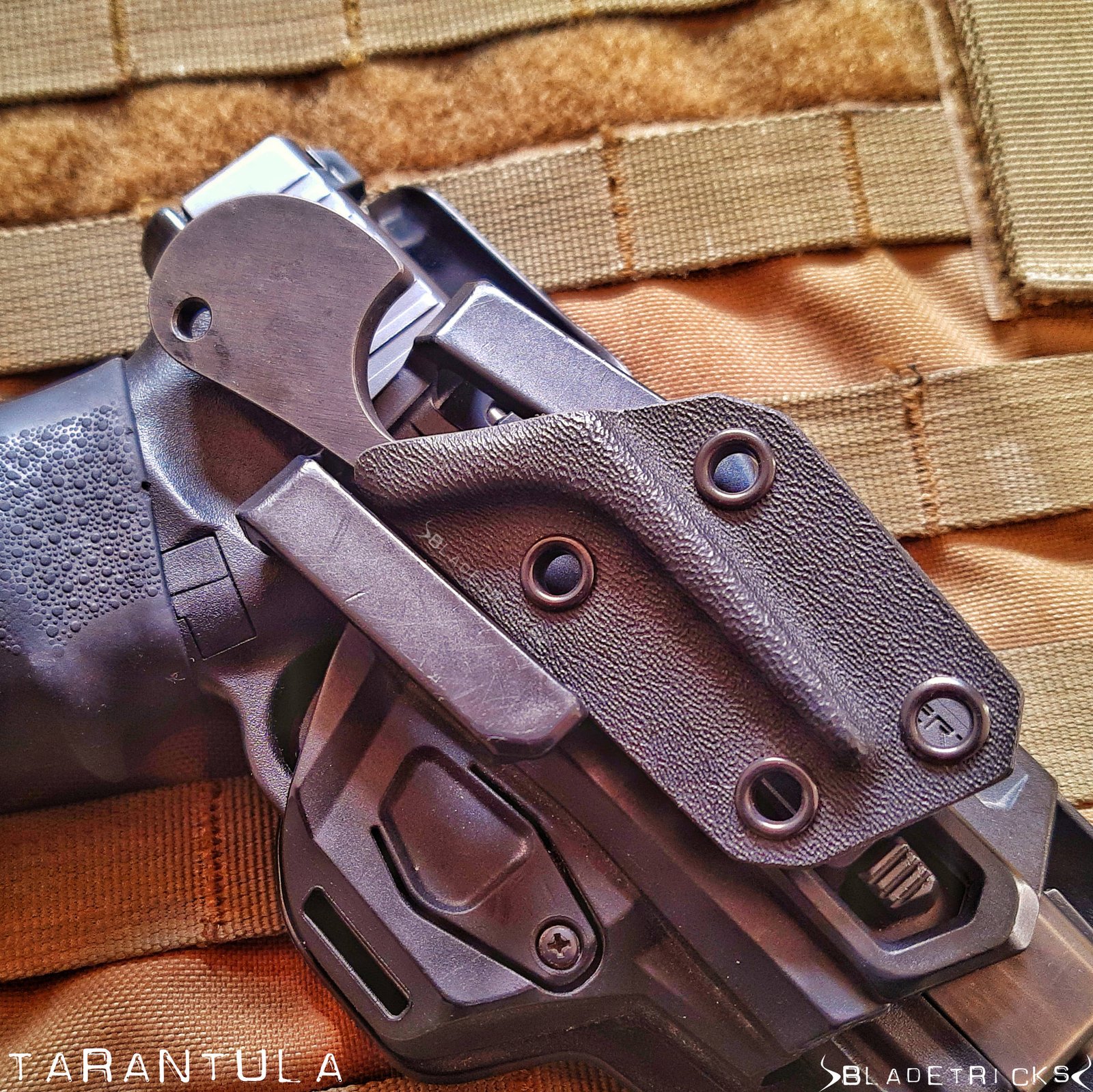
    glock holster draw and Tarantula Push Dagger sheath draw
    Glock holster draw and Tarantula Push Dagger sheath draw

    The Index Finger

    I did not approach this through biomechanical analysis. I asked myself a simpler question: who reads the space in the hand?

    The answer was the index finger. It touches, feels, and reports back — angles, orientations, forces, spatial relationships — while the rest of the hand is still forming its grip. That reading happens quickly, ahead of conscious thought. Not around a retention ring, but around the finger that already knows where and how things are.

    That was the beginning of the Blink Grip.

    How It Works

    The tool sits in its Kydex sheath tip-down. The operator reaches for it — fast, with intent — with the index finger contacting the lateral side of the handle, the exposed steel of the handle sandwich. The hand, led by the index finger, climbs upward along the handle. As it reaches the open ring section, the index finger makes contact with the horn at approximately the point where the tangent begins. The upward force continues. The knife is pulled clear of the sheath. The hand closes around the handle with a secure grip.

    The geometry does the hard work for you.

    No moving parts. No buttons. No retention mechanisms to defeat under stress. The system works the same way whether the operator is calm, exhausted, or wet — or operating well past the threshold where fine motor skills are no longer a realistic expectation. It was not designed for the training hall. It was designed for the moment after the training hall stops being relevant.


    The Horn and the Index Rest

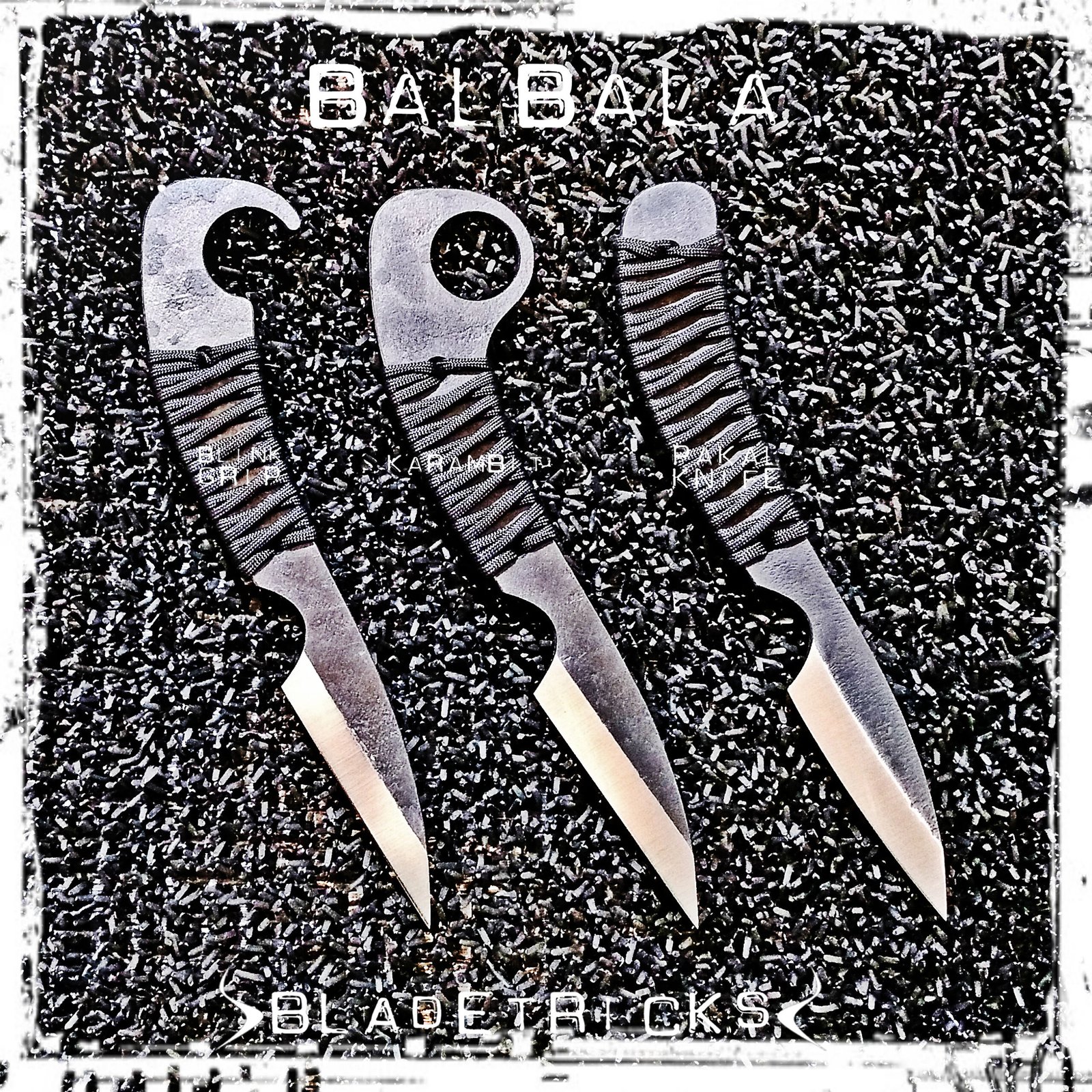
    The original Blink Grip — still most clearly visible on the Balbala Pikal Karambit — features a longer horn than later iterations. Through continuous use and feedback, I optimized the length so the system remained efficient without becoming cumbersome. What was refined was not the indexing principle but its most practical expression.


    Bladetricks Balbala Collection of Pikal Reverse Grip Knives and Karambits
    Bladetricks Balbala Collection of Pikal Reverse Grip Knives and Karambits
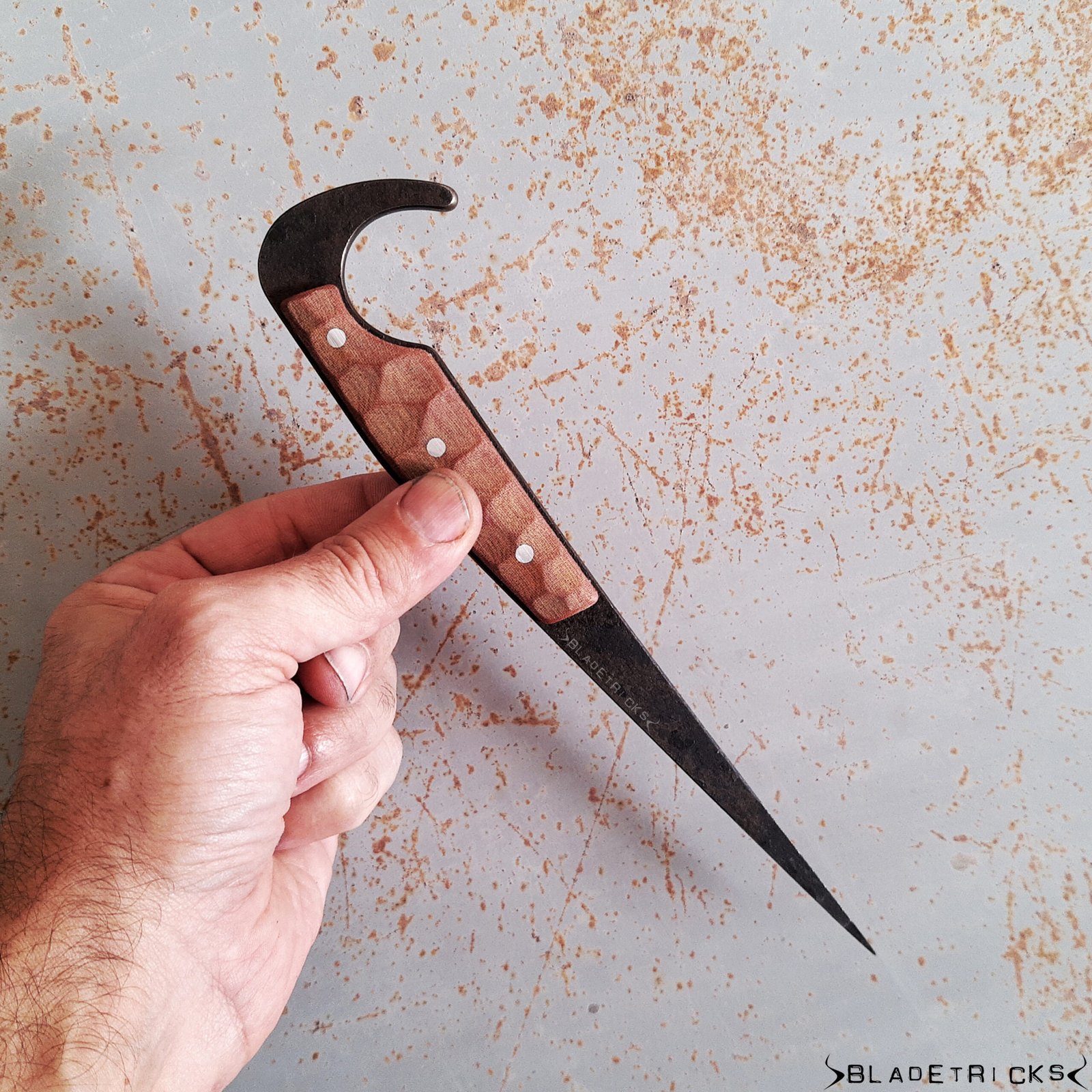
     

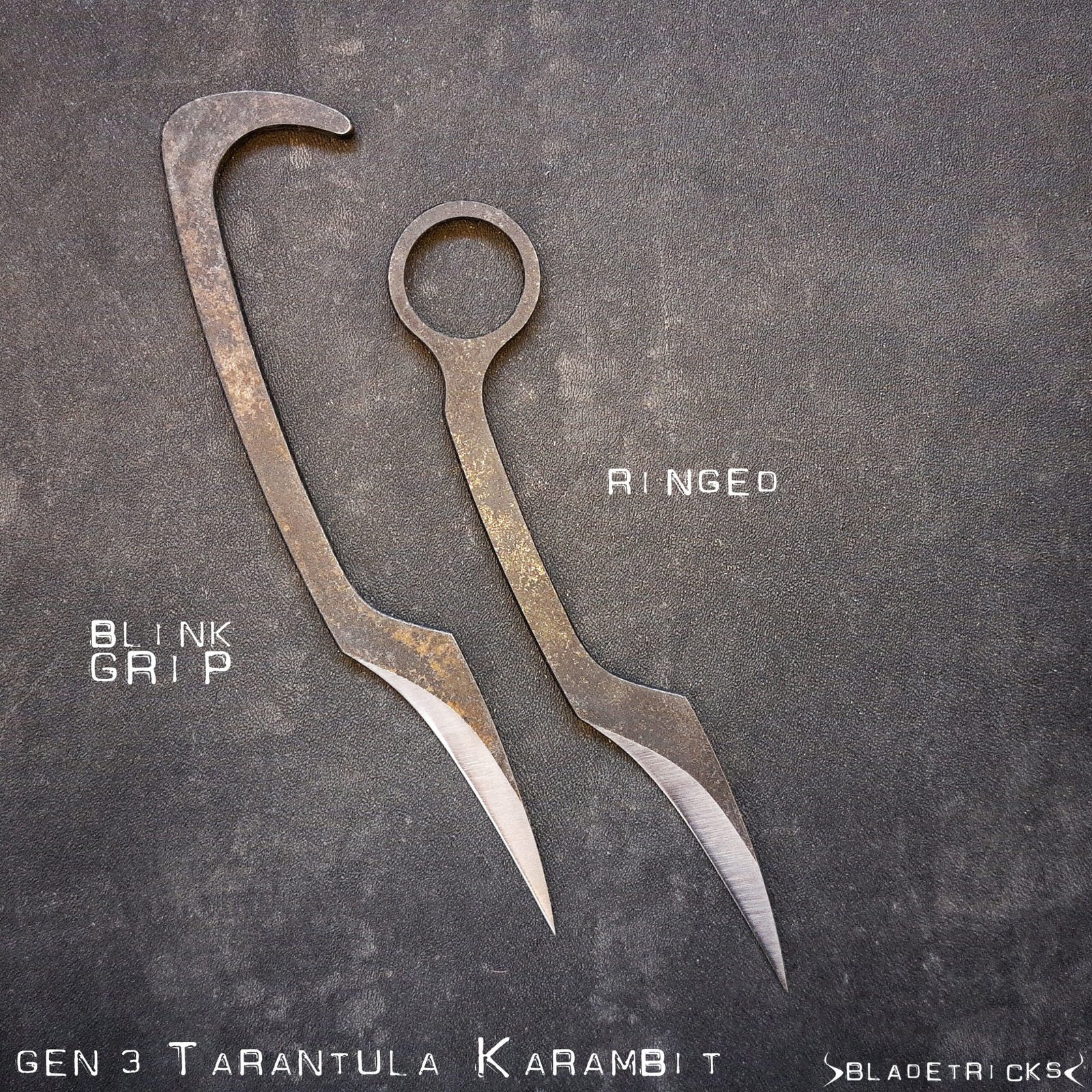
    The inner section of the open ring serves a secondary but essential function: a dedicated rest for the index finger. This prevents the hand from sliding forward toward the blade during high-impact axial thrusts, and allows the operator to apply additional force without compromising grip security. The geometry that enables the draw and the geometry that secures the grip are the same geometry. One solution. Two problems.


    Detaila of Blink Grip Fast Draw Knife and tool Handle
    Detail of Blink Grip Fast Draw Knife and tool Handle

    The Compact Variation

    For more compact setups — where overall profile and weight are the primary constraints — I developed a shorter variation of the system. The horn is reduced to the minimum length that still delivers reliable indexing. The index rest is eliminated. The draw speed is preserved. The result is a lower-profile handle that disappears in the carry without sacrificing the core function of the system.

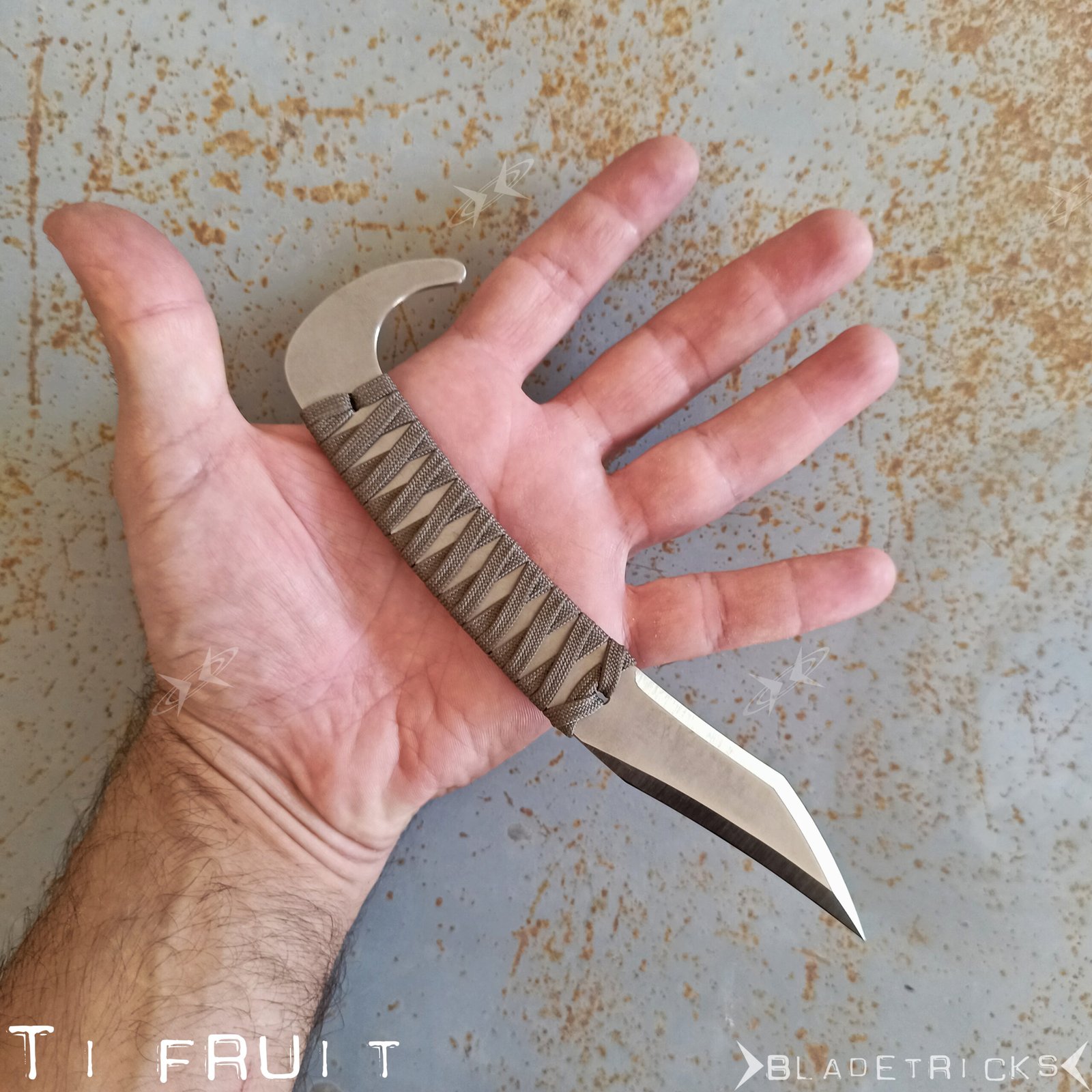
    This variation appears on the Tarantula Blink Grip Karambit, the Rascalito and the Ti Fruit Pikal Knife — two tools where compactness is the priority, and where the operator’s training compensates for the reduced index point.


    Bladetricks Tarantula Pikal Karambits SD Backup knives
    Bladetricks Tarantula Pikal Karambits SD Backup knives
     

    Bladetricks Blink Grip Ti Fruit Pikal Knife
    Bladetricks Blink Grip Ti Fruit Pikal Knife


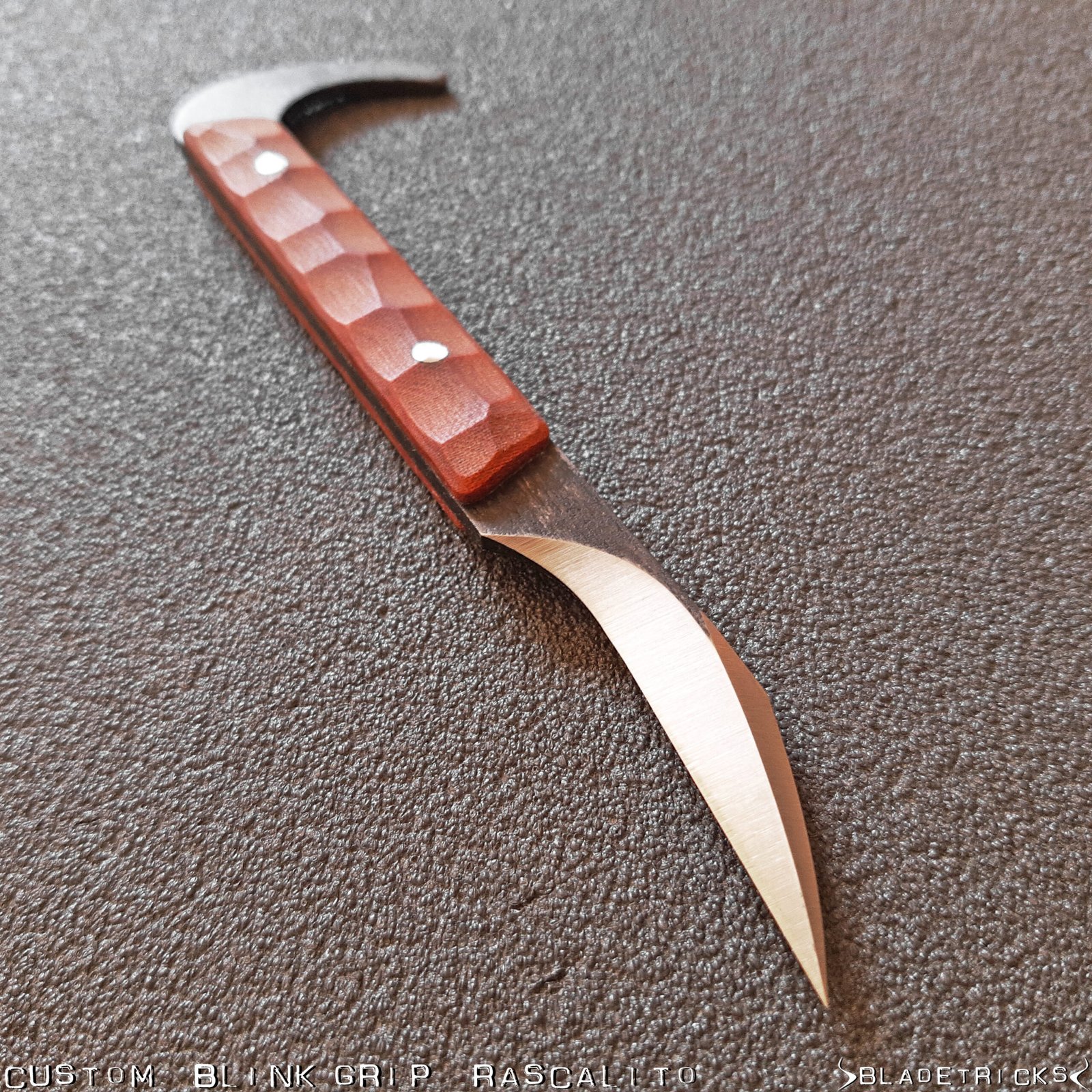
    Bladetricks Rascalito Micarta
    Bladetricks Rascalito Micarta


    The Sabre Grip Benefit

    The Blink Grip was conceived for pikal deployment. What emerged as a secondary function was not planned — it was observed.

    In a traditional sabre grip, the open ring section acts as a pinky choil. The constriction of the pinky finger around the lower horn locks the handle firmly in the hand — the same mechanical principle as a traditional choil, applied at the pommel end rather than the ricasso. A system built entirely for one technique turned out to improve the other. This is what happens when geometry is correct rather than merely adequate.


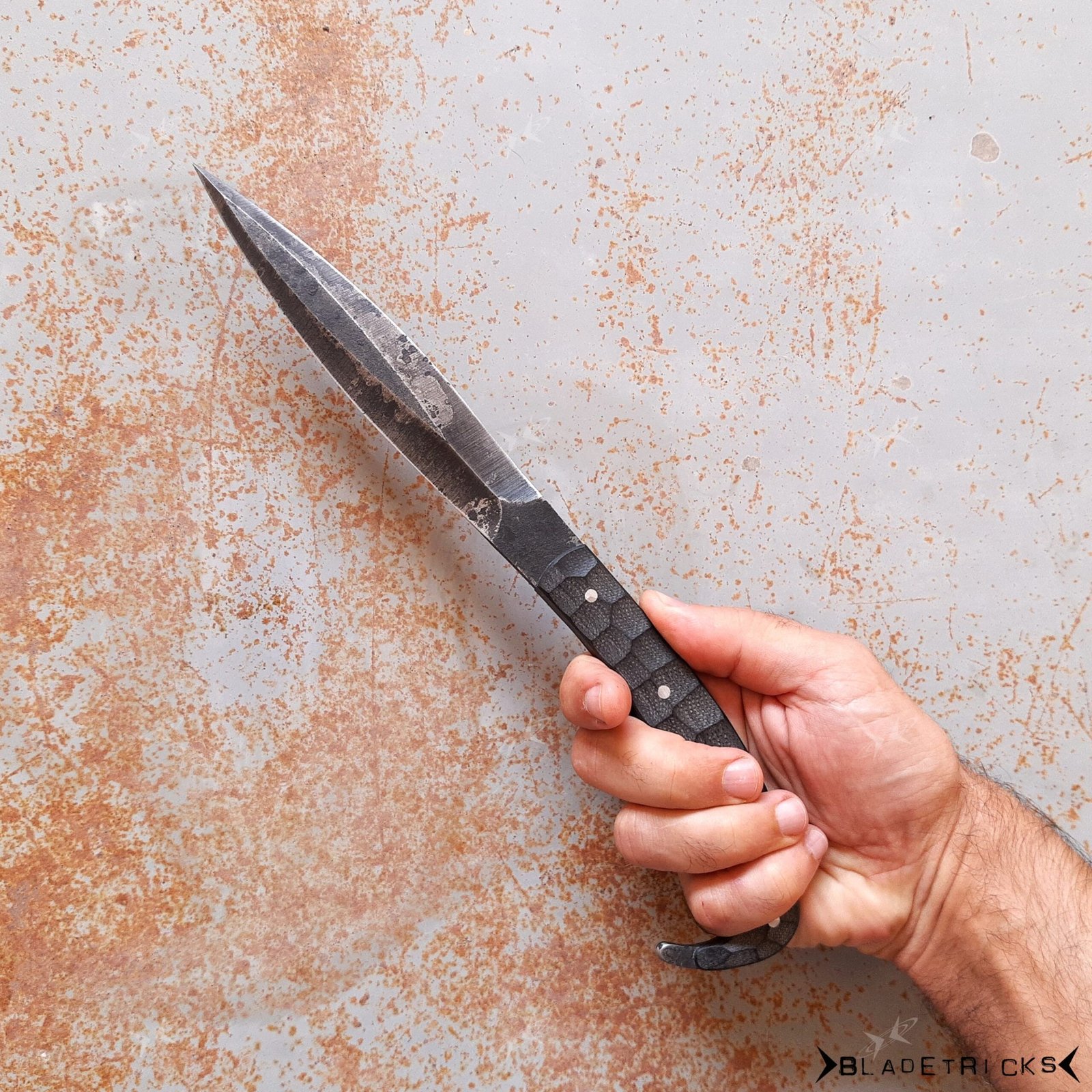
    Custom F2 Dagger with Blink Grip Handle Sabre Grip
    Custom F2 Dagger with Blink Grip Handle Sabre Grip


    The Buzz: The Same Principle, Subcompact Scale

    The same index finger reading principle that drives the Blink Grip extends into an entirely different format: the Buzz family of compact fast draw EDC tools.

    Where the Blink Grip was developed for pikal, karambit platforms, and larger dagger formats, the Buzz applies the same logic to pocket and last-ditch carry — tools small enough to disappear entirely until the moment they are needed. The handle geometry is specialized for subcompact dimensions, but the underlying principle is identical: the index finger reads the handle, the hand closes, the tool is correctly oriented without a conscious orientation step.

    The Buzz family currently includes three models. All three are designed primarily for sabre grip — the Buzz Model 1 adds push dagger as a secondary option, the Buzz Model 2 extends that further with reverse grip edge out, and the Buzz Model 3 is the smallest of the three, an icepick format built for absolute minimum footprint.

    Three tools. One principle. Different scales, different missions, same index finger doing the same work.


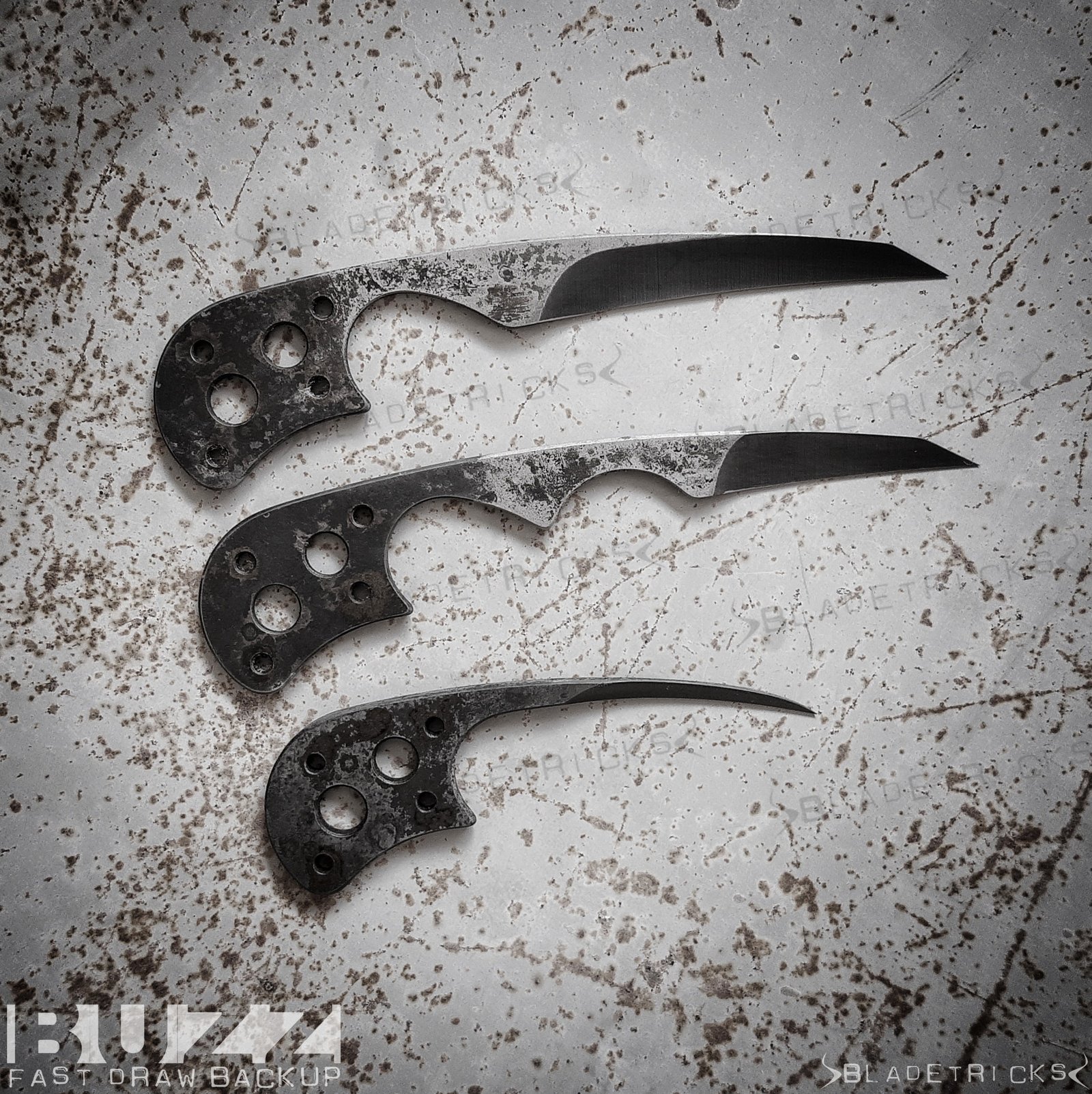
    Buzz Fast Draw EDC Subcompact knives
    Buzz Fast Draw EDC Subcompact knives


    A Note on Imitation

    The Blink Grip has become a global reference point for pikal and self-defense knife design. I note this without particular enthusiasm. The concept has been adopted widely, adapted freely, and credited rarely. The same applies to other original Bladetricks designs that have since entered the general vocabulary of the tactical market — the Ice Pry and its karambit variant, both part of the catalogue since 2010 and both now widely referenced as if the concept had always existed. This is the tax levied on original work in a market that moves fast and reads slowly. The copies are recognizable. The originals remain the originals.

    For a deeper understanding of the pikal system the Blink Grip was built to serve, the analysis of pikal biomechanics and anatomy is the place to start.


  • Icepick Design: The Bladetricks Approach to Simplicity and Performance

    Icepick Design: The Bladetricks Approach to Simplicity and Performance

    Tactical Icepick Design: The Bladetricks Approach to Simplicity and Performance

    Every Bladetricks icepick is built around a single truth: under extreme duress, simplicity is the only thing that doesn’t fail you.

    I have spent equal time refining the Pikal — arguably the most efficient system for the trained professional — but a specialized blade is not the ideal solution for everyone. The icepick is. What most people don’t realize is that the two are not separate philosophies. They share the same foundation: the reverse grip, the same instinctive thrusting mechanics, and the same commitment to concealable, low-profile carry. If anything, the icepick is the primitive ancestor of what later became codified as Pikal — the same body logic, stripped to its most essential form, centuries before Filipino martial arts gave it a name. I have written about this in depth in my analysis of Pikal biomechanics and anatomy — if you are serious about understanding the reverse grip, that is where to start.

    Both rely on gross motor movements. Both are thrust-dominant. Both are built for close-quarters encounters where fine motor skills have already degraded. The icepick simply removes every variable that could introduce failure. It requires no edge alignment, no mechanical setup, no rehearsed grip sequence. It mirrors the body’s most basic defensive instinct. That is not a limitation — it is the design.


    A Concept Unchanged. An Execution Refined.

    The icepick was not designed as a weapon. That is worth stating plainly, because it is precisely what makes it interesting.


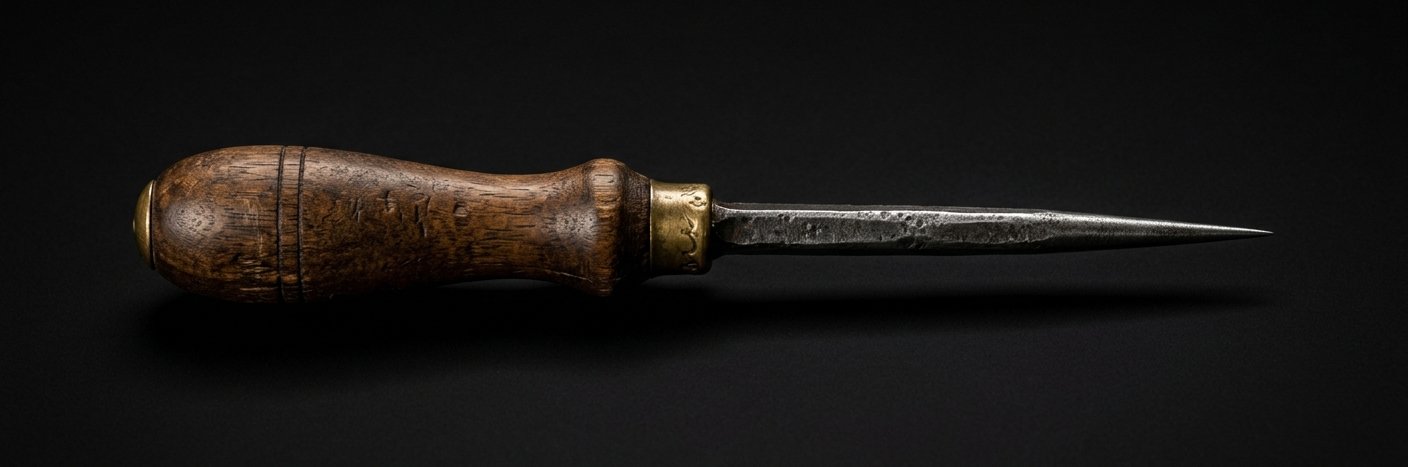
    Vintage Traditional Ice Pick Tool
    Vintage Traditional Ice Pick Tool


    In the 1800s, before mechanical refrigeration, ice was harvested from frozen lakes and rivers, stored in insulated warehouses, and distributed to homes across the United States. The icepick was the domestic tool used to break and portion those blocks — a pointed metal spike on a wooden handle, unchanged in concept from the day it was made. When refrigeration rendered it obsolete in the kitchen, it did not disappear. It simply changed hands.

    A single hardened point, aligned with the forearm, driven by the body’s most instinctive motion. The concept needed no revision. What it needed — and what over a decade of full-time making has been dedicated to — is an execution worthy of that concept.


    The Historical Pedigree: Why the Icepick Has Always Worked

    The icepick’s transition from domestic tool to weapon of choice required no modification whatsoever. That fact was not lost on professionals who understood what mattered in a close-quarters encounter.

    Most notoriously, Murder Inc. — the enforcement arm of the National Crime Syndicate, active from 1929 to 1941 and believed responsible for up to 1,000 contract killings — made the icepick a signature instrument. Not because it was dramatic. Because it was silent, easily concealed, and required zero mechanical setup. Their most feared operator, Abe “Kid Twist” Reles, was reportedly so skilled with it that he could make victims appear to have died of natural causes. A brain hemorrhage, specifically. The medical examiners of 1930s Brooklyn were, on occasion, not looking for what they should have been looking for.

    This was not aesthetics. It was a professional community’s cold conclusion that simplicity, concealment, and penetrating reliability outperformed complexity in every real-world scenario. Nobody handed Reles an instruction manual. Nobody needed to.

    The Bladetricks icepick designs carry that same logic forward — stripped of ornamentation, optimized for the same purpose, and built for people who understand why that matters.


    The Pikal Connection: One Grip, Two Expressions

    The word Pikal comes from the Visayan dialect of the Philippines and literally means “to rip.” In the tribal fighting arts of the Philippines — specifically the Pekiti Tirsia system within Kali — it describes holding a knife in a reverse grip, also known as the icepick grip, with the edge inverted toward the user.


    Bladetricks Fratello Pikal Knife Blade Detail
    Bladetricks Fratello Pikal Knife Blade Detail


    That detail is the one most people overlook: the icepick grip and the pakal grip are the same grip. The icepick predates the formalized Pikal system by centuries. It is the original expression of what Filipino martial arts later refined into a complete combat methodology — the same body mechanics, the same instinctive thrusting logic, the same gross motor reliance that holds up when the sympathetic nervous system has taken over and fine motor control is no longer a realistic expectation.


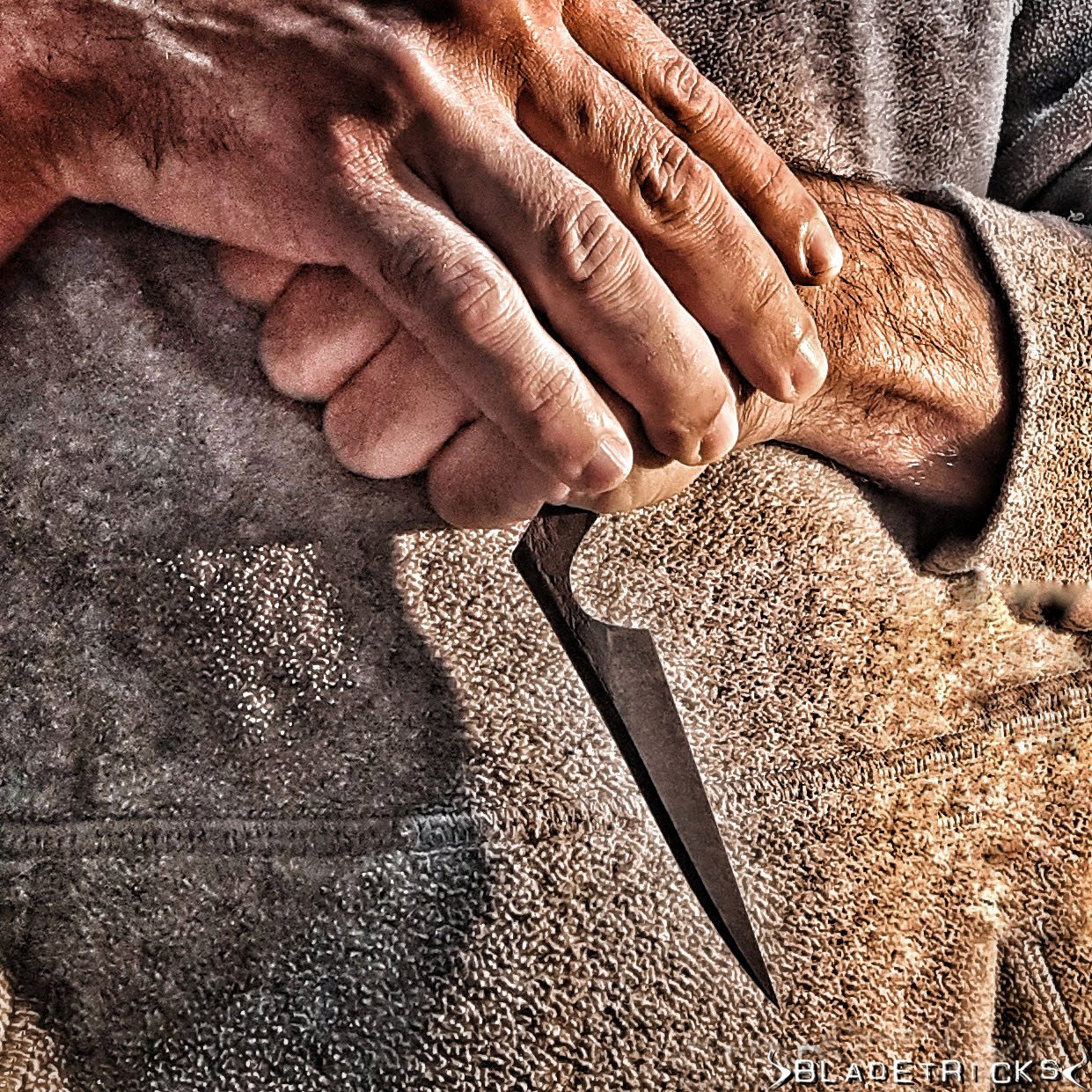
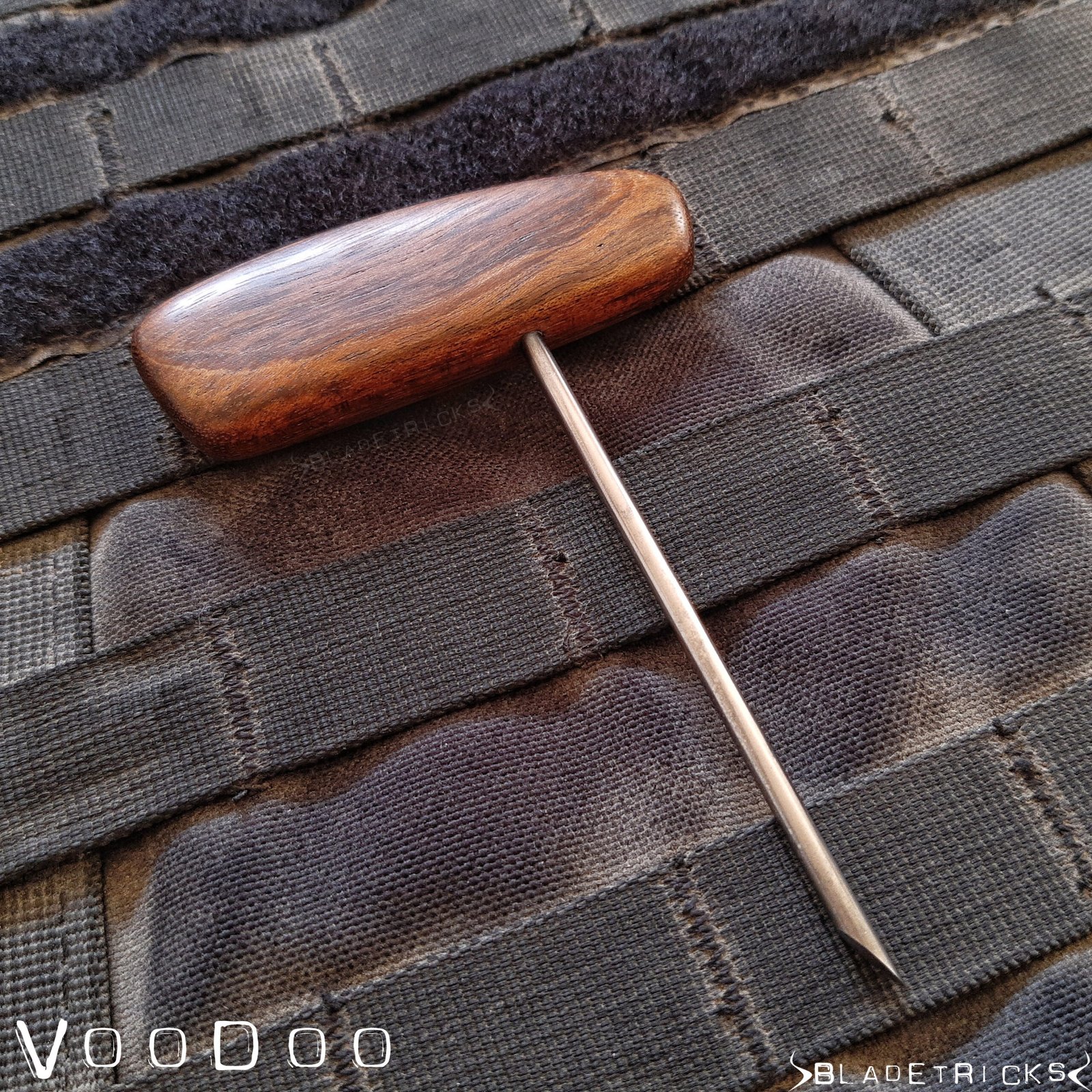
    Voodoo ice pick, reverse grip
    Voodoo ice pick, reverse grip


    Both are thrust-dominant. Both are designed for close-quarters encounters. Both are built around the understanding that under life-threatening stress, the body will do what it knows how to do — and what it knows how to do is drive forward.


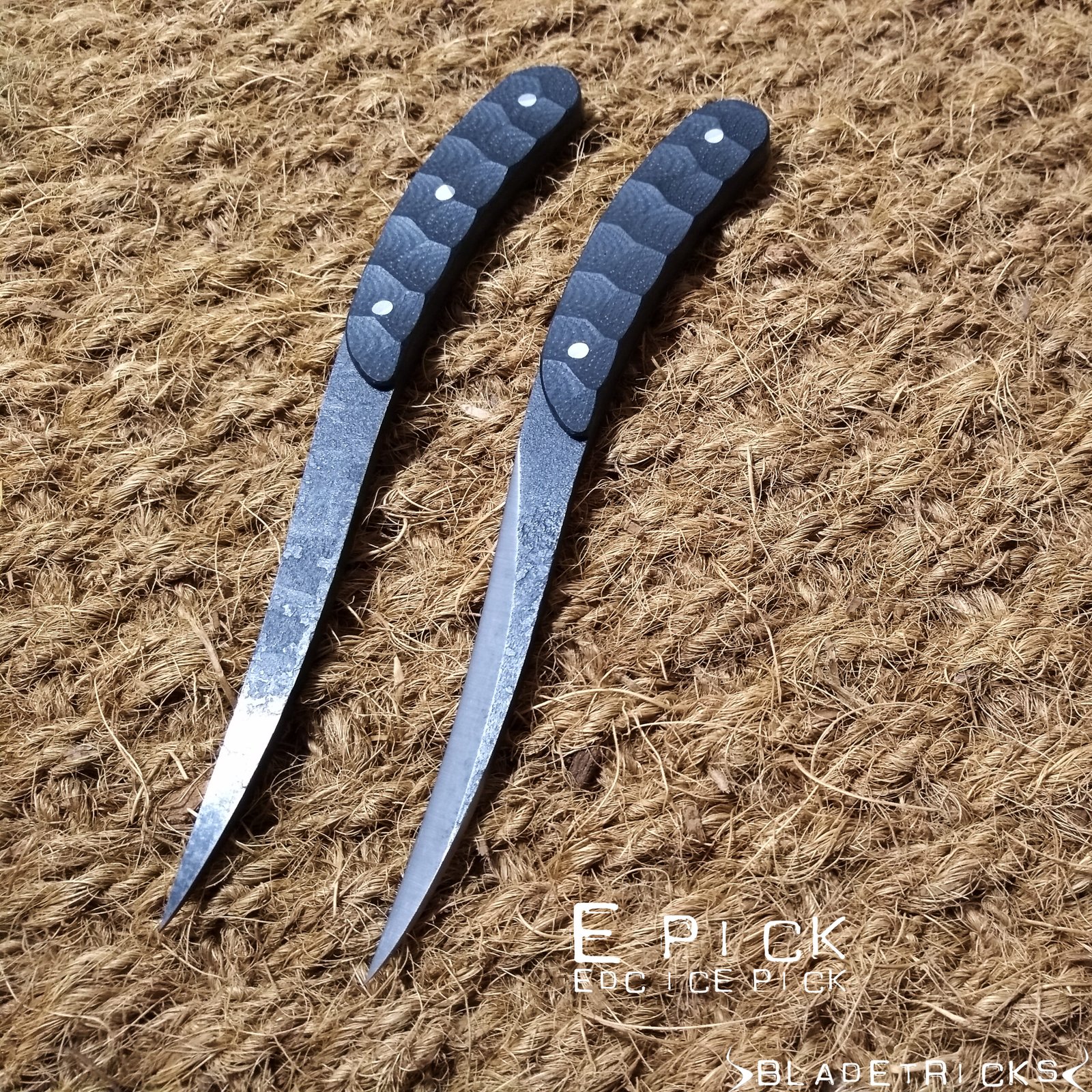
    Bladetricks Epick Pikal Knife and tactical icepick
    Bladetricks Epick Pikal Knife and tactical icepick


    The Pikal adds an edge, a refined geometry, and a trained pulling mechanic. The icepick removes the edge entirely — and with it, every maintenance burden, legal complication, and training dependency. For the right user, that is not a downgrade. It is the point.


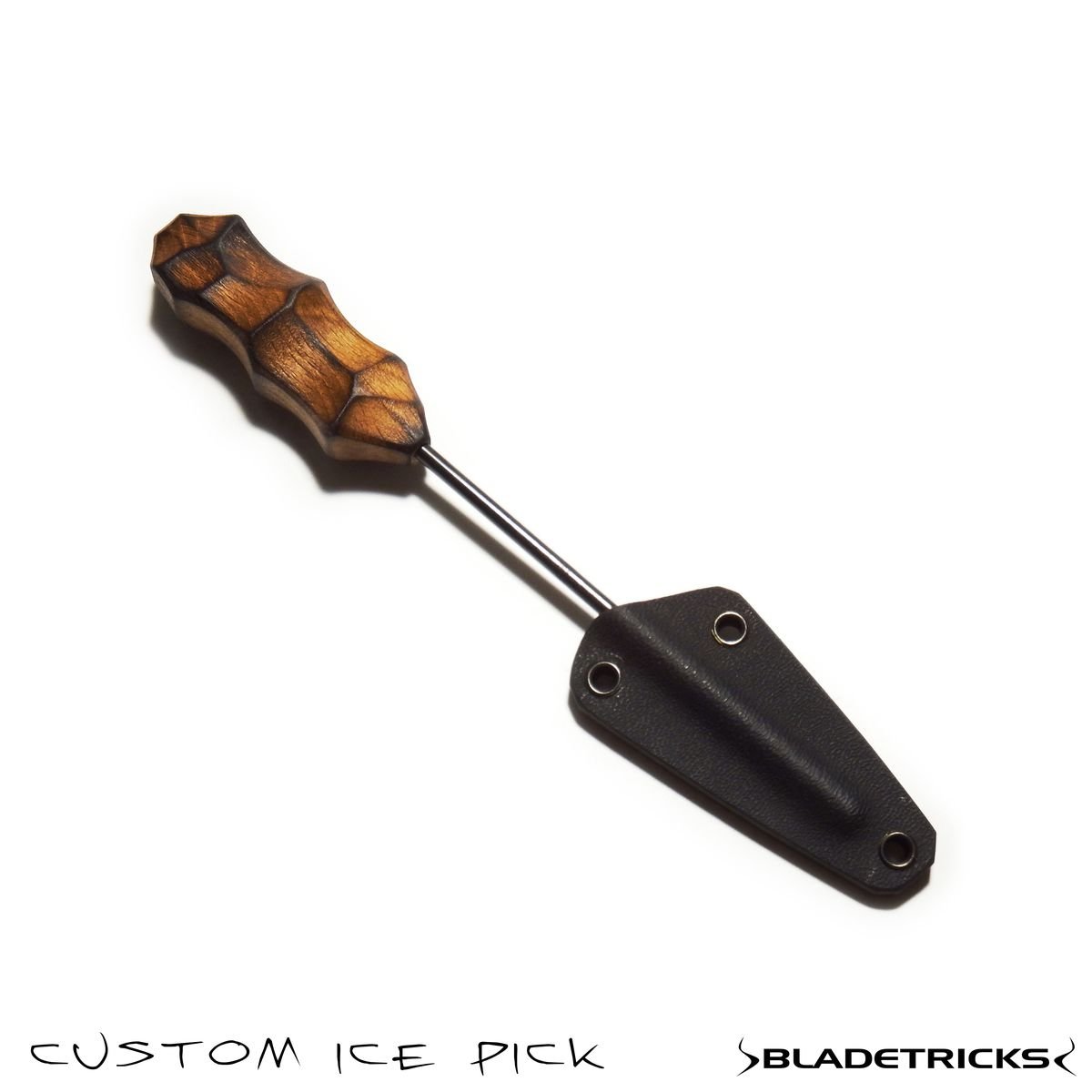
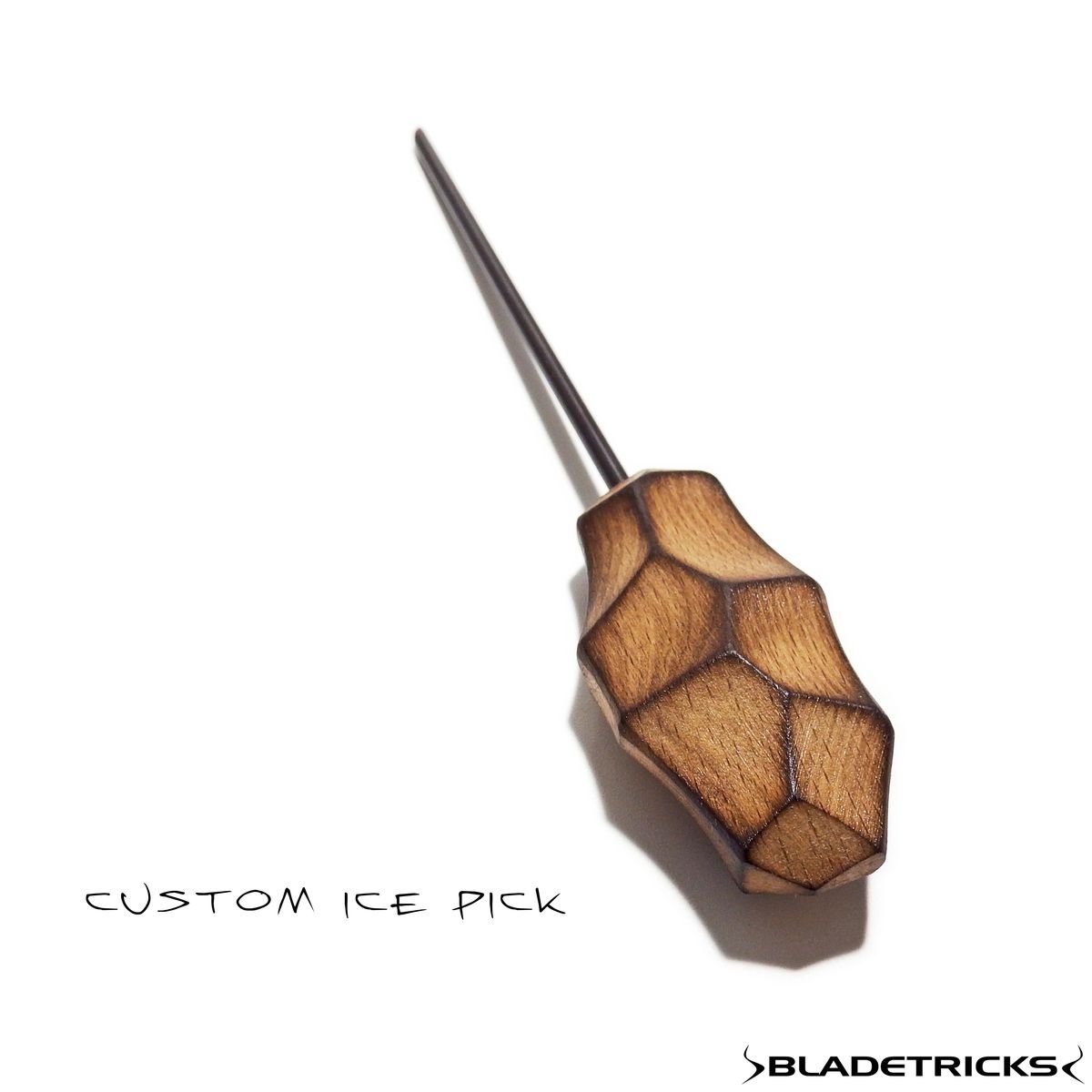
    Bladetricks Custom Traditional EDC Icepick, Beech Wood Handle
    Bladetricks Custom Traditional EDC Icepick, Beech Wood Handle


    The Traditional Spike: Bladetricks Custom Voodoo Icepick Series

    The Bladetricks lineup carries this lineage forward across several purpose-built designs: the Voodoo, the Epick, the Tusk, and the Tarantula Karambit Icepick. Each represents a specific application within the reverse-grip family — from the specialized reach of the Tusk Tarantula to the refined concealability of the Epick. No maintenance. No variables. No failure modes.


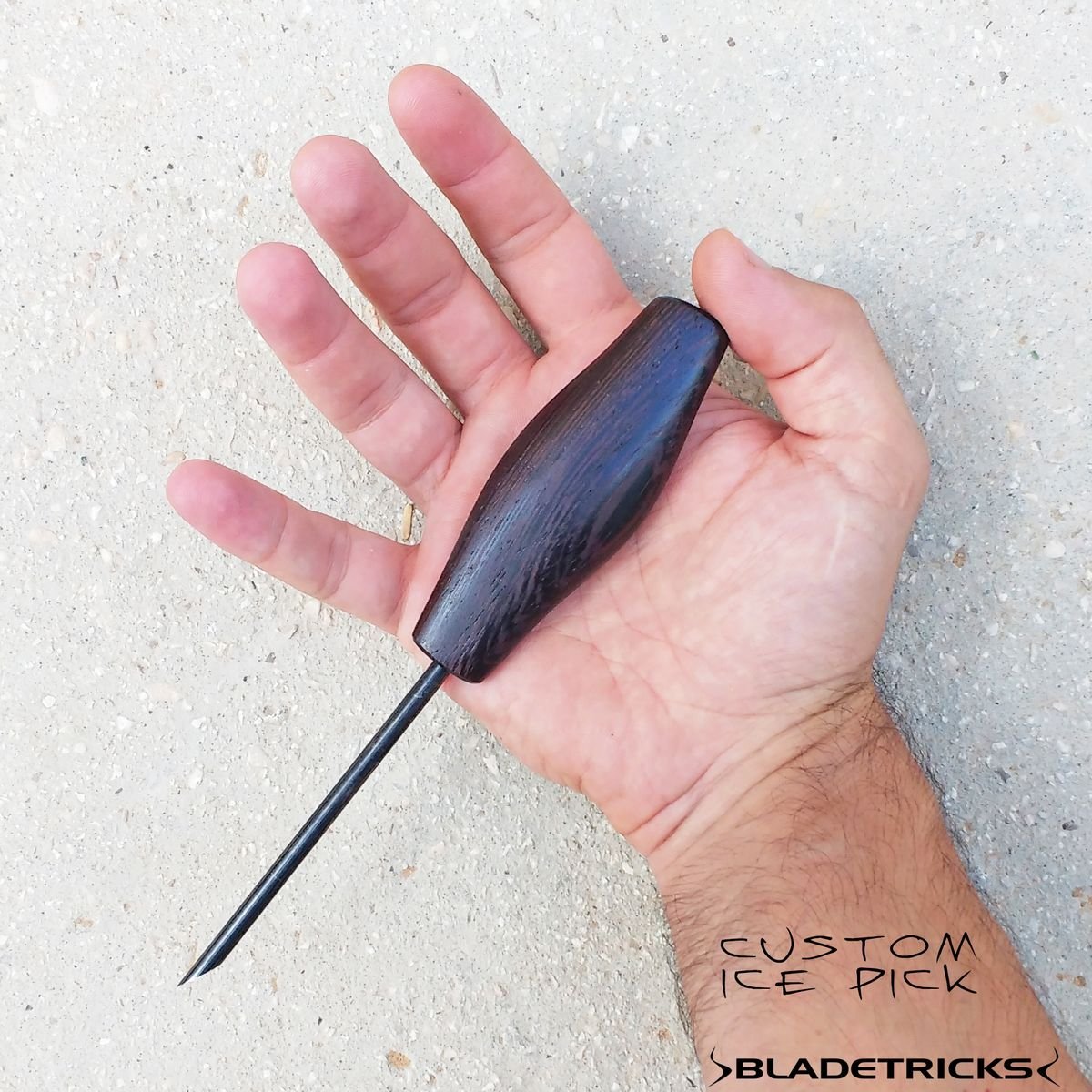
    Wenge Handle, Bladetricks Custom Ice Pick
    Wenge Handle, Bladetricks Custom Ice Pick


    These are definitive last-ditch tools for both the trained professional and those new to defensive carry.


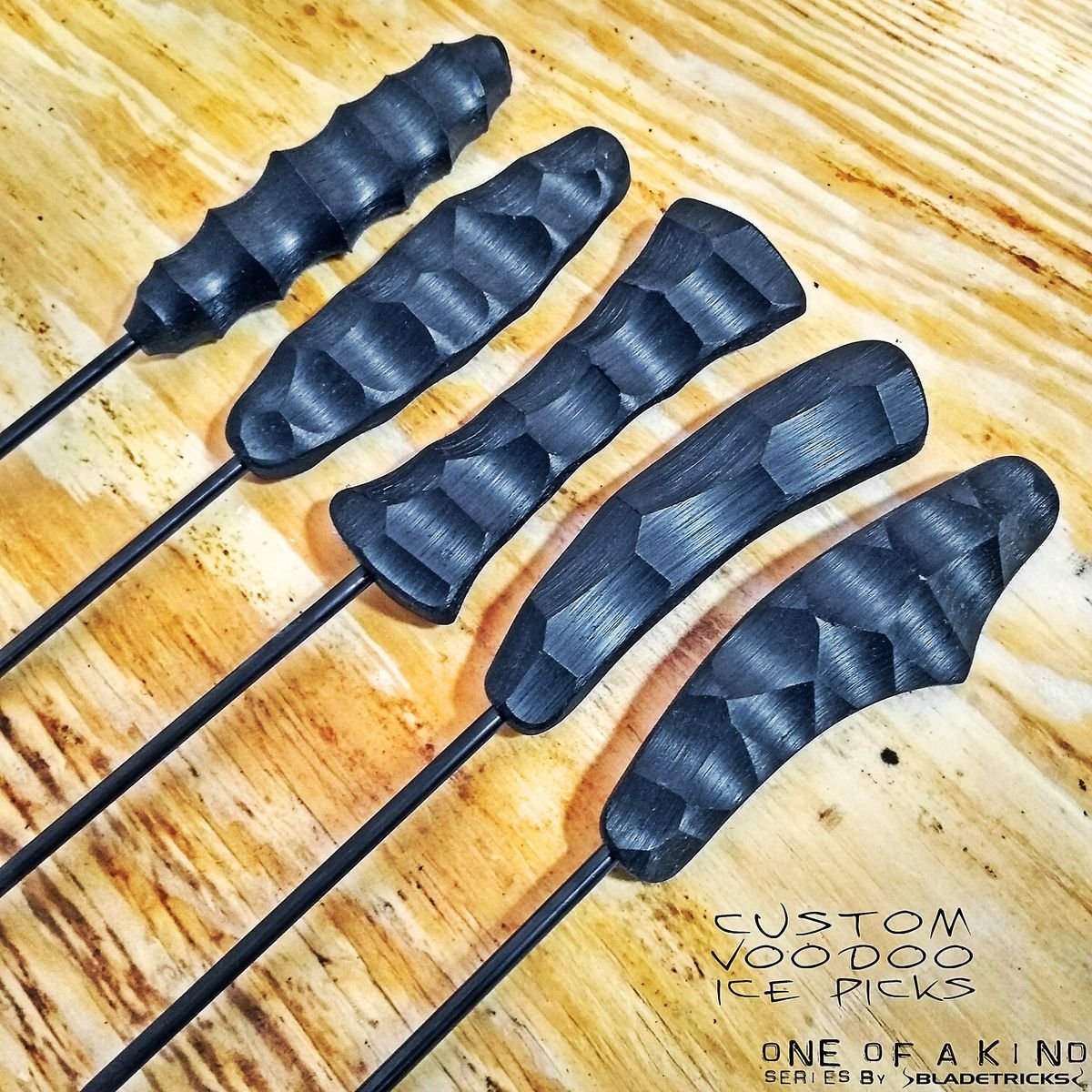
    Bladetricks Custom Voodoo Icepick Polymer Handle
    Bladetricks Custom Voodoo Icepick Polymer Handle


    Bladetricks Polymer Icepick Handles
    Bladetricks Polymer Icepick Handles


    The Push Icepick: Power Through Structure

    For those who prefer the ergonomics of a push dagger combined with the penetration of a spike, the Bladetricks Push Icepick family offers a distinct mechanical advantage. By aligning the spike with the forearm’s natural skeletal axis, these tools deliver power and retention that is extremely difficult to compromise.


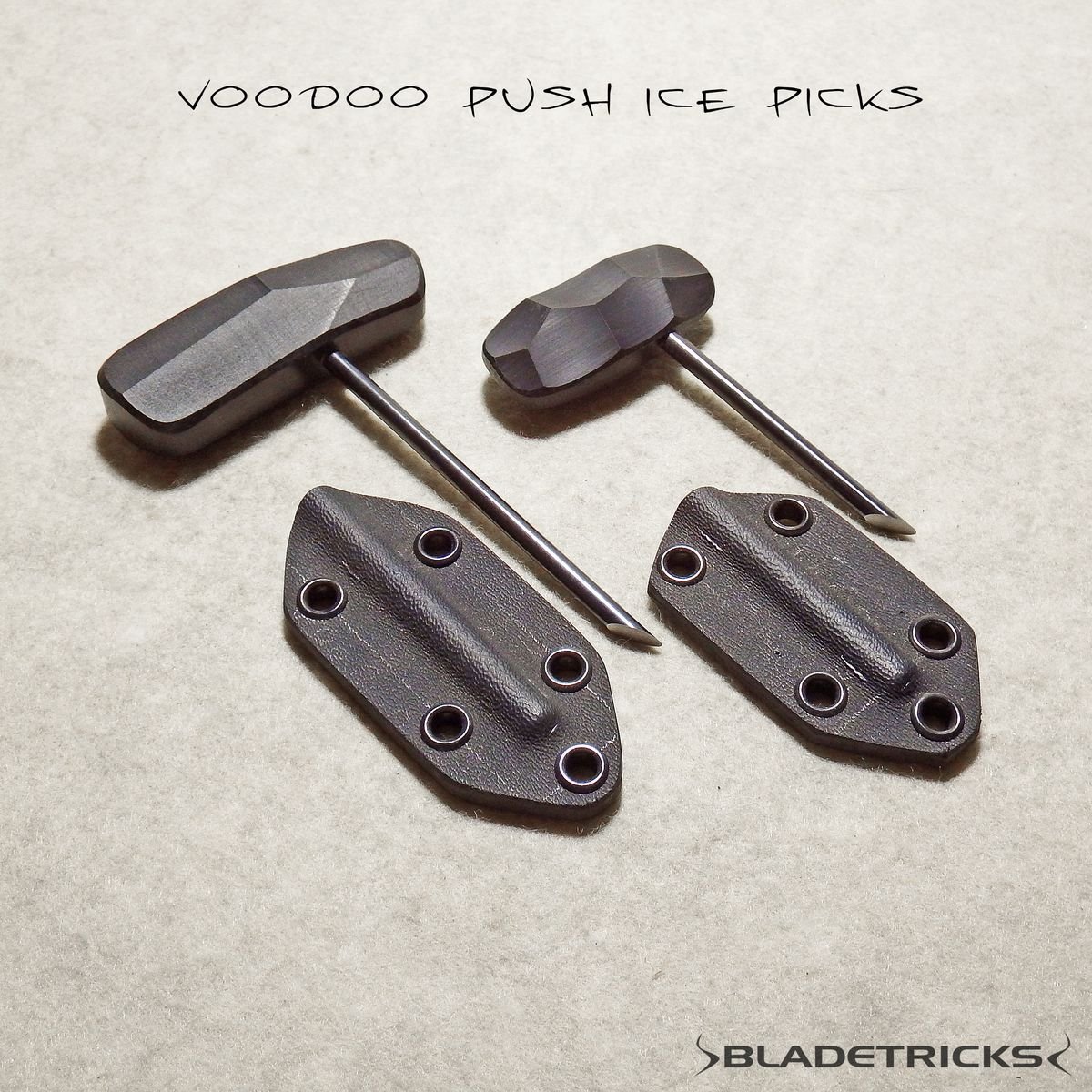
    Bladetricks Voodoo Push Ice Picks
    Bladetricks Voodoo Push Ice Picks


    The family includes the Stop Switch, the Tarantula, the Goliath, and the Voodoo Push Icepick. They are all built as direct extensions of the fist — the most natural human movement becomes the most effective defensive motion.


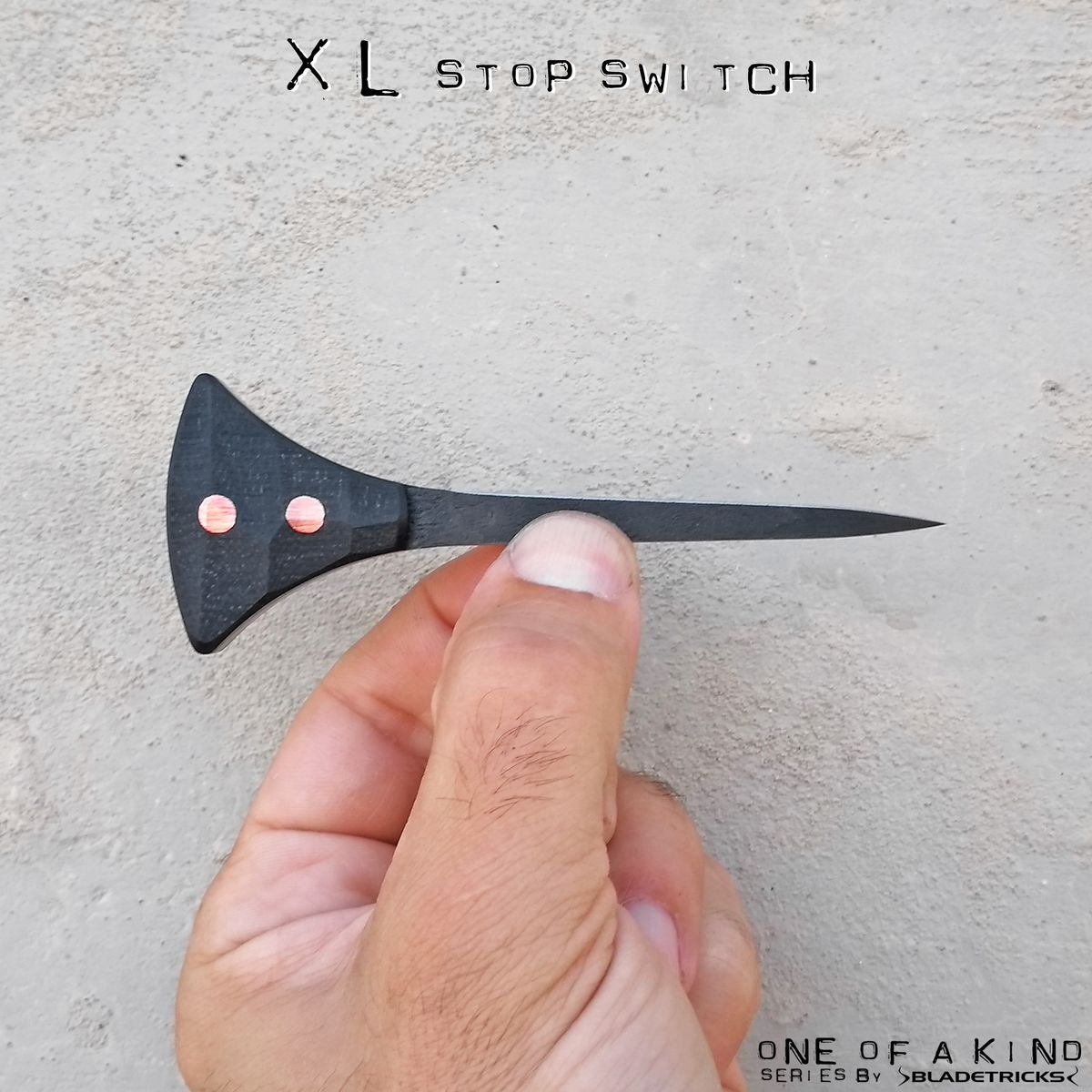
    AN Nash XL Stop Switch Push Icepick, Black G10 and Copper Pins
    AN Nash XL Stop Switch Push Icepick, Black G10 and Copper Pins


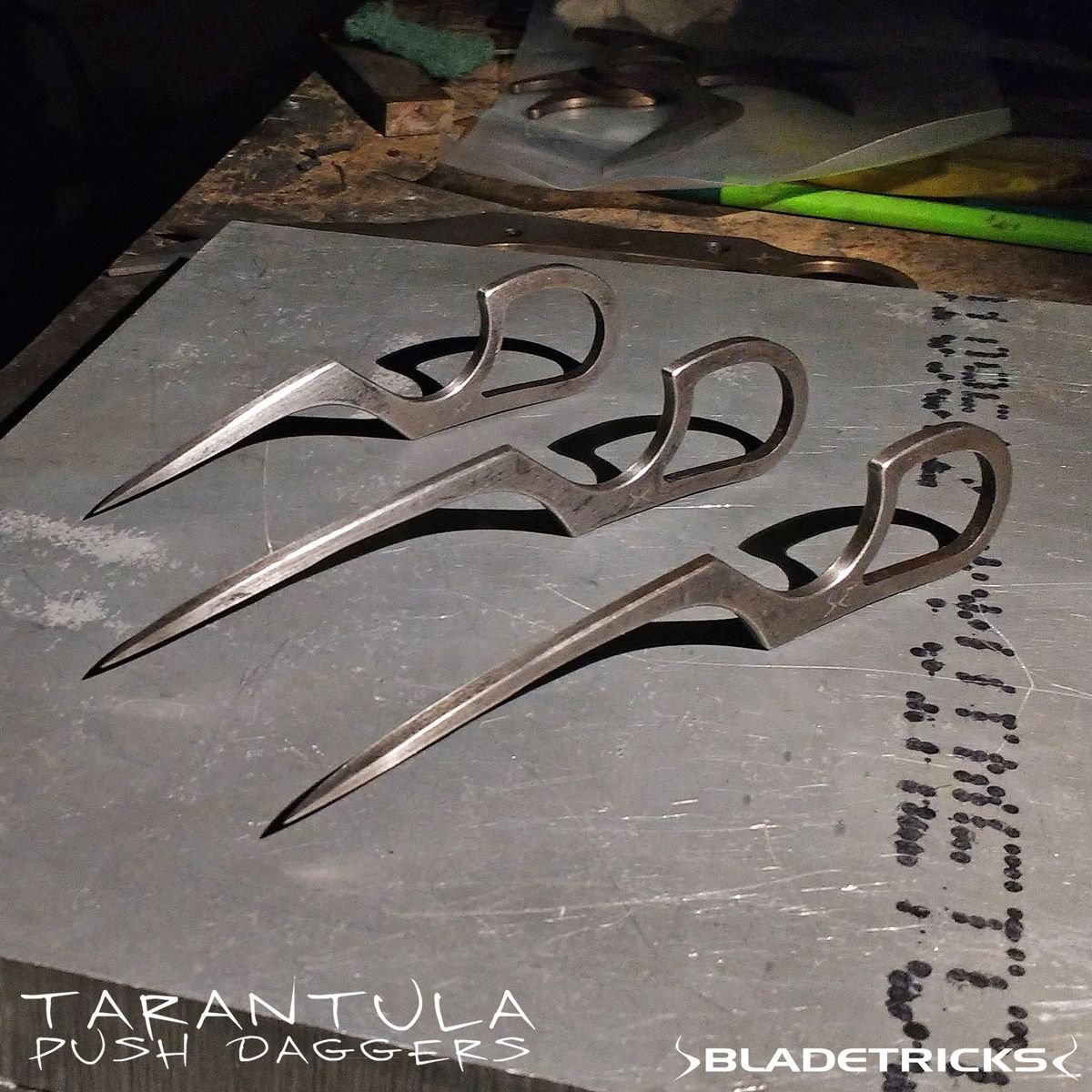
    Bladetricks Tarantula Push Daggers, Full Metal
    Bladetricks Tarantula Push Daggers, Full Metal


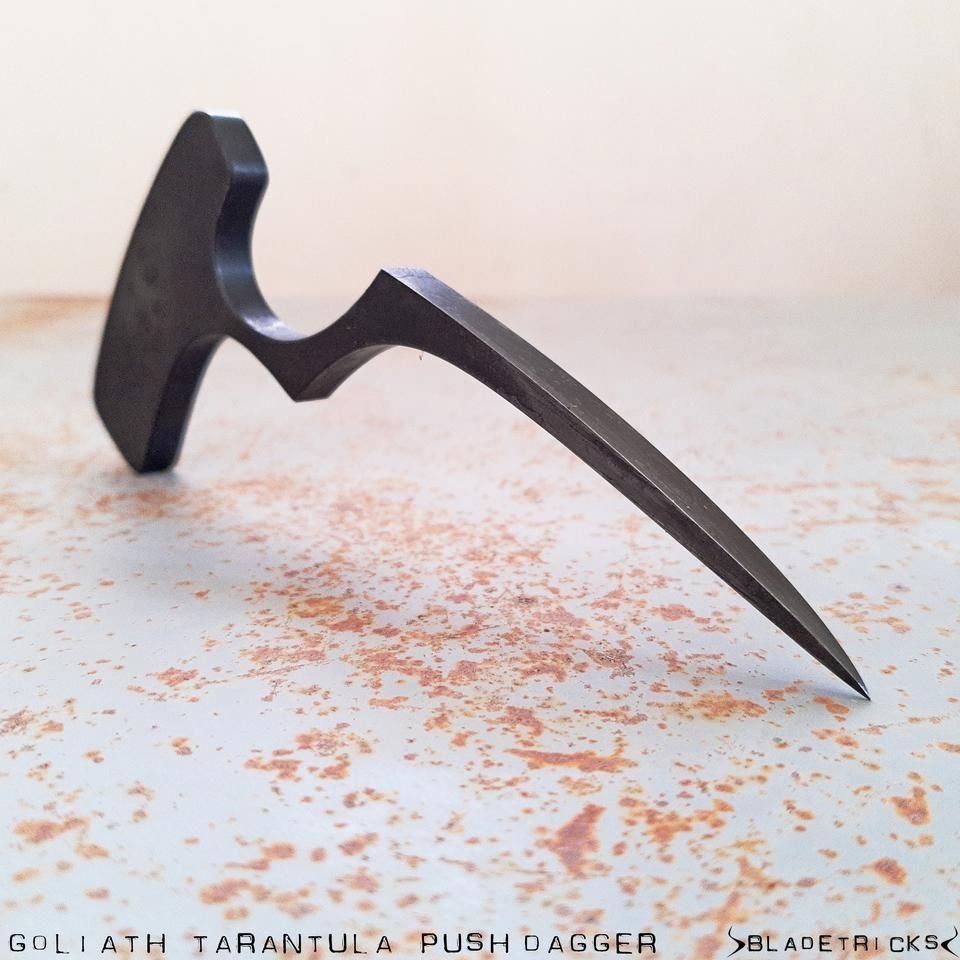
    Tarantula Goliath Push Ice Picks Bladetricks Custom Knives
    Tarantula Goliath Push Ice Picks Bladetricks Custom Knives


    Chisel Tip Geometry: A Technical Standard Worth Understanding

    While most icepick makers pursued the traditional conical tip, the chisel grind tip was a deliberate departure — a geometry I developed early in my work as a maker, one that is now gaining recognition as a performance standard.


    Bladetricks Voodoo ice pick push dagger Chisel Ground Spike Tip Detail
    Bladetricks Voodoo ice pick push dagger Chisel Ground Spike Tip Detail


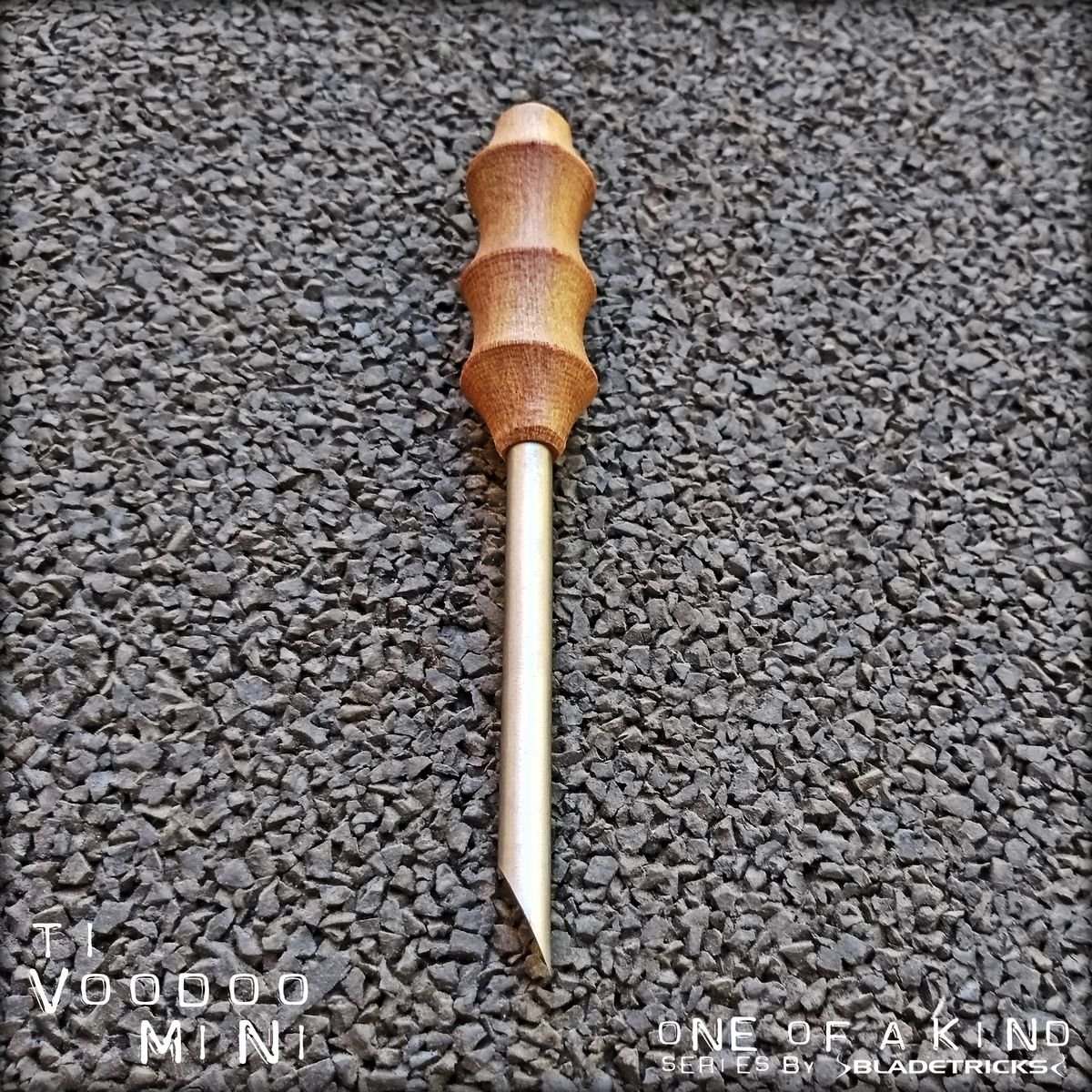
    Bladetricks Mini Voodoo Icepick, Titanium and Micarta
    Bladetricks Mini Voodoo Icepick, Titanium and Micarta


    Why chisel geometry outperforms the conical tip

    The advantages are practical. A chisel tip is significantly easier to maintain and field-sharpen than a conical point. It also produces a mechanically distinct wound opening and subsequent wound channel: rather than displacing and compressing tissue — which can create friction and resistance on extraction — the chisel geometry creates a shearing effect. The result is a cleaner extraction stroke and more consistent stopping performance, findings supported by penetrating wound ballistics research specific to this configuration.


    Voodoo push ice pick tactical dagger Ironwood tissue damage
    Voodoo push ice pick tactical dagger Ironwood tissue damage


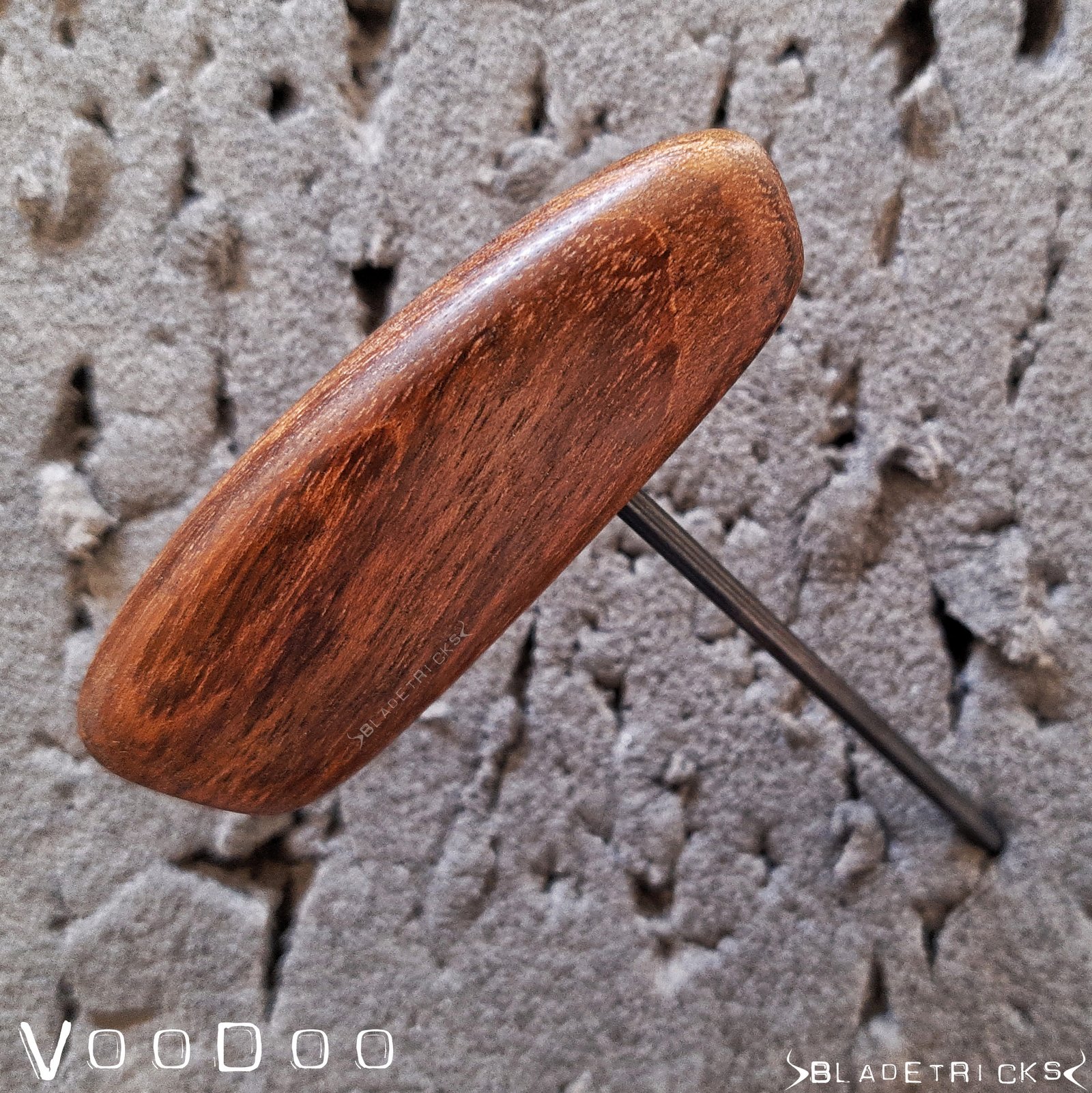
    Tactical EDC ice pick Bladetricks Voodoo push dagger
    Ironwood Handle, Custom Voodoo Icepick


    This geometry is now the foundation of an entire Bladetricks product philosophy.


    The Ice Pry Family and Trauma Geometry

    The Ice Pry tool family — including the Classic, the Mini, and the purpose-built Gen 2 — applies chisel tip logic to a dual-purpose platform. The flat tip enables high-leverage prying and delivers significant mechanical effect upon entry. Two functions, one tool.


    Custom EDC Tactical dagger screwdriver pry bar tool.jpg
    Bladetricks Classic Ice Pry EDC Tools


    Retention and fast-draw variants

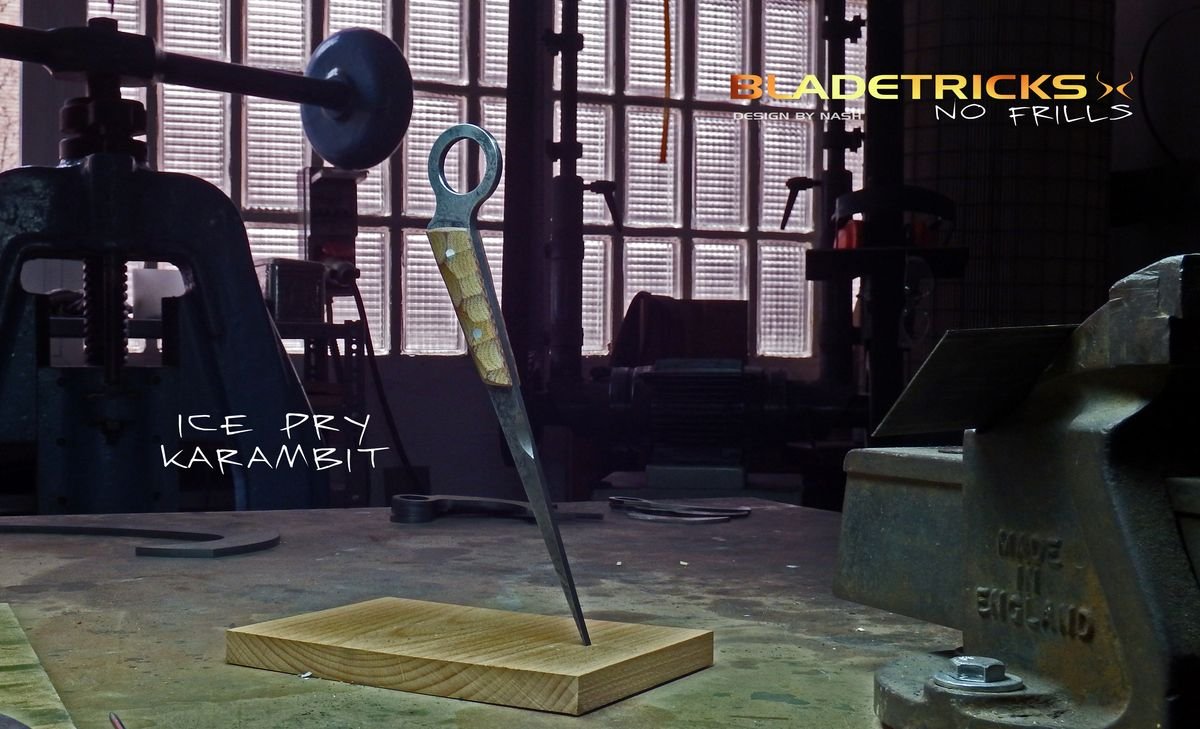
    For those who prioritize secure retention and purpose-built combat geometry, the Ice Pry Karambit integrates a safety ring. The Blink Grip Ice Pry uses a proprietary blind-indexing system refined through continuous iteration — designed for extreme fast draw without looking, and now a reference point for the category.


    Classic Ice Pry Karamit, Micarta
    Classic Ice Pry Karamit, Micarta


    Bladetricks Tarantula Icepick Karambit
    Bladetricks Tarantula Icepick Karambit


    Bladetricks Ice Pry Karambit with Blink Grip Fast Draw Handle
    Bladetricks Ice Pry Karambit with Blink Grip Fast Draw Handle


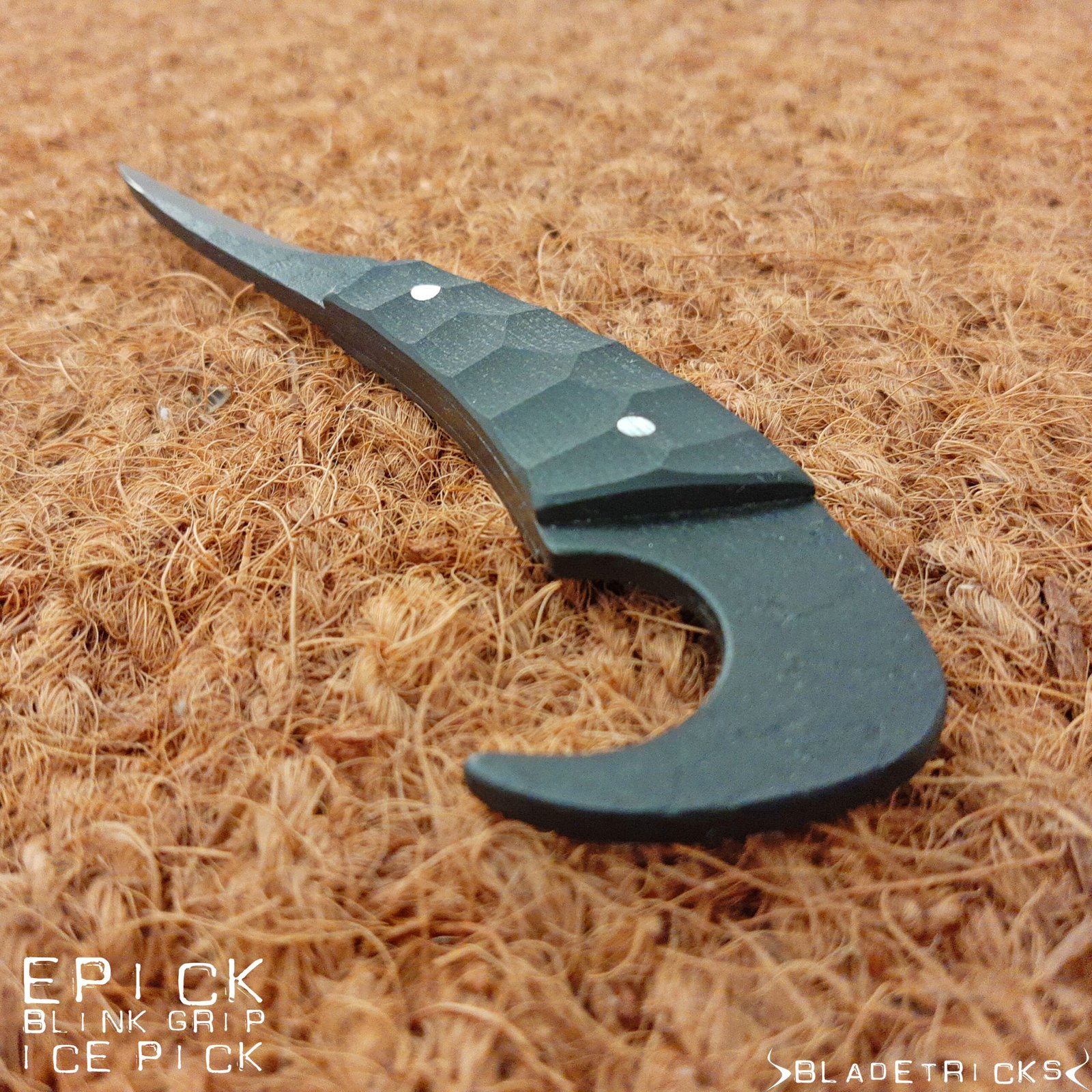
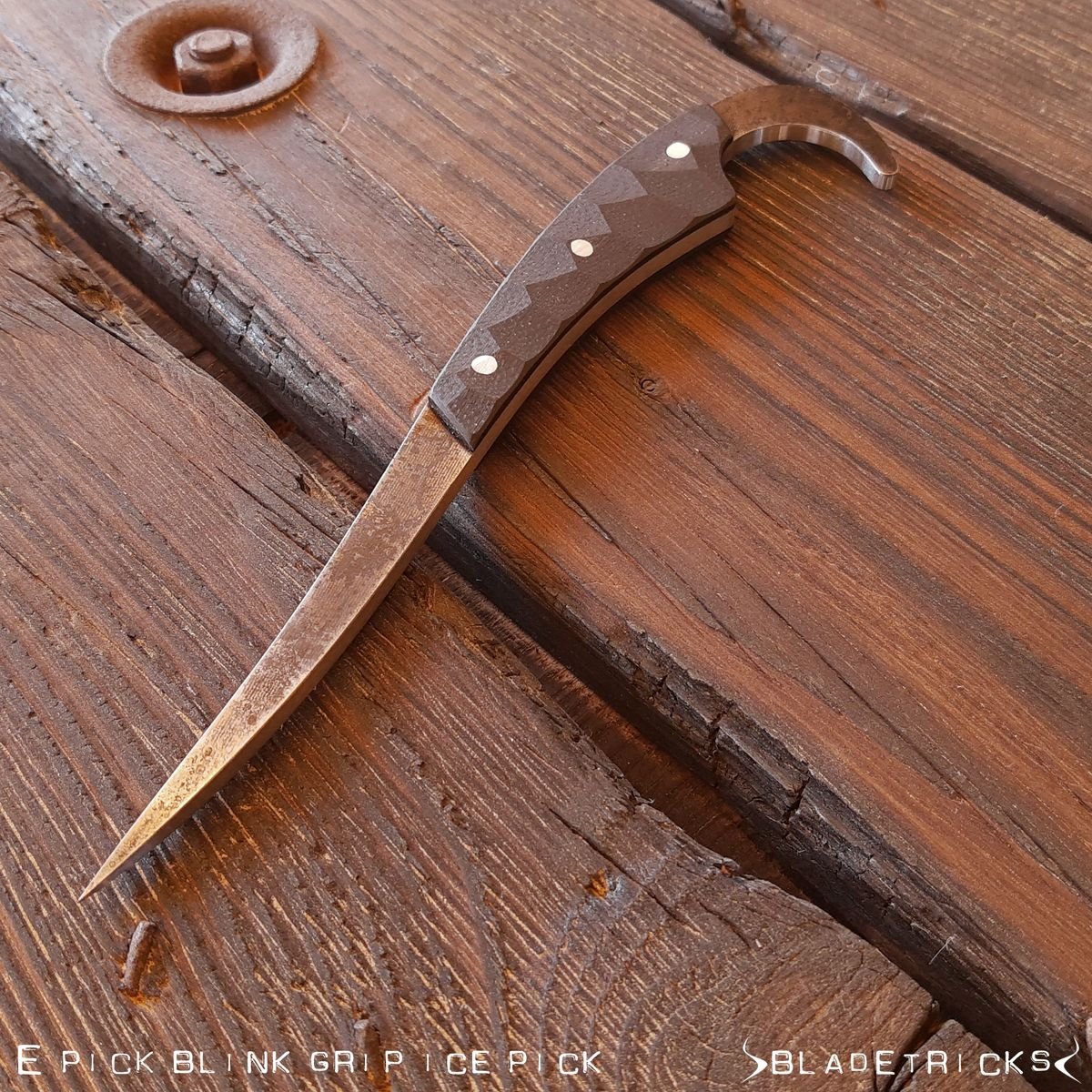
    Epick Blink Grip Fast Draw Icepick
    Epick Blink Grip Fast Draw Icepick


    The DAK Ice Pry: Same Logic, Dominant Hand

    The DAK Ice Pry is what happens when the Classic Ice Pry’s proven utility meets a handle built for full presence rather than concealment. Where the Classic and Gen 2 are tools that disappear into the carry, the DAK makes no attempt to hide — it is sized and shaped like a full-grip knife, carried and held with authority. I conceived it by integrating the original Ice Pry platform with the ergonomic handle profile of the Bladetricks DAK Dagger — wider, slip-proof, more substantial. The hand has nowhere to go. Under force, it stays exactly where it is, with no risk of sliding toward the tip.

    The same functions, the same chisel tip logic, the same reliability — in a format that prioritizes control over concealability.

    Three versions address three distinct requirements: the Original at 224mm preserves the reach of the Classic; the Compact at 198mm reduces the footprint without sacrificing the handle character; the Max shares the Compact’s length but adds width, increasing robustness for more demanding applications. Same lineage. Different scales. The Ice Pry logic holds across all three.


    The Micro Bevel series: edgeless, purpose-built

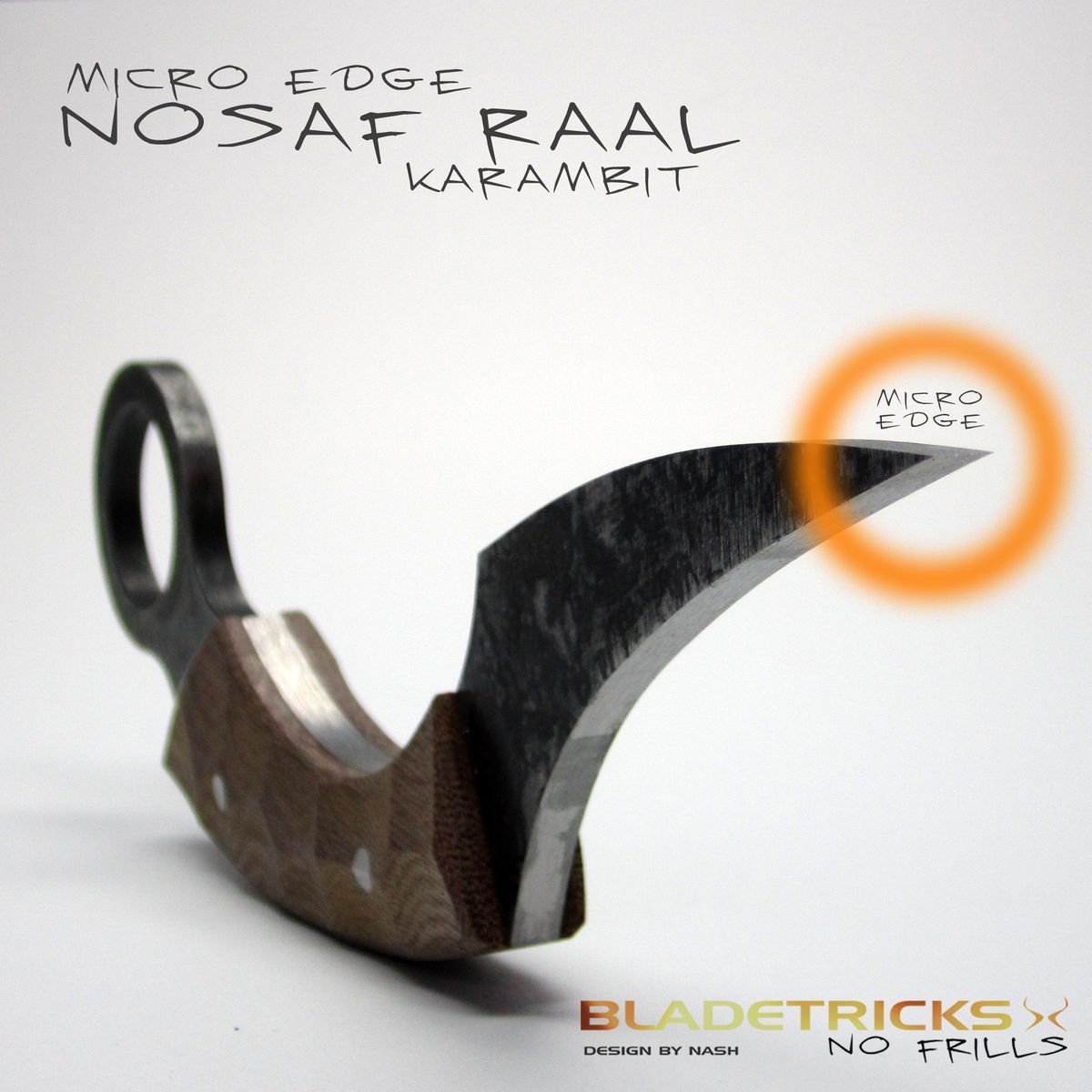
    This principle of purposeful tip geometry extends into the Bladetricks Micro Bevel series. Tools like the XL Micro Bevel Karambit are entirely edgeless — eliminating maintenance requirements and legal carry concerns — while still delivering maximum penetrating effect through the multi-purpose tip. It is a refined transition from pure piercing to structural compromise.


    Bladetricks Micro Edge Nosaf Raal Karambit, Tip Detail
    Bladetricks Micro Edge Nosaf Raal Karambit, Tip Detail


    Who the Icepick Is For

    I recommend icepick designs regularly to those with physical limitations, those still building their training base, or those who need a carry option that is virtually weightless and invisible. It is the equalizer for the less experienced and a reliable secondary for the professional.

    In a market crowded with over-engineered solutions, the Bladetricks icepick is a case for doing one thing with complete precision. The 1800s got the concept right. The execution is what continuous refinement is for.

    Innovating icepick design since 2010. — A.N. Nash | Bladetricks